Rock Your Business Key Takeaways
by Jonathan Slain
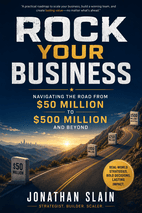
5 Main Takeaways from Rock Your Business
Scale requires a custom operating system, not a generic framework.
Businesses at $10M+ revenue have outgrown standard systems like EOS and need a framework built on their own culture. Autobahn's collaborative authorship models this: simplify to a single page with three big wins, and iterate strategy with the right people in the room.
Put the right people first—they evolve as you scale.
The single biggest growth multiplier is hiring and developing the right people. Use behavior profiles as a GPS for coaching, hire for culture and potential over current skills, and address imposter syndrome openly to unlock full team contribution.
Sales strategy must be intentional, repeatable, and executive-led.
Serendipitous sales fail when markets shift or key reps leave. Focus on one immediate need, secure executive buy-in to avoid quarterly pivots, and track progress weekly and daily to build scalable, repeatable revenue.
Brand is culture—invest in the unexpected and reject false choices.
Your brand reflects what you truly value. See value where others see waste (like 'trash bikes'), use AI to enhance human connection rather than replace it, and integrate humanity and technology without picking one over the other.
Drive growth with balanced KPIs tied to cash flow and culture.
Cash flow is king—orient KPIs around it, balancing brand, revenue, margin, and cash. Avoid a gotcha culture by celebrating progress, and ensure metrics are grounded in a shared vision and translated into meaningful behaviors for every level.
Executive Analysis
These five takeaways form the book's central argument: scaling a business beyond $10M requires a custom operating system that harmonizes people, strategy, culture, and metrics. Generic frameworks fail because they ignore the unique DNA of each company. Instead, leaders must intentionally build repeatable sales processes, a brand that mirrors internal culture, talent systems that evolve, and KPIs that balance cash flow with human accountability. The interconnectedness is key—sales falters without the right people, culture erodes without aligned metrics, and strategy collapses without executive buy-in.
This book matters because it fills a critical gap for mid-market leaders stuck between startup agility and corporate bureaucracy. Unlike many one-author business books, Autobahn's team-of-specialists approach lends credibility and practical depth. It offers actionable, stage-appropriate advice on sales, marketing, hiring, AI, and leadership psychology—including rare coverage of imposter syndrome as an organizational issue. For any executive running a company at the inflection point, this is a playbook for turning chaos into sustainable growth.
Chapter-by-Chapter Key Takeaways
Introduction (Introduction)
Businesses at $10M+ revenue have outgrown standard operating systems like EOS and need a custom-built framework rooted in their own culture.
The single biggest growth multiplier at this stage is the right people—and they will change as the company scales.
Autobahn’s approach is to model the behavior they teach: a team of specialists writes the book together, showcasing how collective expertise outperforms a single “guru” voice.
You can use the book flexibly—jump to the chapter that addresses your current challenge, or assign chapters across your team.
Start with leadership (Chapter One) if you’re in the executive suite; it sets the tone for everything that follows.
Try this: Jump directly to the chapter that addresses your current scaling challenge, but start with leadership if you're an executive—it sets the tone for everything.
3. What We Learned Selling Fish Food and Nike Shoes (Chapter 3)
Outside advisors serve as a blind-spot mirror to uncover what insiders won't say.
Distinguish bicycle sheds (trivial) from nuclear reactors (critical) to focus energy.
Overly complex plans crush momentum—simplify to a single page and aim for three big wins.
Most accountability problems are actually communication failures; align on the goal before deploying KPIs.
Strategy is iterative, not static. Keep the right people in the room regularly.
The same principles work for companies of any size—even families and solo entrepreneurs.
Try this: Use outside advisors to uncover blind spots, simplify your plan to a single page with three big wins, and treat strategy as an iterative conversation with the right people.
4. Every Day Without a Real Sales Strategy Is a Donation to Your Competition (Chapter 4)
Flooding prospects with every option kills close rates; focus on one immediate need and prove value first.
Sales strategy must have executive buy-in, or leadership will sabotage it with knee-jerk quarterly pivots.
Serendipitous sales might work until market conditions shift or your best rep quits—then you’ve got nothing.
Repeatable, scalable revenue comes from intentional coaching, market analysis, and accountability at every level.
Don’t wait for yearly reviews; track progress weekly and daily to keep momentum.
Try this: Secure executive buy-in for a focused sales strategy that targets one immediate need, then track progress weekly to build repeatable, scalable revenue.
5. What Does Your Marketing Smell Like? (Chapter 5)
Use AI critically, not carelessly: Deploy technology to enhance human connection, not replace it. Customers can tell the difference.
Brand is culture, period: Whether internal or external, your brand reflects what you truly value as an organization.
Invest in the unexpected: The "trash bikes" approach—seeing value where others see waste—can become your most powerful brand asset.
Resist false choices: You don't have to pick between humanity and technology. The winning path integrates both, with people in the lead.
Try this: Define your brand by investing in what others overlook, use AI to enhance human connection not replace it, and reject the false choice between technology and humanity.
Next chapter: “6. The Talent Engine” is locked
Keep learning from Rock Your Business — and unlock all 600+ book summaries with audio, mindmaps and AI Q&A.
$0.00 due today · 7 days free, then $89.99/year ($7.49/mo) · Cancel anytime before day 7
plus sales tax where applicable