Rock Your Business Quotes
by Jonathan Slain
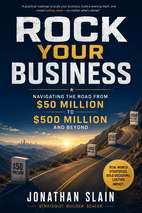
These quotes are sharp, funny, and brutally honest. They come from a business leader who has seen it all and is not afraid to say what actually works. You will find ideas about growth, leadership, and the hard truths that separate the companies that just survive from the ones that thrive.
What makes this book quotable is its mix of unconventional wisdom and everyday logic. Jonathan Slain speaks in metaphors that stick with you, from colonoscopies to basketball. The lines challenge you to rethink how you work, lead, and live. They are meant to be shared, debated, and remembered.
Top Quotes from Rock Your Business
“If you see a bunch of companies all running in one direction, we'll be the ones turning our bus off onto the road less traveled.”
Jonathan Slain describes Autobahn Consultants' contrarian approach to business strategy.
This vivid metaphor captures the power of differentiation and encourages readers to embrace unconventional paths to success.
“The leaders of $100 million organizations aren't doing more; they are doing things completely differently—and the same is true for the $1 billion leader compared to the $100 million leader.”
Explaining that scaling a business requires a fundamental shift in approach, not just harder work.
This quote challenges the common myth that growth comes from working longer hours, emphasizing strategic transformation over sheer effort.
“If you want to live a life worth living, you should start by writing your own obituary and then work backwards to make it something a loved one can do when you pass away.”
Jonathan Slain explains the Investment Highlights Exercise, which helps business owners prepare for a sale by envisioning their ideal outcome.
This line reframes goal-setting in a profound, actionable way, encouraging readers to envision their legacy and reverse-engineer success—a mindset that applies to both business and life.
“You can’t read the label when you're stuck inside the jar.”
Jim Randall explains why companies need an outside consultant to see their own culture and hidden advantages.
This metaphor powerfully captures the difficulty of self-awareness and the value of an external perspective, making it memorable for any leader who feels stuck.
“Not every dollar is a good dollar.”
Deb discussing the importance of defining an ideal client profile and focusing on strategic revenue.
It forces a critical shift from chasing all revenue to prioritizing quality, a key insight for scaling businesses.
“People don’t want a flyer with a list of unique selling points anymore. They want to become the version of themselves who can do rad sh*t when they collaborate with a brand.”
Yas contrasts old-school marketing with the storytelling and aspiration audiences now crave.
The bold, conversational language and aspirational vision make this line both memorable and instantly relatable for modern marketers and consumers alike.
“What I tell these organizations is that if everything is a KPI, nothing is.”
Jim advises organizations that are drowning in excessive KPIs.
This line captures the central paradox of measurement overload and serves as a crisp warning against diluting focus.
Themes Behind the Quotes
A major theme is the critical role of people. Having the right team, understanding how to value them, and leading with self awareness are repeatedly emphasized as the true differentiators at scale. Another theme is the need to break from the crowd. Whether it is taking the road less traveled, focusing on what you stand for instead of just chasing revenue, or realizing that not every dollar is good, the book urges leaders to think differently.
Growth and personal development also run deep. The idea that leadership skills can be learned and that flexibility is a muscle you can exercise appears alongside calls to define your own legacy by working backwards from your obituary. Finally, the human element shines through in marketing and connection. People crave to feel valued and to see themselves transformed, and brands that ignore this pay a price. These themes together form a practical, no nonsense philosophy for scaling a business and a life.
Quotes by Chapter
Introduction
“Only 3 percent of businesses ever reach $1 million in revenue. Of those, only 10 percent ever reach $10 million or beyond. That means that only 0.3 percent of businesses ever make it to $10 million— and we're targeting this book to the rare few that make it to $50 million and want to go even higher.”
Slain explains the extreme rarity of high-growth companies and the book's exclusive focus.
The stark statistics create a sense of elite challenge and motivate ambitious business owners to strive for the top tier.
“The biggest differentiator, when you're moving from $10 to $50 to $100 million and beyond, is people.”
Slain emphasizes the critical role of talent in scaling a business.
This concise statement cuts through complexity and reminds leaders that people, not just systems, drive growth.
“If you have the right people on your team, you can go anywhere, but even the best strategy in the world, without the right people, won't be enough.”
Slain reinforces the primacy of people over strategy in achieving business success.
This memorable, alliterative line resonates universally because it speaks to a fundamental truth every leader knows but often forgets.
1. Lead Like Lives Depend on It
“Understanding where to put your time and energy as the top leader in an organization is the most important work you can do, and a lot of us, myself included, have to learn it the hard way.”
Dr. Katherine Slain reflects on a harrowing ICU experience that taught her the cost of misplaced attention.
This line resonates because it acknowledges that even experienced leaders struggle with prioritization, and that learning through failure is universal.
“He decisions executives make every day don't have the obvious life-or-death urgency of ventilators or open- heart surgery. That seems like a benefit, but in fact, it just makes them easier to ignore until it’s too late.”
Comparing the subtlety of executive decisions to the immediate stakes of ICU medicine.
It powerfully reframes the danger of complacency in business, showing that the lack of immediate negative feedback can be more insidious than visible crises.
“These are skills you can master. Sure, some people are predisposed to be leaders of large organizations, just like some people are naturally gifted at sports or playing an instrument, but with enough time and energy, you can learn to play the trumpet, kick a field goal...or run a company of whatever size you want to build.”
Encouraging executives that the leadership skills needed for scaling are learnable, not innate.
It offers an empowering growth-mindset message, demystifying large-company leadership and making it accessible to anyone willing to invest in learning.
2. Maximize Your Multiple to Achieve Your “American Dream” Exit
“Preparing to sell your company is like preparing for a colonoscopy. You have to drink this nasty stuff, and then basically, you're in the bathroom for a day, cleaning out your whole system.”
Paul Belair uses this analogy to describe the unpleasant but necessary preparation phase of selling a business.
The vivid, humorous analogy makes the daunting process relatable and memorable, emphasizing that thorough preparation—though uncomfortable—is essential for a successful exit.
“The way I define the American Dream is generational wealth. The kind of wealth that means your kids’ kids don't have to worry about money.”
Paul Belair explains what he means by an 'American Dream' exit—creating lasting financial security for future generations.
This succinctly captures a universal aspiration that resonates deeply with business owners: building something that outlasts them and secures their family's future.
“If you had told me, as a twenty-one-year-old kid, that I would start a business mowing grass and plowing snow, sell it for millions of dollars, and not have to work again, I would have told you you were crazy.”
George Hohman reflects on his journey from starting a small landscaping business to achieving a multimillion-dollar exit.
This line powerfully illustrates the transformative potential of entrepreneurship, inspiring readers with a real-world rags-to-riches story that feels both humble and extraordinary.
3. What We Learned Selling Fish Food and Nike Shoes
“The number one reason people don’t want to show up to work every day is that they're not fulfilled, which is often because they don't know how they fit into the goals.”
Rafa Loyo on why employees disengage even when they like the company vision.
It pinpoints a universal leadership failure—lack of clarity—and offers a direct path to engagement by connecting individual work to the bigger picture.
“That hire taught me the difference between being the smartest person in the room and being smart enough to bring in someone who can make the whole room better.”
Jim reflects on hiring a plant manager with a psychology background who transformed his company.
This distinction between personal intelligence and team-building wisdom is a concise leadership lesson that challenges ego and emphasizes collaboration.
“Chasing revenue usually drives companies, but stepping back and focusing on what you really stand for is the key to bringing your strategy to life. If you do that well, revenue will follow.”
Rafa describes how Nike By You shifted from revenue goals to prioritizing customer connection.
It counters conventional profit-first thinking and inspires purpose-driven strategy, showing that authentic focus leads to financial results naturally.
4. Every Day Without a Real Sales Strategy Is a Donation to Your Competition
“Slow is smooth, and smooth is fast.”
Brandon explaining that following a proven strategy is the fastest path to cash, even if it feels slower at first.
This paradoxical phrase is memorable and reframes patience as a strategic advantage, resonating with anyone tempted to rush for quick results.
“I have never had a true sales leader coach me, and I’m top of class (or so I'd like to think!).”
Deb sharing her personal experience of never receiving effective coaching from a sales leader.
This honest, self-aware admission highlights the widespread coaching gap and the untapped potential even in top performers.
“The greatest human need is to feel valued—to be seen, heard, and understood.”
Brandon explaining why matching salespeople to buyer personalities is crucial for connection.
A timeless truth that transcends sales, reminding leaders that empathy and recognition drive both relationships and results.
5. What Does Your Marketing Smell Like?
“Human connection resonates, and it’s something that has yet to be automated.”
Yas explains why Autobahn invests in a human creative team despite the rise of AI.
This line crisply captures the irreplaceable value of genuine human interaction in an age of automation, making it a memorable rallying cry for brands.
“Effective marketing doesn’t just sell a product or service—it sells the transformation your customer experiences when they use that product or service.”
Yas describes the deeper purpose of marketing beyond simple selling.
It reframes marketing as a vehicle for customer identity and change, a perspective that resonates with anyone seeking to build meaningful brand connections.
“If you don’t give your brand a human look and feel, the market will tax you for it.”
Kayli warns that neglecting humanity in branding leads to negative customer reactions.
The metaphor of a 'tax' makes the consequence concrete and urgent, driving home the necessity of human-centered brand strategy.
6. The Talent Engine
“You won't get to $100 million or $1 billion alone. It's just not possible.”
Jonathan Slain explains why relying on others is essential for reaching big goals.
This line delivers a blunt, memorable truth that challenges the myth of the solo hero and underscores the necessity of teamwork.
“It’s not a time waster. It’s an accelerator.”
Yasmin Swartz defends the use of behavioral profiles when a CEO wants to skip them and jump straight to strategic planning.
The simple contrast reframes a common objection into a compelling benefit, making readers see profiling as a shortcut to trust and efficiency.
“My foundational belief, and the reason I like these tools, is that leadership and the other qualities that make a person successful all stem from self-awareness.”
Darla Klein shares her core philosophy on the importance of self-awareness in leadership.
It anchors the chapter's entire argument in a universal truth—self-awareness is the root of success—making the case for profiles feel essential and credible.
“Flexibility is just like any other muscle in your body. Some of us are naturally more flexible than others, but we can all exercise that muscle.”
Darla Klein encourages leaders to develop flexibility in how they work with different people.
The analogy makes an abstract leadership skill tangible and empowering, assuring readers that adaptability can be deliberately strengthened.
7. Death by KPIs
“But first, we need to know that we're playing basketball.”
Matt explains that KPIs are meaningless without a clear understanding of the business strategy.
The metaphor of knowing the game before tracking the score makes the need for strategic clarity unforgettable.