The AI-Driven Leader Quotes
by Geoff Woods
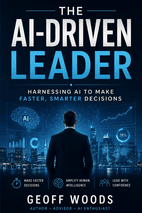
This collection brings together the sharpest insights from The AI Driven Leader. You will find lines that challenge how you think about strategy, speed, and the role of artificial intelligence in leadership. Some quotes are direct and punchy, others are reflective, but all of them are built to stick with you.
What makes this book so quotable is its blend of timeless leadership wisdom with a fresh lens on AI. Geoff Woods does not just talk about tools. He reframes how leaders approach problems, make decisions, and grow. Every quote here earns its place by being both memorable and immediately useful.
Top Quotes from The AI-Driven Leader
“Nothing is worse than running enthusiastically in the wrong direction.”
Author Keith Cunningham's warning about unchecked assumptions and overly optimistic thinking.
It's a vivid and memorable reminder that direction matters more than speed, a timeless leadership insight.
“Al won't replace you; those who harness Al will replace those who don't.”
A central warning in the chapter about the competitive necessity of AI adoption.
It reframes AI as an amplifier rather than a threat, motivating leaders to take action and avoid being left behind.
“My former mentor's advice comes to mind: “It's tough to read the label when you're inside the box.””
The author reflects on his own limited perspective while trying to solve a strategic alignment problem.
This metaphor vividly illustrates the limitation of human perspective and the need for external input, which AI provides. It resonates because it is a timeless, relatable insight about blind spots.
“Great leaders aren't the ones with all the answers. They're the ones who ask the right questions.”
Opening of the chapter, setting the theme of strategic questioning.
This line immediately reframes leadership from having answers to asking better questions, a core principle of the chapter.
“Biases and assumptions in leadership are invisible anchors, slowing even the strongest ships.”
Discussion of how biases creep into decision-making and hinder progress.
The metaphor of invisible anchors is vivid and instantly understandable, making the abstract concept of bias tangible and urgent.
“When this happens, you are failing so slowly it can feel like you are succeeding.”
This appears in the section discussing how short-term thinking leads to sacrificing long-term priorities.
It vividly captures the deceptive nature of gradual decline, reminding leaders that slow failure can be masked by temporary success.
“People do what they're incentivized to do.”
This is stated in the section on aligning incentives, accountability, and long-term growth.
It distills a fundamental leadership truth into a single, actionable sentence, emphasizing the power of compensation structures.
Themes Behind the Quotes
A central theme is the shift from knowing all the answers to asking better questions. The book argues that great leaders are not the ones who solve everything alone, but those who learn to leverage AI as a thinking partner. This changes the focus from individual brilliance to strategic collaboration with technology.
Another recurring idea is that growth requires discomfort and honest self reflection. Many quotes warn against slow failure, hidden biases, and the illusion of progress. The message is clear: real leadership means stepping back, questioning assumptions, and staying open to new ways of working, even when it feels awkward or unfamiliar.
Quotes by Chapter
1. The Rise of AI and the AI-Driven Leader
“The difference between growing your business or going out of business lies in your ability to think strategically.”
The author states this as a core principle after the manufacturing CEO's turnaround story.
It succinctly captures the high stakes of strategic thinking and motivates leaders to prioritize it.
“For the first time in history, there is a way to make faster, smarter decisions without any of the sacrifice: by harnessing artificial intelligence as your strategic Thought Partner.”
The author introduces the core promise of the book.
It presents a revolutionary promise that resonates with overwhelmed leaders seeking efficiency without compromise.
“Your leadership is what will make the difference.”
The author emphasizes that AI is a tool but leadership is timeless.
It empowers readers by refocusing on their own agency and responsibility, making the adoption of AI feel manageable and personal.
2. We’ve Been Here Before: What Past Technological Revolutions Can Teach AI-Driven Leaders
“Strategic thinking and decision-making have always been critical leadership skills. However, our education system often grades you on your ability to have the answer, not on your ability to search for one.”
The author contrasts traditional education with the needs of modern leadership.
This insight resonates because it identifies a systemic flaw—valuing answers over inquiry—and points directly to the skill AI leaders must cultivate.
“Technology transforms industries, but human guidance is essential in shaping a future that prioritizes well-being and ethical use.”
The author's call for responsible leadership in the AI era.
It reminds leaders that technology is neutral; their choices determine whether the outcome lifts humanity or repeats past harms.
“Change may be uncomfortable, but it's where growth happens.”
From the list of key takeaways at the end of the chapter.
It succinctly reframes discomfort as a necessary catalyst for progress, a mindset essential for leaders navigating AI transformation.
3. Shift From Operational Overwhelm to Strategic Clarity: The Essential Mindset for AI-Driven Leaders
“When he took over as CEO, Nadella wanted to shift the culture from a bunch of “know-it-alls” to a culture of “learn-it-alls.””
Describing Satya Nadella's mindset shift at Microsoft.
This memorable phrase captures the essence of moving from fixed to growth mindset, making it an inspiring call to embrace continuous learning.
“If you want different results, you have to demonstrate different leadership behavior.”
The author introduces the need for new leadership behaviors in the AI era.
It's a direct, actionable reminder that change starts with the leader's own actions, not just directives to others.
“This means shifting from telling people what to do to telling people the vision for the company, your strategic plan to get there, and letting them tell you how they plan to make it happen.”
Explaining the new leadership behavior for AI-driven work.
It provides a clear, practical shift in leadership approach that empowers teams and aligns with the chapter's theme of strategic clarity.
“Will enhance you, not replace you. > Al may augment or automate skills and processes, but it will not automate you. You are you, not what you do.”
Addressing fears about AI in the workplace.
This reassuring statement reframes AI as an enhancer, reducing anxiety and focusing on human value beyond tasks.
4. Understand AI: What It Is, How It Works, and How to Get Started
“Imagine harnessing the intelligence of 200 million books at your fingertips, ready to assist with any task at any time. That's the power of Al.”
This line appears in the 'What Is AI?' section, after explaining that a model was trained on 15 trillion tokens equivalent to 200 million books.
It creates a vivid, accessible metaphor for AI's vast potential, making an abstract concept tangible and inspiring curiosity.
“If you don’t understand your business problem, your business challenge, the market forces, and customer demand, then asking ‘How do we use Al?’ is the wrong question.”
Chris Winton, former chief people officer of FedEx and Tesla, says this in the section 'Using AI as a Tool, Not an End Goal'.
It reinforces the critical principle that strategy must precede technology, a timeless leadership lesson that prevents misdirected AI adoption.
“Al helped him collapse weeks of thinking into a simple decision in under thirty minutes. That was incredibly valuable.”
After Florian used AI as his Thought Partner to overcome a mental block.
This line vividly demonstrates the tangible time savings and efficiency AI can bring to decision-making, making the abstract benefit concrete and compelling.
“Remember that struggling is a sign of growth.”
From the section titled 'The Power of Perspective', encouraging leaders facing challenges.
It reframes difficulty as a positive indicator of progress, a simple yet powerful mindset shift that resonates with anyone learning a new skill.
5. Supercharge Your Leadership: Five AI Use Cases You Can Use Today
“Up to that point, I'd asked the same question, ‘How can I do this?’ At that moment I found myself asking, ‘How might Al help me do this?”
The author describes his breakthrough moment when he shifted his mindset from personal effort to leveraging AI as a partner.
This quote encapsulates the core paradigm shift of the entire chapter—moving from a solo problem-solver to an AI-driven leader. It is memorable because it frames the transformation as a simple but profound question swap.
“Remember, Al is a prediction machine. The content it will generate might be 50% to 60% of where you need it to be. That's okay. Then you step in as the Thought Leader to apply your judgment and experience to ensure it is delivering the right message in the right way.”
The author explains the correct approach to using AI for content creation, emphasizing the human role as editor and leader.
This quote demystifies AI's capabilities and sets realistic expectations, while reinforcing that the leader remains essential. It empowers readers to embrace AI without fear of being replaced, and gives a clear, actionable mindset.
6. The High Price of The Wrong Questions: Using AI to Overcome Biases and Assumptions
“The key to getting rich and staying that way is to avoid doing stupid things. I don’t need to do more smart things; I just need to stop doing a few dumb things. I need to avoid making emotional decisions and swinging at bad pitches. I need to think.”
Keith Cunningham's lesson from his book The Road Less Stupid, shared after his $100 million loss.
It flips conventional success advice on its head, emphasizing the power of avoiding mistakes rather than chasing brilliance—a memorable and practical insight.
“I've learned that the questions I ask can shape how people see the world. It’s a superpower when used to help others.”
The author reflects on his experience as an executive coach and the impact of questioning.
It elevates the act of asking questions to a superpower, inspiring leaders to see inquiry as a tool for influence and growth.
7. Collapse the Time From Data to Decisions
“It's tough to read the label when you are inside the box.”
The author explains why leaders make decisions based on limited information—their perspective is shaped by their own experiences and immediate surroundings.
This metaphor powerfully captures the danger of insular thinking, urging leaders to seek outside perspectives to make better decisions.
“I probably saved at least 30%-40% of the time it would have taken me to write the paper if I did not use Al.”
Frank Iannella, CIO of Heineken USA, describes the time savings from using AI to draft a position paper.
This quantifiable proof of AI's efficiency makes a compelling case for leaders to adopt AI tools to accelerate their own work.
“What would take a traditional firm months to do, I could do in minutes.”
Tim O'Sullivan, CEO of Boundless AI, describes how AI enabled his team to complete a biotech company's corporate narrative in two weeks instead of six months.
The extreme contrast between traditional and AI-driven timelines inspires leaders to reimagine what's possible and embrace AI as a competitive advantage.
“The more you learn to harness Al, the more you start to realize just how effective you can become.”
The author reflects on the compounding benefit of mastering AI tools for leadership and decision-making.
This line encapsulates the growth mindset essential for AI-driven leadership, motivating readers to invest in learning the technology.
8. Navigate Short-Term Pressures Without Sacrificing Long-Term Growth
“It's like eating junk food. You can get away with it for a while, but one day you look in the mirror and don’t recognize yourself.”
This metaphor follows the previous quote about failing slowly in the same section.
The relatable analogy makes the abstract concept of long-term neglect tangible and memorable, urging leaders to avoid short-term gratification.