The AI-Driven Leader Key Takeaways
by Geoff Woods
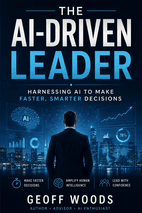
5 Main Takeaways from The AI-Driven Leader
AI Is Your Thought Partner, Not Your Replacement
Geoff Woods repeatedly emphasizes that AI should handle 50–60% of the work—generating options, analyzing data, and simulating scenarios—while you provide context, judgment, and final decisions. The CRIT™ prompt recipe (Context, Role, Interview, Task) and three AI personas (Interviewer, Communicator, Challenger) help you collaborate with AI without outsourcing your thinking.
Shift from Operational Overwhelm to Strategic Clarity
The AI Empowerment Curve normalizes the struggle of learning and provides a clear path from reacting to fires to orchestrating strategy. Leaders must stop being the busiest person in the room and instead focus on the vital few priorities that tap human strengths. AI frees you to do that by collapsing weeks of analysis into minutes.
Master the Art of Asking Great Questions
The wrong question can cost millions. A great question is goal-aligned, simple, and provokes deeper thinking. Use AI to challenge your biases, not reinforce them, and teach your team to think strategically by asking questions rather than giving answers. Get back in the driver’s seat by asking, 'What am I not seeing?'
Use AI to Collapse Time from Data to Decisions
Humans take five hours to process what AI reads in seconds. Upload any data source, ask questions, and get instant insights—no data science degree needed. This speed advantage lets you make smarter, faster decisions while still applying your judgment. Every minute saved compounds into strategic momentum.
Start Small, Model Behavior, and Build Momentum
AI adoption fails when leaders don’t model it. Put a sticky note on your monitor: 'How can AI help me do this?' Use one daily prompt with the CRIT framework for 30 days. Small wins—like a faster marketing brief or a clearer strategy document—create lightbulb moments that spread across the organization.
Executive Analysis
These five takeaways form a single, coherent argument: AI-driven leadership is not about mastering technology but about reclaiming your role as a strategic thinker. Woods argues that the real competitive advantage today is speed, alignment, and execution—all of which AI can amplify if you first adopt the right mindset (Thought Partner, not replacement), ask better questions, and commit to small, consistent action. The book’s central thesis is that the leader’s identity must shift from operational firefighter to strategic orchestrator, using AI as the catalyst to collapse busywork and focus on what only humans can do.
This book matters because it bridges two often-separate disciplines—leadership development and AI adoption—into a practical, battle-tested playbook. Unlike technical guides that overwhelm with jargon or abstract leadership books that ignore AI’s reality, Woods offers a clear framework (CRIT, the AI Empowerment Curve, the seven-step decision framework) that any executive can apply tomorrow. It sits at the intersection of change management, strategic thinking, and personal growth, making it essential reading for leaders feeling the pressure to integrate AI without losing their human edge.
Chapter-by-Chapter Key Takeaways
1. The Rise of AI and the AI-Driven Leader (Chapter 1)
Use AI as a strategic Thought Partner, not
Try this: Treat AI as a strategic thought partner from your very first interaction—never outsource your judgment, but let it generate options and challenge your assumptions.
2. We’ve Been Here Before: What Past Technological Revolutions Can Teach AI-Driven Leaders (Chapter 2)
Change is where growth happens—treat it as an invitation, not a threat.
Be a practice leader: demonstrate AI’s benefits and risks, and learn alongside peers.
Communicate with transparency and empathy, centering people’s interests.
Invest in transferable skills; learning together compounds progress.
Empower others to shape the future—authorship drives ownership.
Move from operational firefighting to strategic leverage on the vital few priorities.
Focus on work that taps human strengths, ensuring fulfillment over burnout.
Try this: Embrace change as an invitation by demonstrating AI’s benefits openly, communicating with empathy, and empowering your team to co-author the future alongside you.
3. Shift From Operational Overwhelm to Strategic Clarity: The Essential Mindset for AI-Driven Leaders (Chapter 3)
Leadership in the AI era is about strategic orchestration, not operational exhaustion.
The AI Empowerment Curve normalizes the struggle and provides a clear path forward.
Community and communication are your two greatest accelerators.
Commit to the journey today—start with the mindset, and the tools will follow.
Try this: Start using the AI Empowerment Curve today to normalize the struggle and commit to the mindset shift before chasing any new tool.
4. Understand AI: What It Is, How It Works, and How to Get Started (Chapter 4)
AI is your Thought Partner, not your Thought Leader. You provide context and judgment; AI challenges and generates options.
When you hit “I don’t know,” use AI to ask you questions or generate prioritized suggestions. It keeps momentum and collapses weeks of thinking into minutes.
Master the communication ingredients: describe the task, give context, assign a persona, specify requirements, establish limits, explain why, and ask AI to interview you.
Use the CRIT™ prompt recipe for strategic thinking: Context, Role, Interview, Task.
The fastest path to competence is daily use. Put a sticky note on your monitor: “How can AI help me do this?”
Try this: Master the CRIT™ prompt recipe (Context, Role, Interview, Task) and keep it visible so every AI conversation begins with clear communication ingredients.
5. Supercharge Your Leadership: Five AI Use Cases You Can Use Today (Chapter 5)
Five use cases to start today: strategic thinking, decision-making, content creation, idea generation, and analysis.
Three powerful AI personas: The Interviewer (uncovers your own ideas), The Communicator (clarifies your message), and The Challenger (pressure-tests your assumptions).
You remain the Thought Leader: AI gets you 50-60% of the way; your judgment completes the rest.
Big changes start small: Try these use cases consistently. If results aren't great at first, refine your communication—not your approach. Over time, momentum builds and possibilities expand.
Try this: Pick one of the five use cases (strategic thinking, decision-making, content creation, idea generation, or analysis) and use it daily for a week, refining your prompts as you go.
6. The High Price of The Wrong Questions: Using AI to Overcome Biases and Assumptions (Chapter 6)
The questions you ask shape your future; wrong ones can cost millions. Master asking the right ones.
A great question is goal-aligned, simple and clear, and provokes deeper thinking.
Mastering this skill elevates your leadership, drives growth, and unlocks value with AI as your Thought Partner.
We all carry biases and assumptions; challenge them to make decisions with clarity.
AI can either challenge your biases or reinforce them—your direction as the Thought Leader makes the difference.
A leader's job is to teach people to think strategically, not by giving answers but by asking great questions.
Be aware of which seat you're in: driver, passenger, or trunk. Get back in the driver's seat as fast as possible.
Try this: Before making any major decision, ask AI to interview you about your goals and biases, then use its questions to uncover blind spots you would otherwise miss.
7. Collapse the Time From Data to Decisions (Chapter 7)
Data overload or scarcity? Either way, you default to limited information. AI expands your perspective by processing what you can’t.
Speed matters. Humans take five hours to read 100,000 tokens; AI takes seconds. That gap is your competitive edge.
Accessibility for all. You no longer need a data science degree. Upload CSVs, ask questions, get answers—instantly.
AI is a Thought Partner, not a replacement. It gets you 50–60% there; your judgment refines the rest.
You can borrow expertise. Branding, research, strategy—AI lets you wield skills you don’t personally own.
Every minute saved compounds. Whether it’s a marketing brief, a corporate narrative, or your own brand kit, collapsing time from data to decisions frees you to focus on what only you can do.
Try this: Upload a spreadsheet or dataset to AI and ask three open-ended questions about it today—collapse hours of analysis into seconds and let your judgment refine the output.
8. Navigate Short-Term Pressures Without Sacrificing Long-Term Growth (Chapter 8)
Short-term pressure often kills long-term competitive advantage slowly—don’t let busyness break the chain.
Use AI as a Thought Partner to simulate scenarios, challenge assumptions, and find the balance between immediate results and future growth.
Align incentives with long-term value creation (cash score, talent retention) to drive the behavior you want.
Build a strategic mindset around customer focus, the four growth drivers, prioritization, data-driven critical thinking, and adaptability.
Empower your team with strategic questions and let AI help you see around corners, but never outsource your own thinking.
Try this: When short-term pressures mount, use AI to simulate two scenarios: one that maximizes immediate results and one that protects long-term growth, then find the balance.
9. Accelerate Strategic Momentum: Make Faster, Smarter Decisions with AI (Chapter 9)
Follow the seven-step framework: clarify the objective, map stakeholders, gather/analyze information, identify solutions/alternatives, evaluate risks, decide and plan, deliver results.
At each step, use AI as a Thought Partner to collapse time and uncover blind spots—but never as a substitute for your judgment.
The biggest wins come from role-playing with AI (stakeholder mapping), using it to generate non-obvious alternatives, and having it risk-test your plans.
Success comes from making the decision right (following the process) then having the humility to iterate toward the right decision.
The 20% from this chapter is summarized in the seven-step list (provided at the chapter’s end). Keep it handy for every major strategic choice.
Try this: Run every major strategic choice through the seven-step framework (clarify objective, map stakeholders, gather info, identify solutions, evaluate risks, decide, deliver) using AI at each step to accelerate and pressure-test.
10. Lead with Strategic Clarity: Ensure Year-Round Alignment (Chapter 10)
Expand Who You Can Become – Set goals that force you to grow. The purpose of a goal is a compass, not a finish line. Plan for a buffer above your target because reality will intervene.
Create True Clarity and Alignment – Real alignment means surfacing disagreements and achieving shared understanding. If your team can’t clearly articulate how you’ll win, you don’t have alignment yet.
Build an AI-Driven Execution System – Static plans fail when markets shift. Build a living structure that keeps strategy, people, and priorities moving together as reality changes.
Use AI to Accelerate Alignment and Value Creation – AI can hear every voice, surface what matters most, and collapse months of alignment work into hours. Authorship creates ownership.
Try this: After setting quarterly goals, use AI to surface hidden disagreements in your team’s understanding, then facilitate a conversation until everyone can articulate how you’ll win.
11. Win the First 30 Days: Turn Your Strategic Plan into Results (Chapter 11)
The first thirty days after a strategic review are your launchpad. Get out of the gates fast and build a lead. Decisive action signals commitment to your team.
Break your plan into short-term, actionable milestones. Without them, you'll drift and eventually abandon your goals.
Block time on your calendar for your priorities. If your calendar doesn't reflect your plan, you're not truly committed. Use AI to audit your calendar weekly.
Create a common language around prioritization. Always talk about what you'll say no to when you say yes to something new. This keeps everyone rowing in the same direction.
Transform your one-on-ones into coaching sessions. Focus on clarity, challenges, and growth—not just status updates.
Let AI be your thought partner. Use it to surface blind spots, audit your calendar, reframe delegation, and sharpen your coaching questions. Strategy execution is not a once-a-quarter event—it's a weekly discipline.
Try this: Block time on your calendar for your top three strategic priorities and ask AI weekly to audit your calendar for misalignment—turn one-on-ones into coaching sessions focused on growth.
13. Integrate AI Seamlessly: Change Management Strategies for Smooth Transitions (Chapter 13)
Strategy first, technology second. Begin with the problem, then choose the tool.
Use the five-step framework to gain executive buy-in: identify the problem, define the use case, map stakeholders, co-author solutions, and lead execution.
Create “lightbulb moments” by using AI as a Thought Partner to solve real challenges.
Validate fears with empathy. Address job displacement, privacy, regulation, and hallucinations openly.
Empower early adopters with tools and training, and share both successes and lessons learned to build a culture of innovation.
Small wins lead to big transformations. Start with low-risk, high-impact use cases, and let momentum do the work.
Try this: Before introducing AI to your team, identify a real problem they face, then co-create a solution with them using AI as a thought partner to generate lightbulb moments.
14. Go from 0 to 1: The Simple Path to Deliver Value with AI (Chapter 14)
Start every task by asking "How might AI help me do this?" Keep it visible.
The AI Empowerment Flywheel is a continuous cycle: ask, communicate, get results, repeat.
Use the 3-step framework when you're not sure where to start: let AI interview you, create a prompt, then execute it.
AI adoption fails when leaders don't model the behavior. Become an AI-driven leader first.
Speed, alignment, and execution are the real competitive advantages—AI can help with all three, but only if your organization is built to move.
Try this: Start every single task today with the question 'How might AI help me do this?' and commit to the AI Empowerment Flywheel of ask, communicate, get results, repeat.
Redefine Who You Are and Who You Can Become (Conclusion)
Identity is not your job title. You are the constant in the equation, even as your tasks and tools evolve. Fear of AI is often fear of losing yourself, not just your paycheck.
The leadership shift is from operational reactor to strategic thought partner. AI handles execution; your role is to define vision, ask the right questions, and lead your people.
Your growth is non-negotiable. Change is not a threat to your identity—it is the mechanism through which your identity evolves. Embrace the transition from leader to AI-driven leader.
The book was never about AI. It was a guide to becoming a more deliberate, strategic, and human leader using AI as the catalyst.
Start today, at small scale. The first step is a single sticky note and one daily prompt using the CRIT™ Framework for thirty days. Momentum comes from action, not intention.
The future belongs to the aligned. Speed and alignment together form the new competitive advantage. Leaders who can collapse time from strategy to results will define the next era.
Try this: Redefine your identity as a leader who evolves with change—use the CRIT framework daily for 30 days, and let momentum, not intention, drive your transformation.