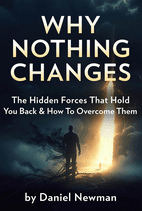
Why Nothing Changes Key Takeaways
by Daniel Newman
5 Main Takeaways from Why Nothing Changes
Change fails due to hidden forces, not weak willpower.
Newman argues that we don't fail because we lack motivation—we fail because we ignore the underlying ecosystem of threats, misalignments, and feedback loops that block progress. By uncovering these forces (like your brain's threat response or identity friction), you can design changes that actually stick.
Shrink your actions to bypass the brain's threat response.
Big changes trigger your brain's danger alarms, causing resistance. Newman advises breaking goals into micro-actions so small they require no willpower—like running for just one minute. These tiny steps build momentum without triggering fear, turning consistency into a superpower.
Alignment of identity, values, and environment eliminates friction.
When your actions clash with who you think you are or the environment you're in, you feel constant resistance. The book shows how small, deliberate corrections—like adjusting your morning routine or redefining your identity as a 'runner'—reduce friction and make change feel natural.
Relapse is predictable—normalize it and recover without shame.
Newman identifies five causes of relapse (stress, triggers, environment, identity fatigue, depletion) and emphasizes that setbacks are part of the process. Instead of spiraling into guilt, you learn to spot the trigger, adjust one thing, and return to your micro-actions immediately.
Growth is an unfinished system, not a project to complete.
You never 'arrive' at lasting change. Newman reframes success as a continuous system of adaptation—stewarding your progress through routines, environment design, and social support. Embracing being unfinished removes the pressure to be perfect and keeps you evolving.
Executive Analysis
These five takeaways form a cohesive argument: change fails not because of a lack of willpower, but because we fight against an entire ecosystem of psychological, environmental, and identity-based barriers. Newman dismantles the myth of heroic self-discipline and replaces it with a systematic approach—starting with tiny micro-actions to bypass threat responses, then aligning identity and environment to reduce friction, normalizing relapse as a recoverable step, and finally embracing change as an ongoing, unfinished system of maintenance. The central thesis is that sustainable transformation comes from understanding and designing around your personal ecosystem, not just trying harder.
This book matters because it moves beyond generic motivation and offers concrete, research-backed tools for anyone stuck in a cycle of failed resolutions. Newman's relatable 5K journey makes the principles tangible, while his focus on self-regulation, feedback loops, and endurance over intensity fills a critical gap in the self-help genre. It stands out by treating change not as a battle of willpower but as a strategy of ecosystem management—making it especially valuable for readers who have tried and failed repeatedly and need a framework that accounts for real-world complexity and setbacks.
Chapter-by-Chapter Key Takeaways
INTRODUCTION (Introduction)
Change fails not because we lack willpower, but because we don't see or address the underlying forces blocking us.
The book is organized into three clear layers: what's blocking you, what to do, and how to maintain change.
Practical, research-backed tools are offered in every chapter for immediate use, not just theory.
The author's own 5K journey serves as a relatable, honest case study of the principles in action.
Try this: Identify one hidden block (like fear of failure or environmental trigger) that has derailed past attempts, and address it directly before starting a new change.
Part II (Chapter 2)
Big change triggers threat responses. Shrink your actions until your brain doesn’t resist them.
Micro-actions build momentum without demanding willpower. Consistency beats heroism every time.
Feedback loops turn plateaus into progress. Review weekly—adjust one thing at a time.
Self-regulation is more important than motivation. Regulate emotions, attention, and energy to stay on track.
Plateaus are thresholds, not dead ends. They signal it’s time to change your approach, not your goal.
Try this: Choose one goal, shrink it to a two-minute version that feels almost trivial, and do that action at the same time every day for a week without increasing.
Part III (Chapter 3)
Misalignment feels like friction because your values, identity, and behaviors are out of sync. Alignment is achieved through small, deliberate corrections, not grand declarations.
Relapse is predictable and recoverable. It's caused by stress, triggers, environment, identity fatigue, and depletion. Normalize it, identify the trigger, and return without shame.
Endurance beats intensity. Intensity relies on ideal conditions; endurance is about staying in the game even when the rules change. Consistency isn't sameness—it's adaptation.
Maintenance is stewardship. What you've built needs ongoing care through routines, environment design, micro-actions, and a supportive community.
You will never “arrive.” Growth is not a project to finish but a system to develop. Embrace being unfinished—it removes the pressure and opens the door to continuous evolution.
Practical frameworks work best when they address the whole ecosystem: identity, environment, emotional patterns, feedback loops, and social support. Change is “you vs. your ecosystem,” not just “you vs. you.”
Try this: When you notice friction or a relapse, pause to name the trigger (stress, environment, identity clash) and then make one tiny adjustment to your environment or routine before returning to your micro-action.