Why Nothing Changes Quotes
by Daniel Newman
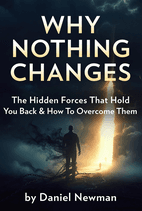
These quotes cut through the noise. They don't offer easy motivation but instead point to the real reasons we stay stuck: hidden comforts, systems that hold us in place, and the brain's preference for predictable pain. Each line feels like a small revelation, something you want to underline or send to a friend.
What makes this book so quotable is how it turns complex ideas into sharp, memorable phrases. You get a mix of tough love and deep empathy, all without the usual self help fluff. The quotes stay with you because they name what you already feel but never had words for.
Top Quotes from Why Nothing Changes
“Courage doesn’t demand fearlessness. It asks only that you recognize the price of inaction.”
Opening line of the chapter, setting the theme.
It reframes courage as a cost-benefit decision rather than a lack of fear, making change more accessible.
“Comfort had disguised itself as success.”
Jim, a founder, reflecting on his stagnation after early growth.
It captures the deceptive nature of comfort, which can look like achievement but actually masks stagnation.
“Letting go hurts because part of you has to die for the rest of you to live.”
Introduction to the emotional cost of change, describing the necessity of grief.
It validates the pain of transformation, acknowledging that growth requires loss, not just gain.
“You are stuck because the systems around you are designed to keep you in place.”
Discussion of social and structural forces that resist personal change.
It shifts responsibility from individual failure to systemic design, empowering readers to see external barriers.
“Big change demands heroism. Micro-actions demand consistency. And consistency beats heroism every time.”
The author contrasts the allure of big change with the effectiveness of micro-actions.
It's a memorable, aphoristic statement that redefines success as steady, small steps rather than dramatic efforts.
“When the step is tiny, resistance has nothing to push against.”
Describing how micro-actions overcome psychological resistance.
This vivid metaphor clearly illustrates why small steps are so effective at bypassing our brain's defenses.
“The plateau is not the enemy. It is the threshold.”
The author discusses skill plateaus and how they are often misinterpreted.
This reframe turns a frustrating stagnation into a sign of impending progress, encouraging perseverance.
Themes Behind the Quotes
One major theme is the tension between comfort and growth. Many of the quotes point out that what feels like success or safety is often just a comfortable trap. Real change requires letting go of parts of yourself, and that process is painful but necessary. Another theme is the importance of small, consistent actions. Big heroic efforts rarely last, but tiny steps can bypass resistance and build momentum over time.
A second theme is the idea that change is not a one time event but an ongoing relationship with your own evolution. You have to keep showing up even when the rules shift. There is also a strong focus on alignment between your actions and your deeper values. When you are misaligned, everything feels like friction. The book emphasizes clarity and deliberate action over brute willpower.
Quotes by Chapter
INTRODUCTION
“When you understand these three layers — what's blocking you, what you need to do, and how you can sustain change — you'll finally have a framework for change that doesn’t collapse under pressure.”
The author introduces the book's three-part framework.
This line distills the core promise of the book into a clear, actionable structure. It gives readers hope that change can be built to last, not just forced through willpower.
“My goal in these pages is clear: to help you see those forces plainly, understand how they work, and learn to navigate them with intention rather than frustration.”
The author states the book's purpose in the introduction.
It reframes the struggle with change from a battle of will to a matter of awareness and deliberate strategy, which feels empowering and achievable.
“More importantly, we'll walk through practical, research-backed strategies to finally create the changes that have felt impossible for far too long.”
The author emphasizes the practical value of the book.
This line directly addresses the reader's deepest frustration—feeling stuck—and promises evidence-based solutions, making the possibility of change feel real and credible.
“By the final page, you'll have a path to change you can trust, what to do differently, and how to apply the core principles in The Change Framework S™ 2] provided at the end of the book — not through willpower alone, but through clarity, alignment, and deliberate action.”
The author describes what the reader will gain from the book.
It offers a tangible outcome—a trusted path—and contrasts it with the common reliance on willpower, highlighting a more sustainable approach that resonates with anyone tired of failed attempts.
Part II
“Behavioral neuroscience research shows that the brain prefers predictable discomfort to unpredictable improvement!2! because predictability equals survival, whereas unpredictability signals potential threat or danger.”
The author explains why big change triggers fear and resistance.
This line succinctly captures a fundamental principle of human psychology, making it a powerful insight for understanding resistance to change.
Part III
“Misalignment always feels like friction - like walking through your own life with the brakes on.”
The author explains the feeling of being misaligned with one's values and actions.
This metaphor vividly captures the exhausting resistance of living out of sync, making the abstract concept of misalignment tangible and relatable.
“It’s the quiet, powerful moment when the new you finally feels like home.”
Describing identity stability after transformation, when the new self no longer requires effort.
It resonates deeply because it names the longed-for peace of authentic change, offering hope that the struggle can yield a sense of belonging within oneself.
“It's the understanding that growth is not a single spark but an ongoing relationship with your own evolution.”
The author reframes growth as a continuous process rather than a one-time event.
This line relieves the pressure to 'arrive' and encourages a compassionate, lifelong perspective on personal development.
“Consistency isn’t about doing the same thing every day. It’s about staying in the game even when the rules change.”
The text discusses adaptation as the superpower of the long game in transformation.
It redefines consistency as resilience and adaptability, which is more empowering and realistic than rigid repetition, especially when life throws curveballs.