The Small-Business Money Game Key Takeaways
by Robinson Aquino
As an Amazon Associate, we earn from qualifying purchases.
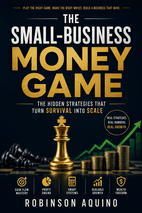
5 Main Takeaways from The Small-Business Money Game
Control the bank to shape outcomes
Whoever controls the flow of capital holds the power. Whether in Monopoly or real business, cash flow management determines who survives and thrives. Focus on owning the financial levers, not just earning a salary.
Play the infinite game, not zero-sum
Sustainable success comes from continuous improvement and mutual growth, not winning at others' expense. Build systems that allow everyone to climb, and avoid entitlement that often accompanies advantage.
Let data transform luck into predictability
Like the Moneyball strategy in baseball, data-driven decisions remove guesswork. Start with solid bookkeeping, layer operational metrics, then strategic indicators—this hierarchy turns intuition into reliable outcomes.
Design systems before chaos becomes structural
Small businesses fail because they are designed to fail—balancing Technician, Manager, and Entrepreneur roles is critical. Growth creates friction; invest in systems (pricing, cash flow, hiring) before scaling amplifies problems.
Ownership builds wealth, not wages
Swapping a steady paycheck for equity can multiply net worth far beyond any salary. Measure your balance sheet annually, protect your focus like a hard asset, and hire a financial translator to avoid six-figure mistakes.
Executive Analysis
These five takeaways form a coherent thesis: small-business success is less about working harder and more about playing a smarter, system-driven game. The book argues that entrepreneurs must shift from reactive, finite-game thinking (where cash flow is a monthly scramble) to an infinite-game mindset where data, strategic pricing, and scalable systems create lasting value. Control of capital, data discipline, and redesigning the business foundation are not optional—they are the rules of the game.
This book matters because it cuts through the romanticized hustle narrative and gives practical, game-based frameworks that any small-business owner can apply immediately. It sits at the intersection of personal finance, entrepreneurship, and strategy, offering a rare blend of behavioral insight and concrete tools (like the PSPG Matrix and the Scale Field Test). For readers drowning in gut-feel decisions or trapped in the Technician role, it provides a clear path to systematic growth and genuine wealth creation.
Chapter-by-Chapter Key Takeaways
Chapter One | The Theory of Games (Chapter 1)
Control the bank. Whoever controls the flow of capital—whether in a board game or real life—holds the power to shape outcomes.
Play the infinite game. Focus on sustainability, continuous improvement, and mutual growth rather than zero-sum victories.
Your position isn't permanent. The economic category you occupy today—Wheelbarrow, Racecar, or Top Hat—can change with the right mindset and strategy.
Wealth shapes behavior. The Monopoly experiment shows that advantages, even unfair ones, tend to breed entitlement, not gratitude. Awareness of this dynamic is key to playing wisely.
Profit and principle can coexist. Building prosperity doesn't require abandoning decency. The goal is to create systems where everyone can climb.
Try this: Audit who controls the cash in your business and build systems to keep capital flowing, not just trickling in—treat it as the central power lever.
Chapter Three | The Moneyball Strategy (Chapter 2)
Never assume the problem before examining the data—self-diagnosis in business is often wrong.
Build a Financial Data Hierarchy: start with solid bookkeeping, layer on operational efficiency metrics, then use strategic indicators for growth.
Data transforms luck into predictable outcomes—just as it did for the 2004 Red Sox, Sofia's dental practice, and Thomas Tull's Hollywood empire.
Choose financial professionals who support your vision and understand the infinite money game.
You get rich in proportion to the value you deliver—not by chasing status or gut feelings.
Try this: Install a simple Financial Data Hierarchy today: clean up your bookkeeping first, add three operational metrics (e.g., cost per lead, conversion rate), then pick one strategic indicator to track weekly.
Chapter Four | Why Small Businesses Are Designed to Fail (Chapter 3)
Balance the three roles: Ensure your leadership covers Technician, Manager, and Entrepreneur—or find partners who fill the gaps.
Purpose over profit: Starting to solve a real problem attracts the right clients and sustains you through hardship.
Hire for culture and experience first: Industry professionals who already share your values build a stronger foundation than friends or relatives.
Growth creates friction: Every new hire delays cash flow; invest in systems before the chaos becomes structural.
Cash-flow constraint is about timing, not just amount: Manage the lag between spending and reimbursement carefully.
COVID exposed weak systems, not weak effort: Stress tests reveal whether your business can survive disruption; use crises to professionalize finance, HR, and operations.
Redesign is the solution when design is the problem: Focus on pricing, value models, cost structures, and systems that support human behavior at its best.
Try this: Map your current leadership roles (Technician, Manager, Entrepreneur) and identify the gap—if you’re doing all three, hire or partner to cover the missing role before adding any new service.
Chapter Five | Pricing Is an Art—Accounting Is A Science (Chapter 4)
Strategic pricing shapes everything—delivery, resources, value perception. A lower price makes growth hard; a higher price (justified by value) lets you invest in team, quality, and profit.
Pricing is an art, but the foundation is accounting science. Don't skimp on professional help.
Use a structured, step-by-step approach to analyze costs, set margins, and transition smoothly.
The right pricing structure sets your pace for scaling, talent attraction, and long-term profitability.
Try this: Run a full cost analysis on your top three products or services, then set a target margin 10% higher—adjust pricing gradually while communicating the added value to clients.
Chapter Six | Starting Smart, Starting Small (Chapter 5)
Narrow your focus iteratively. Even complementary services can dilute your mission and operational strength.
Validate unit economics before scaling. Make sure the math works at a small scale, or scaling will only amplify losses.
Identify and protect your “gold.” The one thing you do best is your competitive advantage—guard it fiercely.
Adopt the hundred-times test. If a process or offering can’t be repeated effectively, don’t start it in the first place.
Try this: Apply the hundred-times test to every new offering: if you cannot repeat the process effectively one hundred times without breaking, do not launch it yet.
Chapter Seven | Turnaround and Transformation (Chapter 6)
The PSPG Matrix forces a fast, data-backed inventory of everything your company does, then tags each with a clear action: Pause, Shrink, Plan, or Grow.
Scoring must be grounded in revenue, profitability, and strategic importance—with caps to prevent inflation and blind spots.
The exercise is useless without deadlines. Convert every decision into a dated action item.
Creative destruction is not about loss; it's about strategic shedding that frees resources for real growth.
Try this: Use the PSPG Matrix this week: list every activity, product, or client, score them by revenue and strategic importance, then assign each a Pause, Shrink, Plan, or Grow action with a firm deadline.
Chapter Eight | Strategic Scaling (Chapter 7)
Technology leverage is the most powerful because it scales at near-zero marginal cost—use it to multiply revenue and productivity within the same footprint.
Sequence your leverage: build the bench first, then install systems, then fund the climb. Hustle starts you; leverage scales you.
The five-question readiness check (unit economics, bench, cash, systems, demand) is a non-negotiable gate—answer no to any, and you're not ready to scale.
Not every business should replicate small units. If your value comes from central control, network effects, or heavy regulation, strengthen the core instead.
The Scale Field Test provides a practical way to diagnose which path fits your business—replicate, hybrid, or centralize.
Try this: Run the five-question readiness check (unit economics, bench, cash, systems, demand) before any scaling push—answer 'no' to one, and pause until it’s fixed.
Chapter Nine | Measuring Wealth (Chapter 8)
Ownership, not wages, builds wealth. Phil’s story proves that swapping a steady paycheck for equity can multiply your net worth far beyond what any job can offer.
Focus is the new currency. In an age of engineered distraction, the ability to concentrate without interruption has become rare and immensely valuable—protect it like a hard asset.
Your balance sheet is the only scoreboard. Ignore GDP headlines and paycheck bumps. Measure your net worth annually by subtracting liabilities from assets. That number tells you if you’re climbing or just spinning.
Hire a financial translator before you need one. A fractional CFO or financial planner who sits with you monthly can prevent six-figure mistakes and uncover hidden capital. Don’t cheap out on the person who reads the instruments.
Try this: Calculate your personal net worth today (assets minus liabilities), then schedule a monthly 30-minute review with a fractional CFO or financial planner to track progress and catch hidden opportunities.
Chapter Ten | Choose Wisely (Chapter 9)
Decision load is a hidden growth killer. Every decision that shouldn't reach the founder's desk is a sign the system needs redesign.
Impossible goals simplify. A 10x target forces you to abandon tactics that don't scale; a 2x goal lets you cling to them.
Clarity of identity matters. Seeing yourself as a system builder, not a firefighter, changes the choices you make.
Structure enables freedom. Visionaries need integrators; deep work requires blocks; flow needs clear goals. Design for those conditions.
Financial literacy is a scaling tool. Without it, decisions stay reactive. With it, you can delegate, forecast, and grow.
Try this: Identify the top three recurring decisions you personally make that could be delegated—then design a system (checklist, rule, or tool) to move them off your desk permanently.