The Small-Business Money Game Quotes
by Robinson Aquino
As an Amazon Associate, we earn from qualifying purchases.
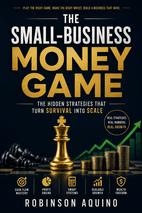
The quotes on this page come straight from Robinson Aquino's 'The Small-Business Money Game'. They are the kind of lines that stop you in your tracks, making you rethink how you run your business. You will find blunt truths about cash flow, growth traps, and the difference between a job and a real asset.
What makes this book so quotable is its ability to package hard earned wisdom into memorable one liners. Each quote feels like a lesson learned the hard way, delivered without sugarcoating. Whether you are just starting out or scaling up, these words will stick with you and shape your decisions.
Top Quotes from The Small-Business Money Game
“Lesson #1: Whoever controls the bank controls the game.”
The author recounts how his older brother cheated by being the banker in Monopoly.
This simple line crystallizes the core power dynamic in any financial system—control of capital equals control of outcomes. It's instantly memorable and actionable.
“Lesson #13: If you change how you see the game, the game itself changes.”
The author presents this as a key lesson derived from the moneyball philosophy applied by Billy Beane and the Red Sox.
It distills a profound insight about perception and opportunity, reminding readers that reframing challenges can reveal solutions hidden in plain sight.
“If your business depends on you, you don’t own a business—you have a job. And it’s the worst job in the world because you're working for a lunatic!”
Michael Gerber's insight about the Technician trap, quoted by the author.
It reframes the classic owner-operator struggle, making the painful truth instantly memorable and forcing founders to confront whether they are building a business or just creating a job for themselves.
“The real game is to own an asset—something that can work without you.”
The author distinguishes between owning a business that is a job and owning a true asset.
This concise line reframes success for entrepreneurs, emphasizing the importance of building a business that doesn't require their constant presence.
“Growth doesn't just use cash; it swallows it.”
The author describes the financial reality of scaling as seen in the RFC brothers' operations.
This vivid metaphor captures the insatiable demand for capital during expansion, resonating with entrepreneurs who have experienced cash crunches.
“Growth multiplies your weakest system, not your strongest.”
The author explains the implication of the scaling formula Scaling = Growth x min (Systems, People, Capital).
This counterintuitive insight warns that expansion exposes hidden weaknesses, which is a sobering truth that many business owners learn the hard way.
“Wages will keep you alive. Ownership will make you wealthy.”
Lesson #40, following Phil's story of shifting from income to ownership.
The contrast is stark and actionable, encapsulating the core lesson of the chapter in a single sentence.
Themes Behind the Quotes
A central theme is moving from working in your business to owning it. Many entrepreneurs become the main worker, leading to burnout. The quotes emphasize building systems that can run without you. Another theme is cash flow and pricing. Underpricing and ignoring cash flow erode profits and confidence.
Growth is a double edged sword. It swallows cash and exposes weak systems. Prepare, measure, and adapt rather than relying on gut feelings. There is also a theme of ethics. Prosperity and decency can coexist. Change your perspective, because how you see the game determines how you play it.
Quotes by Chapter
Chapter One | The Theory of Games
“The true art of playing the money game lies not in bankrupting others but in continuously improving one's own position while also lifting others along the way.”
This is Lesson #2, drawn from the contrast between finite and infinite games.
It reframes success from zero-sum competition to collaborative growth, a mindset shift essential for sustainable entrepreneurship. The phrasing sticks because it pairs self-improvement with generosity.
“Stop aiming to defeat others; start designing systems that let everyone climb.”
Part of Lesson #4 on creating an infinite-game mindset.
This direct imperative turns the reader's focus from rivalry to architecture—build better systems, not just better tactics. It's both a rebuke of cutthroat thinking and a clear, positive directive.
“Prosperity doesn’t have to be disconnected from decency.”
The final lesson of the chapter, summarizing the book's ethical stance.
It challenges the assumption that wealth requires moral compromise, offering hope and permission to pursue success with integrity. The alliteration and brevity make it highly quotable.
Chapter Three | The Moneyball Strategy
“The beginning of every downfall I've seen among entrepreneurs looks the same. Things are going well. They've got momentum. Sales are up, the team's growing, and—more importantly— they're happy. They've trusted their gut, and it hasn't led them astray. Until it inevitably does.”
The author describes the common pattern of entrepreneurial downfall driven by overreliance on intuition.
This passage powerfully captures the seductive danger of success without data, making it a memorable warning against complacency.
“Your gut can't spot a cash-flow crisis, a bloated payroll, or the client quietly holding 20 percent of your revenue hostage.”
The author explains why trusting intuition alone is insufficient for running a business.
It delivers a concrete, vivid list of hidden financial threats that gut feelings miss, making the argument for data-driven decisions unforgettable.
“Our brains are wired to prioritize speed and emotional comfort over accuracy and careful thought.”
The author references Daniel Kahneman's research on cognitive biases.
This succinctly summarizes a fundamental human flaw, resonating with anyone who has ever made a rushed or emotional financial decision.
Chapter Four | Why Small Businesses Are Designed to Fail
“If some companies are considered too big to fail, then by that same logic, there must be millions that are simply too small to succeed.”
The author's realization after observing the government bailouts during the Great Recession.
This line crystallizes the systemic disadvantage small businesses face, turning frustration into clarity and empowering owners to adopt smarter strategies rather than fighting the system blindly.
“You don’t master the money game before you grow; you master it because you grow.”
Lesson #20, summarizing the heart of the author's framework.
It flips the common misconception that readiness precedes growth, reassuring entrepreneurs that the learning happens through the journey itself.
“Every stage demands a new version of you: smarter, calmer, more strategic, more disciplined.”
The author describing the personal transformation required at each breakpoint.
This succinctly captures the relentless self-evolution needed to scale, reminding founders that their own growth is inseparable from their business's growth.
Chapter Five | Pricing Is an Art—Accounting Is A Science
“The moment you make a mistake in pricing, you're eating into your reputation or your profits.”
Opening epigraph of the chapter, attributed to Katharine Paine.
It succinctly warns that pricing errors damage both reputation and profitability, a core theme of the chapter.
“Underpricing doesn’t just hurt the numbers; it slowly erodes confidence, culture, and cash flow.”
After explaining how John's underpricing affected his business.
It broadens the impact of underpricing beyond finances to include confidence, culture, and cash flow, making it a powerful warning.
“The art of pricing involves reaching a point where you're receiving just enough no's to know you've set an appropriate price (at least for the time being).”
Explaining the balance needed in pricing.
It reframes pricing as an art of finding the sweet spot where customer resistance signals a fair price, a memorable insight.
“Money is a story of trust, recordkeeping, and human cooperation—a language we began speaking likely before we learned to write.”
After tracing the history of money from clay tokens to digital.
It encapsulates the book's central idea that money is a human construct based on trust, not just math, making it a profound and quotable insight.
Chapter Six | Starting Smart, Starting Small
“Most people who start a business fail, often losing more than they invested.”
The author presents Lesson #27 after explaining the half-truths about entrepreneurship.
It starkly counters the myth that starting a business is a sure path to wealth, reminding readers of the real risks involved.
“It's a demanding job—with no paid vacation, no sick leave, no retirement plan, and little protection when things go wrong. It’s all work and no life —a self-employment trap disguised as freedom.”
The author describes the reality many entrepreneurs face when their business becomes a demanding job rather than an asset.
This vivid warning strips away the romanticized view of entrepreneurship, highlighting the hidden costs of self-employment.
“You can’t manage what you can't measure.”
The author states Lesson #28 after explaining that poor financial management is the leading cause of business failure.
A timeless principle that underscores the importance of financial visibility and accounting for any business.
Chapter Seven | Turnaround and Transformation
“It is not the strongest of the species that survive, nor the most intelligent, but the one most responsive to change.”
Opening epigraph of the chapter, attributed to Charles Darwin.
This timeless line reframes survival as a matter of adaptability rather than raw power, which is the central theme of the chapter.
“The key to survival isn't luck—it’s preparation.”
Author summarizing the lesson from historical economic cycles and small-business failures.
It delivers a concise, actionable truth that empowers readers to take control rather than leave outcomes to chance.
“Expertise has limits. There's a difference between an expert hired to complete a task and one committed to understanding your business well enough to challenge your thinking and give you the advice you actually need.”
Lesson #33 after the case study of Gina, whose advisors failed her.
This distinction highlights a common pitfall for entrepreneurs who outsource strategy without ensuring deep, personalized understanding.
“Admit the old model is dying, pick up the axe, and clear space for new growth.”
Author's closing advice on the necessity of decisive action during a turnaround.
The blunt, visceral imagery captures the courage required to let go of the past and make room for transformation.
Chapter Eight | Strategic Scaling
“If the previous chapter was about finding shelter in the storm, this one is about the climb that follows— scaling the mountain while the rock is still slick and the air thin.”
The author transitions from the previous chapter's theme of survival to this chapter's focus on growth.
The imagery of a dangerous climb perfectly conveys the precarious, high-stakes nature of scaling, making the challenge feel both aspirational and urgent.
“If sweat alone scaled, the longest shifts would build the biggest companies.”
The author discusses the need for leverage rather than just hard work to achieve scale.
This punchy line reframes the hustle mindset, reminding readers that effort without systems, capital, or technology has limits.
Chapter Nine | Measuring Wealth
“If attention is the new currency, focus is the new wealth.”
Lesson #39 in the chapter, where the author discusses the attention economy.
It's a succinct, memorable redefinition of value in the modern era, equating focus directly to wealth.