Traffic Secrets Quotes
by Russell Brunson
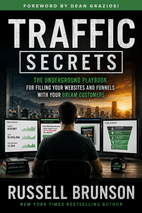
These quotes capture the essence of building a traffic system that works on any platform. They remind you that traffic is people, and people are predictable. Expect to find lines about identifying your dream customers, throwing out hooks, and focusing on their needs. The book is quotable because it turns complex ideas into simple, shareable truths.
Russell Brunson's personal stories make the lessons stick. Whether he is talking about his chiropractic training or his college years, he shows that entrepreneurs must master getting attention. These quotes push you to act now, dig your well before you are thirsty, and never wait for customers to come to you. They are practical, timeless, and memorable.
Top Quotes from Traffic Secrets
“Waiting for people to come to you is not a strategy.”
Dean Graziosi states this after explaining the common failure of entrepreneurs who rely on their product alone.
This succinct, blunt line cuts through self-delusion and forces readers to acknowledge that passive hoping will not build a business.
“I strongly believe that entrepreneurs are the only people on earth who can actually change the world.”
Dean Graziosi explains his personal mission to help entrepreneurs succeed.
This empowering statement elevates the reader's sense of purpose and reinforces that their work matters beyond just profit.
“Do you ever feel that Mark Zuckerberg is like Thanos, and his whole goal is to wipe out half the entrepreneurs who are advertising on Facebook? He could literally snap his fingers and half the online entrepreneurs would lose their businesses overnight.”
Peng Joon says this to the author after watching Avengers: Infinity War, sparking the idea for the book.
This vivid analogy immediately grabs attention and frames the core warning of the book: relying on a single traffic platform is dangerously fragile.
“Traffic is people, and people are extremely predictable. The core strategies that I’m going to teach you will outlast and supersede any particular platform, so you can apply them anywhere.”
The author introduces the direct response marketing mindset that underpins the book.
It reframes traffic from a technical puzzle to a human behavior challenge, offering a stable foundation amid constant change.
“The people who put all their focus on creating something amazing (instead of also focusing on getting people to actually see what they created) are the people that fail.”
The author reflects on common entrepreneurial failures after coaching hundreds of thousands of entrepreneurs.
It delivers a blunt, memorable truth that challenges the build-it-and-they-will-come mindset, urging balance between creation and distribution.
“Every human being on this planet is always moving in one of two directions when they make a decision: away from pain or toward pleasure.”
The author's introduction to the concept of pain and pleasure as motivators.
It succinctly summarizes a fundamental human motivation principle, making it a powerful anchor for understanding customer behavior.
“The first key to the Dream 100 is that you need to dig your well before you're thirsty.”
Russell Brunson explains the foundational principle of building relationships with influencers before you need them.
This memorable metaphor encapsulates the proactive, long-term approach to relationship building that is central to the Dream 100 strategy.
Themes Behind the Quotes
A central theme is the importance of building a traffic foundation that is not tied to any single platform. The strategies taught are designed to survive when algorithms change or networks evolve. Another key theme is the relentless focus on the dream customer. Successful businesses identify exactly who they want to reach, find where those people gather, and then craft messages that grab their attention.
The quotes also highlight the power of psychological triggers, especially the pain and pleasure principle that drives every decision. They emphasize the need to create compelling hooks, tell engaging stories, and make irresistible offers. Finally, there is a strong theme of proactive relationship building, whether through the Dream 100 approach of cultivating influencers or by nurturing your biggest fans. The underlying message is that waiting is not a strategy; you must actively pull people into your world.
Quotes by Chapter
Publisher’s Note
“All these strategies have one big thing in common: when the storms come, the user interface changes, or the traffic moves, they will still work!”
The author introduces the core advantage of the strategies described in the book.
This line promises resilience in the face of digital platform volatility, giving readers confidence that the methods are future-proof.
“This book will give you the safety and security you need to know that your business, traffic, and leads are all on stable ground.”
The author reassures the reader about the value of the book.
It directly addresses a common fear among online entrepreneurs—unstable traffic—and offers a sense of control and peace of mind.
“It worked for me when I was forced to move from Friendster (most of you don’t even remember Friendster, do you?) to Myspace to Facebook . . . and it will work when we have to move from Facebook and Google to the next big networks too!”
The author shares a personal example of adapting to platform shifts.
The humorous aside about Friendster makes the point relatable, and the repeated transitions prove the strategy’s enduring effectiveness.
“Mastering these growth hacks will give you the ability to build your traffic foundation on solid ground.”
The author describes the outcome of the growth hacking techniques in Section Three.
It reinforces the theme of stability and empowers readers with a clear, achievable goal for long-term success.
Foreword by Dean Graziosi
“I went to college for four years to get my degree, then I spent an additional four years at chiropractic college to become a chiropractor. In all that time, not once did they ever talk about how to actually get patients to come to my clinic.”
Dr. Woolner (Chad) tells Dean Graziosi about his frustration with his education.
It highlights the shocking gap between learning a skill and learning how to market it, which resonates deeply with entrepreneurs who feel similarly unprepared.
“But understanding exactly who your dream customer is, discovering where they're congregating, and throwing out hooks that will grab their attention to pull them into your funnels (where you can tell them a story and make them an offer) is the strategy.”
Dean Graziosi introduces the core framework of the book after sharing Dr. Woolner's turnaround.
It provides a clear, memorable, and actionable blueprint that replaces confusion with a step-by-step approach to getting traffic.
Introduction
“We have mastered the strategy (not just the tactics) behind getting traffic, and these strategies work on all advertising platforms in the past, present, and future.”
The author explains the two reasons his company survived multiple platform slaps.
It distinguishes timeless principles from ephemeral tactics, giving readers hope that they can build a resilient business.
“Those who master these strategies will absorb the traffic, customers, and sales of those who were not prepared.”
The author states his moral responsibility to prepare entrepreneurs for the coming storm.
This line creates a compelling incentive: mastering the book's strategies leads to gaining what others lose.
Secret #1: Who Is Your Dream Customer?
“If it was something that Alexis would love, then the answer was yes. If it wasn’t something she would love, then the answer was always no.”
From the story about Sally Beauty Supply's customer avatar Alexis.
This line illustrates the principle of making all business decisions through the lens of the customer, which is a powerful and memorable approach to customer-centric marketing.
“Most entrepreneurs mistakenly think that their business is about them, but it’s not. On the contrary, your business is about your customer.”
The author Russell Brunson's direct statement about business focus.
This line cuts to the core of a common entrepreneurial mistake and reframes the purpose of a business, making it a memorable shift in perspective.
Secret #2: Where Are They Hiding? The Dream 100
“The real power of the internet: it has allowed us to connect with like-minded people in a way that wasn't possible before.”
Russell Brunson reflects on finding other wrestlers on TheMat.com.
This line distills the core insight of the chapter—that the internet concentrates audiences, making it easier for businesses to find their dream customers.
“Traffic (your dream customer) is already there. Your job is to identify where they are, tap into those existing streams of traffic, throw out some hooks, and then get a percentage of your dream customers to start coming to you.”
Russell explains a common misunderstanding about creating traffic vs. tapping into existing traffic.
It reframes traffic from something you must create to something you simply tap into, empowering entrepreneurs to focus on targeting rather than broadcasting.
“If you focus on identifying them and marketing to them, your dream customers will start flowing into your funnels faster than by anything else you could do.”
Russell summarizes the core strategy of the Dream 100 after sharing success stories.
This drives home the promise of the Dream 100 method—that concentrated effort on the right influencers yields faster results than any other traffic tactic.
“The goal of the Dream 100 is to take your ideal buyers from ‘I've never heard of this company’ to ‘What is this company I keep hearing about?’ to ‘I think I’ve heard of that company’ to ‘Yes, I've heard of that company’ to ‘Yes, I do business with that company.”
Chet Holmes explains the progression of brand awareness through his Dream 100 strategy.
This memorable progression clearly illustrates the step‑by‑step psychological shift that repeated, personalized outreach creates in a potential buyer.
Secret #3: Hook, Story, Offer, and the Attractive Character
“The hook is the thing that grabs someone's attention so you can tell them a story.”
The author defines what a hook is in marketing.
It provides a crystal-clear definition of a fundamental concept, making it easy for readers to understand and apply.
“If an ad isn’t working, it's always because of the hook, the story, or the offer.”
The author explains how to diagnose issues in marketing funnels.
This simple, memorable mantra gives marketers a direct troubleshooting path, cutting through complexity.
“The better the offer is, the more likely someone is to do the thing that you actually want them to do.”
The author discusses how offers drive desired actions.
It states a universal truth about incentives, empowering readers to improve conversions by enhancing their offers.
“And if you want to solve all these problems, create better hooks, tell better stories, and make better offers.”
The author sums up the chapter's core lesson.
This actionable call to action encapsulates the entire framework, motivating readers to focus on the three essential elements.
Secret #4: Work Your Way In, Buy Your Way In
“Pretend like you are trying to date your Dream 100, because you kind of are.”
Russell advises readers on how to approach influencers in the early stages of relationship building.
The dating analogy makes the advice instantly relatable and underscores the need for patience, authenticity, and mutual benefit.
“Your best promoters will always be your biggest fans.”
Russell explains why he gives free access to his products to Dream 100 members before asking for promotion.
This concise truth highlights the power of creating genuine advocates rather than transactional relationships.
“I've found that paid traffic will get you started more quickly, but the second you turn off the ads, the traffic stops.”
Russell contrasts paid advertising with earned traffic from relationships.
It vividly illustrates the ephemeral nature of paid traffic versus the lasting value of earned attention.
Secret #5: Traffic That You Own
“I had stumbled upon the key that could change everything for me.”
The author recalls his breakthrough realization while doing math in class about the potential of an email list.
Resonates because it captures the moment of discovering a simple yet powerful principle that can transform one's life.
“When Collette looked at me in that moment, I knew she believed in me, even though I had no track record of success, and I'm so grateful that she did.”
The author asks his wife to let him spend $1,000 they didn't have on a course, and she supports him.
Highlights the emotional support and belief from a loved one, which is often crucial for entrepreneurial success.