Quantum Physics Made Easy Key Takeaways
by Donald B. Grey
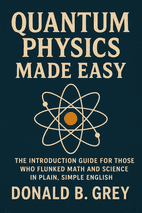
5 Main Takeaways from Quantum Physics Made Easy
At quantum scales, observation changes reality and certainty is impossible.
The book explains that measuring quantum systems, like in the double-slit experiment, inherently alters them, while the uncertainty principle shows that precise knowledge of both position and momentum is unattainable. This underscores a universe where probability, not deterministic laws, governs subatomic behavior.
Particles exist in multiple states at once and can be instantly entangled across space.
Quantum superposition allows particles to be in multiple states simultaneously, as shown in Schrödinger’s cat thought experiment, while entanglement enables instantaneous influence between particles regardless of distance, defying classical physics and enabling potential technologies like quantum teleportation.
Scientific breakthroughs emerge from challenging assumptions through debate and thought experiments.
The Bohr-Einstein debates exemplify how intellectual clashes drive progress, while thought experiments like Schrödinger’s cat highlight quantum paradoxes. This process refines theories and encourages critical thinking beyond intuitive limits.
Unifying quantum mechanics with gravity is the holy grail of modern physics.
The book explores how black holes expose the conflict between general relativity and quantum mechanics, and how string theory proposes extra dimensions to reconcile them. This quest for a 'theory of everything' pushes the boundaries of theoretical physics.
Quantum mechanics powers today's technology and promises revolutionary future applications.
From electronics to medical imaging, abstract quantum principles underpin modern innovations, while emerging fields like quantum computing and teleportation hint at transformative advances. Understanding these concepts enriches our appreciation of everyday life and cosmic mysteries.
Executive Analysis
These five takeaways form the book's central argument: quantum physics, though counterintuitive, is an accessible framework that reveals a probabilistic universe where observation shapes reality, particles behave in non-local ways, and scientific progress thrives on debate. By connecting foundational principles like superposition and entanglement to cutting-edge theories and practical applications, the book demystifies quantum mechanics as both a philosophical adventure and a driver of technological innovation.
This book matters because it translates complex quantum concepts into relatable insights, empowering readers to grasp how subatomic phenomena influence everything from black holes to smartphones. It sits uniquely in the popular science genre by balancing theoretical depth with actionable lessons, encouraging lifelong curiosity and a deeper understanding of the universe's fundamental workings.
Chapter-by-Chapter Key Takeaways
What Is Quantum Physics, and Why Should I Learn It? (Chapter 1)
Quantum physics, while technical, is accessible and enriches our understanding of both everyday life and the universe.
It studies matter at atomic and subatomic scales, contrasting with classical physics that deals with larger, observable objects.
The field is inherently theoretical, relying heavily on mathematics and probability rather than direct observation.
Einstein's theory of relativity, proven through phenomena like gravitational redshift, revolutionized our understanding of space, time, and light.
Try this: Embrace quantum physics as an accessible lens to enrich your understanding of both everyday life and cosmic mysteries.
Quantization and the Uncertainty Principle (Chapter 2)
Quantization of Energy: Energy is emitted in discrete chunks, not continuously, as demonstrated by Planck's solution to black-body radiation.
Planck's Constant: A fundamental value (h) that defines the minimum energy change, used in E = hf to calculate photon energy.
Uncertainty Principle: At quantum scales, measuring position and momentum simultaneously is impossible, with precision in one increasing uncertainty in the other.
Wave-Particle Behavior: Quantum entities exhibit both wave and particle properties, challenging classical concepts of location and movement.
Observer Effect: Measuring quantum systems inherently changes them, emphasizing the unique nature of quantum reality.
Try this: Accept that at the smallest scales, precise measurement is inherently limited and reality is governed by probability.
Waves and Particles and the Double Slit Experiment (Chapter 3)
Wave-particle duality is a core principle where entities like light and matter display both particle-like and wave-like properties.
The photoelectric effect showed that light's energy is quantized, with frequency determining electron ejection, not intensity.
The double-slit experiment visually demonstrates wave interference, and even single particles create these patterns, confirming duality.
Historical experiments by figures like Einstein, Young, and Millikan were crucial in overturning classical physics and embracing quantum concepts.
Try this: Visualize wave-particle duality through the double-slit experiment to grasp how light and matter defy classical categories.
Quantum Non-Locality and the Bohr-Einstein Debates (Chapter 4)
Scientific progress thrives on debate: The Bohr-Einstein clashes exemplify how intellectual disagreements drive experimentation and refinement of theories.
Quantum mechanics challenges classical intuition: Concepts like the Copenhagen interpretation and wave-particle duality reveal a universe where observation shapes reality.
Thought experiments are powerful tools: Einstein's scenarios, though ultimately refuted, pushed the boundaries of quantum understanding and highlighted its paradoxes.
Non-locality remains a profound mystery: Quantum entanglement's "spooky" implications continue to inspire research and debate in physics today.
Try this: Engage in rigorous debate and thought experiments to challenge and refine your understanding of complex scientific concepts.
Next chapter: “Quantum Entanglement and Teleportation” is locked
Keep learning from Quantum Physics Made Easy — and unlock all 600+ book summaries with audio, mindmaps and AI Q&A.
$0.00 due today · 7 days free, then $89.99/year ($7.49/mo) · Cancel anytime before day 7
plus sales tax where applicable