Abundance or Collapse: The Fork in the Road for AI, Robotics, and Civilization Key Takeaways

by Farzad Mesbahi
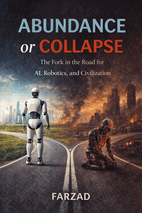
Abundance or Collapse: The Fork in the Road for AI, Robotics, and Civilization by Farzad Mesbahi Book Cover

5 Main Takeaways from Abundance or Collapse: The Fork in the Road for AI, Robotics, and Civilization

Exponential tech advances will disrupt society within years, not decades.

Wright's Law drives accelerating cost reductions in batteries, solar, and compute, creating an economic flywheel that will make jobs economically obsolete faster than most expect. This forces an urgent societal choice between managing the transition to abundance or facing collapse.

Personal preparation is critical for surviving the chaotic AI transition.

With economic displacement likely in 2-5 years, individuals must immediately audit their skills, build economic resilience, and pivot towards capital or uniquely human traits. Waiting for government solutions is risky due to institutional failure.

Sustainable AI advantage comes from proprietary data moats, not just algorithms.

Companies like Tesla win via vertical integration and real-world data from billions of miles, creating compounding advantages that competitors cannot replicate. This pattern will determine winners across industries from healthcare to retail.

Governments will likely fail to manage the AI transition, risking social unrest.

Misaligned incentives and knowledge gaps make governments prone to clumsy, reactionary policies. Societal stability depends on broad distribution of AI's benefits, requiring proactive advocacy for smart regulation while preparing for disruption.

Thrive in the AI era by augmenting with technology and investing strategically.

Embrace the chess model where AI amplifies human value; cultivate skills in creativity, trust, and coordination. Use a rigorous investment framework to identify where value will be created and destroyed in the coming transformation.

Executive Analysis

The book's central thesis is that exponential advancements in AI, robotics, and energy are converging to create a fork in the road for civilization: one path leads to unprecedented abundance, the other to societal collapse. The key takeaways interconnect to show that technological disruption is inevitable and accelerating, but the outcome depends on how individuals, companies, and governments manage the transition. The economic flywheel from Wright's Law, compounded by data moats and vertical integration, will reshape industries within years, demanding urgent personal and systemic adaptation.

This book matters because it provides a concrete, actionable framework for navigating the most significant economic shift since the Industrial Revolution. Unlike speculative AI discourse, it grounds predictions in economic laws like Wright's Law and offers specific strategies for career pivots, investments, and policy advocacy. It sits at the intersection of technology analysis, economic forecasting, and personal development, serving as an essential guide for anyone seeking to prosper in the coming age of AI.

Chapter-by-Chapter Key Takeaways

Chapter 1 (Chapter 1)

  • Wright's Law is the engine: Exponential cost reductions in batteries, solar, and compute are not linear but accelerate with scale, creating a powerful economic flywheel that most analysts underestimate.

  • Abundance is the goal, disruption is the path: The Convergence aims at a future of radically cheaper labor, energy, and intelligence, but the transition will be devastatingly disruptive for millions whose jobs become economically obsolete.

  • Asking the wrong questions: The critical debate is no longer about preventing technological displacement but about managing its aftermath—redesigning society, economics, and meaning in an age of potential abundance.

  • Prepare for a chaotic transition: The shift will happen in years, not generations, disproportionately impacting Western societies and demanding urgent, conscious preparation from individuals to avoid being blindsided.

Try this: Accept that exponential technological change is inevitable and start preparing now for both its opportunities and disruptions.

Chapter 2 (Chapter 2)

  • The central competitive battleground is scalability, not just localized technical competence. A solution that works perfectly in one city but cannot be deployed everywhere is at a strategic disadvantage.

  • Tesla's data advantage, fueled by billions of real-world miles from its existing fleet, creates a compounding moat that is exceptionally difficult for competitors to replicate, regardless of their financial resources.

  • Vertical integration—controlling the vehicle, AI, software, and hardware—provides a cohesive advantage that "horizontal" players partnering across companies struggle to match.

  • While timelines have historically been optimistic, the nature of software deployment means scaling can happen with unprecedented speed once key thresholds are crossed, as the required hardware is already in place globally.

  • FSD serves as a microcosm of the broader AI transition: it promises massive societal benefit (safer, cheaper transportation) but simultaneously guarantees significant workforce disruption, forcing a societal choice between abundance and collapse.

Try this: Evaluate companies and technologies based on their scalability and proprietary data moats, not just current performance.

Chapter 3 (Chapter 3)

  • The Optimus vision faces four major hurdles: Tesla's historical timeline optimism ("Elon Time"), a nonexistent regulatory landscape, profound mechanical/software integration challenges, and credible competition.

  • The expected rollout begins with internal Tesla factory deployment within a few years, expanding to industrial partners later this decade, and reaching mainstream home and municipal use by the 2030s.

  • Optimus is the key technology for contesting the global labor market, making the Age of Abundance technically possible.

  • The technology itself is neutral; it can lead to a future of widespread prosperity or severe societal disruption, depending on how the economic and social transition is managed.

  • This discussion naturally leads to the third leg of "The Convergence": the energy revolution needed to power this new AI-and-robotics-driven world.

Try this: Monitor the development of humanoid robots as a bellwether for the automation of physical labor and plan accordingly.

Chapter 4 (Chapter 4)

  • Energy is the fundamental, non-negotiable foundation for the AI and automation revolution, creating a critical bottleneck that could constrain growth.

  • Tesla exemplifies the strategic advantage of integrating AI, robotics, and energy into a single, self-reinforcing system.

  • A global race for energy infrastructure is underway, with China currently building capacity at a pace that may secure its lead in AI development.

  • The path to energy abundance is clear technologically and economically, but its realization hinges on political will and regulatory acceleration. The choices made in the next few years will determine which nations and companies shape the future.

Try this: Recognize energy infrastructure as the critical enabler for AI and robotics, and support policies that accelerate its deployment.

Chapter 5 (Chapter 5)

  • The critical timeline for AI-driven economic displacement is 2-5 years, not decades.

  • Effective governance and cultural willingness to adapt are decisive advantages in managing the transition, challenging assumptions of Western systemic inevitability.

  • Personal strategy must be immediate and decisive: the top tier must compound advantages, the middle tier must honestly assess vulnerability and reposition toward capital or indispensable skills.

  • Political action must shift from cultural wars to demanding concrete, competent policy for economic transition.

  • The potential for a future abundance exists, but the barbell effect guarantees a turbulent and unequal transition period where individual positioning is crucial.

Try this: Immediately audit your career for AI vulnerability and reposition towards capital or indispensable human skills.

Chapter 6 (Chapter 6)

  • The Innovator's Dilemma is a predictable pattern where successful companies fail because their structures, optimized for past success, prevent them from embracing disruptive new technologies.

  • Legacy automakers are a prime contemporary example, as their outsourced, combustion-engine-focused models leave them unable to compete with integrated software-platform companies like Tesla.

  • The speed of AI advancement makes this disruption faster and more decisive than any in history, as corporate planning cycles cannot keep pace with exponential technological improvement.

  • This pattern is not confined to automotive; it will ruthlessly play out in finance, healthcare, education, and law as AI and software become the primary drivers of value.

  • Survival depends on recognizing the pattern early and having the organizational willingness to truly cannibalize the legacy business before it's too late.

Try this: If in a legacy industry, urgently assess how AI could disrupt your business model and be willing to cannibalize it proactively.

Chapter 7 (Chapter 7)

  • The global competition for AI talent is intensifying, with China successfully incentivizing its experts to stay or return home, while U.S. immigration and political climates risk repelling them.

  • "Winning" the AI race is not about total dominance but about maintaining a leadership position in advanced capabilities and, crucially, ensuring AI develops within an open, competitive ecosystem rather than under authoritarian control.

  • America retains fundamental and durable advantages, but preserving its lead requires a conscious, serious effort to correct policy weaknesses and double down on its strengths as the competition accelerates.

Try this: Advocate for policies that attract and retain global AI talent to maintain competitive innovation ecosystems.

Chapter 8 (Chapter 8)

  • Governments are critically important for managing the AI transition but are structurally predisposed to fail in this task due to misaligned incentives, knowledge gaps, and entrenched power.

  • Individual survival and success depend on proactive self-reliance—building personal capabilities and economic positioning independent of government support.

  • Societal stability is at grave risk if AI benefits are not broadly distributed, as historical patterns show economic marginalization leads to political instability and collapse.

  • Effective policy should focus on smart regulation that fosters broad-based prosperity without stifling innovation, but current trends point toward clumsy, reactionary measures.

  • The prudent stance is to advocate for better governance while simultaneously taking full personal responsibility for navigating the coming changes.

Try this: Build personal economic resilience independent of government support, while advocating for policies that ensure broad AI benefits.

Chapter 9 (Chapter 9)

  • The fundamental disruption of AI is psychological and identity-based, challenging the meaning and self-conception of cognitive professionals.

  • AI agents represent a qualitative leap from tools to autonomous workers, capable of executing complex, multi-step workflows with minimal oversight, offering massive amplification to those who learn to orchestrate them.

  • The transition is already underway and accelerating, with a high risk of severe social unrest due to simultaneous economic displacement and loss of purpose.

  • The time to prepare is now, as the cost of being overly cautious is far lower than the cost of being caught unprepared.

  • A robust thesis must acknowledge strong counterarguments, including potential technical plateaus, regulatory delays, political backlash, and the historical resilience of human adaptability.

  • Ultimately, the economic and competitive pressures driving AI adoption are likely to overwhelm friction, making significant disruption the most probable outcome.

Try this: Start experimenting with AI agents today to understand their capabilities and how they can augment your work.

Chapter 10 (Chapter 10)

  • Invest in Understanding First: Dedicate significant time to deeply research an industry you care about before ever considering an investment. Investing without this knowledge is mere speculation.

  • Apply the Framework Rigorously: Any potential investment must pass the four-criteria test: being misunderstood, targeting a massive market, having exceptional leadership, and offering sufficient magnitude of return.

  • Conviction Enables Resilience: True understanding builds the conviction necessary to hold investments through volatility, which is essential for capturing the power of long-term compounding.

  • Take Personal Responsibility: The framework is a tool for thinking, not a source of advice. All conviction and analysis must be your own to avoid the pitfalls of blind followership.

  • Prepare for a Historic Shift: The coming technological transformation will create massive winners and losers. This framework is designed to help identify where value will be created and destroyed in the years ahead.

Try this: Before investing, deeply research an industry using the four-criteria framework to identify misunderstood opportunities with massive potential.

Chapter 11 (Chapter 11)

  • Ignore the Snapshots: Current AI capabilities and benchmark scores are nearly useless for predicting long-term winners, as they change rapidly.

  • Follow the Trajectory: Sustainable advantage comes from proprietary data moats—unique, owned data that compounds and cannot be replicated by competitors.

  • Apply the Filter: Evaluate companies through the lens of five questions about their data's uniqueness, compounding nature, replicability, organizational leverage, and durability.

  • Look Beyond AI Labs: The most valuable AI assets may reside in traditional companies (auto, retail, healthcare) that generate unique data, if they can learn to exploit it.

  • Real Data Endures: Despite advances in synthetic data, real-world, human-generated data will likely maintain its primacy for training superior AI systems for at least the next decade.

Try this: When evaluating AI companies, focus on their access to unique, compounding real-world data rather than current benchmark scores.

Chapter 12 (Chapter 12)

  • Certain human-centric skills—physical presence, novel judgment, frontier creativity, trust, relationships, and complex coordination—offer a longer runway for career defensibility against AI.

  • An honest assessment acknowledges the transition will be disruptive and not everyone will succeed; urgent, informed action is critical.

  • The optimistic model for the future is "augmentation," not replacement, as demonstrated by the chess world where AI mastery amplified human value, popularity, and economic success.

  • The goal is to build a future where AI handles repetitive cognitive tasks, freeing humans to focus on uniquely human strengths like creativity, connection, and meaning.

Try this: Cultivate skills in physical presence, novel judgment, creativity, trust, and coordination to remain valuable in an AI-augmented world.

Epilogue (Epilogue)

  • The next decade is likely to see massive consolidation in AI, with a few ecosystems dominating, driven by companies deeply integrated with real-world data and infrastructure.

  • Economic dislocation appears inevitable, creating a barbell distribution where the middle class is squeezed, necessitating social policies like UBI, albeit reactively.

  • Technological abundance, particularly in transportation, healthcare, and labor via robots, holds promise for dramatically lowering living costs for the most vulnerable.

  • Entire industries, from automotive to professional services, face existential disruption within specific, near-term windows, demanding proactive adaptation.

  • The transition period carries high risks of social unrest, with governments expected to struggle in response.

  • The provided prediction tracker is not a crystal ball but a tool for iterative learning, emphasizing the discipline of updating beliefs based on evidence and maintaining a balance between conviction and flexibility in planning for the future.

Try this: Use a prediction tracker to iteratively update your beliefs about AI's impact and adapt your plans based on evidence.

Continue Exploring