AI for Good Quotes
by Josh Tyrangiel
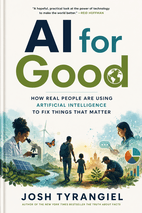
This collection brings together the most striking lines from Josh Tyrangiel's "AI for Good." You will find insights from educators, technologists, and health care leaders grappling with the real world impact of artificial intelligence. These quotes capture moments of clarity, frustration, and hope.
What makes this book so quotable is its refusal to shy away from the messy human side of technology. The lines are sharp, honest, and often surprising. They remind us that progress is not just about algorithms but about people choosing to care, to adapt, and to ask tough questions.
Top Quotes from AI for Good
“But the trajectory is clear: It will only get easier, faster, and a little less strange every day forward. The same cannot be said about people.”
The author reflects on the inevitable progress of AI and contrasts it with human nature.
It captures the paradox that while AI improves rapidly, humans remain resistant to change, highlighting the real challenge of adopting transformative technology.
“The choice isn’t between a world with Al and a world without it. That ship has sailed. The choice is between Al designed by people who think fixing things is worth the trouble, and Al designed by people who think breaking things is more efficient.”
The concluding lines of the introduction, summarizing the book's core argument.
This passage succinctly frames the central dilemma of the AI era, urging readers to actively shape the technology rather than passively accept its worst impulses.
“Sometimes magic is just someone spending more time on something than anyone else might reasonably expect.”
Teller, the silent half of Penn & Teller, speaking about his craft in an interview with Esquire.
This line frames the immense computational effort behind AI as a form of modern magic, making a complex technology feel understandable and awe-inspiring.
“ChatGPT doesn’t think, or have opinions, or a moral compass. On its own, it has no ability to assess whether what it's saying is correct or useful, which is why it can explain the laws of thermodynamics one moment, and confidently invent fake laws of thermodynamics the next.”
The author explaining the fundamental limitations of large language models.
It vividly captures the dangerous gap between apparent knowledge and actual understanding, reminding readers that AI fluency is not truth.
“Those kids are usually at the back of the line.”
Vicki Zubovic argues for piloting Khanmigo in Title I schools serving low-income students.
It succinctly highlights systemic inequity in education, making a powerful moral case for prioritizing underserved communities when introducing new technology.
“I'm competing with open tabs and TikTok,” she said. “I can get frustrated with students about it, or I can take a step back and ask, ‘Maybe it's me. Maybe I'm the problem.”
Melissa Higgason, a high school science teacher, reflecting on the difficulty of holding students' attention in the age of digital distractions.
It shows a teacher's self-awareness and willingness to question her own methods, a key theme of the chapter. The candid admission resonates with educators facing similar struggles.
“The fantasy of Al replacing teachers is just that—a fantasy. The real change, if it happens, will be piecemeal and quiet. And it will rely on teachers willing to adapt, trusted to experiment, and stubborn enough to realize that being more human might require talking to a thing with no heartbeat.”
The author's concluding reflection after observing teachers integrate Khanmigo into their classrooms.
This passage eloquently reframes the AI-in-education debate, emphasizing that true transformation comes from human adaptation, not replacement. The poetic final line encapsulates the chapter's title and central insight.
Themes Behind the Quotes
A central theme is the tension between technological potential and human reality. The quotes show that while AI can streamline systems and personalize learning, it cannot replace human judgment, empathy, or the messy unpredictability of people. Another recurring idea is that the real challenge is not building the technology but managing its adoption by resistant or overwhelmed humans.
Another theme is the importance of trust and intention. Many quotes emphasize that the purpose behind AI design matters as much as the technology itself. Whether in education or health care, the goal should be to empower, not replace. Finally, there is a persistent call for productive struggle and specificity, both in interacting with AI and in teaching others how to use it effectively.
Quotes by Chapter
Chapter 1: Ed’s Dead
“Rather than reducing the thicket of existing software, Ed would be a cheerful machete—hacking its way into grade and attendance information, updated school lunch menus, bus arrival times, and personalized learning assistance.”
The author describes the purpose of Ed, the LAUSD AI chatbot.
The vivid metaphor of a 'cheerful machete' captures the hubris and irony of adding more technology to solve technology problems.
“Ed? Ed's dead, buried in a graveyard full of failures.”
After detailing the collapse of Ed and other EdTech failures.
This blunt statement crystallizes the chapter's theme of failure and sets the tone for the rest of the book.
“This is my life’s work,” says Khan. “And that introduces a whole other consideration of the stakes.”
Khan reflects on the risk of partnering with OpenAI for an AI tutor.
It reveals the immense personal stakes and the weight of responsibility Khan feels.
“I told the team I think we're ina position to do it best,” says Khan, “because we actually do care, right? Versus people who just pretend to.”
Khan convinces his team to embrace AI despite risks.
It underscores the importance of integrity and ethical commitment in the face of technological change.
Chapter 2: How to Train Your Tutor (While Slowly Losing Your Mind)
“Literally, the product conversation was just, ‘Uh, let's start?”
DiCerbo, a Khan Academy executive, describing the shockingly informal beginning of their collaboration with OpenAI.
This quote highlights the chaotic, unstructured reality behind a high-stakes AI partnership, contrasting with typical corporate processes.
“When I was tutoring I didn’t say you're wrong or you're right. I said, ‘That's not exactly what I got. How did you get your answer? Can you explain it?”
Sal Khan recounting his own tutoring style, which he hoped to replicate in an AI tutor.
It encapsulates the humane, curiosity-driven approach to teaching that the team struggled to encode into a probabilistic model, showing the human ideal behind the technology.
Chapter 3: You’ll Be Disappointed for a Long Time Until You’re Not
“It’s this nuanced way they're able to extrapolate and then guide you through something.”
Shieh says this when explaining the subtle improvements in GPT-4 that made it more like a real tutor.
It eloquently describes the elusive quality of true intelligence in AI tutoring, making the reader understand the depth of the challenge.
Chapter 4: Get Buffington
“If you're not going to trust Sal Khan, who are you going to trust?”
Peggy Buffington convinces her teachers to join the Khanmigo pilot on short notice.
This line demonstrates how personal reputation and trust can override skepticism, underscoring the weight of Khan's credibility in educational circles.
“The real high achievers can fly ahead, you're not boring them anymore. And kids who are struggling—who are honestly too embarrassed to ask questions in front of the rest of the class—they get attention that works for them without that pressure.”
Buffington describes how Khanmigo enables differentiation in the classroom.
It eloquently captures the transformative potential of AI tutoring to address both ends of the learning spectrum, solving the long-standing challenge of teaching to the middle.
Chapter 5: Every Student’s a Critic
“My mom doesn’t understand that much English, and then also she'll say, “I can't help you because I don’t really know how to do this.” Because math was different in her day. So we can change the problems to Arabic and she asks Khanmigo to explain things in a different way to her and then she can help me.”
Noor, a fourth grader, describes how Khanmigo bridges language and generational gaps by allowing her mother to participate in her learning.
This quote beautifully illustrates how AI can serve as an equity tool, connecting families across language and educational barriers—the kind of human-centered benefit that transcends test scores.
“With EdTech, it's always: What promises are being made? You say this is going to cure everything? And it never does, because you're dealing with people—children—in a school where everyone has different backgrounds, especially in a community like ours. Every one of these kids is unique, so there's a part of me that's always going to be a bit skeptical.”
Principal Neysa Miranda voices her cautious skepticism about educational technology before introducing students to Khanmigo.
This grounded, realistic perspective from an experienced educator reminds readers that no technology can replace the nuanced understanding of human diversity—a necessary counterbalance to tech hype.
“If you're doing the distributive property, Ms. Colon can show you the arrows and help you solve it in space. But because Khanmigo is just typing, it just says, “distribute from this to this.” I'm a visual learner, so that’s not helpful.”
Stella, an eighth grader, criticizes Khanmigo for lacking the visual and spatial teaching that a human math teacher provides.
This student's sharp comparison exposes a key limitation of text-based AI tutors: they cannot replicate the embodied, multi-sensory instruction that many learners rely on.
“I tell them, I'm not your mom. I cannot read your mind. You have to be specific. You have to be detailed. Whether you want to get a response from me or you want something from Khanmigo, you have to think it through and ask for it with precision.”
Math teacher Leticia Colon explains to her students the critical skill of formulating precise questions, whether for a human or an AI.
This quote reframes AI as a tool that teaches metacognition and communication skills—the real value lies not in the bot's answers but in forcing students to articulate their own thinking.
Chapter 6: More Human Today
“We've got to find ways to have kids engage in productive struggle, to put the thoughts that they have in their head into the chatbot. All that matters is that we get them to practice more. We can't be picky.”
Vicki Zubovic, Khan Academy's head of education, advising the author about using Khanmigo.
This line captures the pragmatic, no-nonsense approach to using AI in education, acknowledging that imperfect engagement is better than none. It highlights the tension between idealistic pedagogy and real-world classroom challenges.
Chapter 1: Tommy
“We do not aspire to be a digital Al company, and Cleveland Clinic is not going to become the Microsoft of health care. People come to Cleveland Clinic because they need treatment for complex conditions that only we can provide. That is our reason to exist.”
Mihaljevic states Cleveland Clinic's core mission and its stance on AI.
It powerfully reaffirms the organization's patient-centered identity while rejecting shallow tech trends.
“To 30 percent of US health-care costs are administrative, which is a mind-boggling fact,” he says. “Twenty-five to 30 percent of our costs would be close to $5 billion. So if we can streamline, that money can then be put into access and improvements of care.”
Mihaljevic explains the administrative waste in healthcare and the potential for AI to redirect funds.
It provides a concrete, staggering statistic that makes the case for AI's practical value in healthcare.
Chapter 2: Digital Twins
“Safer, cheaper, more effective medicine based on you, not just a dataset of people like you.”
Chris Nguyen explaining the promise of digital twins.
This line perfectly captures the shift from population-based medicine to personalized care, emphasizing the individual patient's unique heart model.
“I want digital twins. So that's the next step. We've gotta start making the digital twin army, right!”
Chris Nguyen excitedly stating his goal after a successful automated cardiac MRI demonstration.
It conveys infectious ambition and the playful, determined spirit of innovation, with 'digital twin army' being a memorable phrase.
“Yeah, the tech is easy,” Kwon said. “People. It's the people, time and again, time and again. One day they might be reasonable, the next day they may be totally irrational.”
Debbie Kwon reflecting on the biggest challenge to implementing AI — people, not technology.
It underscores the often-underestimated human and organizational obstacles that can be more daunting than technical hurdles.
“How open would I be to a colleague telling me there's a better way to do my job?”
The narrator reflects on their own resistance to change after witnessing a demonstration by Kwon.
This line captures the universal discomfort of being shown a better method, making readers question their own openness to critique and improvement.
Chapter 3: Twenty-Dollar Burgers in a Haunted House
“The health-care industry is headed off a cliff. It's unsustainable.”
Rohit Chandra, Cleveland Clinic's chief digital officer, says this over dinner at the hotel restaurant.
This starkly captures the existential crisis of the healthcare industry in a memorable, blunt phrase that resonates with anyone aware of its financial unsustainability.
“Trying to find a way to make health care cheaper, better, safer, more sustainable—anything and everything that technology can do to fix that or help with that is imperative.”
Chandra describing his mission to find clinicians who share his urgency.
It encapsulates the ambitious goal of using technology to transform healthcare, appealing to both idealism and pragmatism while emphasizing the imperative for action.
“I have to have somebody who can look me in the eye and say, ‘Yes, I will kill myself to drive this.”
Chandra explaining what he looks for in clinical partners.
This highlights the intense commitment needed to drive change in a resistant system, using a visceral and dramatic call to action that underscores the stakes.