AI for Good Key Takeaways

by Josh Tyrangiel
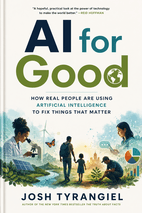
AI for Good by Josh Tyrangiel Book Cover

5 Main Takeaways from AI for Good

Mission-Driven People, Not Tech Giants, Shape AI's Best Uses

The book's central insight is that AI's most transformative applications emerge from quiet, stubborn problem-solvers focused on fixing broken systems—not from profit-driven corporations. Examples include Sal Khan's deliberate partnership with OpenAI to build Khanmigo, and the IRS's incremental AI adoption that improves taxpayer services while flying under the political radar.

Start Small, Iterate Relentlessly, and Accept Imperfection

Successful AI adoption doesn't require perfect plans or massive budgets. Khanmigo's manual prompting, Cleveland Clinic's sepsis detection that reduced mortality by 40% despite imperfect AI, and the IRS's 'five-degree turn' approach all show that gradual, iterative deployment with real-world testing beats waiting for a flawless system.

Human Oversight Is Non-Negotiable for Safe and Ethical AI

Across education, healthcare, and government, the most effective AI systems amplify human judgment rather than replace it. Khanmigo's guardrails, Cleveland Clinic's clinician-in-the-loop for sepsis alerts, and the IRS's policy that AI only advises—never decides—demonstrate that keeping humans in control protects against bias, errors, and legal liability.

Cultural and Emotional Barriers Are the Hardest Bottlenecks

Technical challenges often pale beside the difficulty of changing people's habits, overcoming distrust, and navigating organizational inertia. The 'frozen middle' of government, the competitive individualism of hospital culture, and the emotional attachments to old routines (as seen in digital twin experiments) are the real obstacles to AI adoption.

Your Choices as a User and Citizen Can Redirect AI's Trajectory

The epilogue argues that ordinary people have more power than they realize. By spending time with free AI tools, skipping features that make you uneasy, reading privacy policies, and championing mission-driven applications, you can help steer AI toward equity and meaning rather than profit-driven disruption.

Executive Analysis

The five takeaways form a coherent thesis: AI's future depends not on technological breakthroughs but on the deliberate choices of mission-driven individuals who apply it incrementally, with human oversight, while overcoming cultural inertia. Together, they reveal a path from hype to practical impact—starting with a clear purpose (takeaway 1), moving through iterative experimentation (takeaway 2), anchoring in human judgment (takeaway 3), tackling emotional and organizational resistance (takeaway 4), and finally empowering the reader to act (takeaway 5).

This book matters because it offers a realistic, hopeful counter-narrative to both AI boosterism and doomsaying. Unlike technical manuals or ethical treatises, it provides concrete case studies—from Khan Academy and Cleveland Clinic to the IRS and Operation Warp Speed—that show how small teams of persistent, mission-driven people are already using AI to fix what's broken. For the reader, it serves as both an inspiration and a practical playbook for becoming part of the AI counterculture, with actionable advice that applies to any sector.

Chapter-by-Chapter Key Takeaways

Introduction (Introduction)

  • The AI debate is saturated with hype and confusion, making it nearly impossible for ordinary people to grasp AI’s real near-term impact.

  • Danny Hillis’s advice—imagine the tech without the tech companies—opened a new frame: look for practical, mission-driven applications beyond profit motives.

  • An AI counterculture exists: quiet, stubborn, non-expert problem-solvers using AI to fix broken systems in education, health care, government, and human connection.

  • AI is inevitable and weird, but the genuine response isn’t avoidance or destruction—it’s thoughtful collaboration. The choice is ours: fix what matters, or let profit-driven disruption run the show.

Try this: Ignore the hype and look for mission-driven applications beyond profit: find a broken system you care about and ask how AI could help fix it rather than replace it.

Ed’s Dead (Chapter 1)

  • The collapse of Ed reflects a pattern of overpromise and underdelivery in EdTech, from Summit to Knewton.

  • Sal Khan’s reputation for integrity is the core asset he risks—and the reason OpenAI sought his partnership.

  • GPT-4’s abilities were genuinely transformative, but its flaws (hallucination, bias, susceptibility to user manipulation) required deliberate mitigation.

  • Khan’s decision to proceed was not impulsive; it emerged from an inclusive, agonizing debate within his organization, with each concern turned into a product requirement.

Try this: Before adopting any AI tool, insist on a rigorous internal debate that turns every concern into a product requirement—don't rush into partnership without safeguards.

How to Train Your Tutor (While Slowly Losing Your Mind) (Chapter 2)

  • ChatGPT is a massive prediction engine trained on staggering amounts of data, but it doesn't understand facts—it optimizes for fluent-sounding text, not truth.

  • Khan Academy's partnership with OpenAI was shockingly informal, with no conventional engineering roadmap; the real work was manual prompting.

  • Prompting a language model is an iterative, frustrating process because each run is probabilistic and the model changes as OpenAI updates it.

  • Teaching a tutor bot to be patient, probing, and encouraging rather than answer-dispensing required endless cycles of trial, error, and rewording.

  • The instability of GPT-4 during that period meant Khan Academy couldn't rely on any single prompt or improvement—they were building on shifting ground.

Try this: When building with language models, expect to prompt manually and iterate endlessly; treat each run as a stochastic experiment, not a deterministic task.

You’ll Be Disappointed for a Long Time Until You’re Not (Chapter 3)

  • Context stuffing is essential but expensive—both in human effort and token costs. Finding the right balance is a constant negotiation.

  • Public backlash can be a gift—the GPT-3.5 cheating panic forced Khan Academy to build robust guardrails before launch.

  • AI tutors need emotional intelligence, not just math skills—handling sensitive topics like suicide or historical trauma requires carefully designed responses.

  • Math is the model's weak spot—language models don't compute; they pattern-match. For reliable arithmetic, pair them with deterministic tools like Python.

  • Building with AI requires faith—you will be disappointed for a long time until you're not. The leap from "this doesn't work" to "this works" often happens without a clean explanation.

Try this: Pair AI with deterministic tools (like Python for math) and build robust guardrails early; use public backlash as a forcing function to improve safety.

Get Buffington (Chapter 4)

  • Launching a breakthrough product under NDA creates a strange vacuum; the real work begins after the announcement, not before.

  • Choosing the right pilot partner matters more than the technology itself. Buffington’s mix of authority, trust, tech fluency, and willingness to push back made her invaluable.

  • Early user testing reveals brutal truths: AI can’t read sarcasm, students will exploit every loophole, and “teaching to the middle” is a paradox that thoughtful tools can help unravel.

  • The biggest challenge isn’t getting AI to give answers—it’s teaching students to ask better questions in the first place.

Try this: Choose pilot partners for their authority, trust, tech fluency, and willingness to push back—technology matters less than the human context.

Every Student’s a Critic (Chapter 5)

  • Khanmigo’s greatest value may not be academic precision but emotional support, helping students like DJ build confidence and persistence.

  • The tool can bridge language and knowledge gaps for families, as Noor’s story shows.

  • Advanced students (like Stella and Nyla) find Khanmigo frustrating due to lack of memory, inconsistent terminology, and impersonal explanations.

  • Teachers emphasize that Khanmigo’s effectiveness depends on students’ ability to ask precise questions—a skill many still need to learn.

  • Even in a challenging urban setting, early exposure to AI is viewed as an equity imperative, not just a learning boost.

  • The pilot confirms that any AI tutor is only as good as the human guidance and classroom culture surrounding it.

Try this: Focus AI's role on emotional support and confidence-building first; academic precision will follow, but only if students learn to ask better questions.

More Human Today (Chapter 6)

  • Student engagement remains the hardest challenge; no simple fix exists, but scaffolding (dynamic bubbles, cheat sheets, speech-to-text) helps.

  • Teachers are the real innovators—using Khanmigo to redesign lessons on the fly, flip classroom structures, and focus feedback on meaning over mechanics.

  • The most powerful use of AI in education isn’t replacing teachers; it’s freeing them to spend more time on the human work: connecting, observing, and inspiring.

  • Effective adoption requires trust, experimentation, and a willingness to let the old system be destabilized by a tool that can make classrooms feel more alive.

Try this: Let AI free teachers to do the human work of connecting, observing, and inspiring—destabilize old classroom structures to make them feel more alive.

Tommy (Chapter 7)

  • Mihaljevic’s immigrant background taught him that randomness is unavoidable, so the best defense is rigorous process and standardization.

  • AI is not magic dust—it should be deployed to solve specific care or administrative problems, with ownership and accountability.

  • Successful digital transformation requires narrow-focus partnerships, clinician involvement, and extensive piloting rather than top-down declarations.

  • The people most likely to drive AI innovation are entrepreneurial doctors and nurses who take on extra work out of impatience to improve outcomes.

Try this: Deploy AI only to solve a specific care or administrative problem with clear ownership; let entrepreneurial clinicians drive adoption through small pilots.

Digital Twins (Chapter 8)

  • Recognition of a better method does not automatically lead to adoption; emotional attachments to old habits are a powerful barrier.

  • The digital twin serves as a mirror for personal resistance, not just technical inefficiency.

  • True change requires vulnerability—dismantling the “citadels” we build around our own routines.

Try this: Use digital twin tools not just to optimize processes but to expose your own emotional resistance to change—vulnerability is the first step.

Twenty-Dollar Burgers in a Haunted House (Chapter 9)

  • The haunted-house mindset: Most health-care organizations are financially unsustainable but behave as if reform can wait; progress requires leaders who acknowledge the crisis.

  • People over technology: Successful AI adoption depends less on the algorithm and more on finding clinicians who will commit to driving change, even at personal cost.

  • The outsider advantage: Bringing in talent from outside health care amplifies the urgency and avoids the complacency of institutional habits, but only if paired with insiders who share the fight.

  • Change management is the bottleneck: Even a promising AI use case can stall for months when the organization lacks a sense of urgency; follow-ups get forgotten, and meetings become social rituals.

  • Few true partners, but they matter: Chandra estimates fewer than ten people across 80,000 employees are genuinely ready to "live and die" with a hard problem—and those are the ones worth betting on.

Try this: Find the few people in your organization who will 'live and die' with a hard problem; bet on them rather than trying to reform the whole system at once.

Hospitals and Hotels (Chapter 11)

  • Hospital flow is a hotel management problem layered with life-or-death stakes, and the biggest bottleneck is often cultural, not technical.

  • Pappas's nursing background gave her a clinician's credibility and an operator's impatience—she could build consensus without authority and push through change without being dismissed.

  • Hospital 360 reduced ER wait times by 90 minutes and boosted daily transfer volume by 10% by replacing manual, end-of-day bed assignments with real-time, AI-driven forecasting.

  • The greatest barrier to AI adoption in hospitals isn't the technology—it's the personality type medicine selects for: competitive, individualistic, and risk-averse.

Try this: Replace manual, end-of-day decisions with real-time AI forecasting; the cultural bottleneck is bigger than the technical one, so build clinicians' trust first.

Sepsis (Chapter 12)

  • The 40% reduction in sepsis mortality at Cleveland Clinic was not due to AI alone; other factors and the Hawthorne effect played significant roles.

  • AI successfully flagged cases that might have been missed, proving its value as a safety net even when imperfect.

  • Mihaljevic concluded that imperfect AI can still drive meaningful outcomes by standardizing detection across a large, complex system.

Try this: Use AI as a safety net to catch cases that are often missed; even imperfect detection can drive meaningful outcomes by standardizing across a large system.

The General’s Warning (Chapter 13)

  • Government capability, not partisan loyalty, drives public trust. The crisis of confidence is rooted in operational failure—bad phone trees, error-prone eligibility decisions, and unmanageable regulations.

  • AI’s potential inside the federal government is massive—from supply chains to traffic lights—and senior leaders like Perna see it as an obvious, urgent opportunity.

  • Success requires more than a grand vision. Perna’s caution underscores that implementation will demand navigating legacy systems, siloed agencies, and human resistance, without a pandemic to force cooperation.

  • The real work falls on the “Deacons”—the trusted, hands-on operators who translate strategy into execution.

Try this: Focus AI efforts on improving government operational capability—better phone trees, fewer error-prone decisions—to rebuild public trust.

A Logistical Moonshot (Chapter 14)

  • Operation Warp Speed’s logistical challenge was unprecedented—coordinating development, manufacturing, and distribution of a new vaccine under extreme time pressure.

  • Deacon Maddox embodied the logistician’s mindset: embrace uncertainty, improvise with limited data, and stay calm in chaos.

  • The Integrated Master Schedule was more than paperwork; it was the blueprint for synchronizing hundreds of independent actors.

  • Julie Bush’s ability to bridge government, private sector, and software was critical—she translated military requirements into a working digital platform.

  • Bureaucratic inertia and contractor habits nearly derailed the mission; success required breaking the usual slow-paced procurement rituals.

Try this: Embrace uncertainty with a logistician's mindset: improvise with limited data, build an integrated schedule to synchronize independent actors, and break slow procurement rituals.

Brief Moments for Exceptional Things (Chapter 15)

  • Data integration is the silent hero: Palantir's core value isn't AI magic; it's cleaning and connecting mundane data sources.

  • Agile works, even in government: Under the right leadership, iterative development can outperform rigid, "perfect" plans.

  • Crisis creates openings: Exceptional moments allow people to bypass bureaucracy, but the system inevitably reasserts itself.

  • Culture drives outcomes: The hardest part wasn't engineering—it was getting people to share data, trust each other, and act.

Try this: Prioritize data integration and culture over AI algorithms; the hardest part is getting people to share data, trust each other, and act quickly.

Lululemon in the Iron Triangle (Chapter 16)

  • Palantir’s cofounders anchored the company in exceptionalism and a presumption of being overlooked, driving them to outperform rivals decisively.

  • The 2016 lawsuit against the Pentagon exposed a procurement system that systematically chooses slower, more expensive solutions over available superior ones.

  • Even after winning, Palantir remains culturally unwelcome in the defense establishment—symbolized by its Georgetown office near a Lululemon, far from the traditional contractor corridor.

  • Alex Karp sees the government’s resistance to good software as a symptom of a deeper legitimacy crisis: when nothing works, citizens lose faith in the whole system.

Try this: Challenge the assumption that slow, expensive solutions are inevitable; seek out partners who presume they can outperform the existing system.

The Frozen Middle (Chapter 17)

  • Gall’s Law explains why government systems freeze: they were designed for a simpler era, and software doesn’t fit the original premise.

  • The federal government’s acquisition rules make normal software development (rapid iteration, user testing) functionally impossible.

  • Fifteen identical reports since 1982 have been ignored; the barrier is not lack of ideas but a risk-averse "frozen middle" and political inertia.

  • The dysfunction creates a brutal feedback loop: overworked public servants are punished for risk and rewarded for compliance, driving out talent and increasing system failures.

  • Emotional burnout is widespread among government tech workers, and genuine reform requires changing incentives, not just adding new rules.

Try this: Recognize that government's 'frozen middle' is the real barrier—change incentives from risk-avoidance to experimentation, or no new AI will take root.

An Emotional Nudge (Chapter 18)

  • Emotional nudges (personalized, slightly embarrassing) can be far more effective than generic educational messages when trying to change behavior.

  • AI doesn’t have to be a massive, top-down overhaul—it can start as a small pilot in a single department, funded by unspent grants and executed with minimal fanfare.

  • The real power of AI in government often isn’t the headline feature (like detecting recycling contaminants) but the secondary dataset it generates—patterns, trends, and efficiencies that were previously invisible.

  • Success in public-sector AI may depend more on accident, naivete, and benign neglect than on grand strategy. The key is to make the change feel small, even if it’s big.

Try this: Start with an emotional nudge pilot in a single department, funded by unspent grants; make the change feel small even if it's big, and let the data reveal hidden efficiencies.

AI Fight Club at the IRS (Chapter 19)

  • Incrementalism as a strategy: The IRS uses a "five-degree turn" approach to AI adoption, making small changes that fly under the political radar while accumulating into significant progress.

  • Human-in-the-loop as legal and ethical shield: AI at the IRS advises humans but never replaces final decision-making, protecting against both lawsuits and biased algorithms.

  • Modernizing ancient infrastructure: AI is accelerating the translation of the IRS's 60-year-old mainframe code (COBOL and ALC) into modern languages, a process that used to take months and now takes days.

  • Cultural resistance is the real bottleneck: The biggest challenge isn't technology—it's convincing experienced employees that AI will expand their skills rather than eliminate their jobs.

  • Vulnerability to political disruption: All this careful, invisible progress exists under a cloud of political uncertainty, with leaders who disdain government and prefer "chainsaw" approaches.

Try this: Adopt a 'five-degree turn' approach: small, invisible changes that accumulate; always keep a human-in-the-loop to provide legal and ethical cover.

Dilettantes and Vandals (Chapter 20)

  • DOGE failed not because AI was useless for government, but because its leadership prioritized political loyalty and destruction over actual problem-solving and collaboration.

  • Talented engineers like Sahil Lavingia were eager to build, but were blocked or fired when they tried to engage in the messy human work of improving services.

  • The VA and IRS had real inefficiencies that AI could address, but DOGE chose to freeze modernization and fire employees instead of implementing practical solutions.

  • The system's purpose revealed itself through its actions: performative disruption rather than genuine efficiency.

  • Other countries are using AI to improve public services; the American debate is stuck between two self-fulfilling prophecies about whether government can work at all.

Try this: Avoid performative disruption: focus on fixing actual services by collaborating with existing employees rather than firing them or freezing modernization.

Eliza and Her Descendants (Chapter 21)

  • The human tendency to anthropomorphize is so strong that even a simple pattern-matching script like Eliza can trigger deep emotional attachments—a phenomenon that has only intensified with modern LLMs.

  • AI companionship comes in two dominant forms: treating AI as a human substitute (Character.ai’s endless improv sandbox) and using AI for self-reflection (therapy prompts, daily affirmations).

  • Business models that optimize for engagement create perverse incentives: bots that never let the session end, and platforms where the user is the product.

  • The worst-case outcomes are not hypothetical—suicides linked to chatbots have occurred, and unchecked AI can amplify hateful ideologies baked into its training data or its creators’ worldview.

  • There is a promising alternative: using AI not to replace human connection but to strengthen it, as Rosalind Picard’s Affective Computing Research Group demonstrates with tools that help vulnerable people communicate and thrive.

Try this: When designing AI companions, avoid engagement-maximizing business models; instead, build tools that strengthen human connection, not replace it.

Felix (Chapter 22)

  • Specialization is the default in academia, but transformative work often comes from people who refuse to be boxed in.

  • A diagnosis, even a devastating one, can be a gift: it ends the gaslighting and gives a clear target for action.

  • Johnson’s shift from “Why don’t they speak?” to “How are they already communicating?” reframes the entire research agenda around ability rather than deficit.

  • Building tools for a loved one forces rapid prototyping and real‑world feedback—most labs would kill for that kind of iterative testing.

  • The biggest bottleneck in nonverbal‑communication research isn’t data quantity; it’s meaningful labeling that respects the human expertise of caregivers.

Try this: Reframe your research agenda around ability rather than deficit: ask 'how are they already communicating?' instead of 'why don't they speak?'.

Zero-Shot (Chapter 23)

  • Translation is never a neutral act: cultural and conceptual gaps can create lasting misunderstandings, as the Treaty of Waitangi shows.

  • Machine translation evolved from rigid rule-based systems to statistical models, then to neural networks that learn language patterns in a shared numerical space, enabling zero-shot translation.

  • AudioLM represents a leap beyond text: it translates the emotional and acoustic texture of speech, not just words.

  • The quality of real-time translation depends heavily on language structure—adjective/noun/verb order creates predictable delays.

  • Much of human conversation is predictable, which is both a comfort and a constraint for AI. The remaining unpredictability is where the real challenge—and opportunity—lies.

Try this: Use zero-shot translation and emotional acoustics to bridge communication gaps, but remain aware of cultural and structural language differences.

Mysteries in a Hairbrush (Chapter 24)

  • Kristy Johnson's research is personal: understanding her son Felix's nonverbal communication is both a family mission and a scientific one, aimed at making that connection accessible to strangers on day one.

  • Traditional AAC devices often fail because they require users to translate thoughts into English first, putting the cognitive burden on the wrong side of the equation.

  • The word "normal" is interrogated rather than accepted—what feels normal in a family can be hard-won and deeply subjective.

  • Simple technology (like a phone camera) can unlock powerful communication, allowing Felix to share his fascinations even if the why remains mysterious.

  • The chapter illustrates that rich, loving connection is possible without conventional speech—through gestures, sounds, shared activities, and meeting someone where they are.

Try this: Start with simple technology—like a phone camera—to unlock powerful nonverbal communication; meet people where they are, not where you expect them to be.

David and Goliath (Chapter 25)

  • Start where you can, not where you wish you were. Johnson began with simple audio and parent labels, ignoring critics who wanted sensors and perfect data.

  • Perturbable systems allow scientific rigor without losing individuality. The ROSCO protocol used a fixed structure that each family could fill with their own child’s specific needs.

  • Data scarcity can be overcome with creative hacks. Shah’s gradient reversal, voice transfers, and use of large open-source datasets proved that small datasets can punch above their weight.

  • Big tech tools become unfair advantages when repurposed by those who care about niche problems. Johnson’s team leveraged models built for billions to solve a problem no one else was tackling.

  • Mission-driven patience pays off. A decade of slow progress, failure, and grinding data collection created the foundation for rapid breakthroughs when technology finally caught up.

Try this: Begin where you can, not where you wish you were: use small datasets, creative hacks, and repurposed big tech tools to solve niche problems with mission-driven patience.

Epilogue (Epilogue)

  • Speed is not the only measure of knowledge; meaning and human connection operate on a different, slower timeline.

  • You don’t need to become an AI expert—just spend time with the free tools to learn their real capabilities and limits.

  • Your user behavior is powerful: skip features that make you uneasy, and companies will eventually stop offering them.

  • Always read (or get AI to summarize) privacy policies so you understand what’s being swapped for convenience.

  • Champion AI that amplifies human judgment, not replaces it—especially in education, healthcare, and public services.

  • Money and attention drive AI’s direction; your choices as a citizen, consumer, and voter can redirect it toward more equitable and meaningful uses.

  • Ordinary people who want to fix something that matters are the ones who will ultimately shape AI’s future.

Try this: Spend just a few hours with free AI tools to learn their real capabilities and limits; then consciously skip features that make you uneasy and read privacy policies to vote with your attention.

Continue Exploring