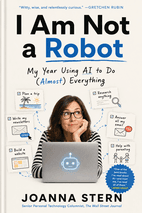
Joanna Stern's I Am Not a Robot chronicles a year-long experiment ceding health, parenting, work, and creativity to artificial intelligence—from AI-written texts to robotaxis and chatbot therapists—for curious skeptics wanting an honest, firsthand look at AI's real capabilities and limits.
Feature
Insta.Page
Blinkist
Shortform
Summary Depth
Full Chapter-by-Chapter
15-min overview
Detailed analysis
Audio Narration
✓ (AI narration)
✓
✓
Visual Mindmaps
✓
✕
✕
AI Q&A
✓ Voice AI
✕
✕
Quizzes
✓
✕
✕
PDF Downloads
✓
✕
✓
Price
$59.99/yr
$146/yr (PRO)
$199/yr
*Competitor data last verified February 2026.
About the Author
Joanna Stern
Joanna Stern is a senior personal technology columnist for The Wall Street Journal, where she covers consumer electronics and tech trends. She is best known for her in-depth reviews and creative video segments, including the popular "Joanna Stern's Review" series. Prior to the Journal, she wrote for The Verge and ABC News, and she frequently appears on television to discuss technology.
1 Page Summary
Joanna Stern takes readers through a year-long, deeply personal experiment to answer a single question: what happens when you let artificial intelligence take over nearly every aspect of your daily life? From health and parenting to work and creativity, Stern tests the limits of AI with a mix of earnest curiosity and self-deprecating humor. She builds a chatbot to manage her schedule at the World Economic Forum, lets AI write her texts and emails, tries robotaxis with her family, and even experiments with an AI therapist and a robot masseuse. The book is rooted in a working definition of AI as “the creation of intelligent machines that can think, see, learn, and act like humans—and maybe even exceed human abilities,” offering readers a practical lens for understanding a technology that has become as vague as the word “organic.”
What makes the book distinctive is its relentless, firsthand immersion. Stern doesn’t just report on AI; she lives with it, strapping on brainwave headbands, letting AI plan her meals, and documenting every frustration and small joy along the way. She visits the birthplace of the term "artificial intelligence" at Dartmouth, tours a roaring data center in Virginia, and interviews figures like Sam Altman and Bill Gates about their visions for the future. The narrative is structured around seasons, with each phase exploring a different domain of life—health, transportation, domestic labor, education, and relationships. Stern’s willingness to show both the absurd (an AI that cannot correctly count hamsters) and the genuinely useful (an AI that helps interpret a mammogram) gives the book a rare honesty.
This book is for anyone who has ever wondered whether AI is a tool, a threat, or just an overhyped gimmick. Stern’s intended audience includes the curious skeptic—the person who has used ChatGPT but feels uneasy about its growing presence in medicine, finance, and parenting. Readers will come away with a clearer understanding of AI’s real capabilities and limits, from the "health slop" of generic advice to the surprising intimacy of an AI companion. By the end, Stern doesn’t offer a tidy verdict on whether AI is salvation or poison, but she does equip readers with the questions and frameworks they need to navigate a future where intelligent machines are an inescapable part of everyday life.
I stumbled onto something unexpected in the archives: John McCarthy’s original 1955 grant proposal, the one that first used the term “artificial intelligence.” The request for $13,500 (about $160,000 today) to fund a summer conference felt almost quaint next to today’s AI budgets. But the definition he offered back then still rings true: “every aspect of learning or any other feature of intelligence can in principle be so precisely described that a machine can be made to simulate it.” Later, in 2007, McCarthy distilled it further as “the science and engineering of making intelligent machines.”
That phrase—“intelligent machines”—became my anchor. Because “AI” had turned into one of those words that’s been stretched so thin it means everything and nothing. Like “organic” on a snack package. So I built my own definition, pieced together from research papers, interviews, and a full year of living with these systems. Here it is, if you’re the highlighter type:
Artificial intelligence is the creation of intelligent machines that can think, see, learn, and act like humans—and maybe even exceed human abilities.
That’s really all you need to keep in mind as you read this book. Everything else is just trying to mimic how we do things, sometimes brilliantly, sometimes hilariously.
To help you navigate the confusion, I put together a quick history and a handy cheat sheet. Because understanding where this all came from is the best way to see where it’s headed.
A Very Abbreviated History of AI
The timeline starts in 1950 with Alan Turing’s “imitation game”—the Turing test—and runs through 2022 when ChatGPT went viral. Along the way you’ll meet ELIZA the therapist chatbot (1966), Deep Blue beating Kasparov at chess (1997), Roomba shuffling across living rooms (2002), Watson winning Jeopardy! (2011), Alexa settling into kitchens (2014), AlphaGo’s genius-level Go moves (2016), and the Transformer paper that changed everything (2017). The pace accelerates dramatically in just the last few years—a clear signal of how fast this future is coming.
The AI Zoo
I like to think of AI as a zoo full of different species. Each system under the “AI” label is as different as a recommendation engine, a self-driving car, and a chatbot. They all live under the same big tent, but they’re not even close to the same thing. That matters because right now every company throws around “AI” like it’s one magical brain that can do everything. It’s not. Understanding the differences is the key to knowing what these systems can actually do for you—and what they definitely can’t.
The Totally Non-Boring AI Glossary™
The rest of the chapter introduces the classic nested circles of AI: Artificial Intelligence > Machine Learning > Neural Networks > Deep Learning. The core idea is that machine learning flips old-school programming on its head. Instead of “if this, then that” rules, computers learn from mountains of data, finding patterns on their own. Deep learning takes that to the next level, handling messy real-world data like videos of cars driving or laundry folding. You’ll also learn about AI models (the finished product you interact with), training (the trial-and-error process of teaching the model), and frontier models (the cutting-edge versions that companies race to build).
Key Takeaways
AI isn’t one single technology; it’s a zoo of different systems with different strengths and limitations.
The definition that matters: “intelligent machines that can think, see, learn, and act like humans—and maybe even exceed us.”
Machine learning and deep learning are the engines behind modern AI, not simple if-then rules.
The history shows how fast progress has accelerated, especially in the last few years.
Understanding the glossary terms (model, training, deep learning) helps you see through the hype and know what you’re actually dealing with.
Key concepts: Note to Readers
1. Note to Readers
Defining AI
McCarthy's 1955 proposal first used 'artificial intelligence'
AI is the science of making intelligent machines
Author's definition: machines that think, see, learn, act like humans
Understanding this definition is key to reading the book
Abbreviated History of AI
Timeline from Turing test (1950) to ChatGPT (2022)
Key milestones: ELIZA, Deep Blue, Roomba, Watson, Alexa, AlphaGo
Transformer paper (2017) changed everything
Progress has accelerated dramatically in recent years
The AI Zoo Concept
AI is a zoo of different species, not one technology
Systems differ: recommendation engines, self-driving cars, chatbots
Companies misuse 'AI' as a single magical brain
Understanding differences reveals what AI can and can't do
Core AI Glossary
Nested circles: AI > Machine Learning > Neural Networks > Deep Learning
Machine learning learns from data, not if-then rules
Deep learning handles messy real-world data
Key terms: model, training, frontier models
Key Takeaways
AI is a zoo of systems with different strengths
Definition: intelligent machines that may exceed humans
Machine and deep learning are modern AI engines
History shows rapid acceleration in progress
If you like this summary, you probably also like these summaries...
💡 Try clicking the AI chat button to ask questions about this book!
Chapter 2: How AI Was Used to Make This Book
Overview
The technical backbone that made this book possible isn't a mystery. It isn't a full explanation of code—it’s a friendly explanation of the fundamental ingredients that power modern AI, from the gargantuan amounts of energy and specialized chips required, to the ways machines learn to see, read, and even crack jokes. Think of it as a crash course in the ABCs of artificial intelligence, setting the scene for the field trips and interviews ahead.
The Raw Power Behind the Magic
AI doesn't run on wishful thinking. It demands staggering amounts of “compute”— racks of GPUs humming nonstop, guzzling electricity and needing constant cooling. That’s the factory floor of the AI age, and we’ll get a firsthand look soon at a data center. Without that hardware, nothing else works.
What AI Feeds On: Training Data
You'll see this term a lot: training data. It’s the fuel. Imagine giving a teenager millions of jokes to become a comedian, or showing a dental student thousands of X-rays to spot cavities. That’s training data—textbooks, homework, and practice tests rolled into one. Want an AI to drive? Feed it endless hours of road footage. The quality and quantity of this data shapes everything the AI will ever know.
The Brain: Neural Networks
Your brain uses billions of neurons to tell a squirrel from a rabbit. Neural networks are the digital copycats—layers of mathematical “neurons” that pass signals back and forth, hunting for patterns in all that training data. Pile on more layers, and the network gets “deeper,” capable of solving messier problems. It’s the architecture that makes learning possible.
Eyes for Machines: Computer Vision
Computer vision gives machines the ability to see and interpret images. With deep learning, they can identify a cavity in an X-ray, read a stop sign, or figure out which lump on the floor is a sock and which is a beloved stuffed animal. It’s how AI learns to “see” the world the way we do.
Different Ways to Learn
Not all learning is the same. The chapter introduces two key methods:
Supervised Learning – Like using flashcards: you show the AI a photo of a Golden Retriever and tell it, “This is a Golden Retriever.” The AI studies the labeled examples until it can recognize new dogs on its own. Fast and precise, but it requires humans to do the labeling.
Unsupervised Learning – No answer key provided. You dump a pile of unlabeled data in front of the AI and let it sort things out. It starts grouping similar items together on its own—like a kid organizing toys by color without ever being told the names of colors. It might discover categories like “indoors” vs. “outdoors” or that certain words tend to hang out together.
These methods shaped how the AI that helped write this book was trained, and they’ll pop up again as we explore real-world applications.
Key Takeaways
AI runs on massive computational power (GPUs, energy, cooling).
Training data is the essential fuel—garbage in, garbage out.
Neural networks are the layered architecture that enables pattern recognition.
Computer vision lets machines interpret images and video.
Supervised learning uses labeled data for quick, task-specific training.
Unsupervised learning lets AI discover patterns without human guidance.
Key concepts: How AI Was Used to Make This Book
2. How AI Was Used to Make This Book
Raw Power Behind AI
Requires massive compute with GPUs
Consumes huge amounts of electricity
Needs constant cooling in data centers
Hardware is essential foundation
Training Data as Fuel
Data is the fuel for AI learning
Quality and quantity shape AI knowledge
Examples: jokes, X-rays, road footage
Garbage in, garbage out principle
Neural Networks Architecture
Digital copycats of brain neurons
Layers of mathematical neurons find patterns
Deeper networks solve messier problems
Architecture enables learning
Computer Vision Capabilities
Gives machines ability to see images
Identifies objects like cavities or signs
Uses deep learning for interpretation
Learns to see world like humans
Learning Methods
Supervised: labeled data like flashcards
Unsupervised: no answer key, self-discovery
Supervised is fast but needs human labeling
Unsupervised finds patterns without guidance
⚡ You're 2 chapters in and clearly committed to learning
Why stop now? Finish this book today and explore our entire library. Try it free for 7 days.
Chapter 3: Are You My AI?
Overview
Standing in Dartmouth Hall staring at a bronze plaque bolted above three garbage cans is an odd way to begin a journey into artificial intelligence, but that’s exactly where this chapter starts—at the birthplace of the term itself, coined by John McCarthy in 1956. Digging through his old files reveals the spark: a conjecture that every aspect of learning could be described precisely enough to simulate with a machine. From that seed, the definition of AI has become as overused as “organic” in the snack aisle, so the chapter builds its own: intelligent machines that can think, see, learn, and act like humans—and maybe even exceed them.
A quick march through history shows how fast things have exploded, from Alan Turing’s imitation game in 1950 to ChatGPT signing up 100 million users in two months flat. Along the way, ELIZA made people bond with a therapist chatbot, Deep Blue beat a chess champion, and Watson guessed “Toronto” when asked for a US city. The AI zoo is vast: a recommendation engine, a self-driving car, and a customer service chatbot all call themselves AI but do wildly different things. Understanding those differences isn’t nerdy taxonomy—it’s knowing what these systems can actually do.
The glossary unpacks the key terms without putting you to sleep. Under the big umbrella of artificial intelligence sits machine learning, which powers neural networks and deep learning. You’ll meet generative AI built on transformers (the architecture that reads entire sentences at once) and large language models that don’t “know” facts but predict the next logical word. There’s multimodal systems handling text and images together, prompts as your instructions, hallucinations when the AI confidently makes stuff up, and slop for low-quality AI churn. The spectrum matters too: we live in an era of narrow AI—hyper-specialists like chess bots or poetry bots that can’t swap jobs. The holy grail is general AI, a machine with human-level smarts across every domain, and beyond that looms superintelligence, smarter than humans in everything. The finish line for AGI keeps moving, and nobody agrees what it actually looks like.
Then AI starts acting on our behalf. Agents don’t just answer questions—they book flights and call rides. Robots move in the physical world, some autonomous, some puppets. And cyborgs? You might already be one with a pacemaker or smartwatch. The philosophical quandary hits next: can a machine actually feel—pain, joy, the satisfaction of a perfect parallel park? Or is it just a really convincing simulation? That question sits alongside the danger of anthropomorphizing—projecting human traits onto systems that are only regurgitating patterns. The chapter fesses up to dropping quotation marks around “learn” and “understand” because it got exhausting, so the robots get their verbs.
Finally, the existential debate: the technological singularity—the moment AI improves itself faster than we can control it—divides people into doomers who see existential risk (Elon Musk put his personal p(doom) at 20% in early 2025) and accelerationists who want to speed things up. It gets heavy fast, but by the end you have the language, the history, and the stakes. You’re ready to step out of Dartmouth and into a world where AI stops being theory and starts doing everything.
Key Takeaways
AI exists on a spectrum: narrow specialists (ANI), human-level generalists (AGI), and superhuman intelligences (ASI).
Agents, autonomous robots, and brain-enhanced cyborgs are the practical fronts where AI takes action.
Sentience and anthropomorphism are critical philosophical fault lines—machines don’t truly feel, but we often treat them as if they do.
The singularity, doomer pessimism, and p(doom) scores frame the existential debate around AI’s long-term risks.
Understanding these terms is essential before exploring AI’s real-world impact.
Key concepts: Are You My AI?
3. Are You My AI?
Defining AI: History and Scope
Term coined by John McCarthy in 1956
AI defined as machines that think, see, learn, act
Rapid evolution from Turing test to ChatGPT
AI includes diverse systems like chess bots and chatbots
Key AI Concepts and Terminology
Machine learning powers neural networks and deep learning
Generative AI uses transformers and large language models
Hallucinations and slop are common AI flaws
Prompts instruct AI; multimodal handles text and images
The AI Spectrum: Narrow to Superintelligence
Narrow AI specializes in single tasks like chess
General AI aims for human-level smarts across domains
Superintelligence would surpass humans in everything
AGI's finish line keeps shifting and is debated
AI in Action: Agents, Robots, and Cyborgs
Agents book flights and perform tasks autonomously
Robots move physically, some autonomous, some controlled
Cyborgs include humans with pacemakers or smartwatches
These systems blur the line between AI and human
Philosophical and Existential Debates
Machines simulate feelings but don't truly experience them
Anthropomorphizing AI risks misunderstanding its limits
Technological singularity could outpace human control
Doomers see risk; accelerationists push for speed
Chapter 4: Winter: Healthy New Year
Overview
January arrives with the familiar ritual of health resolutions—doctor visits, exercise, clean eating—all promptly abandoned for BBQ chips and the pretense that scrolling workout videos counts as cardio. But this year, the author decides to redirect that ambition into a more grounded experiment: investigating how AI might genuinely improve personal health and, more importantly, how it's already reshaping the performance of doctors. The tech industry has long promised a flawless, omniscient digital physician that never tires and knows every detail of your medical history. Bill Gates boldly predicts free, world-class medical advice for everyone within a decade. Yet beneath this utopian vision lurk uncomfortable questions: who truly reaps the rewards—patients or the corporations building these systems? And what becomes of the doctor-patient relationship when the "doctor" is essentially a dataset?
The Personal Promise and the Public Hype
The author's own experience mirrors a common tension: grand intentions collide with messy reality. Rather than another abandoned resolution, this winter project becomes a way to test the AI health hype against everyday life. The promise is seductive—a personal physician with perfect recall, up-to-date on all medical literature, available 24/7. Science fiction has dreamed of this for decades, and now executives insist it's imminent. But the chapter doesn't accept this narrative at face value. Instead, it sharpens the lens on a crucial distinction: the difference between technology serving patients and technology serving the systems that profit from healthcare.
The Fragility of Human Medicine
A deeper anxiety emerges: if we place too much trust in machine doctors, will human doctors lose the very qualities that make them healers? The author flags this risk early—not as a Luddite rejection of progress, but as a genuine concern about de-skilling. When clinical judgment gets outsourced to algorithms, what happens to intuition, empathy, the art of listening? The chapter positions these not as nostalgic ideals but as essential ingredients of care that AI cannot replicate, no matter how many terabytes of data it digests. This sets up the winter exploration as a high-stakes inquiry, with the author stepping out into the sharp January air ready to see what's actually happening on the ground.
Key Takeaways
AI's healthcare promises are alluring but require scrutiny—especially regarding who benefits most from the technology.
The gap between ambitious resolutions and daily habits mirrors the gap between AI hype and practical impact.
A central tension exists between AI's efficiency and the irreplaceable human elements of doctoring, such as empathy and clinical intuition.
The chapter begins with a personal, grounded lens that will guide the investigation through real-world encounters rather than abstract promises.
Key concepts: Winter: Healthy New Year
4. Winter: Healthy New Year
AI Health Hype vs. Reality
Resolutions often fail; this is a grounded experiment
Tech promises flawless digital doctors
Bill Gates predicts free world-class medical advice
Distinguishing tech serving patients vs. profit systems
Fragility of Human Medicine
Risk of de-skilling human doctors
Outsourcing judgment threatens intuition and empathy
AI cannot replicate the art of listening
Central Tension: Efficiency vs. Humanity
AI efficiency clashes with irreplaceable human elements
Empathy and clinical intuition are essential care ingredients
High-stakes inquiry into real-world impact
Grounded Investigation Approach
Personal lens guides real-world encounters
Avoids abstract promises for practical impact
Sharp January air sets the scene for exploration
Frequently Asked Questions about I Am Not a Robot
What is I Am Not a Robot about?
This book chronicles a year-long experiment where the author, a Wall Street Journal reporter, embedded artificial intelligence into every facet of her life—from health diagnostics and self-driving cars to home robots, AI-generated creative work, and even intimate relationships. Through vivid field trips, journal entries, and personal tests, she explores whether today’s intelligent machines truly deliver on their promises or simply create new complications. The narrative balances hands-on firsthand experience with rigorous reporting, revealing the raw infrastructure behind AI, its environmental costs, and the messy gaps between the hype and reality. Ultimately, it’s an honest, funny, and unsettling look at what it means to live alongside machines that can think, see, and learn but can’t always get it right.
Who is the author of I Am Not a Robot?
Joanna Stern is a senior personal technology columnist for The Wall Street Journal, where she has covered consumer tech for over a decade. Known for her sharp, often humorous reporting style, she previously worked at ABC News and has built a reputation for testing technology against real-life situations. This book grew out of her year-long, immersive experiment in which she systematically handed over control of her body, home, and work to AI systems.
Is I Am Not a Robot worth reading?
Absolutely. It’s one of the most grounded and entertaining accounts of AI’s real-world impact that does not settle for either utopian hype or dystopian panic. Stern’s willingness to actually live with the technology—from robotaxis and AI therapists to a robot chef and an AI-powered toothbrush—gives readers an honest, firsthand look at what works, what fails, and what it feels like to trust machines with deeply human tasks. If you want a smart, funny, and unfiltered guide to the age of intelligent machines, this is the book to read.
What are the key lessons from I Am Not a Robot?
One major lesson is that AI excels at narrow, structured tasks like reading X‑rays or summarizing documents, but it flounders on common sense, physical dexterity, and understanding human nuance—often leading to embarrassing or even dangerous errors. Another is that the technology carries hidden costs: the environmental toll of data centers, the risk of cognitive offloading (where our own critical thinking weakens), and the subtle ways AI can erode trust in personal relationships and professional expertise. The book also shows that the most valuable use of AI is as a collaborative tool—a tireless assistant that amplifies human effort—rather than as a replacement for human judgment and connection. Ultimately, the author concludes that the future with AI is unpredictable, inevitable, and terrifying, but also full of possibilities that require constant vigilance and adaptation.
📚 Explore Our Book Summary Library
Discover more insightful book summaries from our collection