I Am Not a Robot Mindmap: Visual Summary of All Chapters | Insta.Page

I Am Not a Robot — Interactive Mindmaps

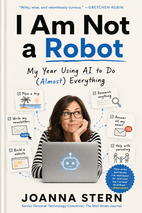
I Am Not a Robot by Joanna Stern Book Cover

by Joanna Stern

Joanna Stern's I Am Not a Robot chronicles a year-long experiment ceding health, parenting, work, and creativity to artificial intelligence—from AI-written texts to robotaxis and chatbot therapists—for curious skeptics wanting an honest, firsthand look at AI's real capabilities and limits.

On Insta.page you also get an Apply This Book tool that lets you combine insights from up to 3 books to solve your specific situation.

Chapter mindmaps

Free preview: chapters 1–4 are fully interactive. Click any node to expand or collapse. Subscribe to unlock the rest.

Chapter 1: Note to Readers

Key concepts: Note to Readers

1. Note to Readers

Defining AI

  • McCarthy's 1955 proposal first used 'artificial intelligence'
  • AI is the science of making intelligent machines
  • Author's definition: machines that think, see, learn, act like humans
  • Understanding this definition is key to reading the book

Abbreviated History of AI

  • Timeline from Turing test (1950) to ChatGPT (2022)
  • Key milestones: ELIZA, Deep Blue, Roomba, Watson, Alexa, AlphaGo
  • Transformer paper (2017) changed everything
  • Progress has accelerated dramatically in recent years

The AI Zoo Concept

  • AI is a zoo of different species, not one technology
  • Systems differ: recommendation engines, self-driving cars, chatbots
  • Companies misuse 'AI' as a single magical brain
  • Understanding differences reveals what AI can and can't do

Core AI Glossary

  • Nested circles: AI > Machine Learning > Neural Networks > Deep Learning
  • Machine learning learns from data, not if-then rules
  • Deep learning handles messy real-world data
  • Key terms: model, training, frontier models

Key Takeaways

  • AI is a zoo of systems with different strengths
  • Definition: intelligent machines that may exceed humans
  • Machine and deep learning are modern AI engines
  • History shows rapid acceleration in progress

Chapter 2: How AI Was Used to Make This Book

Key concepts: How AI Was Used to Make This Book

2. How AI Was Used to Make This Book

Raw Power Behind AI

  • Requires massive compute with GPUs
  • Consumes huge amounts of electricity
  • Needs constant cooling in data centers
  • Hardware is essential foundation

Training Data as Fuel

  • Data is the fuel for AI learning
  • Quality and quantity shape AI knowledge
  • Examples: jokes, X-rays, road footage
  • Garbage in, garbage out principle

Neural Networks Architecture

  • Digital copycats of brain neurons
  • Layers of mathematical neurons find patterns
  • Deeper networks solve messier problems
  • Architecture enables learning

Computer Vision Capabilities

  • Gives machines ability to see images
  • Identifies objects like cavities or signs
  • Uses deep learning for interpretation
  • Learns to see world like humans

Learning Methods

  • Supervised: labeled data like flashcards
  • Unsupervised: no answer key, self-discovery
  • Supervised is fast but needs human labeling
  • Unsupervised finds patterns without guidance

Chapter 3: Are You My AI?

Key concepts: Are You My AI?

3. Are You My AI?

Defining AI: History and Scope

  • Term coined by John McCarthy in 1956
  • AI defined as machines that think, see, learn, act
  • Rapid evolution from Turing test to ChatGPT
  • AI includes diverse systems like chess bots and chatbots

Key AI Concepts and Terminology

  • Machine learning powers neural networks and deep learning
  • Generative AI uses transformers and large language models
  • Hallucinations and slop are common AI flaws
  • Prompts instruct AI; multimodal handles text and images

The AI Spectrum: Narrow to Superintelligence

  • Narrow AI specializes in single tasks like chess
  • General AI aims for human-level smarts across domains
  • Superintelligence would surpass humans in everything
  • AGI's finish line keeps shifting and is debated

AI in Action: Agents, Robots, and Cyborgs

  • Agents book flights and perform tasks autonomously
  • Robots move physically, some autonomous, some controlled
  • Cyborgs include humans with pacemakers or smartwatches
  • These systems blur the line between AI and human

Philosophical and Existential Debates

  • Machines simulate feelings but don't truly experience them
  • Anthropomorphizing AI risks misunderstanding its limits
  • Technological singularity could outpace human control
  • Doomers see risk; accelerationists push for speed

Chapter 4: Winter: Healthy New Year

Key concepts: Winter: Healthy New Year

4. Winter: Healthy New Year

AI Health Hype vs. Reality

  • Resolutions often fail; this is a grounded experiment
  • Tech promises flawless digital doctors
  • Bill Gates predicts free world-class medical advice
  • Who truly benefits—patients or corporations?

Personal Promise vs. Public Hype

  • Testing AI health hype against everyday life
  • Seductive promise: perfect recall, 24/7 availability
  • Distinguishing tech serving patients vs. profit systems

Fragility of Human Medicine

  • Risk of de-skilling human doctors
  • Outsourcing judgment threatens intuition and empathy
  • AI cannot replicate the art of listening

Central Tension: Efficiency vs. Humanity

  • AI efficiency clashes with irreplaceable human elements
  • Empathy and clinical intuition are essential care ingredients
  • High-stakes inquiry into real-world impact

Grounded Investigation Approach

  • Personal lens guides real-world encounters
  • Avoids abstract promises for practical impact
  • Sharp January air sets the scene for exploration
You've reached the end of the free mindmaps

Next chapter: “Journal Entry: Traffic Jam in My Bloodstream” is locked

See every chapter of I Am Not a Robot as an interactive mindmap — and unlock all 450+ book summaries with audio and AI Q&A.

$0.00 due today · 7 days free, then $59.99/year ($4.99/mo) · Cancel anytime before day 7

Continue exploring I Am Not a Robot