I Am Not a Robot Quotes
by Joanna Stern
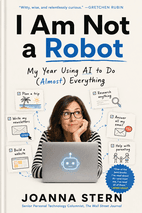
These quotes come from Joanna Stern's exploration of AI and its impact on everyday life. The book is packed with witty one liners and sharp observations that make complex topics feel human and relatable. Readers will find everything from playful jabs at tech jargon to serious reflections on trust and medicine.
What makes the book so quotable is Stern's ability to blend humor with genuine insight. She takes on big questions about machine intelligence and human fallibility without losing a conversational tone. The result is a collection of lines that stick with you, whether they make you laugh or pause to think.
Top Quotes from I Am Not a Robot
“But “Al” is just an umbrella term. Underneath it are dozens of different tools, systems, and species. And understanding those differences isn’t just nerdy taxonomy. It’s the key to knowing what these systems can actually do for you—and what they definitely can’t.”
The author explains why distinguishing between types of AI is crucial for practical understanding.
It demystifies the overused label 'AI' and empowers readers to critically evaluate the technology they encounter, shifting from passive consumption to informed engagement.
“If you took a shot of tequila every time you read the term “training data” in this book, you'd need a self- driving car to get you home.”
The author humorously warns readers about the frequency of the term 'training data' in the book.
It’s a playful and relatable joke that makes a technical concept memorable, while also hinting at the book's tone.
“And sometimes they're just totally wrong but delivered with the confidence of a car salesperson.”
The author describes the unreliable output of generative AI.
This humorous and relatable simile perfectly encapsulates the experience of using AI that sounds confident but is often wrong. It makes a technical flaw memorable and human.
“Can machines actually feel and experience things, or are they just really good at pretending?”
This is from the section defining 'sentience' in the chapter.
It distills the central philosophical question about AI consciousness into a simple, haunting dichotomy that challenges both researchers and readers.
“If I had a dollar for every time an Al executive told me that improved health care is one of Al's greatest promises, I'd have enough cash to cover all my copays—and yours.”
The author reflects on the frequency of AI industry claims about healthcare.
This line uses humor and hyperbole to capture the skepticism many feel about overhyped AI promises, making it both relatable and memorable.
“The machine misses cancers; the humans miss them, too; and ... well, we die.”
The author reflects on the danger of over-reliance on AI in diagnostics.
This stark, rhythmic sentence encapsulates the ultimate stakes—human life—when both humans and machines fail. Its brevity and chilling finality make it a powerful warning.
“Silicon Valley has pinpointed humanity's greatest weakness. Not war, not greed, but our total paralysis in front of a fridge full of leftovers.”
The narrator reflects on the marketing claims of AI companies like Google, ChatGPT, and Meta that promise to solve the everyday problem of deciding what to cook.
This line brilliantly satirizes Silicon Valley's tendency to frame trivial inconveniences as grand human failings, making readers laugh while recognizing the absurdity of their own fridge paralysis.
Themes Behind the Quotes
One central theme is the gap between the grand promises of AI and its actual, often mundane limitations. Stern highlights that AI is not a single magic tool but a collection of different systems, each with specific strengths and weaknesses. She encourages readers to look past the buzzwords and understand what these tools can and cannot do, often with a healthy dose of skepticism.
Another key theme is the complicated relationship between AI and human trust, especially in healthcare. The quotes explore how machine intelligence can both assist and unsettle, from radiology to dentistry. Stern suggests that AI acts as an amplifier, bringing more information to light, but also exposing cracks in existing systems. The ultimate question is not whether machines can replace humans, but how we maintain our humanity as we integrate them.
Quotes by Chapter
Note to Readers
“ARTIFICIAL INTELLIGENCE IS THE CREATION OF INTELLIGENT MACHINES THAT CAN THINK, SEE, LEARN, AND ACT LIKE HUMANS—AND MAYBE EVEN EXCEED HUMAN ABILITIES.”
The author provides her own distilled definition of AI after research and experience.
This bold, all-caps declaration cuts through the hype and gives readers a clear, memorable anchor for understanding AI's potential and ambition.
“While the term “Al” is everywhere, at its core, it describes intelligent machines trying—sometimes amazingly, sometimes laughably—to mimic how we do things.”
The author summarizes the essence of artificial intelligence in plain language.
The humorous contrast between 'amazingly' and 'laughably' makes the concept relatable and humanizes the technology, reminding us that AI is both impressive and imperfect.
“Machine learning flipped the script. Instead of memorizing rules, the computer “learns” from mountains of data. It isn’t just following instructions; it's finding patterns, often in ways we can't predict.”
The author explains the paradigm shift from traditional programming to modern AI.
This vividly illustrates the leap from rigid logic to adaptive learning, capturing both the wonder and the unease of machines that discover patterns beyond human foresight.
How AI Was Used to Make This Book
“We'll see what that looks like up close soon, on our field trip to the data center, the factory floor of the Al age.”
The author introduces an upcoming visit to a data center.
This line reframes data centers as the industrial heart of AI, drawing a powerful parallel to factory floors of the Industrial Revolution.
“Neural networks are the underlying architecture that makes learning possible.”
The author defines neural networks in the context of AI.
It succinctly captures the fundamental role of neural networks, making a complex idea accessible and essential to understanding AI.
Are You My AI?
“The study is to proceed on the basis of the conjecture ‘that every aspect of learning or any other feature of intelligence can in principle be so precisely described that a machine can be made to simulate it.”
John McCarthy's original definition of AI from his 1955 grant proposal for the Dartmouth Summer Research Project.
This line captures the foundational ambition of AI research—the belief that every aspect of human intelligence can be precisely simulated by machines. It echoes through decades of AI development.
“I became mildly obsessed with what the “father of Al” set out to do and how he defined a term now stamped on everything from baby monitors to highway billboards to every CTO's pitch deck.”
The author describes her fascination with John McCarthy, the 'father of AI.'
It highlights how the term 'AI' has become ubiquitous and diluted, making the search for its true meaning compelling. The vivid imagery of baby monitors and billboards resonates with anyone overwhelmed by AI marketing.
Winter: Healthy New Year
“What happens to the doctor-patient relationship when the “doctor” is basically a dataset?”
The author poses a rhetorical question about the impact of AI on medicine.
It forces readers to confront a profound ethical dilemma, challenging the assumption that data-driven care preserves human connection.
“And what if we place so much trust in machine doctors that our human doctors lose what made them doctors in the first place?”
The author continues questioning the consequences of over-reliance on AI.
This line warns of a future where medical expertise is stripped of its human essence, resonating with anyone who values empathy in healthcare.
Journal Entry: Traffic Jam in My Bloodstream
“Hi, Joanna! What's up? Your cholesterol. You're eating bad stuff. Stop doing that. See you in a year, if your diet doesn’t kill you first.”
The narrator sarcastically translates the doctor's rushed voicemail about her lab results.
It captures the impersonal, dismissive tone of modern healthcare communication, making readers feel the frustration of receiving serious medical news in a flippant manner.
“Welcome to the American health care system, where your blood test results arrive via an online portal you can never remember the password to and are summarized in a thirty-second voicemail that's rushed and vaguely insulting.”
The narrator reflects on the process of receiving her lab results.
This line perfectly encapsulates the absurdity and inefficiency of the system, resonating with anyone who has dealt with frustrating, impersonal medical bureaucracy.
“The Al doctor is in, and it sounds suspiciously like a mediocre NPR segment.”
The narrator describes her experience using Google's NotebookLM to generate a podcast about her health data.
It highlights the surreal contrast between AI's engaging but hollow presentation and the human care it replaces, provoking thought about the limits of technology.
“It's like a traffic jam in your bloodstream.”
The AI female host explains the effect of high cholesterol using a metaphor.
This vivid, relatable image makes a complex medical concept instantly understandable, showing how a simple analogy can be more memorable than clinical jargon.
Machine Eyes and My Complicated Breasts
“It's a real cotton ball in an igloo situation.”
The author describes the challenge of dense breast tissue appearing white on a mammogram, the same color as tumors.
This vivid, humorous analogy makes a complex medical concept instantly relatable and memorable, capturing the frustration of trying to spot cancer in dense tissue.
“People should stop training radiologists now.© It's just completely obvious within five years deep learning is going to do better than radiologists.”
Geoffrey Hinton, often called one of the godfathers of AI, made this bold prediction in 2016.
This quote captures the overconfidence that often accompanies early AI predictions, and its later retraction highlights the complexity of integrating AI into medicine. It is memorable as a stark, almost arrogant claim that quickly needed revision.
“The machine should do what it's best at doing, which is consistently outperforming humans on things like a life-and-death reading.”
McClennan, a radiologist or AI expert, describes the ideal collaboration between physician and machine.
This line elegantly frames the human-machine relationship as a dance, emphasizing complementary strengths rather than replacement. It resonates because it offers a balanced, hopeful vision for the future.
Journal Entry: The Assistant That Can’t Get My Coffee
“But assembling an entourage—chief of staff, head of comms, assistant carrying a collection of branded tote bags—wasn't exactly in the budget.”
The narrator explaining why they cannot afford a human support team at Davos.
The humorous list of staff underscores the absurdity of the event's expectations, and the long dash structure makes it memorable.
“The tool delivered much of the value of a human assistant, minus the ability to get me coffee.”
The narrator summarizing the utility of their AI assistant, DavosBot.
This line wryly acknowledges both the impressive capability of AI and its fundamental limitation—lack of physical presence—making it a perfect metaphor for the current state of AI.
“And stoking people's envy? That's the whole point of Davos.”
The final sentence of the journal entry.
It delivers a cynical, punchy conclusion that reveals the underlying social currency of the conference—envy—and ties back to the theme of AI assistants as status symbols.
The Dental Distrust
“Dentistry is part science, part art, and part business.”
The author summarizes the nature of dentistry after investigating AI's role in dental upselling.
This line encapsulates the inherent tension in dental care—a mix of objective medical practice, subjective judgment, and profit motive—that sets the stage for the chapter's central conflict.
“I already didn't trust some dentists. Add Al with colorful annotations and official labels, and that distrust doubled.”
The author reflects on her own experience after a dentist tried to upsell her using AI imagery.
This moment of self-awareness captures how technology can amplify suspicion rather than build trust, a feeling many readers can relate to.
“The trust is shakier from the start. Technology that reassures in oncology can feel manipulative in dentistry—not because the Al is fundamentally different, but because the foundation is.”
The author contrasts AI's reception in cancer care versus dental care.
It offers a sharp, memorable insight into why the same AI tool can be perceived so differently depending on the field's preexisting trust levels.
“Maybe the real story isn’t that Al will transform health care into something unrecognizable, but that it will act like an amplifier, exposing more information for medical practitioners and patients to evaluate and decide what is optimal or critical to address at the moment.”
The author offers her concluding reflection on AI's role in medicine.
This nuanced view reframes the AI debate—not as a revolutionary change but as a magnifier of existing human systems and flaws, prompting deeper questions about fixing those systems first.