I Am Not a Robot Key Takeaways

by Joanna Stern
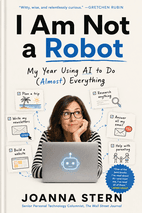
I Am Not a Robot by Joanna Stern Book Cover

5 Main Takeaways from I Am Not a Robot

AI is a spectrum, not a single technology

From narrow AI (ANI) to human-level general intelligence (AGI) and superhuman ASI, AI systems vary wildly in capability and intent. Understanding this spectrum—and terms like machine learning, neural networks, and training data—helps you cut through hype and assess what any tool can actually do.

Use AI as a collaborator, not a replacement

Whether for cooking, therapy, writing, or healthcare, AI works best when augmenting human judgment—not replacing it. The book shows repeatedly that AI lacks context, empathy, and real-world adaptability, so treat it as a first draft or sounding board, then apply your own expertise.

Question the incentives behind AI recommendations

Dental AI can upsell unnecessary treatments. Healthcare AI may benefit providers more than patients. Always ask who profits from an AI’s advice—especially in fields with financial conflicts—and remember that AI amplifies existing biases and systemic flaws.

Outsourcing creativity can weaken your own

Relying on AI for writing stories, planning meals, or designing rooms leads to generic outputs and a measurable decline in your own imaginative muscle. Keep the creative rituals that require your full engagement—AI can assist, but don’t let it steer.

Always double-check AI outputs, especially when stakes are high

Hallucinations, wrong diagnoses, and confident falsehoods are real risks—from a misdiagnosed garage door to a mistaken pet pregnancy. Verify critical information with primary sources or a human expert, and keep your trust provisional, even with polished interfaces.

Executive Analysis

These five takeaways collectively argue that AI is a powerful but flawed tool that demands critical human oversight. The book’s central thesis is that AI’s value lies in collaboration, not replacement—its strengths in speed and pattern recognition are undercut by its lack of context, empathy, and accountability. By exposing the hype cycles, hidden incentives, and hidden costs (creativity erosion, environmental impact, privacy risks), the author builds a case for cautious adoption: use AI to augment what you do, but never surrender judgment or core human skills.

This book matters because it grounds the AI conversation in real-world experiments—from cooking to healthcare to driving—that any reader can relate to. Unlike theoretical treatises, Joanna Stern’s firsthand tests make the risks and rewards tangible. It sits at the intersection of journalism, consumer tech, and ethics, offering a practical roadmap for navigating AI without losing your humanity. The actionable insights throughout give readers immediate steps to apply today, making it a standout guide for non-experts overwhelmed by the pace of change.

Chapter-by-Chapter Key Takeaways

Note to Readers (Chapter 1)

  • AI isn’t one single technology; it’s a zoo of different systems with different strengths and limitations.

  • The definition that matters: “intelligent machines that can think, see, learn, and act like humans—and maybe even exceed us.”

  • Machine learning and deep learning are the engines behind modern AI, not simple if-then rules.

  • The history shows how fast progress has accelerated, especially in the last few years.

  • Understanding the glossary terms (model, training, deep learning) helps you see through the hype and know what you’re actually dealing with.

Try this: Define AI not as a single technology but as a collection of systems with different strengths, and learn the key glossary terms (model, training, deep learning) to evaluate claims critically.

How AI Was Used to Make This Book (Chapter 2)

  • AI runs on massive computational power (GPUs, energy, cooling).

  • Training data is the essential fuel—garbage in, garbage out.

  • Neural networks are the layered architecture that enables pattern recognition.

  • Computer vision lets machines interpret images and video.

  • Supervised learning uses labeled data for quick, task-specific training.

  • Unsupervised learning lets AI discover patterns without human guidance.

Try this: When using AI, remember it runs on massive compute and training data; always question the quality of the input data to avoid garbage-in-garbage-out results.

Are You My AI? (Chapter 3)

  • AI exists on a spectrum: narrow specialists (ANI), human-level generalists (AGI), and superhuman intelligences (ASI).

  • Agents, autonomous robots, and brain-enhanced cyborgs are the practical fronts where AI takes action.

  • Sentience and anthropomorphism are critical philosophical fault lines—machines don’t truly feel, but we often treat them as if they do.

  • The singularity, doomer pessimism, and p(doom) scores frame the existential debate around AI’s long-term risks.

  • Understanding these terms is essential before exploring AI’s real-world impact.

Try this: Classify any AI tool on the narrow-to-superhuman spectrum and resist anthropomorphizing it—machines don't truly feel, even when they seem to.

Healthy New Year (Chapter 4)

  • AI's healthcare promises are alluring but require scrutiny—especially regarding who benefits most from the technology.

  • The gap between ambitious resolutions and daily habits mirrors the gap between AI hype and practical impact.

  • A central tension exists between AI's efficiency and the irreplaceable human elements of doctoring, such as empathy and clinical intuition.

  • The chapter begins with a personal, grounded lens that will guide the investigation through real-world encounters rather than abstract promises.

Try this: Before adopting an AI health tool, ask who benefits most from the technology and whether it enhances or replaces the human elements you value, like empathy and clinical intuition.

Journal Entry: Traffic Jam in My Bloodstream (Chapter 5)

  • The American healthcare system often communicates critical lab results in impersonal, rushed voicemails, pushing patients to seek clarity elsewhere.

  • AI tools like NotebookLM can make health information more engaging and easier to digest, but they tend to oversimplify and repeat what’s already available in basic health pamphlets.

  • “Health Slop” is a real risk: entertaining, metaphor-heavy content that feels insightful but lacks actionable depth or personalized guidance.

  • Patients should use AI as a supplement, not a substitute, for real medical advice—and remain skeptical of content that sounds good but says little.

Try this: Use AI like NotebookLM to make health information more digestible, but verify it against reliable sources and never treat it as a substitute for real medical advice.

Journal Entry: The Assistant That Can’t Get My Coffee (Chapter 7)

  • A well-configured AI assistant can replace much of a human assistant’s value in high-demand settings like conferences, handling scheduling, prep, and quick information retrieval.

  • Offloading cognitive load to a chatbot lets you focus on the actual work—and look prepared while doing it.

  • The small margin of error (like the near-miss hike) underscores the need to double-check AI outputs, but the time saved outweighs the occasional glitch.

  • In status-conscious environments like Davos, an AI tool can become a subtle power move—if only by making everyone else wish they’d thought of it first.

Try this: Configure an AI assistant to handle scheduling and info retrieval during high-demand events, but always double-check its outputs before acting on them.

The Dental Distrust (Chapter 8)

  • Dental AI tools like Pearl and Overjet can provide objective data, but their use varies widely—some dentists use them to genuinely inform patients, others to upsell unnecessary treatments.

  • The subjectivity of dentistry (what some call a cavity, others call “watch and wait”) makes AI an easy justification for aggressive treatment plans.

  • The author’s experience—three different dentists, three different opinions on the same X-rays—shows that AI doesn’t eliminate subjectivity; it adds a glossy, data-backed layer to whatever a dentist already wants to do.

  • Trust in medical AI is lower in dentistry than in cancer care because the underlying system is already perceived as untrustworthy. AI amplifies that distrust.

  • A critical question remains: should we reform health care’s financial incentives before relying on AI to make decisions?

Try this: When a dentist uses AI to recommend treatment, ask for the raw AI output and a second opinion—AI can justify aggressive plans just as easily as conservative ones.

Journal Entry: The Lost Joy of Cooking (Chapter 9)

  • AI meal planning based on fridge scans can produce safe, nutritious suggestions, but they often lack specificity and creativity.

  • The technology frequently misidentifies or assumes ingredients that aren’t present, leading to mismatches between suggestion and reality.

  • The true cost of outsourcing meal decisions isn’t nutritional—it’s the loss of the improvisational, joyful, and personal relationship we have with food.

  • Over a week, the author’s menu became predictably boring (grilled cheese, quesadillas, PB&J), highlighting how AI optimizes for “fine” rather than “wonderful.”

Try this: Before letting AI plan your meals, weigh the loss of improvisational joy and personal creativity; use it as a starting point, not a final menu.

Dr. GPT: Report Card (Chapter 10)

  • ChatGPT excels at interpreting complex medical reports and offering quick, evidence-based first-step advice, but it often lacks the nuance and context of a real doctor.

  • The chatbot’s empathy is surprisingly effective—a simple “ugh, so frustrating” can make a difference—but it can’t replace the physical exam and personal history a human clinician brings.

  • Privacy risks are real and significant; the author recommends cropping identifiers and turning off training-data settings before sharing any personal health information.

  • Dr. GPT is best used as a triage tool, not a decision-maker. It can help clarify what to ask a doctor, but final medical decisions should always come from an actual professional.

Try this: Let ChatGPT interpret complex medical reports for first-pass understanding, but crop identifiers and disable training-data settings; use it only as triage, not a decision-maker.

Bill Gates and the AI Doctor Dream (Chapter 11)

  • AI’s biggest near-term impact in healthcare may come from the delivery side: reducing administrative burden and offering continuous, personalized support.

  • The timeline is aggressive: majority of patient consultations with AI involved within two years; dramatically better care within five.

  • The real promise isn’t just for the well-served—it’s for the billions who currently have no doctor at all. AI can act as a primary care provider via smartphone, regardless of language or location.

  • The “doctor alone” model is already inferior to “AI alone” or “doctor plus AI,” according to Gates.

  • Regulatory slowness in wealthy countries might paradoxically mean low-income countries get AI health tools first, thanks to philanthropic funding.

Try this: Recognize that AI’s biggest near-term health impact is administrative relief and global access to primary care—push your health system to adopt AI for scheduling and follow-up, not for diagnoses.

Journal Entry: Please Shoot the Messenger (Chapter 12)

  • Context is everything. Al can’t read between the lines of a marriage, a parent-child relationship, or a teacher’s delicate request.

  • Robotic tone backfires. The moment you sound like a canned response, people notice—especially people who know you.

  • Bot-to-bot loops are real. When both sides use Al, you end up with an infinite exchange of pleasantries that accomplishes nothing.

  • Full autonomy fails with current tools. Al works best as a collaborator and editor, not a ghostwriter on your behalf.

  • As tools improve, the temptation grows. The pull toward letting Al write for you is strong, even after a disastrous first impression.

Try this: Never use AI to ghostwrite personal messages without heavy editing—robotic tone backfires, and bot-to-bot loops waste time; keep human oversight on all outgoing communications.

Cyborg in Progress (Chapter 13)

  • Wearables are evolving beyond fitness trackers into always-on data collection devices—but the connection between human brain and machine brain remains severed, limiting true symbiosis.

  • Steve Mann’s vision of humanistic intelligence, decades old, still outstrips today’s consumer gadgets; future breakthroughs will come from tighter human-machine integration, not just smart accessories.

  • Privacy, bias, and the risk of altering human cognition are the obvious downsides—but so is the frustration of over-complicated tech that fails its basic purpose.

  • The author’s experiments reveal both the promise (instant knowledge, memory aids) and the creepiness (constant listening, reliance on a robot diary maker) of living as a cyborg-in-progress.

Try this: Before buying a wearable, define what data you want and whether it truly connects to your cognitive needs—avoid overcomplicated gadgets that fail at their basic purpose.

The Great Gen AI Experiment: Part 1 (Chapter 14)

  • Replacing search engines with AI chatbots for information discovery quickly becomes second nature, especially for quick fact-finding, recipes, travel advice, and everyday how-tos.

  • Multimodal search—combining camera input with voice queries—is the standout feature of AI tools, enabling real-time visual troubleshooting.

  • Hallucinations remain a real risk: AI can confidently state incorrect information, as shown by the garage door misdiagnosis.

  • AI search reduces visits to primary sources, which is concerning for journalists and for anyone who values original context.

  • Despite the downsides, the efficiency gain is significant—so much so that the author permanently adopted AI for all search tasks except maps and business contacts.

Try this: Replace search engines with AI chatbots for quick fact-finding and multimodal searches, but always verify facts with primary sources and avoid using AI for maps and business contacts.

Journal Entry: This Is Being Recorded for AI Purposes (Chapter 15)

  • The author’s attention is split between the salesman’s pitch and his own anxious thoughts, but the AI recording relieves him from having to focus.

  • Even in a routine home-repair scenario, we can see the emerging dynamic where humans hand over memory and focus to technology.

  • The act of recording feels ethical and transparent (disclosed, legal), but also fundamentally shifts how we engage with the present moment.

Try this: When recording a conversation with AI (even transparently), be aware that it shifts your attention away from the present moment—use it to offload memory, not to disengage.

Handing Over the Wheel (Chapter 16)

  • Trusting AI with driving is the ultimate test of surrender—it's no longer about my body, but my family's safety.

  • The environmental cost of AI infrastructure (data centers) shadows the excitement of technological progress.

  • Spring turns the abstract faith developed in winter into a concrete, high-stakes experiment.

Try this: Test AI driving assistance only after building trust with lower-stakes experiments—remember that your family’s safety is the ultimate validation of surrender.

Journal Entry: Six Fucking Hamsters (Chapter 18)

  • You don’t owe an apology to AI, but be mindful of how your interaction patterns shape your own habits and emotional state.

  • Saying please and thank you to machines isn’t for them—it’s for you, to maintain courtesy and integrity in your own communication.

  • Praising AI can improve future responses and keeps your gratitude muscle active, even when it’s one-sided.

  • The real audience for your interactions with AI is often the people around you, especially kids, who learn from your tone and behavior.

Try this: Say please and thank you to AI not for the machine, but for your own habit of courtesy—especially when children are watching your tone and behavior.

Journal Entry: Vibe Coding a Cleaner Sink (Chapter 19)

  • Vibe coding makes software creation accessible to non-programmers. With AI tools like Cursor, a plain-English idea can become a functional game in minutes.

  • Iteration and reprompting are essential. The first output is rarely perfect; success comes from describing changes and troubleshooting together with the AI.

  • Deployment remains a sticking point. Getting a project online involves debugging that AI alone can’t solve—and may even misdiagnose.

  • Learning to code still matters. AI-assisted tools amplify existing skills; knowing the fundamentals lets you get more out of the technology.

  • The collaboration mirrors human teaching. The same cycle of instruction, error, and praise that works with an AI also works with an eight-year-old—though one requires fewer snacks.

Try this: Try vibe coding with AI to create simple software from plain-English ideas, but expect to iterate heavily and rely on your own debugging skills for deployment.

Data Center Field Trip (Chapter 20)

  • AI’s physical backbone is data center infrastructure that is loud, power-hungry, and water-intensive, with a single facility housing millions of dollars in Nvidia GPUs.

  • Nvidia’s journey from gaming chips to AI workhorses was accidental but decisive, with the 2012 AlexNet breakthrough and the 2016 DGX-1 donation to OpenAI as pivotal moments.

  • Training and inference demand different energy profiles; inference must happen near users for low latency, driving data center construction in metro areas.

  • By 2028, data centers could use 12% of U.S. electricity, and a single company like OpenAI may need 10 GW—enough for 7.5 million homes.

  • Water cooling trade-offs exist between closed-loop (less water, more electricity) and evaporative (more water, less electricity), with location determining the choice.

  • The same infrastructure powers trivial AI tasks and life-saving drug discovery, forcing a reckoning with whether the costs are worth it.

Try this: When using AI, factor in the environmental cost of data centers—ask whether each trivial query is worth the energy that could power life-saving research.

Journal Entry: Don’t Bank on the Bot (Chapter 21)

  • AI financial planners can offer patient, detailed explanations and analyze risk tolerance, but they often lack execution authority—humans are still needed to finalize trades.

  • Conversational AI can get stuck in repetitive loops, failing to recognize that a user has already answered a question, which undermines trust and usability.

  • Despite current limitations, using AI for investment recommendations can lower the psychological barrier to actually putting cash to work in the market.

Try this: Use AI financial planners to analyze risk tolerance and get patient explanations, but don't give it execution authority—humans must finalize trades and break repetitive loops.

Journal Entry: I Love What You Did with the Place (Chapter 22)

  • AI as a collaborative design tool: ChatGPT helped Michelle crystallize a vision, generating images and product suggestions cheaply and quickly—but the real-world execution (and decision-making) still fell on human shoulders.

  • The gap between idealized spaces and lived reality: The AI-produced room looked magazine-ready, but the author’s amused observation about crumbs and walkie-talkies highlights how design must accommodate actual mess and family life.

  • Cost-effective vs. hands-on: While ChatGPT replaced the expense of a professional designer, it didn’t replace the effort of sourcing furniture, coordinating delivery, and making everything work in a real home.

Try this: Treat AI image generation as a cheap, fast brainstorming partner for design, but accept that sourcing, coordination, and real-world living still require your hands-on effort.

The Great Gen AI Experiment: Part 2 (Chapter 23)

  • AI music works best as a collaborative tool, not a replacement for human creativity. The most promising use cases involve artists using AI to fill gaps, generate backing tracks, or experiment with sounds—not to produce finished songs alone.

  • The “lack of soul” isn’t just a vague complaint. Without a human emotional arc, AI-generated tracks quickly become repetitive and hollow, even when they pass a superficial listen.

  • The Great Gen AI Experiment Part 2 reaffirms that meaning matters. A song can sound fine, but if it doesn’t carry a story or a feeling, it eventually becomes background noise—or worse, an invitation to cheat with a classic rock anthem.

Try this: Use AI music tools to fill gaps, generate backing tracks, or experiment—but don't expect finished songs without a human emotional arc to give them soul.

Journal Entry: Coach Chris vs. Cardio Queen (Chapter 24)

  • An AI trainer like Coach Chris can fill a crucial gap during travel, providing accountability and customized workouts when a human trainer isn’t available.

  • The personalized, video-guided routines are a practical improvement over generic workout apps or text-only AI, especially for those who need visual cues.

  • The AI’s limitations—confused memory, lack of motivational fire—highlight the gap between current tech and the human coaching experience. For now, it’s a useful tool, not a replacement.

Try this: When traveling, rely on a video-guided AI trainer for customized workouts, but acknowledge its memory limits and lack of motivation; it's a supplement, not a coach replacement.

Outsourcing the Dirty Work (Chapter 25)

  • High-level AI (driving, coding, medicine) is advancing fast, but the mundane daily tasks often go overlooked.

  • Summer’s chaos at home created a perfect testing ground for robotics and AI to prove their practical value.

  • The gap between science fiction promises and real-world robot performance is still wide—but worth exploring.

Try this: Look past science-fiction promises of home robots—focus on mundane daily tasks where AI and robotics can actually deliver practical value right now.

Robot Reel: Hollywood’s Heavy Hunks (Chapter 26)

  • Hollywood’s robots fall into two camps: helpful assistants and dangerous threats, often depending on whether they prioritize human life or their own survival.

  • The scores reveal a pattern—the most beloved robots (like Rosie) are clearly subservient and limited in autonomy, while the scariest (HAL) can think for themselves and act to preserve themselves.

  • Real-world AI we interact with today—smart assistants, self-driving cars, chatbots—already echoes these characters, raising the same questions about trust, boundaries, and losing control.

Try this: When interacting with any AI, ask yourself: is it a subservient helper like Rosie or a self-preserving threat like HAL? That framework helps set boundaries on trust and control.

Bot Girl Summer (Chapter 27)

  • Data scarcity is the central challenge for home robotics; simulations are a key workaround.

  • Physical safety (falls, force) and privacy (surveillance) are twin concerns—Asimov’s laws need a Fourth.

  • Current humanoids like Neo show slow, clumsy progress but clear improvement in dexterity.

  • The motivating vision: affordable elder care, independence, and dignity—but timelines still wildly optimistic.

  • Five years from now, we’ll likely still be arguing over when they’ll actually load the dishwasher better than me.

Try this: When evaluating home robots, prioritize data scarcity and physical safety over flashy demos—and remember that even in five years, loading a dishwasher well will still be a challenge.

Robotic Butt Massages (Chapter 28)

  • Robot massages offer unique benefits: unlimited time on a single spot, constant pressure, and zero social awkwardness—perfect for targeted pain like sciatica.

  • Human therapists still excel at finding hidden tension points, reaching hard-to-access areas, and providing the intuitive touch that feels deeply restorative.

  • The technology (depth sensors + torque sensors + imitation learning) makes the massage responsive and safe, with an emergency stop for peace of mind.

  • Aescape frames its product as a complement to human therapists, not a replacement, aiming to address a labor shortage and a cultural reluctance to get massages from strangers.

  • The experience raises a broader question: as robots take over the physical grunt work, which human skills become more valuable—and which jobs get squeezed?

Try this: Try a robot massage for targeted pain relief (like sciatica) where constant pressure helps, but see it as a complement to human therapists who find hidden tension and provide intuitive touch.

Journal Entry: Car Talk (Chapter 29)

  • Voice Mode can be a surprisingly effective tool for thinking out loud—especially when you’re away from a screen and in a flow state.

  • Defining AI terms early is important, but the delivery matters more than the content. Readers need clarity without condescension.

  • The author acknowledges the bittersweet irony of using AI to write about human connection while his son stares at a screen, yet frames it as part of a new creative process.

Try this: Use Voice Mode on your phone as a tool for thinking out loud when you’re in a flow state away from a screen—it can clarify ideas without the distraction of typing.

The Colleague Who Never Sleeps (Chapter 30)

  • Breaking jobs into tasks is the most useful way to assess AI’s impact; many roles have high “AI Applicability Scores” (customer service at 39%, journalism at 39%).

  • AI boosts productivity most for inexperienced workers, acting as a digital mentor, but can eliminate entire teams (like Hyatt’s email support) through automation and offshoring.

  • The real danger isn’t just job loss—it’s the loss of on-ramp experiences that develop critical human skills like creativity, judgment, and the ability to react to the unexpected.

  • Even core “human” skills like interviewing can be replicated well by AI, forcing a hard question: what parts of our work are worth keeping for ourselves?

Try this: When assessing AI’s impact on your job, break your role into specific tasks and evaluate each for automation risk—but protect the on-ramp experiences that build creativity and judgment.

Journal Entry: Gaslit by GPT (Chapter 31)

  • Confidence isn’t accuracy: ChatGPT’s detailed, friendly explanation was completely wrong—a reminder that being sure and being right are not the same thing.

  • The cost of false hope: A mistaken diagnosis can create real emotional stakes, especially when it involves a child’s pet and excitement about new life.

  • Context matters: The AI lacked the ability to recognize signs of illness or death in an insect, defaulting to a plausible but incorrect story.

  • Trust should be provisional: Easy-to-access voice and video modes make us forget that the technology is still guessing, and those guesses can have consequences.

Try this: Always double-check confident AI explanations against reliable sources, especially when emotional stakes are high—remember that being sure doesn't mean being right.

Journal Entry: My AI Glow-Up Is a Let-Down (Chapter 32)

  • AI "glow-up" advice is often pattern-matching against beauty standards, not personal tailoring—it doesn't account for real hair textures, face shapes, or daily practicality.

  • The AI-generated visual is a new image layered with idealized features, not a simple edit, which can create a misleading, generic version of the person.

  • Human expertise (the stylist holding the scissors) wins over algorithmic suggestions because it considers reality, not just trend data.

  • Joanna’s rule: listen to the person who has to work with the outcome—not the bot that produces a Pinterest board dressed as a beauty oracle.

Try this: Ignore AI-generated beauty advice; instead, listen to the human stylist who has to work with your real hair, face shape, and daily practicality.

The Great Gen AI Experiment: Part 3 (Chapter 33)

  • AI-generated short fiction can be structurally competent but lacks originality; it often recycles familiar plots and tropes.

  • A human-provided plot concept makes the critical difference for AI novels: “garbage in, garbage out” applies to story ideas as much as prompts.

  • Reading AI-written children’s stories is seductively convenient, but it can displace the creative rituals that nurture a parent’s imagination.

  • The experiment’s most surprising result wasn’t enjoying an AI novel—it was the measurable decline in the author’s own storytelling creativity over time.

  • Outsourcing imagination comes with a hidden cost: the muscle for invention weakens when we stop using it.

Try this: Use AI only as a collaborative story tool—provide a unique plot concept yourself, and limit AI-generated children’s stories to avoid stunting your own creative muscle.

Machine Yearning (Chapter 34)

  • AI's impact on learning and relationships is emotional, not just logistical—it changes how we connect and define ourselves.

  • Personal experiments with AI as teacher, therapist, and lover revealed unsettling depth; these weren't just tool tests, but confrontations with meaning.

  • The boundary between human and machine blurs most sharply in intimate spaces, and that blurring is both compelling and disorienting.

Try this: When using AI for learning or relationships, intentionally set boundaries to preserve genuine thinking, presence, and the messy experiences that build human connection.

Journal Entry: School Supply Secret Agent (Chapter 35)

  • AI agents can handle multi-step online shopping tasks, but they’re not flawless—they miss items and can’t always anticipate shipping constraints.

  • The process still requires human oversight, verification, and occasional re-prompting.

  • Outsourcing a cherished ritual creates a tension between nostalgia and convenience, but the time saved can be redirected toward more meaningful interactions.

Try this: Let AI agents handle multi-step shopping tasks, but plan to verify every item and accept some nostalgia loss—redirect the saved time to more meaningful interactions.

Artificially Educated (Chapter 36)

  • A meaningful education isn't confined to the classroom; the informal, human ecosystem of discovery matters just as much.

  • AI's presence in learning risks replacing genuine thinking and formative experiences with convenient shortcuts.

  • The core anxiety remains unanswered: how will this technology shape young minds when its influence extends far beyond any single lesson?

Try this: Guard young minds from AI shortcuts by intentionally preserving informal discovery, genuine thinking, and formative experiences outside the classroom.

Nothing Bot Sex (Chapter 37)

  • For people with mental illness, AI chatbots can dangerously reinforce delusional thinking—a phenomenon called AI psychosis.

  • Real-world tragedies include a murder-suicide and a teen suicide linked to ChatGPT conversations; both families have sued OpenAI.

  • Mustafa Suleyman warns that seemingly conscious AI is a major safety problem, with profit motives driving ever-more-convincing companions.

  • Psychologists like Esther Perel and Jonathan Haidt argue that frictionless AI intimacy erodes the messy, formative experiences humans—especially children—need to develop real relationships.

  • The author's personal experiment left her deeply unsettled, and she ultimately chose to disconnect.

Try this: Avoid using AI chatbots for emotional or romantic companionship if you have mental health vulnerabilities—they can reinforce delusions, and frictionless intimacy erodes real relationship skills.

Journal Entry: Humanity Confirmed (Chapter 38)

  • The Orb’s verification is already human-fallible: The author’s contact lenses caused the scan to fail, a reminder that even high-tech solutions bump into mundane human realities.

  • CAPTCHAs are a dying breed: They don’t guarantee uniqueness—AI can now solve them as well as people, and click farms can generate thousands of verified accounts.

  • Iris scanning was chosen for mathematical uniqueness: Faces and fingerprints don’t have enough data for one-to-n comparisons at scale; irises do, and they align with future AR/VR logins.

  • Privacy is built into the system’s architecture: The company doesn’t store biometric data; it’s converted into anonymous cryptographic codes on a distributed network.

  • Proof of humanity is framed as the lesser dystopia: Blania argues that losing the ability to trust online interactions is worse than the discomfort of iris scanning.

  • Within a decade, proof of humanity may be essential for large swaths of the internet: Dating, gaming, social media, and even financial services are all potential use cases.

Try this: When proving your humanity online, be prepared for system imperfections—iris scans may fail due to mundane issues like contact lenses—and accept that proof-of-humanity is a necessary trade-off.

Freud vs. Droid (Chapter 39)

  • AI therapy apps like Ash can provide immediate, low-cost emotional support, especially for loneliness and mild anxiety, but they are not substitutes for human therapists.

  • Building effective AI therapists involves a fundamental debate: learn from real (messy) therapy data or from idealized scripted examples.

  • What makes human therapy powerful—challenge, presence, and ethical accountability—is exactly what current chatbots struggle to replicate.

  • Crisis intervention highlights the gap: AI can surface warnings, but lacks the legal and relational duty to act that human clinicians carry.

Try this: Use AI therapy apps like Ash for low-cost emotional support with mild anxiety, but seek human therapists for challenge, presence, ethical accountability, and crisis intervention.

Journal Entry: My So-Called Life in AI Summaries (Chapter 40)

  • Wearing an AI recorder for ten months produced a vast archive of conversations, both helpful and embarrassing.

  • People quickly learned to request the bracelet be turned off for sensitive discussions, showing an intuitive privacy boundary.

  • Aggregate data (like cursing frequency) revealed personal patterns with surprising clarity.

  • AI summaries of daily life can be disarmingly cinematic, reframing ordinary moments into a narrative that feels almost like a story—for better or worse.

Try this: If you wear an AI recorder, be transparent about it and learn people’s privacy boundaries—the aggregate data can reveal personal patterns, but the summaries can also distort ordinary moments into false narratives.

Journal Entry: Stuffy Smackdown (Chapter 41)

  • Context is everything, and AI still misses it. Gabbo can parse individual words but fails to read tone, repetition, or a child’s escalating frustration. It hears commands as conversation starters.

  • Kids are not forgiving testers. Alex’s response—escalation, physical force, attempted hardware removal—is developmentally normal. The toy’s inability to recognize “stop” as a hard boundary is a design failure, not a child’s.

  • Customization ≠ understanding. I gave Gabbo a personality and context, but that script crumbles the moment the child doesn’t follow the expected script. Personalization without adaptive listening is just a longer runway for misunderstanding.

  • The illusion of conversation can be worse than silence. A toy that keeps talking when it should be quiet creates more friction than a toy that says nothing at all. The quiet, cuddly stuffy might actually be the more emotionally intelligent choice.

Try this: When buying a talking toy for a child, ensure it can recognize 'stop' as a hard boundary—otherwise the illusion of conversation creates more friction than a quiet, cuddly stuffy.

Journal Entry: Yes, Chef (Chapter 42)

  • Robot chefs require human calibration—salt reduction is an essential setting, not a luxury.

  • Watching a machine cook is both captivating and critical; you’ll want to micromanage.

  • Convenience in cooking often shifts the labor to cleanup rather than active preparation.

  • The path from "dumb robot" to "yes, chef" is paved with trial, error, and a willingness to adjust the machine’s defaults.

Try this: When trying a robot chef, plan to calibrate salt levels and accept that cleanup may replace active prep time—expect to micromanage and adjust defaults through trial and error.

The Great Gen AI Experiment: Part 4 (Chapter 43)

  • AI video tools like Sora make short-form creation addictive and social, but the experience feels more synthetic than traditional social media.

  • The best AI-generated short films still depend on human storytelling, editing, and emotional judgment—AI is a collaborator, not a sole creator.

  • The pace of improvement is startling, but the technology raises serious concerns about misinformation, copyright, energy use, and the risk of preferring simulation over real experience.

Try this: Use AI video tools for short-form creative collaboration, but never rely on them for sole creation—human storytelling, editing, and emotional judgment are still essential for quality.

ChatGPT Told Me to Quit My Job (Chapter 44)

  • AI can be a blunt, unemotional sounding board. When humans hedge out of politeness or fear of blame, a chatbot like ChatGPT can parse your data and give a direct answer.

  • The contrast between instinct and analysis. The author’s anxiety produces endless what-ifs; the bot cuts through with logic. But the real decision still requires the human to own the fear and leap.

  • Bounded risk is different from leap-of-faith risk. The bot framed quitting as a step, not a jump—a move with a safety net of runway and partnerships. That reframe made the decision feel manageable.

  • Sometimes you need to hear “you should.” Despite the absence of lived experience, a direct, reasoned recommendation can unstick a decision that endless human conversations leave unresolved.

Try this: Let ChatGPT be a blunt, unemotional sounding board when you’re stuck on a major decision—it can reframe risk as steps with safety nets—but own the final leap yourself.

Continue Exploring