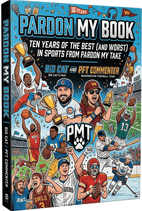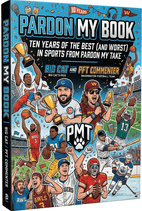
Pardon My Book Summary by Big Cat (Free)

When Two Twitter Accounts Meet: An Internet Love Story

Chapter 1 of 4
0:000:00
EN
1x
Voice
PDF

Pardon My Book

by Big Cat

Pardon My Book book cover

What is the book Pardon My Book about?

Big Cat's Pardon My Book chronicles the improbable rise of the Pardon My Take podcast, from a 2013 Twitter DM to a cultural phenomenon, through origin stories, athlete interviews, and the unplanned stunts that defined its raw, unpolished edge. Written for the show's dedicated AWLs and anyone fascinated by sports media disruption.

FeatureInsta.PageBlinkist
Summary DepthFull Chapter-by-Chapter15-min overview
Audio Narration
Visual Mindmaps
AI Q&A
Quizzes
PDF Downloads
Price$89.99/yr$146/yr (PRO)
*Competitor data last verified July 2026.

1 Page Summary

Pardon My Take chronicles the improbable rise of one of sports media’s most successful podcasts, tracing its origins from a 2013 Twitter DM exchange between a Barstool Sports blogger (Big Cat) and an anonymous SB Nation writer (PFT Commenter). The book details how two strangers, who independently converged on the same absurd comedic sensibility, built a partnership that would eventually challenge the established sports media order. Their journey from a failed Zoom test to the accidental mashup name "Pardon My Take" (a combination of First Take and Pardon the Interruption) is presented as a series of unplanned breaks, timing accidents, and stunts, including a cease-and-desist from ESPN that became viral free publicity, a gambling goldfish, and a traveling RV tour called "Grit Week." The narrative emphasizes that the show's defining tone emerged not from strategic planning but from a willingness to be themselves, move past early failures, and fill a niche no other podcast occupied by recapping the previous night's games.

The book is structured not as a linear business memoir but as a collection of chapters that blend origin stories with extended interviews and firsthand accounts from athletes, coaches, media figures, and the show's rotating crew. Key figures like Blake Bortles, JJ Watt, Blake Griffin, Chris Long, Jim Harbaugh, and Scott Van Pelt offer insights into why the show works, often crediting its authenticity and the hosts' willingness to be the butt of the joke. The narrative also explores the business side, including Barstool's sale to Peter Chernin's firm, PFT's contract standoff, and the eventual Penn Gaming deal, which threatened to pull the partners apart but instead solidified their understanding that "the sum is better than the parts." A recurring theme is the tension between polished media and the show's raw, unpolished edge, which the authors argue broke down barriers and made guests and listeners feel like they were eavesdropping on a private conversation.

Intended for the show's dedicated fanbase (known as "AWLs") and anyone interested in the intersection of sports, comedy, and media disruption, the book offers a behind-the-scenes look at how a podcast built on inside jokes, recurring bits (like the "dip spit bottle" mystery and the "lottery ball" curse), and a rotating cast of characters became a cultural phenomenon. Readers gain insight into the show's guiding principle—making themselves laugh and trusting the audience to follow—and the deliberate cultivation of a workplace that prioritizes personal trust over institutional process. The final chapters pivot to the deeper meaning of the show, exploring what "grit" means to various figures, the personal growth of its hosts into fatherhood, and how the format’s authentic joy replaced suited sports talk, creating a one-sided friendship that outlasts any specific sports topic.

When Two Twitter Accounts Meet: An Internet Love Story

Overview

An origin story usually begins with a chance meeting in person, but the internet offers connections that are disembodied and easily dismissed. How does a relationship that starts as two strangers trading jokes online become the foundation of a partnership worth telling? That uncertainty hangs over every digital first encounter.

The origin story is not romantic: a Barstool Sports blogger and a freelance SB Nation writer slid into each other's Twitter DMs in 2013 and proposed making jokes together. Nothing was planned; the podcast came later. Fans kept accusing each man of stealing the other's jokes, but neither was copying. Their humor simply ran parallel, aligning on everything from Big Ben's injuries to trolling bigger accounts. They finally met on a semi-blind date in Chicago, since PFT was still anonymous, and their first riff was the Cal Ripken steroid question: everyone from 90s baseball had been crucified, so why did the iron man never face scrutiny?

Key Takeaways
  • The joke-stealing accusations were a misreading of two comedians who independently converged on the same absurd angles, not evidence of copying.
  • Their entire operation began as an unplanned experiment in making each other laugh, with the podcast arriving only as a byproduct of that impulse.
  • The Cal Ripken exchange crystallized their shared comedic principle: no sports figure, however iconic, should escape the kind of scrutiny applied to lesser stars.
  • PFT's anonymity did more than protect his identity; it forced their first meeting to be a genuine test of whether the on-screen chemistry could survive face-to-face.

Key concepts: When Two Twitter Accounts Meet: An Internet Love Story

When Two Twitter Accounts Meet: An Internet Love Story

Digital Origins

  • 2013 Twitter DMs between two sports writers
  • Unplanned collaboration built on shared humor
  • Joke-stealing accusations were false convergence

Chemistry Test

  • Semi-blind Chicago meeting due to PFT's anonymity
  • Cal Ripken steroid question sparked first riff
  • Face-to-face chemistry validated online connection

Core Comedic Principle

  • No sports icon escapes scrutiny, however legendary
  • Absurd angles applied equally to all figures
  • Humor ran parallel, not copied
💡 Try clicking the AI chat button to ask questions about this book!

30 Hours in 1985

Overview

Two people on opposite sides of an open media war keep sneaking off to hang out anyway. The problem is not whether their friendship survives the rivalry. The puzzle is what a thirty-hour gap between birthdays has to do with the start of something neither side saw coming.

The First Meet-Up

A Chicago meet-up ended with the two hosts swapping DMs for actual texts, which made the friendship feel legitimate, and they agreed to make content together. Earlier they had riffed on a mock podcast about Cal Ripken and steroids, joking they would ignore the Mitchell report and the sudden acne and braces of 1990s sluggers.

Super Bowl 49

Their second meeting came at Super Bowl 49 in Arizona, the Seahawks-Patriots game with Malcolm Butler's interception. PFT was credentialed for SB Nation, part-time and anonymous; Big Cat was with Barstool, which was attending its first Super Bowl as a four-man crew, including Dave Portnoy and Hank, working out of a cheap Scottsdale Airbnb for the Rundown. Barstool was openly hostile with Deadspin and similar sites, but PFT ignored colleagues who dismissed Barstool as misogynists.

The Birthday Discovery

At the party, PFT didn't realize it was Big Cat's 30th birthday, and Big Cat didn't know PFT's was the next day. Big Cat was born January 30, 1985 at 2:11 am; PFT on January 31 at 8:15 am. Thirty hours separate them, with one day when Big Cat existed on earth before PFT. That, they realized, was the literal birth of their number one sports podcast, a coincidence that feels absurd now that they are professionally bound together.

Dave and Hank

PFT met Dave, who responded to Big Cat's explanation that PFT misspells intentionally with "Huh?" Dave trusted Big Cat's instincts. Later, at a club near the Gronkowski brothers' table, Big Cat and Dave were ordered to put their shirts back on, a rule that applied only to fat men, not the six-packs. Hank and PFT's first notable exchange involved smell-testing a bag of cocaine.

Key Takeaways
  • The move from DMs to text messages, paired with a joking podcast about Cal Ripken and steroids, was the real seed of what became a professional partnership.
  • Their Super Bowl 49 meeting brought together two tiny operations: SB Nation’s part-time anonymous credential and Barstool’s four-man debut out of a cheap Scottsdale Airbnb.
  • The podcast’s origin is a biological fluke: Big Cat entered the world thirty hours before PFT, a gap that now reads as destiny but was pure coincidence.
  • Dave’s instant trust in Big Cat and the absurd shared moment of smell-testing a bag of cocaine established the tone of the crew that would later define their careers.

Key concepts: 30 Hours in 1985

30 Hours in 1985

The First Meet-Up

  • Chicago meet-up moved from DMs to texts
  • Agreed to make content together
  • Joked about mock podcast on Cal Ripken and steroids

Super Bowl 49 Meeting

  • Second meeting at Seahawks-Patriots game
  • PFT credentialed part-time for SB Nation
  • Barstool's first Super Bowl as four-man crew
  • PFT ignored colleagues dismissing Barstool as misogynists

The Birthday Discovery

  • Neither knew the other's birthday at the party
  • Big Cat born Jan 30, PFT Jan 31, 1985
  • Thirty hours apart, one day of solo existence
  • Coincidence became origin of their top podcast

Dave and Hank Encounters

  • Dave puzzled by PFT's intentional misspellings
  • Dave trusted Big Cat's instincts immediately
  • Club rule: shirts off only for six-packs, not fat men
  • Hank and PFT smell-tested a bag of cocaine

Key Takeaways

  • DM-to-text shift seeded professional partnership
  • Two tiny operations met at Super Bowl 49
  • Podcast origin was a biological fluke
  • Dave's trust and absurd moments defined crew tone

Blogs With Balls

Overview

Two colleagues arrive at a conference expecting the validation that will justify their careers. Instead, one leaves humiliated by a noncommittal employer, the other publicly attacked for the brand he loves. The future they had counted on collapses in the same room, and what happens next depends on how they respond.

A party truce

At a party, Big Cat and Hank handed PFT a bump of cocaine, and he took it. That settled things for Big Cat: PFT had partied with them, so he could never trash Barstool among his SB Nation friends. The book pauses to urge readers to test their drugs and stay safe, then notes that passing a bag around on their thirtieth birthdays at a club with the Gronkowski brothers (not the famous one, who was roughly 200 feet away) qualified as probably the coolest moment of their lives.

The conference

Blogs with Balls ran yearly from 2009 into the mid-2010s, officially a pioneering conference series uniting sports bloggers, new media professionals, and journalists to discuss the evolving sports media landscape. Its real purpose was to make bloggers feel important and legitimate while television, newspapers, and radio still dominated. The conference proved the catalyst for PFT joining Barstool and for Pardon My Take starting.

Shattered expectations

Before Chicago, PFT still worked part-time at SB Nation, among its most talented writers yet without a full-time offer. Big Cat was in a quarter-life crisis: he loved Barstool, but the site earned no respect, and while Dave picked fights with other outlets, Big Cat's efforts to befriend them always failed. PFT attended as an audience member; Big Cat sat on a panel. PFT came expecting a dinner with SB Nation's higher-ups to produce a full-time job offer; Big Cat expected his panel to win over skeptical media types. Both expectations collapsed.

The dinner and the ambush

At the dinner, SB Nation praised PFT's work but said there was no budget for full-time. In hindsight it reads like a draft blunder, on the level of Sam Bowie over Michael Jordan or Darko Miličić over Carmelo Anthony. PFT arrived at the conference deflated. Big Cat's panel, meant to cover the future of sports blogging, became an ambush on Barstool and misogyny, with everything on trial:

  • "Guess That Ass"
  • Smokeshow of the Day
  • offensive humor in general
Key Takeaways
  • Blogs with Balls functioned less as a media conference than as a ritual of legitimacy, conferring importance on bloggers while the traditional outlets still called the shots.
  • The shared cocaine moment at the party was more than a birthday anecdote; it turned a potential critic into a participant and made future attacks unthinkable.
  • Both PFT and Big Cat arrived in Chicago expecting the conference to validate their career paths, and both left having to confront that the old media world was not ready to take them seriously.
  • SB Nation's refusal to offer PFT a full-time role at that dinner now looks like the kind of personnel blunder franchises spend years regretting.

Key concepts: Blogs With Balls

Blogs With Balls

The Conference's Real Purpose

  • Ran yearly 2009 to mid-2010s
  • Uniting bloggers and media professionals
  • Made bloggers feel important and legitimate
  • Catalyst for PFT joining Barstool

Shattered Expectations

  • PFT sought full-time SB Nation offer
  • Big Cat hoped panel would win respect
  • Both left with their futures collapsing
  • Old media not ready to take them seriously

The Dinner and the Ambush

  • SB Nation praised work but no budget
  • Dinner rejection like a draft blunder
  • Big Cat's panel became Barstool attack
  • Offensive humor and features on trial

The Cocaine Bond

  • PFT took a bump at the party
  • Turned potential critic into participant
  • Made future attacks on Barstool unthinkable
  • Coolest moment with Gronkowski brothers nearby

Key Takeaways

  • Conference was a ritual of legitimacy
  • Shared moment prevented future criticism
  • Both faced old media's dismissal
  • SB Nation's miss now looks regrettable

The Chernin Deal

Overview

The biggest hurdle was money: the company had momentum but not the financial backing to expand. A path forward existed, but only if the right partner could be found without compromising what made the operation what it was.

A Grilling

Grilled on a Blogs with Balls panel, PFT and Big Cat each saw he'd never fit in: PFT as talent at a journalism-minded blog, Big Cat in media's inner club. Success meant their own terms, which seeded Pardon My Take.

The Sale

Money blocked the hire. In August 2015 Dave Portnoy flew Big Cat to a New York dinner with KFC. Barstool would sell only to a buyer who left it unchanged. Peter Chernin's firm fit. Its backing and a New York move would push past blogging into daily video and podcasts. KFC had started KFC Radio, betting podcasting would pay, featuring Big Cat.

Key Takeaways
  • The exclusion PFT and Big Cat faced from established media was not a dead end but the condition that forced them to build an independent format.
  • Barstool's sale to Peter Chernin's firm succeeded only because the agreement made non-interference a hard condition, not a courtesy.
  • The New York move and new investment did more than supply capital; they turned a blogging operation into a daily production house for video and audio content.
  • KFC Radio's early bet on podcasting supplied the proof that shifted the expanded company's priorities toward audio as a core revenue stream.

Key concepts: The Chernin Deal

The Chernin Deal

The Funding Barrier

  • Money was the biggest hurdle to expansion
  • Momentum existed but lacked financial backing
  • Right partner needed without compromising identity

Path to Independence

  • PFT and Big Cat rejected by established media
  • Exclusion forced creation of Pardon My Take
  • Success required operating on their own terms

The Chernin Deal

  • Portnoy flew Big Cat to New York dinner
  • Sale required non-interference as hard condition
  • Chernin's backing enabled daily video and podcasts
  • KFC Radio proved podcasting's revenue potential
You've reached the end of the free chapters

Next chapter: “Three Guys Coming Together” is locked

Keep reading Pardon My Book — and unlock all 500+ book summaries with audio, mindmaps and AI Q&A.

$0.00 due today · 7 days free, then $89.99/year ($7.49/mo) · Cancel anytime before day 7

About the Author

Big Cat

Big Cat is a pen name for an independent author known for blending humor with poignant coming-of-age stories, particularly within the contemporary romance and young adult genres. Their notable works include the acclaimed "Swing" series and the novel "The Second Chance," which explore themes of identity and self-discovery. Drawing from their background in education and youth mentorship, Big Cat infuses their narratives with authentic dialogue and emotionally resonant character growth.

Frequently Asked Questions about Pardon My Book

What is Pardon My Book about?
The book chronicles the improbable rise of a sports podcast that began with two strangers trading jokes on Twitter and grew into a cultural phenomenon. It covers the early struggles, the business battles, the viral stunts, and the relationships with athletes and media figures that shaped the show's identity. Along the way, it reveals how an unpolished, authentic approach beat polished competitors and built a devoted community of listeners.
Who is the author of Pardon My Book?
The author is Big Cat, real name Dan Katz, one of the two co-hosts of the Pardon My Take podcast and a prominent Barstool Sports personality. The book draws on his firsthand experiences and the show's history, including his partnership with PFT Commenter and producer Hank Lockwood.
Is Pardon My Book worth reading?
For anyone who loves sports comedy or wants the inside story of how a scrappy podcast took over the media landscape, this book delivers. It is packed with hilarious behind-the-scenes anecdotes, candid business lessons, and heartfelt reflections on friendship, fatherhood, and the meaning of grit. The writing captures the same irreverent, self-aware voice that made the podcast so popular.
What are the key lessons from Pardon My Book?
One major lesson is that authenticity and trust matter more than polish: the show thrived by being unvarnished and letting hosts be themselves, which made guests and listeners let their guard down. Another is that seizing unexpected opportunities—like emailing an internship application from the side of a highway—can change your career. The book also emphasizes that grit is built through struggle and community, not inherited, and that creative partnerships survive when both sides recognize the whole is greater than the sum of its parts. Finally, it teaches that the best comedy and content come from genuine connection and a willingness to be the butt of the joke.
0