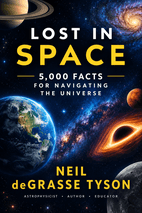
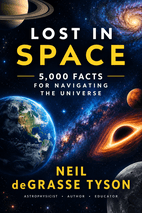
Neil Tyson's Lost in Space presents 5,000 facts charting the cosmos from Earth's formation to galaxies and spacetime, organized so curious general readers can start anywhere or read straight through, blending historical figures like Ibn al-Haytham with modern discoveries.
Feature
Insta.Page
Blinkist
Shortform
Summary Depth
Full Chapter-by-Chapter
15-min overview
Section-by-section guides
Audio Narration
✓
✓
✓
Visual Mindmaps
✓
✕
✕
AI Q&A
✓
✕
✕
Quizzes
✓
✕
✕
PDF Downloads
✓
✕
✓
Price
$89.99/yr
$146/yr (PRO)
$199/yr
*Competitor data last verified July 2026.
1 Page Summary
In Lost in Space: 5,000 Facts for Navigating the Universe, Neil Tyson presents a sweeping exploration of the cosmos built on a simple but profound premise: every answer about the universe seems to open two more questions, and the gap between what we can observe and what we can understand keeps widening. The book's central thesis is that curiosity is not a detour from science but its engine—the same urge to ask "why" that drove ancient astronomers now powers modern astrophysics. Knowledge builds fact by fact along a path that is anything but straight, with forks, detours, and U-turns, moving outward from the Sun and Moon to the planets, stars, galaxies, and finally space and time itself. This framework of accumulating verified facts, including specific details like a jet of gas from a newborn star spanning eight light-years, reflects the book's commitment to grounding cosmic understanding in tangible, measurable discoveries.
Tyson's approach is distinctive in its structured, fact-driven itinerary through the universe, organized to allow readers to start at the beginning or dip in anywhere. The book proceeds methodically through cosmic scales and histories: from Earth's formation 4.6 billion years ago and the evolution of its atmosphere, through the development of optics and the first telescopes that changed seafaring, warfare, and trade as much as astronomy, to the solar system where over 90 percent of known objects were discovered after 2000. Tyson weaves in historical figures like Mendeleev, who predicted undiscovered elements, and Ibn al-Haytham, the "father of modern optics" who demanded experimental support for hypotheses, alongside modern revelations such as Voyager 2's data distinguishing gas giants from ice giants. This blend of historical narrative and contemporary scientific fact, presented in discrete, accessible units, makes complex cosmology approachable without oversimplifying it.
The intended audience is clearly the curious general reader—anyone who has ever looked up and wondered, from those who want a structured journey through the cosmos to those who prefer browsing bite-sized facts. Readers will gain a broad, fact-anchored understanding of the universe's scale and history, from the formation of elements in stars to the potential for life on moons like Europa and Enceladus. More importantly, they will come away with the recognition that the desire to ask "why" is not a distraction from science but its very foundation, and that understanding the universe is assembled one verified fact at a time, even as each answer reveals new questions. The book ultimately offers not just information but a way of thinking—a navigational tool for a universe that remains, in many ways, still lost to us.
Introduction
Overview
Every answer about the cosmos seems to open two more questions. The gap between what we can observe and what we can understand keeps getting wider. We want to ask why before we even have the words for it. Curiosity alone has never been enough to close that gap.
Curiosity drives science. We ask why because our brains seek understanding. You can see it in toddlers, and it runs through history from ancient astronomers to today's astrophysicists.
A path of 5,000 facts
Knowledge builds fact by fact. The path isn't straight. It has forks, detours and U-turns. The search moves outward:
the Sun and Moon
the planets
the stars
the galaxies, including our own Milky Way
space and time
Readers may start at the beginning or dip in anywhere. One fact: a jet of gas shooting from a newborn star in the star-forming region Sh2-284 stretches eight light-years. That's nearly double the Sun's distance to Alpha Centauri.
Key Takeaways
The urge to ask why isn't a detour from science. It's the engine. The same urge carried ancient astronomers toward modern astrophysics.
Understanding the universe is assembled one verified fact at a time. The route between those facts bends, forks, and sometimes reverses direction.
Astronomy starts close and moves outward: the Sun and Moon first, then the planets, the stars, the galaxies including our own, and finally space and time themselves.
Readers can enter this material at any point they choose. The chapters don't demand to be taken in sequence.
Cosmic distances are hard to grasp. The jet in the star-forming region Sh2-284 is eight light-years long. That's nearly double the Sun's distance from Alpha Centauri.
Key concepts: Introduction
Introduction
Curiosity as the Engine of Science
The urge to ask why drives scientific inquiry.
Curiosity is not a detour but the engine of science.
From ancient astronomers to modern astrophysicists, curiosity persists.
Building Knowledge Fact by Fact
Knowledge accumulates one verified fact at a time.
The path is not straight; it has forks, detours, and U-turns.
Understanding grows by connecting facts.
Outward Journey Through the Cosmos
Astronomy starts close: Sun and Moon, then planets, stars, galaxies.
Finally, it explores space and time themselves.
Readers can enter at any point; chapters need not be sequential.
💡 Try clicking the AI chat button to ask questions about this book!
Chapter One: Home Base
Overview
Earth is the only home we've ever known, and its story is a wild one. Our planet formed 4.6 billion years ago from a collapsing cloud of gas and dust. The early Earth was molten. Heavy iron and nickel sank to the center, and lighter rock floated up to form the crust. The oldest Earth rock we've found is 4.011 billion years old, and it turned up as a meteorite on the Moon. Water came later, hitching a ride on asteroids. Plate tectonics got going 3 to 4 billion years ago, and microbes showed up by 3.5 billion years ago.
Now zoom out to the elements that make up everything. Mendeleev published his periodic table in 1869 with 63 elements. Today we know 118. He even predicted three that hadn't been found yet: gallium, scandium, and germanium. Hydrogen makes up most of the mass in the universe, and stars forge heavier elements through fusion. Oxygen and silicon dominate Earth's crust. Aluminum was discovered in 1825 and was once as precious as silver.
Above us, the atmosphere has five layers: the troposphere, stratosphere, mesosphere, thermosphere, and exosphere. The troposphere holds the oxygen we breathe. The stratosphere contains ozone. The thermosphere is where satellites orbit. The ionosphere reflects radio waves, and the Coriolis effect deflects moving objects. The space station loses altitude every month and needs rocket boosts to stay up.
So where does the atmosphere end and space begin? That depends on who you ask. Theodore von Karman, the Hungarian physicist who led the rocket science lab that became NASA's Jet Propulsion Laboratory, placed the boundary near 50 miles up. The FAI rounded it to 100 kilometers. The FAA chose 50 miles. NASA Mission Control keeps to 76 miles, where aircraft need rocket boosts to stay aloft. The line moves with pressure: half the atmosphere sits below 31 miles, and a tenth below 6.2 miles.
Light behaves strangely up there too. Atmospheric molecules scatter shorter wavelengths of light, spreading blue and violet across more of the sky than other colors. Violet scatters most of all, beyond what human eyes can register. Near the horizon, blue fades to white because light travels a longer scattering path there. The night sky is never fully dark. A faint airglow marks sunlight striking the upper atmosphere, in layered reds, greens, purples, and yellows. It's faint from the ground but clear from the International Space Station.
Weeks or months in zero gravity leave astronauts struggling to hold a pen. Years or generations in space would demand artificial gravity. Holding 1 g means accelerating at 32 feet per second each second. The best way to produce it is centrifugal force, the pull riders feel on a carnival swing. Centripetal force is real, holding an orbiting object at a fixed distance. Centrifugal force is apparent, the outward tendency.
In Kubrick's 2001: A Space Odyssey, Discovery One's quarters surround a rotating ring that must spin at a precise speed to simulate 1 g, with gravity weakening toward the center. The ring turns about three times too fast, pinning anyone near the outer edge like a Gravitron rider.
Gravity is indistinguishable from acceleration. This is the equivalence principle, which Einstein called his happiest thought. In 1907 he pictured someone falling weightlessly in a broken elevator, alongside objects that seemed to hover. An upward-shooting elevator would pin that person to the floor.
Total solar eclipses will end. The Moon drifts outward, so they grow rarer until the last one, about 620 million years from now. Arthur Eddington used the eclipse of May 29, 1919 to derive the first verifiable proof of general relativity: a star cluster appeared displaced exactly as Einstein's calculations of warped spacetime predicted.
A meteoroid becomes a meteor when it burns through the mesosphere, and a meteorite if it survives to the ground. Some meteorites are older than Earth. The Martian meteorite ALH84001 showed signs of a wet environment and possibly ancient life, though the experiments remain inconclusive.
In 2022, NASA's DART craft struck the moonlet Dimorphos at 14,000 miles an hour, shrinking its orbit around Didymos by 32 minutes. It was the first time humans altered a celestial object's path. Bennu, a rubble pile about a third of a mile wide, has a most likely collision date of September 24, 2182, with odds of only 1 in 2,700.
Comets mix rock, ice, and dust. Their ancient ice may hold clues to how water and life reached Earth. Fred Whipple called them dirty snowballs in 1950. Each has a nucleus, a coma, and two tails, plasma and dust, that point away from the Sun and can stretch 100 million miles.
Swift-Tuttle orbits every 133 years and supplies the Perseids. 'Oumuamua, in 2017, was the first recorded object from beyond the solar system. Halley's comet returns every 76 years, last in 1986 and next in 2061, feeding the Eta Aquarid and Orionid showers. Rosetta landed on 67P/Churyumov-Gerasimenko in 2016, finding water ice, glycine, and phosphorus.
Meteor showers happen as Earth crosses the debris trail a comet leaves behind. The meteors seem to stream from one point, the radiant, an effect of perspective. Viewing is best after midnight, when Earth's night side rotates into the debris stream. The Leonid storm of 1833 delivered 50,000 to 150,000 meteors an hour and toppled Aristotle's bubble theory after Denison Olmsted's public call for witness reports.
The zodiac is one of the oldest systems for describing the sky. Babylonian astronomers divided it into 18 segments. By 500 B.C. it had narrowed to the 12 signs used today, which Ptolemy helped popularize. Because Earth's axis wobbles like a slow top on a nearly 26,000-year cycle, the traditional dates no longer align with the constellations. A 13th sign, Ophiuchus, belongs astronomically but not in horoscopes.
The Inca tracked light and dark constellations, including a llama, fox, snake, and toad, each marking when that animal appeared or gave birth. The dark llama Yacana had eyes of Alpha and Beta Centauri. Many cultures read the Milky Way's dark lanes as water holes, caves, or an underworld entrance. Aboriginal tradition places the Emu in the Sky in that negative space.
Navajo constellations include the Porcupine, Butterfly, Bear, Gila Monster, and Turkey. Polaris is a home's central fire. The Big Dipper is a father and leader. Cassiopeia is a mother who provides stability and food. Together they depict a family revolving around the fire.
Earth's chemical inventory was assembled from two sources: hydrogen and helium left over from the early universe, and heavier elements forged inside stars. Water arrived later aboard water-rich asteroids. Where the atmosphere becomes space is a negotiated figure rather than a physical edge, and it falls as the air thins. Nothing about the night sky is fixed for human purposes. Precession will keep pulling the zodiac away from its constellations, and the Moon's slow retreat will one day put an end to total solar eclipses. Comets and asteroids are the most plausible carriers of Earth's water and of the chemistry life needed, which makes those bodies worth studying and, as DART showed, worth deflecting in principle. Living beyond Earth for years or generations will require a spinning habitat to supply 1 g, since the body expects constant downward pull and no other method can hold a crew at that force.
Key Takeaways
Earth formed 4.6 billion years ago, and water likely arrived later on asteroids.
The boundary between atmosphere and space is a matter of definition, not a physical edge.
Long-term life in space would require a spinning habitat to create artificial gravity.
Meteor showers, comets, and asteroids all connect to the story of how Earth got its water and chemistry.
The night sky changes over time, and total solar eclipses will eventually end.
Key concepts: Chapter One: Home Base
Chapter One: Home Base
Earth's Formation and Structure
Formed 4.6 billion years ago from collapsing gas and dust
Heavy iron and nickel sank to form core; lighter rock formed crust
Oldest Earth rock is 4.011 billion years old, found as Moon meteorite
Water arrived via asteroids; plate tectonics began 3-4 billion years ago
Elements and the Periodic Table
Mendeleev published periodic table in 1869 with 63 elements
Today 118 elements known; he predicted gallium, scandium, germanium
Hydrogen dominates universe's mass; stars forge heavier elements
Oxygen and silicon dominate Earth's crust; aluminum once precious
Atmosphere and Space Boundary
Five layers: troposphere, stratosphere, mesosphere, thermosphere, exosphere
Space boundary debated: von Karman ~50 miles, FAI 100 km, FAA 50 miles
Half atmosphere below 31 miles; tenth below 6.2 miles
Light and Sky Phenomena
Atmospheric scattering makes sky blue; violet scatters most but invisible
Night sky never fully dark due to faint airglow
Airglow shows layered reds, greens, purples, yellows from ISS
Gravity and Acceleration
Zero gravity weakens astronauts; artificial gravity needs 1 g acceleration
Centrifugal force simulates gravity; centripetal force holds orbits
Equivalence principle: gravity indistinguishable from acceleration
Einstein's happiest thought: falling elevator feels weightless
Eclipses and Relativity
Total solar eclipses will end in ~620 million years as Moon drifts
1919 eclipse provided first proof of general relativity by Eddington
Star cluster appeared displaced as Einstein's warped spacetime predicted
Meteors, Comets, and Asteroids
Meteoroid becomes meteor in mesosphere; meteorite if it hits ground
DART mission altered Dimorphos's orbit in 2022, first human path change
Comets are dirty snowballs with nucleus, coma, and two tails
Meteor showers occur as Earth crosses comet debris trails
Chapter Two: Looking Up
Overview
We keep looking up, but most of the cosmos still passes us by. Even our best instruments can't reach everything that's hidden. The problem isn't curiosity. It's that our senses and our familiar tools have limits.
From Stargazing to Spacefaring
After hundreds of thousands of years of watching the sky, humanity finally left the ground. New discoveries broke old ideas and revealed hidden languages of the universe. The first telescopes changed seafaring, warfare, and trade as much as they changed astronomy.
Bringing the Cosmos Closer
Earth's atmosphere blocks most kinds of light, but it lets visible light through. That's why we can see stars, and why our eyes evolved for that narrow band. Around 300 B.C., Euclid's Optics was the first work to treat vision and the interaction of light and matter with mathematics.
The Book of Optics
In the tenth century, Ibn Sahl analyzed Ptolemy's Optics. He worked out the math of curved mirrors and convex lenses. Ibn al-Haytham, known in Europe as Alhazen, lived from A.D. 985 to 1040 and earned the name "the father of modern optics." He demanded that hypotheses be supported by experiments. He proved light travels in a straight line. He argued that vision happens when light enters the eye, not when something comes out of it. And he held that light moves at a finite speed that changes with the medium.
Lyman Spitzer compared the atmosphere's blur to a long exposure of an infant with a rattle. His namesake telescope was the first to detect light from planets outside the solar system. Its supply of liquid helium coolant ran out in May 2009, and the renamed Spitzer Warm Mission continued until January 2020.
Webb's Infrared Eye
JWST launched on Christmas Day 2021. It sits one million miles out at the Earth-Sun L2 Lagrange point, one of five points where the gravitational pulls of Earth and the Sun balance out. It detects objects 100 times fainter than Spitzer and sees in infrared. That's the band where the most ancient, distant objects appear, because expansion stretches their wavelengths. It has four aims: find the universe's earliest stars and galaxies, trace the evolution of galaxies, watch stars and planetary systems take shape, and weigh the potential for life in other planetary systems.
First Light
The telescope's first five images came out in July 2022. They covered SMACS 0723, WASP-96b, the Southern Ring Nebula, Stephan's Quintet, and the Carina Nebula.
In 1895, Wilhelm Röntgen made the first x-ray. He took it of his wife Anna's hand. When she saw the image, she said she had seen her own death.
Little Curies
Marie Skłodowska-Curie coined the word "radiation." She paused her research to deploy the first mobile x-ray units in World War I and trained about 150 women to run them. The Little Curies let doctors find broken bones and pinpoint embedded bullets. That exposure caused the aplastic anemia that killed her at 66.
Chandra
Earth's atmosphere absorbs high-energy light, so seeing the universe at those wavelengths requires space telescopes. A 1964 rocket detected x-rays from Cygnus, the first black hole found this way. Chandra launched on July 23, 1999. Its mirrors are polished so smoothly they bounce x-rays to a pinpoint 30 feet away. It showed that dark matter interacts with itself less than believed.
Gamma Rays
Cold War satellites built to verify a test-ban treaty detected emissions that Los Alamos researchers traced to deep space. That founded gamma-ray astronomy. In 2008 Fermi recorded the most powerful burst yet seen, and Webb's 2022 BOAT—the brightest of all time—was likely the brightest in 10,000 years.
Kennedy framed reaching the Moon as hard rather than easy, and Apollo answered it between 1962 and 1972. Gus Grissom, Ed White, and Roger Chaffee died in a capsule fire during a 1967 test. Crewed flight halted for 20 months. The mission was later named Apollo 1.
Apollo 8, 10, and 11
Apollo 8 first orbited the Moon and returned, in December 1968. Apollo 10, in May 1969, rehearsed the landing. Thomas Stafford and Eugene Cernan descended to about 10 miles above the future Apollo 11 site. Apollo 11 landed on July 20, 1969.
What the Landings Left Behind
Armstrong's intended "a" went unheard. A mirror array still measures the Earth-Moon distance to within centimeters. The footprints could survive millions of years without wind or rain. Returning crews were quarantined 21 days. Three new minerals turned up in the returned Moon rocks: armalcolite, tranquillityite, and pyroxferroite. Twelve Americans walked on the Moon, the last on Apollo 17 in December 1972.
The Outer Space Treaty
The 1967 treaty banned weapons of mass destruction in orbit. It barred territorial claims and held signatories responsible for damage and contamination. More than 100 countries signed. Diplomacy alone enforces it. Satellite constellations, private tourism, and asteroid mining went unimagined, and nothing governs what may be brought back to Earth. The 2020 Artemis Accords require strict accounting of launched objects and shared discoveries.
Space Debris
Half a million fragments between 0.4 and 4 inches are in orbit. Between 1998 and November 2024, the space station changed course 39 times to dodge debris. The Kessler effect describes cascading collisions that could make orbit unusable.
The Space Station
Five agencies from 15 countries built it. At $150 billion, it is the costliest object ever made. Its first crew launched in October 2000, and it retires in 2031 into Point Nemo.
The Body in Microgravity
Roughly half a gallon of fluid shifts from the legs to the head, leaving astronauts congested. Muscle mass can drop by a fifth in a week, so they exercise 2.5 hours daily.
Food in Orbit
Crumbly food is banned aboard the station. Granules can damage electronics or endanger the crew. Sticky foods shed nothing, so tortillas and peanut butter work where bread and chips do not. Microbes and protein decay spoil food, so NASA irradiates meals before shrink-wrapping. Freeze-dried food is light to launch and shelf-stable for decades. Astronauts report desensitized taste buds, making hot sauce a staple. Treats that taste of home sustain morale.
Animals in Space
Laika, a Moscow stray, launched aboard Sputnik 2 in 1957 and died hours later when the heat shield failed. No return had been planned. Ham the chimpanzee reached 157 miles in 1961, clearing the way for Alan Shepard.
Extremophiles
Extremophiles do more than tolerate hostile conditions. They prefer them. Tardigrades, eight-legged and about half a millimeter long, rode a Russian spacecraft in 2007, and most survived 10 days in low Earth orbit. Under radiation they excrete betalain, a pigment being explored to protect astronauts. Lake Vostok, sealed under Antarctic ice for 15 million years, stands in for the oceans of Europa and Enceladus.
Key Takeaways
Modern optics begins with Ibn al-Haytham's insistence that hypotheses survive experiment, and with his conclusion that light travels finitely and at different speeds through different media.
The atmosphere lets in only a narrow band of visible light. So the universe's full history can only be seen from orbit, and infrared telescopes are the only way to see the most ancient, redshifted objects.
Apollo left a mirror that still measures the Earth-Moon distance to centimeters. The 1967 treaty says nothing about commercial extraction or sample return, and orbital debris keeps cascading. So the next space age will be shaped by rules and cleanup as much as by rockets.
Human bodies in orbit need constant workarounds. Fluid shifts, muscle loss, and dulled taste turn exercise and food engineering into mission-critical systems rather than comforts.
Extremophiles thrive in radiation, vacuum, and ancient isolation. That broadens the range of worlds that could support life, making Europa and Enceladus real possibilities.
Key concepts: Chapter Two: Looking Up
Chapter Two: Looking Up
Optics and Vision
Euclid's Optics (300 BC) first applied math to vision and light.
Ibn al-Haytham (Alhazen) proved light travels straight and enters the eye.
He demanded experiments and held light speed finite, varying by medium.
Infrared and Spitzer
Spitzer compared atmospheric blur to a long-exposure infant photo.
Spitzer first detected light from exoplanets.
Its coolant ran out in 2009; warm mission continued to 2020.
James Webb Space Telescope
Launched Dec 25, 2021, to Earth-Sun L2, one million miles out.
Detects 100x fainter than Spitzer, in infrared for ancient objects.
Four aims: earliest stars, galaxy evolution, star formation, life potential.
First images in July 2022 covered five targets.
High-Energy Astronomy
Röntgen discovered X-rays in 1895; Curie deployed mobile X-ray units in WWI.
Chandra (1999) showed dark matter interacts less than believed.
Gamma-ray astronomy founded from Cold War satellites; Fermi and Webb saw record bursts.
Apollo Program
Apollo 8 orbited Moon (1968); Apollo 11 landed July 20, 1969.
Apollo 1 fire killed three astronauts; crewed flight halted 20 months.
Moon landings left mirror arrays, footprints, and three new minerals.
Twelve Americans walked on Moon; last was Apollo 17 in 1972.
Space Law and Debris
1967 Outer Space Treaty banned WMDs in orbit and territorial claims.
2020 Artemis Accords require accounting of launched objects and shared discoveries.
Half a million fragments in orbit; Kessler effect could make orbit unusable.
Life in Space
ISS built by 5 agencies, 15 countries; cost $150 billion; retires 2031.
Microgravity shifts half a gallon of fluid to head; muscle drops 20% weekly.
Astronauts exercise 2.5 hours daily to counter muscle loss.
Chapter Three: Planetary
Overview
The solar system feels like settled ground, a backyard we have already mapped. Yet almost everything in it was found only recently, much of it cannot be seen or stood upon, and the object holding it all together defies nearly every assumption we bring to it.
The solar system formed about 4.6 billion years ago when a stellar shock wave collapsed an interstellar cloud. "Planet" comes from the Greek planetes, meaning wanderer. Five planets are visible to the naked eye:
Mercury
Venus
Mars
Jupiter
Saturn
Solar System Layout
According to the book, over 90 percent of known solar system objects were discovered after 2000. Four inner rocky planets and four outer giants are divided by the asteroid belt. Jupiter and Saturn are gas giants, while Uranus and Neptune are ice giants, as Voyager 2 data revealed in the 1990s. All four outer planets have rings. Earth is average in size but densest. Astronomers use the astronomical unit (AU), the Earth-Sun distance of about 93 million miles.
Potential for Life
Life beyond Earth may be more likely on moons such as:
Europa
Ganymede
Callisto
Enceladus
Titan
Retrograde Motion
Mercury's apparent backward drift across the sky is an illusion of viewing angle: it never reverses, only continues around the far side of the Sun. Ancient astronomers, who placed Earth at the center of all motion, found this baffling.
A Thin Exosphere
Mercury has almost no atmosphere, only an exosphere, the outermost layer where particles escape easily. Its daytime sky would be black and star-filled rather than blue, and its nights fall to minus 290°F. Its weak magnetic field is nearly three times stronger in the north than in the south.
Caloris Basin and Vulcan
The Caloris Basin impact's seismic waves raised hills and fractures on the planet's opposite side, a landscape called "weird terrain." To explain anomalies in Mercury's orbit, nineteenth-century astronomers invented Vulcan, which Einstein's general theory of relativity rendered unnecessary in 1916.
Shifting Plates
The impact that may have formed the Moon may also have started plate tectonics, which resurfaces Earth and erases most craters. Tectonics has acted as a thermostat, but human emissions override it. In about 1.5 billion years the plates may halt, letting erosion wear mountains into hills while sediment raises the seas until continents flood.
Drifting Clocks
Days are not exactly 24 hours. July 5, 2024, was the shortest day since atomic clocks were adopted, 1.66 milliseconds under. Tidal forces, earthquakes and melting glaciers lengthen days by 1.7 milliseconds per century, hence leap seconds. Leap days overshoot a true year by 44 minutes, so century years skip one unless divisible by 400: 2100, 2200, 2300.
The Weight of Air
At sea level, air presses at 15 pounds per square inch. That weight, not suction, is why a ten-square-inch cup resists 150 pounds.
Dust and Poison
Martian dust storms blow at up to 60 miles an hour, but the thin air makes them feel like a breeze. They span continents and darken the planet for weeks. The regolith is toxic with perchlorate. NASA grew potatoes in Mars-like soil, though most died.
Extremes and Rovers
Mars holds the solar system's largest volcano, canyon and impact crater. Perseverance is sampling Jezero crater, an ancient lakebed, where a boulder named Cheyava Falls held organic molecules. A NASA and European Space Agency plan would return those samples using an Earth Return Orbiter, a Sample Retrieval Lander and the volleyball-sized Mars Ascent Vehicle.
Phobos and Deimos
The moons could be asteroids Mars captured. Phobos orbits 3,700 miles out, drawing six feet closer each century, and might host a radiation-shielded base before it shatters into a ring.
Ceres
Ceres holds about a third of the asteroid belt's mass and is the nearest dwarf planet to Earth. Giuseppe Piazzi found it from Sicily in 1801, and in 2006 it was promoted to dwarf planet as Pluto was demoted.
Jupiter
Jupiter outweighs all the other planets combined twice over, and has no solid surface. Twenty-one fragments of comet Shoemaker-Levy 9 struck it in 1994. Its Great Red Spot, now 1.3 Earths wide, is shrinking.
Moons
Galilean moons:
Io is the solar system's most volcanically active world.
Europa conceals a saltwater ocean under 10 to 15 miles of ice.
Ganymede, the largest moon anywhere, has its own magnetosphere.
Callisto is the most heavily cratered object known.
Saturn
Saturn's rings are mostly water ice, vanish in about 100 million years, and are only 30 feet thick in places. Titan has lakes of liquid hydrocarbons. Enceladus's geysers feed a ring.
Cassini
Cassini orbited Saturn from 2004 to 2017 and returned over 450,000 images. Its final dive into the atmosphere collected data impossible to obtain any other way and prevented the craft from striking moons that could support life.
Uranus
Herschel found Uranus by telescope in 1781, the first planet discovered that way. Tipped roughly 98 degrees by an ancient impact, it is the coldest planet, with seasons each lasting a quarter of its year.
Neptune
Le Verrier and Adams each independently calculated Neptune's position from irregularities in Uranus's orbit. Galle saw it the night their letter arrived in September 1846. Voyager 2, the sole visitor, flew past in 1989.
Kuiper Belt and Oort Cloud
The Kuiper belt, a doughnut of icy objects starting at Neptune's orbit, holds most dwarf planets. The Oort cloud lies about 1,000 times farther out and has never been seen.
Defining a Planet
Until 2006 "planet" had no official definition, so Pluto stayed the ninth. The 2005 discovery of Eris, heavier and farther out, pushed the International Astronomical Union to act on August 24, 2006. A planet must now:
Be round.
Orbit the Sun rather than another object.
Clear its orbit.
Meeting the first two but not the third makes a dwarf planet. Pluto failed the third: the Kuiper belt holds comparably sized objects, and Eris outweighs it. Ceres was upgraded by the same ruling, and Haumea, Makemake and Eris joined it. "Plutoed" was the American Dialect Society's 2006 word of the year.
Planet X
Percival Lowell predicted a distant planet from orbital anomalies in 1906, and Tombaugh's 1930 find was taken as it. Voyager data in 1993 showed those orbits were normal; the hunt lay dormant until 2016, when astronomers revived it.
Key Takeaways
A planet is a category that astronomers define rather than discover: the three-part test adopted in 2006 turned on orbital clearing alone, which is why Pluto fell out of the list while Ceres moved up into it.
Mercury's apparent backward drift, and the orbital anomalies that once required an invented planet Vulcan, both dissolved once the Sun replaced Earth at the center of the picture and general relativity replaced Newtonian mechanics.
The best prospects for life elsewhere in the solar system are ice-covered moons with hidden oceans, not the surfaces of the planets themselves.
Earth's long-term habitability is contingent rather than guaranteed: the tectonic activity that keeps the planet resurfaced and temperature-regulated is expected to stall in roughly 1.5 billion years, and it cannot offset the warming humans are adding now.
Most of what orbits the Sun has only recently come into view, with the great majority of known objects catalogued since 2000 and the distant Oort cloud still unobserved.
Key concepts: Chapter Three: Planetary
Chapter Three: Planetary
Solar System Formation and Layout
Formed 4.6 billion years ago from collapsing interstellar cloud
Over 90 percent of known objects discovered after 2000
Four inner rocky planets, four outer giants, asteroid belt between
Astronomical unit (AU) equals Earth-Sun distance, about 93 million miles
Mercury's Extreme Environment
Only a thin exosphere; daytime sky black, nights minus 290°F
Caloris Basin impact created 'weird terrain' on opposite side
Vulcan invented to explain orbit anomalies, disproven by Einstein
Weak magnetic field nearly three times stronger in north
Earth's Dynamic Systems
Plate tectonics resurfaces Earth, erasing most craters
Tectonics acts as thermostat, but human emissions override it
Days vary; tidal forces and melting glaciers lengthen them
Leap seconds and leap days correct for orbital drift
Mars and Its Moons
Toxic regolith with perchlorate; dust storms darken planet for weeks
Largest volcano, canyon, and impact crater in solar system
Perseverance sampling Jezero crater for ancient organics
Phobos and Deimos may be captured asteroids; Phobos slowly spirals in
Jupiter and Its Galilean Moons
Outweighs all other planets combined twice over; no solid surface
Great Red Spot shrinking, now 1.3 Earths wide
Io most volcanically active; Europa hides saltwater ocean
Ganymede largest moon with magnetosphere; Callisto most cratered
Saturn, Uranus, and Neptune
Saturn's rings mostly water ice, vanish in 100 million years
Titan has hydrocarbon lakes; Enceladus geysers feed a ring
Neil deGrasse Tyson is an American astrophysicist, science communicator, and author known for making complex scientific ideas accessible to the public. He has written notable books including Astrophysics for People in a Hurry, Cosmos: Possible Worlds, and Death by Black Hole, and he serves as director of the Hayden Planetarium at the American Museum of Natural History. Tyson is also widely recognized for hosting the television series Cosmos: A Spacetime Odyssey and for his frequent media appearances promoting science literacy.
Frequently Asked Questions about Lost in Space
What is Lost in Space about?
The book explores humanity's ongoing quest to understand the cosmos, starting with Earth's formation 4.6 billion years ago and the elements that make up our world. It then traces the history of looking up, from ancient stargazing to modern optics, and surveys the solar system's layout, including the recent discovery of most of its objects. Throughout, it emphasizes that curiosity drives science and that understanding is built fact by fact.
Who is the author of Lost in Space?
Neil Tyson is the author of this book. The chapters demonstrate a deep knowledge of astronomy, planetary science, and the history of scientific inquiry, presented in an accessible and engaging manner.
Is Lost in Space worth reading?
Yes, it is worth reading for anyone curious about the universe. The book makes complex topics like planetary formation, the periodic table, and the search for life beyond Earth both digestible and fascinating, inspiring readers to keep asking why.
What are the key lessons from Lost in Space?
Key lessons include that the urge to ask why is the engine of science, not a distraction. Knowledge advances one verified fact at a time, often through unexpected paths and revisions. Earth's dynamic history and the solar system's many hidden worlds show that discovery is far from over, and that our senses and tools have limits we must overcome.
📚 Explore Our Book Summary Library
Discover more insightful book summaries from our collection