As an Amazon Associate, we earn from qualifying purchases.
What is the book Broken Canon about?
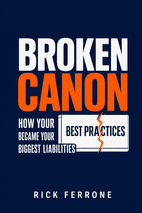
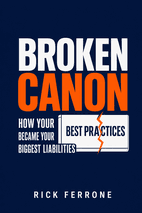
Rick Ferrone's Broken Canon traces the Productivity Paradox—trillions spent on digitizing work while productivity growth stays near 2%—to an unwritten "business canon" of inherited beliefs and practices, and the "canon tax" they impose. Through CEO Jim's conversations with guide Paul, it exposes flaws in hiring, budgeting, measurement, and mission statements. Written for leaders and managers whose standard fixes never stuck.
Feature
Insta.Page
Blinkist
Shortform
Summary Depth
Full Chapter-by-Chapter
15-min overview
Section-by-section guides
Audio Narration
✓
✓
✓
Full access to all 800+ summaries
✓
✓
✓
Visual Mindmaps
✓
✕
✕
AI Q&A
✓
✕
✕
Missing a book? Request it, usually live within 48h
✓
✕
✕
Quizzes
✓
✕
✕
PDF Downloads
✓
✕
✓
Send to Kindle
✓
✓
✓
Price
$89.99/yr
$146/yr (PRO)
$199/yr
*Competitor data last verified July 2026.
1 Page Summary
Rick Ferrone's Broken Canon: How Your Best Practices Became Your Biggest Liabilities argues that the decades-long mystery of the Productivity Paradox—trillions spent on digitizing and automating work while productivity growth stays stuck near 2% a year—traces back to a shared cause: an unwritten "business canon" of beliefs, assumptions, and inherited practices that companies run on but rarely question. Much of this canon is leftover industrial-age thinking, and digitizing it has only buried old flaws deeper, generating an ongoing cost the book calls the "canon tax." Ferrone frames the canon as flawed in three recurring ways—a missing piece, a misapplication, or an unintended consequence—and shows how these flaws surface in ordinary practices across hiring, decision-making, budgeting, measurement, mission statements, and teamwork. Chapter by chapter, familiar touchstones (the ham with three inches cut off, the gorilla-counting video, the GAaP gap between finance and operations, Apollo 13's reframed mission) expose how unexamined routines direct capable people toward the wrong work.
The book's distinctive approach is narrative and diagnostic rather than prescriptive. The concepts unfold through an extended story: Jim, a mid-sized software company CEO, arrives at a Costa Rica resort unable to name what is wrong, and through conversations with Paul—a guide who supplies questions rather than answers—he traces his symptoms back to the canon. Ferrone pairs this storytelling with research and evidence, citing the Productivity Paradox, Paul Nutt's finding that roughly half of organizational decisions fail, a later McKinsey survey showing similar coin-flip odds, and hiring statistics on failure and turnover. He introduces tools of thought—inattentional blindness, schema-driven perception, the gap, root causes—and tests them against recognizable management rituals like the committee spiral and the answer-first reflex. What makes the book distinctive is its insistence that the obstacle is invisible structure, not effort: the framework itself can direct hard work toward the wrong destination.
The intended audience is leaders and managers—CEOs, executives, operators—who have tried the standard fixes (consultants, reorganizations, offsites, new tools, OKRs) and found that none was enough. Readers will gain a way to see the canon operating in their own organizations, to distinguish efficiency from effectiveness in what they measure, to treat budgets as investment portfolios and talent as an asset whose value can be tracked, and to give separate departments a single shared finish line. The promised payoff is not another best practice but the ability to stop paying the canon tax: to find the flaws everyone inherited, correct them, and unlock the productivity that more technology alone has never delivered.
0. THE LOSS
Overview
Companies have spent decades and trillions digitizing, automating, and improving how they work, yet productivity has barely moved. Tools keep getting more powerful, and the next wave promises to scale whatever is already in place. Why the gains never arrived, and whether more power will widen the gap rather than close it, is the question.
Productivity growth in advanced economies has stayed near 2% a year for four decades while computing power rose more than a millionfold. Trillions went into deploying that power, but the gains did not follow. Economists call this the Productivity Paradox. The technology works. The problem runs through both people and leadership, so the cause has to be shared.
The shared cause is a common set of beliefs, assumptions, and practices passed down through schools, experts, and best practices. Think of it as the unwritten rulebook companies run on but rarely question. Much of it is leftover thinking from the industrial age. Digitizing and automating it did not redesign it; it buried old flaws deeper. The ongoing cost is what you might call the canon tax. Profits can hide it, but only correcting the flaws removes it. It shows up in ordinary practices. Financial reports were never designed to manage the business. Functions get treated as costs rather than investments. Teams work without a shared definition of winning. Missions do not guide anyone. People are not valued in any meaningful way.
The tax comes from running a bad playbook well, not from incompetence. AI will learn and apply the same rulebook, magnifying its flaws rather than fixing them.
The book recounts how physicians once spread infection unknowingly because handwashing between patients was not standard procedure. Even after the flaw was found, acceptance took decades. The same scrutiny should apply here. Fixing the flaws requires three questions. Why do you do it that way? Are you getting the results you want? Is there a better way?
Solutions can be summarized; problems must be understood through context. The first companies to remove the tax gain an unfair advantage.
Key Takeaways
The four-decade gap between computing power and output is not a technology failure; it is the cost of running firms on inherited industrial assumptions.
That inherited playbook costs real money even when profits conceal it, and executing it efficiently makes things worse rather than better.
AI trained on existing practice will reproduce and amplify the same defects, so adoption without redesign compounds the problem.
The long-delayed acceptance of handwashing shows that a flaw can be visible and still survive for decades. Fixes are easy to copy, but figuring out what is wrong takes context.
Firms that find and remove those inherited defects before competitors do gain a durable edge.
Key concepts: 0. THE LOSS
THE LOSS
The Productivity Paradox
Productivity growth stuck near 2% for four decades despite millionfold computing power increase.
Trillions invested in technology yielded little gain, known as the Productivity Paradox.
Technology works; the problem lies in people and leadership, so cause is shared.
The Inherited Playbook
Unwritten rulebook of beliefs and practices from industrial age, rarely questioned.
Digitizing and automating buried old flaws deeper instead of redesigning them.
Running a bad playbook well creates the canon tax, not incompetence.
The Canon Tax
Ongoing cost from flawed practices: financial reports not for management, functions seen as costs.
Teams lack shared definition of winning; missions don't guide; people not valued.
Profits can hide the tax, but only correcting flaws removes it.
AI Amplifies Flaws
AI will learn and apply the same flawed rulebook, magnifying defects.
Adoption without redesign compounds the problem rather than fixing it.
Fixing the Flaws
Handwashing example shows visible flaws can survive decades; acceptance takes time.
Three questions: Why do you do it that way? Are you getting results? Is there a better way?
First firms to remove the tax gain an unfair advantage.
💡 Try clicking the AI chat button to ask questions about this book!
1. THE ESCAPE
Overview
A leader on a rare break keeps getting pulled back to a problem he cannot name, even as his capable team keeps stumbling and no obvious crisis explains why. The harder he tries to pin it down, the more his usual fixes stop working.
The forced break
Kate planned the trip to the Four Seasons in Costa Rica after months of urging Jim to take a real break. He is a CEO of a mid-sized software company, and he arrives with work still crowding his attention. He wakes before six, leaves the room for coffee, and sits at the Bahia restaurant watching the staff work together in a way he envies. The company is not in crisis, he tells himself. It is a rough patch, with too many unforced errors, a weak year, and a board asking more questions. Three years into the job, he wants to believe the fix is a cleanup rather than an overhaul. Even a paddleboarding afternoon, the first time he feels on vacation, does not last: a call from CFO Nina reports a client problem he thought had been resolved six months earlier.
The pool-bar conversation
At the pool bar Jim meets Paul, an older man who lives a few miles down the coast and seems to know the bartender, Carlos. Their exchange comes down to the difference between staying busy and making progress. Paul points out that the daily routines of a job can push out the work itself. Jim admits the trouble has lasted months and says he cannot drop it, comparing it to a tune he cannot get out of his head. Paul asks whether anything obvious is wrong, then whether there might be nothing wrong at all, and maybe the bar has just moved. Jim rejects the idea. There is a problem, and he needs to name it.
The erased questions
That night Jim cannot sleep. He takes the guest journal and writes three questions, pressing hard into the page. He reads them repeatedly, taps the page, erases all three, and returns to bed.
Key Takeaways
When a rough patch drags on for months and nothing you try holds, ask whether the job itself is set up the right way, not just whether you are working hard enough inside it.
Keep the routines that fill a calendar separate from the work that actually moves the company. A well-run operation elsewhere is a useful comparison, not a distraction.
Stay open to the answer that nothing is broken and the bar has simply moved. A new normal is almost impossible to see from inside the daily routine.
Write the problem down and notice which version you erase. The question you cannot stand to read is the one doing the damage.
Notice when you cannot stop working even with nothing on fire. The break you refuse to take is a sign of the problem itself.
Key concepts: 1. THE ESCAPE
THE ESCAPE
The Unnamed Problem
Jim senses a persistent issue he cannot name or resolve.
Usual fixes stop working as the rough patch drags on.
He believes the fix is a cleanup, not an overhaul.
The Forced Break
Kate plans a Costa Rica trip to force Jim to rest.
Work still crowds his attention despite the vacation.
A CFO call interrupts his first moment of relaxation.
Busy vs. Progress
Paul distinguishes staying busy from making real progress.
Daily routines can push out the actual work.
Jim compares his problem to a tune stuck in his head.
The Erased Questions
Jim writes three pressing questions in a journal.
He erases all three, revealing what he cannot face.
The erased question is the one doing the damage.
Signs of the Real Issue
Inability to stop working signals the problem itself.
Consider whether the job is set up correctly.
Stay open to the idea that the bar has simply moved.
2. THE PROBLEM
Overview
A leader has tried the standard fixes and still cannot explain why progress keeps stalling. The harder question is whether the obstacle is something he cannot see, and how he would even know where to look.
At a Costa Rica resort, Jim, a CEO who rose from project manager, tells Paul that his company is stuck. He has tried:
consultants
reorgs
offsites
new tools
OKR
NPS
Each helped, he says, but none was enough. Losing a big client to a competitor that undercut them, then winning the client back, exposed cracks he wants sealed before the next storm. No team is assigned to the issue; everyone is heads down, and fire drills keep pulling people away. Jim also lists other unresolved concerns:
hiring, where many promising people do not work out and the hit rate is too low
alignment
execution
strategy that looks good on paper but does not reach daily work
pressure from investors, employees, and customers
The Business Canon
Paul says Jim has already taken the obvious and sensible steps. If nothing has surfaced, the problem may lie in flaws in the business canon, the shared assumptions and standard practices that people rely on without examining. He asks whether Jim might have a problem he cannot see because he does not know where to look. Jim insists he knows the operation inside and out. Paul points to the FedEx logo, whose hidden arrow Jim never noticed until it was shown to him. Business problems can hide in plain sight in the same way, present but unnoticed until someone directs attention to them. Jim accepts the analogy but says his company has no hidden arrows. Paul agrees he is probably right, then says it might still be worth a look.
Key Takeaways
When an organization is stuck, look for what's missing before you throw more money or people at it. Consultants, reorganizations, offsites, tools, and metric programs each helped a little, and none was enough. That pattern is the clue: the missing piece is something the standard toolkit doesn't cover.
The way your industry does things can be the obstacle, not the solution. If no one ever questions the usual playbook, you'll keep patching the same symptoms over and over.
The real constraint is often invisible from inside the operation. Not because the leader lacks information, but because people pay attention to what they're used to. Knowing how things run doesn't mean you can see what everyone has quietly agreed to ignore.
A cluster of unresolved complaints — weak hiring results, misalignment, execution drag, strategy that never reaches daily work, stakeholder pressure — points to one root cause, not five separate failures.
Problems with no owner don't get fixed. When every team is buried in current work and emergencies set the agenda, anything without a named owner and protected time stays exactly where it is.
Key concepts: 2. THE PROBLEM
THE PROBLEM
The Stuck Organization
Standard fixes (consultants, reorgs, tools) helped but none was enough
Losing and regaining a client exposed cracks to seal
Shared assumptions and practices relied on without examination
Industry playbook can be the obstacle, not the solution
Unquestioned norms lead to patching symptoms repeatedly
Invisible Constraints
Problems hide in plain sight, like the FedEx arrow
Leaders know operations but miss what everyone ignores
Attention to the familiar blinds us to the missing piece
One Root Cause, Not Many
Cluster of complaints (hiring, alignment, execution) points to one cause
Treating symptoms separately wastes effort and money
Look for what's missing before adding more resources
Ownership and Protected Time
Problems without an owner don't get fixed
Teams buried in current work and emergencies can't address root causes
Assign a named owner and protect time to solve the real issue
3. THE MYTH
Overview
Leaders can describe in detail how their company differs from every other, and that difference feels like proof their problems are unlike anyone else's. The real question is whether that belief matches reality, or whether it cuts them off from lessons that would otherwise apply.
Jim is convinced his firm is a special hybrid of software development, hands-on implementation and real client support. Paul pushes back by asking what Jim's customers buy besides his product. They use other suppliers too. Their buying habits can't make Jim's firm uniquely special. If sharing customers made a vendor unique, then every vendor serving those same customers would be unique in exactly the same way. And specialized labor shows up in every sector: software developers, actuaries, attorneys, electricians.
The outside looks different, but the inside runs on the same parts.
Paul lists what almost every company has. Finance, HR, IT, Sales, Marketing and Legal, usually organized by function. Common software such as ERP, G/L, CRM and payroll. Mission, vision and values statements. Strategic plans, budgets and performance measures. Competitors, positioning and pricing decisions. Internal communication channels.
Products and services can be distinctive, but the operation is built from the same parts. Leaders get isolated because they spend their careers in a few industries, and moving up narrows their view even more. Paul calls this structural reinforcement: the business world trains people to play up what makes their company different, including its problems.
Jim's leadership traits — handling complexity, connecting dots, motivating a team, communicating and prioritizing — aren't tied to any one industry. Given time to learn another sector's customers and constraints, he admits he could probably lead there. That admission undercuts the uniqueness claim.
The shared beliefs and practices form a canon — a standard playbook. Functional organization. Financial reporting. Hiring and performance management. Budgeting. Paul argues these are old designs from the 1920s and 1930s, now wrapped in software and dashboards. Companies built on the same model keep hitting the same stubborn problems, so the pattern is structural, not personal. The cost is the Canon Tax: weak companies may fail, while strong ones still earn less than they would without the drag.
The book cites Robert Solow's Productivity Paradox from the 1980s: chips have grown millions of times more powerful while productivity has risen only about 2% per year for decades. It also reports a Fortune survey of 6,000 senior executives in which nearly 90% said AI had not yet improved productivity. Automating broken processes hides and scales them. The uniqueness myth adds to the waste: firms reinvent solutions instead of borrowing from other industries, and consultants, academics and business books reinforce the same sector silos. Paul's example is an airline-industry fix that rescued a title insurance company from bankruptcy.
Jim would meet the same problems elsewhere, Paul says, but no other industry would hire him without sector experience.
Key takeaways:
Sharing customers can't make a vendor unique, because the same logic would make every supplier serving those customers unique in exactly the same way.
Nearly every company's operating core is built from the same parts — functional departments, standard enterprise software, planning rituals, budgets and performance measures — so industry differences are surface detail, not organizational structure.
Leadership capabilities such as handling complexity, connecting disparate information and motivating teams carry over across sectors; what doesn't transfer automatically is familiarity with a new industry's customers and constraints.
The accepted canon of functional organization, financial reporting, hiring practices and budgeting originated in the 1920s and 1930s and still drags on performance even at strong companies.
Automating an inherited process preserves and magnifies its flaws, and treating your own sector as exceptional discourages adopting solutions that have already worked in other industries.
Key concepts: 3. THE MYTH
THE MYTH
The Uniqueness Myth
Leaders believe their company's differences make its problems unique.
Sharing customers doesn't make a vendor unique; same logic applies to all suppliers.
Specialized labor exists in every sector, so it's not a differentiator.
Outside looks different, but inside runs on the same parts.
Common Operating Core
Almost every company has finance, HR, IT, sales, marketing, and legal departments.
Standard software like ERP, CRM, and payroll is ubiquitous.
Mission statements, strategic plans, budgets, and performance measures are universal.
Products may differ, but operations are built from the same components.
Structural Reinforcement
Leaders get isolated by spending careers in few industries.
Business world trains people to play up differences, including problems.
Leadership traits like complexity handling and team motivation are industry-agnostic.
Admitting ability to lead elsewhere undercuts uniqueness claim.
The Canon and Its Costs
Shared beliefs and practices form a standard playbook from the 1920s-30s.
Functional organization, financial reporting, hiring, and budgeting are old designs.
Companies on same model hit same stubborn problems; pattern is structural.
Canon Tax: weak firms fail, strong firms earn less than they could.
Productivity Paradox and Waste
Solow's paradox: chips grew powerful but productivity rose only ~2% yearly.
Fortune survey: 90% of executives say AI hasn't improved productivity.
Automating broken processes hides and scales flaws.
Uniqueness myth causes reinventing solutions instead of borrowing from other industries.
You've reached the end of the free chapters
Next chapter: “THE BAIT” is locked
Keep reading Broken Canon — and unlock all 800+ book summaries with audio, mindmaps and AI Q&A.
$0.00 due today · 7 days free, then $89.99/year ($7.49/mo) · Cancel anytime before day 7
Rick Ferrone is an American author and outdoor enthusiast known for his book Toughing It Out: How to Survive in the Wilderness, which offers practical guidance on bushcraft and emergency survival skills. His writing draws on his extensive experience with hiking, camping, and self-reliance in remote environments. Ferrone's work is aimed at readers seeking accessible, hands-on knowledge for staying safe and resourceful outdoors.
Frequently Asked Questions about Broken Canon
What is Broken Canon about?
The book examines why decades of digitization, automation, and management improvement have not produced expected productivity gains, pointing to the Productivity Paradox. It argues companies run on a business canon—inherited beliefs, assumptions, and practices from the industrial age—that creates hidden costs called the canon tax. Through the story of CEO Jim and his conversations with Paul, it shows how leaders try standard fixes like consultants, reorganizations, tools, and OKRs yet miss deeper design flaws. It then explores practical ways to challenge those assumptions and improve decisions, goals, measurement, talent, and teamwork.
Who is the author of Broken Canon?
Rick Ferrone is the author of the book, though the supplied chapter material does not provide biographical details about him. The content is presented through a business narrative featuring CEO Jim and his conversations with Paul.
Is Broken Canon worth reading?
It is worth reading for leaders who have tried the usual fixes—consultants, reorganizations, new tools, OKRs—and still see progress stall. The book offers a structured way to spot hidden assumptions, define goals, find root causes, improve decision-making, and connect measurement, hiring, budgeting, and teamwork to real value. Its narrative style makes abstract management flaws concrete and actionable.
What are the key lessons from Broken Canon?
One key lesson is that technology and automation cannot fix flawed practices; digitizing an outdated business canon can bury old problems deeper and create a costly canon tax. Leaders should question inherited management beliefs, define specific outcomes, assess the current gap, and identify root causes before choosing fixes. Decision-making deserves priority over execution because a bad decision cannot be rescued by faster implementation. Companies also need shared goals, meaningful value measures, better talent screening, and budgets treated as investment portfolios rather than cost guardrails.
📚 Explore Our Book Summary Library
Discover more insightful book summaries from our collection