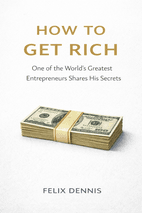
Felix Dennis's How to Get Rich delivers a brutally honest, contrarian guide to wealth accumulation, arguing that success requires obsession, ownership, and immense personal sacrifice. It's for aspiring entrepreneurs seeking a sobering reality check, not a get-rich-quick scheme.
Feature
Insta.Page
Blinkist
Shortform
Summary Depth
Full Chapter-by-Chapter
15-min overview
Section-by-section guides
Audio Narration
✓
✓
✓
Visual Mindmaps
✓
✕
✕
AI Q&A
✓
✕
✕
Quizzes
✓
✕
✕
PDF Downloads
✓
✕
✓
Price
$89.99/yr
$146/yr (PRO)
$199/yr
*Competitor data last verified July 2026.
1 Page Summary
In How to Get Rich, the late British publishing magnate and poet Felix Dennis delivers a brutally honest, contrarian, and often profane guide to wealth accumulation, drawn from his own journey from a hippie magazine editor to a multi-millionaire. The central thesis is unflinching: getting rich is extremely difficult, requires immense sacrifice, and is not for everyone. Dennis dismantles common myths, arguing that ideas are worthless without execution, that "passive income" is largely a fantasy for the novice, and that the primary driver of wealth is ownership—specifically, owning a substantial stake in a successful business. He emphasizes that the desire for money must be an "obsession" that overrides comfort, leisure, and often personal relationships.
Dennis's approach is distinctively grounded in gritty, firsthand experience rather than theoretical finance. The book is filled with autobiographical anecdotes, from his early legal battles with Oz magazine to launching Maxim and building his empire, which serve as cautionary tales and object lessons. His style is deliberately provocative and memorable, using lists, boldfaced maxims, and repetitive mantras like "ACTION CHANGES THINGS" to hammer home his points. What sets it apart is its focus on the psychological and personal cost of the pursuit, frankly discussing the loneliness, stress, and compromises involved, making it less a cheerful self-help manual and more a sobering reality check.
The intended audience is not those seeking get-rich-quick schemes or investment tips, but rather aspiring entrepreneurs with the stomach for a relentless, all-consuming endeavor. Readers will gain not a step-by-step plan, but a clear-eyed framework for the required mindset: the necessity of boldness, the importance of retaining equity, the art of hiring people smarter than oneself, and the critical need to persevere through failure. Ultimately, Dennis's core offering is a dose of unvarnished truth about the trade-offs of the wealth-creation process, compelling the reader to seriously answer the book's opening question: "Do you really, really want to be rich?"
Introduction: How Rich?
Overview
This chapter sets the stage by exploring what it truly means to be rich in the modern world, distinguishing between astronomical fortunes and the attainable wealth that brings freedom and choice. With a conversational and often witty tone, it dismisses the pursuit of billionaire status, focusing instead on a more pragmatic goal: becoming "common or garden rich" enough to buy time, options, and independence. The discussion navigates the slippery nature of wealth measurement, the psychology of envy, and the stark reality that money doesn't guarantee happiness, all while preparing the reader for the journey ahead.
Defining the "Common or Garden Rich"
The author clarifies that this book isn't for those dreaming of Gates-like empires or inherited dukedoms. Instead, it's for anyone who desires a more accessible form of richness—enough to stop worrying about prices, to retire or work passionately, to live and travel freely, and to ultimately purchase time and autonomy. This level of wealth also brings the less glamorous side of affluence: the inevitable attention from tax planners and advisors, and a peculiar kind of respect born from envy rather than admiration for virtue.
The Shifting Value of a Million
Money's value is never static. The chapter points out that using purchasing power over the last 25 years as a rough guide, a million dollars today has less than half the buying power it did in 1980. This relativity makes defining "rich" a moving target, emphasizing that wealth must be considered in contemporary terms rather than historical figures.
Two Ways to Measure Wealth
To cut through the complexity, the author provides two distinct frameworks. The first table measures cash-in-hand or quickly realizable assets, ranging from "The comfortable poor" ($100k-$400k) to "The filthy rich" (over $200 million). A crucial note is that even the very wealthy rarely have such vast sums in liquid form, as converting assets triggers taxes and requires careful planning.
The second table addresses total net worth or true asset value, which includes illiquid assets like property and private holdings. Here, "rich" begins at the "lesser rich" tier of $30-$80 million. The author stresses that true net worth is notoriously hard to pin down due to taxes, estate planning, and the sheer complexity of large portfolios, leading many wealthy individuals to distrust published rich lists.
The Happiness Paradox and Your Goal
A sobering reminder is offered: wealth does not equal happiness and often brings stress and guilt. Quoting James Baldwin, the author compares money to sex—it consumes your thoughts only when you lack it. Yet, acknowledging that readers are here for riches, not philosophy, a clear target is set. The book aims to help you reach the "lesser rich" bracket of $30-$80 million in total assets, a starting point that might barely edge you onto a British rich list but signifies substantial financial success.
Beyond Conventional Measurements
The chapter playfully suggests alternative ways to gauge wealth, like "Availability on Request" (having a fairy godmother for funds) or "Lifetime Spending Totals." These highlight the arbitrariness of all measurements and note that many born into "old money" are effectively cash-poor due to assets being locked in trusts, underscoring the difference between perceived and accessible wealth.
Key Takeaways
This book targets achievable, "common or garden" wealth that grants freedom and time, not billionaire status.
Wealth is relative; its purchasing power erodes over time, so modern benchmarks are essential.
There's a critical distinction between liquid, spendable assets and total net worth, with the latter being difficult to calculate accurately.
True "richness" in terms of total assets begins around $30-$80 million, according to the author's framework.
Acquiring significant wealth does not automatically lead to happiness and introduces new complexities like tax planning and managed envy.
All measurements of wealth are somewhat arbitrary, but setting a clear goal is the first step toward attaining it.
Key concepts: Introduction: How Rich?
1. Introduction: How Rich?
Target Audience & Goal
Aims for 'common or garden rich', not billionaire status
Wealth that buys time, freedom, and independence
Dismisses pursuit of astronomical fortunes
The Relativity of Wealth
Purchasing power erodes over time
A million today is worth less than half of 1980
Defining 'rich' is a moving target
Two Frameworks to Measure Wealth
Liquid assets vs. total net worth
True net worth includes illiquid assets like property
Wealth lists are often inaccurate due to complexity
The Wealth-Happiness Paradox
Money doesn't guarantee happiness
Wealth can bring stress and guilt
Focus is on financial goal, not philosophy
Arbitrary Nature of Measurements
Alternative gauges like 'Availability on Request'
Perceived vs. accessible wealth differs
Old money may be asset-rich but cash-poor
💡 Try clicking the AI chat button to ask questions about this book!
Chapter 1: Pole Positions
Overview
Overview
The chapter tackles the most common barrier to building wealth: getting started. It dismantles the three primary, age-related excuses people use to avoid beginning their journey—being too young and inexperienced, being too comfortable in a mid-level career, and being too entrenched as a senior professional with responsibilities. The author argues that all these objections are spurious and that each life stage, far from being a handicap, offers unique advantages for those determined to become rich.
Your Background is Not an Obstacle
Before addressing the age-based excuses, the author makes a foundational declaration: money itself is utterly neutral. It does not discriminate based on race, gender, upbringing, or education. While people may create barriers through prejudice, the pursuit of wealth is only limited by one's own belief in these external limitations. If you believe your background disqualifies you, you have already failed.
The Young, Penniless, and Inexperienced
Contrary to popular belief, this is the most advantageous position from which to start. Having nothing means there is nothing to lose, which fosters a natural risk-tolerance and fearlessness. This group possesses immense stamina, a callousness toward failure that aids quick recovery, and an intuitive grasp of modern technology—all critical assets. Their greatest weapon is their ignorance of "conventional wisdom," allowing them to attempt what others deem impossible. The author cites personal examples, like launching successful poster-magazines and early computing titles, as victories achieved by ignoring naysayers. Most importantly, their lack of expertise makes them willing to learn, a trait more valuable than any initial capital.
The Slightly Better Off and On the Way Up
This group, often mid-career professionals, hesitates due to the fear of losing hard-earned security—a good job, status, and future promotions. They see market niches but are paralyzed by the fear of failure. The author, as an employer, confesses he respects and even fears employees in this category who leave to start their own ventures. He encourages them to act, framing the potential departure not as a betrayal but as a natural progression. The leverage they have with a current employer is greater than they think, and taking the plunge is the only way to discover it. Their window is closing as comfort sets in and stamina wanes.
The Senior Manager or Professional
This demographic has vast experience and industry knowledge but is heavily burdened by responsibilities: mortgages, children's education, and a comfortable lifestyle. They have watched others fail and use these observations as excuses for their own inaction. The author is blunt: these responsibilities are often a smokescreen for a deeper unwillingness to risk their established position. While their odds are slimmer due to ingrained caution, it is not impossible. Their best strategy, if they possess the lingering hunger evidenced by picking up the book, is to partner with a young, fearless counterpart who can supply the stamina and risk-appetite they lack.
Key Takeaways
The perceived obstacles to starting are almost always excuses, not valid limitations.
Each stage of life and career offers specific, exploitable advantages for wealth creation.
Youth's advantage is having nothing to lose, boundless stamina, tech-savviness, and a blissful ignorance of so-called "conventional wisdom."
Mid-career's challenge is overcoming the fear of losing comfort and security; action must be taken before comfort becomes permanent.
Senior professionals' hurdle is cutting through the camouflage of responsibility to acknowledge their own risk-aversion; partnership can be a solution.
Money is neutral; only your own beliefs and actions can limit your potential to acquire it.
Key concepts: Chapter 1: Pole Positions
2. Chapter 1: Pole Positions
Money is Neutral
Money does not discriminate based on background
Only self-imposed beliefs create limitations
External barriers are often internalized excuses
Advantages of Youth
Nothing to lose fosters risk tolerance
Ignorance of conventional wisdom enables innovation
High stamina and quick recovery from failure
Intuitive grasp of modern technology
Mid-Career Hesitation
Fear of losing hard-earned security paralyzes action
Comfort becomes a trap that closes the window
Current employer leverage is greater than realized
Senior Professional Challenges
Responsibilities often camouflage risk aversion
Vast experience paired with ingrained caution
Partnership with youth can supply missing elements
Core Argument Against Excuses
Age-related objections are spurious limitations
Each life stage offers unique exploitable advantages
Starting is the primary barrier to building wealth
Chapter 2: A Million to One
Overview
Overview
This chapter dismantles the myth that becoming rich is a near-impossible statistical fluke. By examining the raw numbers and then realistically accounting for who is actually in the race, it reveals that the odds are far more favorable for those with the drive and determination to try. Blending statistical analysis with cultural observations and personal confession, it argues that the biggest barrier isn't the math, but one's own mindset.
The Misleading Nature of Raw Statistics
At first glance, the arithmetic seems daunting. Using the UK as an example, only about 0.000016% of the population qualifies as rich—a mere sixteen chances in a million. This frames wealth as a lottery with terrible odds. However, this initial calculation is a classic case of lies, damned lies, and statistics, as it ignores the crucial human factors that shape the competition.
Who Is Really Excluded from the Race?
The field of potential rivals shrinks considerably when we consider who, for various reasons, is unlikely or unable to compete seriously for wealth. Poor health can sap the necessary stamina, while advanced age or mental handicaps present significant hurdles. In fact, close to 40% of the population may fall into these categories. Furthermore, millions work in sectors like government, where becoming rich is highly improbable. Most critically, only a small fraction of people—perhaps as low as 3%—possess the genuine desire and single-minded dedication required to build substantial wealth.
How the Odds Dramatically Improve
When these exclusions are factored in, the probability transforms. Starting from sixteen in a million, the odds of joining the top thousand richest in the UK improve to about one in a thousand. This shift highlights that the pool of serious contenders is much smaller than the total population, making the goal far more accessible for those who commit to it.
A Cultural Lens and a Personal Warning
The journey is also influenced by culture. The author points out that American society generally encourages wealth creation, while in Europe, a subtle social stigma can still persist. From a personal perspective, the chapter offers a cautionary tale. The pursuit itself can become a destructive addiction, leading to health issues and personal chaos—a truth the author learned from hard experience. Yet, this is framed not as a reason to avoid wealth, but as a pitfall to be aware of and manage.
The Imperative to Begin
Ultimately, the chapter dismisses the odds as an excuse. If daunting statistics deter you, you likely lack the essential fortitude, and you will, as a consequence, remain poor. The narrative thus pivots from analyzing barriers to issuing a call to action. The time for hesitation is over; the real work of getting started begins now.
Key Takeaways
The initial statistical odds of becoming rich are misleading because they don't account for the vast number of people who are not actively competing.
Factors like health, age, profession, and, most importantly, personal desire dramatically narrow the field of serious contenders.
Cultural environment matters, with the U.S. typically being more conducive to wealth creation than Europe.
The pursuit of wealth can be addictive and carry personal risks, but these are not inevitable consequences and can be mitigated with self-awareness.
Letting perceived long odds discourage you is a guarantee of failure; action and determination are the true differentiators.
Key concepts: Chapter 2: A Million to One
3. Chapter 2: A Million to One
The Misleading Raw Statistics
Initial odds frame wealth as a near-impossible lottery
Ignores crucial human factors shaping the competition
Who Is Not Seriously Competing
Health, age, or disability exclude many
Certain professions make wealth improbable
Only a small fraction possess genuine desire
The Dramatically Improved Odds
Odds improve when factoring out non-contenders
Goal becomes far more accessible for the committed
Cultural and Personal Considerations
American society encourages wealth creation more
Pursuit can become a destructive addiction
Risks are manageable with self-awareness
The Call to Action
Letting odds deter you guarantees failure
Action and determination are the true differentiators
Chapter 3: Harnessing the Fear of Failure
Overview
The chapter confronts the most common and paralyzing obstacle on the path to wealth: the fear of failure. It argues that this fear, often manifested as a dread of public embarrassment or letting others down, is the primary reason people never start. Rather than a monstrous foe to be defeated, the author suggests this fear should be recognized, understood, and ultimately harnessed as a source of energy and a competitive advantage.
The Cult of the Jeremiah
The world is filled with “Jeremiahs”—people who take pleasure in doom-mongering and pointing out every potential risk in a new venture. They often hide behind committees, a mechanism designed to diffuse future blame rather than to foster decisive action. While robust debate is valuable, endless prevarication is the enemy of progress. The author shares a costly personal lesson: he was dissuaded by a well-meaning executive from launching a personal computer magazine, only to later buy into a competitor’s successful title at a significant premium. The core failure was his own in listening to the Jeremiah and delaying action.
The Two-Headed Monster
The fear of failure has two core components. The first is the fear of letting down oneself or others, potentially leading to financial calamity. The author questions the real scale of this calamity, especially for those starting with little, noting that the fear of embarrassment is often far more powerful than the fear of actual financial ruin.
This leads to the second, stickier component: the fear of having one’s failure broadcast to the world. This dread of public judgment and potential mockery is a powerful deterrent, whether in a corporate boardroom or an individual’s career choice. People will often impute their own fears of failure to others (like “company morale”) as a form of coded, socially acceptable cowardice.
The Roads Not Taken
Through personal anecdotes, the chapter illustrates how this public fear dictates life-altering decisions. He tells of “Julie,” a bright young woman who chose the safe, respectable path of a bioengineering Ph.D. over taking over her father’s used-car business, a venture with real wealth-building potential. Her choice was swayed by the fear of failing in a very public, male-dominated arena. Similarly, he reflects on his own mother’s unrealized potential, constrained not by ability but by the crushing social expectations of her era that made a woman’s business ambition taboo. In both cases, caring too much about the opinion of the community blocked the path to wealth.
Growing a Carapace
The essential armor for any would-be wealth creator is a mental “carapace”—a thick enough skin to withstand the inevitable schadenfreude (joy in others’ misfortune) that comes with both failure and success. One must be prepared for initial mockery, gloating during setbacks, and envy upon achievement. This social friction is presented as a certain tax on the attempt to rise financially.
The Uncomfortable Checklist
The chapter culminates in a blunt checklist of non-negotiable attitudes. If you cannot subscribe to these, the author suggests you abandon the quest. The list includes being willing to fail publicly, not caring what the neighbors think, bearing the worry you cause loved ones, being prepared to work punishing hours, treating the quest as a game, and, fundamentally, facing down your fear of failure. Wealth requires sacrifice, often from those around you as well as yourself.
From Nightmare to Steed
The final shift is a strategic one: reframing the fear of failure from a terrifying monster (the “800-pound gorilla”) into a nightmare—a horse. A horse can be tamed, harnessed, and ridden. The very emotion that restrains smarter, more capable people becomes your opportunity if you can learn to master it. You cannot surrender to it; you must confront it, go around it, or cozy up to it. The chapter concludes with the author’s firm conviction that this fear is the single biggest gatekeeper to wealth. If you cannot open that gate, you will never get started.
Key Takeaways
The Primary Obstacle: Fear of failure, particularly the fear of public embarrassment and judgment, is the most significant barrier to beginning the journey to wealth.
Beware the Committee: Endless debate and committee formation are often just fear-driven tactics to avoid responsibility and blame, not genuine risk assessment.
The Social Cost: Achieving wealth often requires developing a thick skin to withstand mockery for trying and envy for succeeding. Caring excessively about others’ opinions is a wealth deterrent.
The Personal Cost: The pursuit requires significant personal sacrifice and may impose worry and strain on close relationships—a cost that must be accepted.
Reframe the Fear: Successful individuals do not eliminate the fear of failure; they learn to harness its energy. View it not as a paralyzing monster but as a powerful force that can be disciplined and used to your advantage.
The Brutal Truth: If you cannot meet the basic mental and emotional demands of this pursuit—outlined in the author’s checklist—you are unlikely to succeed, and there is no shame in choosing a different path.
Key concepts: Chapter 3: Harnessing the Fear of Failure
4. Chapter 3: Harnessing the Fear of Failure
Nature of the Fear of Failure
Primary barrier is fear of public embarrassment
Two components: letting others down and public judgment
Fear often outweighs actual financial risk
External Obstacles: The Jeremiahs
Beware of doom-mongers who highlight every risk
Committees often diffuse blame rather than enable action
Endless debate is the enemy of progress
Social and Personal Costs
Caring about community opinion blocks wealth paths
Requires thick skin against mockery and envy
Pursuit imposes strain on close relationships
Essential Mindset Requirements
Must be willing to fail publicly
Treat the quest as a challenging game
Accept punishing work hours and personal sacrifice
Transforming Fear into Advantage
Reframe fear from monster to harnessable force
Master fear that restrains smarter competitors
Fear becomes your opportunity when tamed
You've reached the end of the free chapters
Next chapter: “The Search” is locked
Keep reading How to Get Rich — and unlock all 600+ book summaries with audio, mindmaps and AI Q&A.
$0.00 due today · 7 days free, then $89.99/year ($7.49/mo) · Cancel anytime before day 7
Felix Dennis was a British publisher, poet, and philanthropist best known for founding Dennis Publishing, which launched iconic magazines such as *Maxim* and *The Week*. He achieved significant success in magazine publishing before later gaining recognition for his poetry, notably with his collection *A Glass Half Full*.
📚 Explore Our Book Summary Library
Discover more insightful book summaries from our collection