HOW TO GET RICH Quotes
by Naval Ravikant
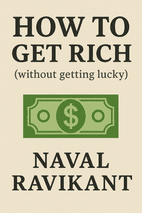
This page collects the sharpest lines from Naval Ravikant's book on wealth. Each quote cuts through the noise to deliver a clear, actionable truth. You will find ideas about owning your time, building leverage, and rejecting status games. What makes this book so quotable is that Naval distills complex economic and psychological principles into simple, memorable statements. He doesn't sugarcoat. He gives you the raw mechanics of getting rich and staying free. These are the lines that stick in your mind and change how you think about money.
Top Quotes from HOW TO GET RICH
“The reason you want wealth is because it buys you your freedom.”
Naval explains the purpose of wealth after defining it as assets that earn while you sleep.
It reframes wealth as a means to personal autonomy rather than material excess, resonating with anyone seeking to escape a soul-crushing job or lifestyle.
“Wealth isn’t about taking something from somebody else—it’s about creating abundance for the world.”
The opening line of the chapter, setting the thesis for ethical wealth creation.
It reframes wealth as a positive-sum game, challenging the common belief that making money is inherently exploitative.
“Making money isn’t about luck. It’s about becoming the kind of person who makes money.”
Naval states the core thesis of the chapter.
It reframes wealth creation as an internal transformation rather than external chance, empowering readers to take control.
“You are not going to get rich renting out your time. You must own equity, a piece of the business to gain your financial freedom.”
Nivi cites Naval’s first point on the only path to wealth.
This line challenges the conventional belief that hard work alone leads to riches, emphasizing ownership over labor. It serves as a memorable mantra for entrepreneurs seeking financial independence.
“People living far below their means enjoy a freedom that people busy upgrading their lifestyles just can’t fathom.”
Naval Ravikant, discussing the importance of not upgrading your lifestyle too quickly.
This line captures the essence of the chapter—that freedom comes from restraint, not consumption. It resonates because it flips the conventional wisdom that more spending equals more happiness.
“Society will pay you for creating what it wants, but doesn't know how to get, and delivering it at scale.”
Opening line of the chapter.
This sentence perfectly encapsulates the book's core thesis on wealth creation, making it instantly memorable and actionable.
“The internet means you can find your audience for your product, or your talent, and skill no matter how far away they are.”
Naval explains the internet's superpower of global connectivity.
This line emphasizes the radical shift from local limitations to global reach, empowering anyone with a unique skill. It resonates because it makes the abstract concept of 'scaling' concrete and personal.
Themes Behind the Quotes
A central theme is that wealth comes from creating value, not taking it. Naval emphasizes that money is a record of past contributions to society. Another major idea is the necessity of ownership. Renting out your time caps your potential, so you must own equity or use leverage to disconnect input from output. Living below your means is also key. It buys you freedom and removes the pressure to chase status. Finally, the internet is portrayed as the ultimate equalizer. It allows anyone to scale a unique skill or product to a global audience, making niche obsessions profitable.
Quotes by Chapter
1. Seek Wealth, Not Money or Status
“Status is your ranking in the social hierarchy.”
Naval distinguishes status from wealth while discussing the two fundamental games people play in life.
This simple, clear definition helps readers instantly grasp the zero-sum nature of status, contrasting it with the positive-sum nature of wealth.
2. Make Abundance for the World
“Today, I would rather be a poor person in a First World country, than be a rich person in Louis the XIV’s France.”
Naval explains how technological progress has made even the poor today wealthier than historical aristocrats.
This stark comparison vividly illustrates the immense abundance created by innovation, making the abstract concept of wealth creation tangible.
“I don’t think capitalism is evil. Capitalism is actually good. It's just that it gets hijacked.”
Naval defends capitalism while acknowledging its vulnerabilities to corruption and monopolies.
It offers a nuanced defense of a often-maligned system, separating the ideal from its abuses and encouraging constructive reform.
“This idea that it's stolen is this horrible zero-sum game that people who are trying to gain status play.”
Naval critiques the misconception that all wealth is taken from others.
It calls out the destructive mindset of zero-sum thinking, which stifles cooperation and innovation in favor of status competition.
3. Free Markets Are Intrinsic to Humans
“We're the only animals who cooperate across genetic boundaries, because we can track credits and debits in voluntary exchanges.”
Naval explains the biological basis for free markets early in the chapter.
It articulates the unique human trait of voluntary exchange, making free markets seem natural and inevitable.
“If you get too many takers, and not enough makers, society falls apart.”
Naval warns about the imbalance between producers and consumers.
It succinctly captures the danger of a society that prioritizes consumption over production, a warning that resonates in political discourse.
“That's the game that keeps the iPhone buzzing in your pocket.”
Naval lists tangible benefits of the market system.
It uses a modern, relatable example to illustrate how the economic system directly impacts daily life, making abstract concepts concrete.
4. Making Money Isn’t About Luck
“I like to think that if I lost all my money and if you drop me on a random street in any English-speaking country, within 5, 10 years I'd be wealthy again.”
Naval illustrates his belief that wealth-building is a reproducible skill.
This vivid scenario inspires confidence that financial success can be rebuilt through learned abilities, not luck.
“In 1,000 parallel universes, you want to be wealthy in 999 of them.”
Naval describes his goal of achieving wealth through skill rather than randomness.
The parallel universe metaphor powerfully emphasizes the desire for reliable, repeatable success over rare lucky breaks.
5. Make Luck Your Destiny
“Build your character in a way so luck becomes deterministic.”
Naval explains the fourth kind of luck, where character turns luck into destiny.
It succinctly captures the chapter's central philosophy that personal character can systematically attract opportunity.
“We make our fortunes and we call them fate.”
Nivi quotes former UK Prime Minister Benjamin Disraeli to describe the fourth kind of luck.
The aphorism is poetic and timeless, reinforcing that what we call luck is often a product of our own actions.
“You can’t be normal and expect abnormal returns.”
Nivi quotes Stanford professor Jeffrey Pfeffer to emphasize the need for unconventional behavior.
It delivers a punchy, memorable warning that mediocrity cannot produce extraordinary outcomes.
“Play stupid games win stupid prizes.”
Naval uses this as an opposite example, warning against wasting time on social status games.
Its blunt, colloquial style sticks in the mind and urges focus on meaningful pursuits.
6. You Won’t Get Rich Renting Out Your Time
“In almost any salaried job, even at one that’s paying a lot per hour like a lawyer, or a doctor, you're still putting in the hours, and every hour you get paid.”
Naval explains the inherent limitation of hourly work.
It vividly illustrates why even high-paying jobs fail to create real wealth by tying income to time. This resonates with anyone feeling stuck in a linear income model.
“You really just want a job, or a career, or a profession where your inputs don't match your outputs.”
Naval advises on choosing a career that allows non-linear earnings.
This provides a clear, actionable principle for career selection focused on leverage and creativity. It shifts the mindset from working harder to working smarter.
“Tools and leverage are what create this disconnection between inputs and outputs.”
Naval defines the mechanism behind wealth creation.
It succinctly explains the key to non-linear wealth: using tools to amplify effort. This insight helps readers understand how to escape the time-for-money trap.
7. Live Below Your Means for Freedom
“The most dangerous things are heroin, and a monthly salary.”
Naval quotes Nassim Taleb to illustrate the addictive nature of steady income.
The shocking comparison between a monthly salary and heroin highlights how routine paychecks trap people in a wage-slave mentality. It sticks in the mind because it sharply redefines what 'dangerous' means in financial life.
“The way you want to get wealthy is you want to be poor, and working, and working, and working.”
Naval explains the counterintuitive path to wealth through deferred gratification.
This sentence challenges the get-rich-quick mindset by embracing delayed rewards. Readers find it memorable because it reframes poverty and hard work as strategic choices rather than misfortunes.
“You basically, once you make a little bit of money, you still want to be living like your old self, so that just the worry goes away.”
Naval advises maintaining a modest lifestyle even after earning money.
This simple, practical advice directly links frugality to peace of mind. It resonates because it promises that financial worry disappears when you refuse to inflate your lifestyle.
8. Give Society What It Doesn’t Know How to Get
“You will get rich by giving society what it wants, but does not yet know how to get at scale.”
Naval, co-author, responds to Nivi's observation about renting time.
This direct, pithy restatement of the chapter's message is easy to recall and repeat, serving as a powerful mantra for entrepreneurs.
“Money is IOUs from society saying, "You did something good in the past. Now here's something that we owe you for the future."”
Naval explains the nature of money earlier in the chapter.
This metaphor reframes money as a record of past value, making the abstract concept tangible and motivating readers to focus on creating real value.
“Entrepreneurship is essentially an act of creating something new from scratch. Predicting that society will want it, and then figuring out how to scale it, and get it to everybody in a profitable way, in a self-sustaining way.”
Naval summarizes the entrepreneurial process near the end of the chapter.
This definition distills entrepreneurship into a clear, three-step formula—creation, prediction, and scaling—that is both inspirational and practical for aspiring founders.
9. The Internet Has Massively Broadened Career Possibilities
“The Internet has massively broadened the possible space of careers, by allowing you to scale any niche obsession.”
Naval states the chapter's core thesis at the start.
It succinctly captures the central insight of the chapter: the internet transforms niche interests into viable careers. Readers remember it as the key takeaway.