Dealing with Uncertainty Quotes
by Laurie Bowman
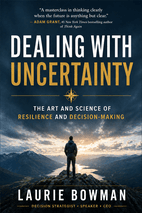
Welcome to this collection of quotes from Laurie Bowman's Dealing with Uncertainty. Here you will find insights on courage, resilience, and the art of making decisions when the outcome is unknown. These lines capture the book's practical wisdom for navigating life's unpredictable moments.
What makes this book so quotable is its blend of honesty and compassion. Bowman writes from experience, offering truths that are both hard hitting and hopeful. The quotes are not just memorable; they are actionable reminders that uncertainty can be a source of growth. They stick with you long after you read them.
Top Quotes from Dealing with Uncertainty
“Preparation isn’t about erasing uncertainty but about acting with integrity despite it.”
The author reflects on their experience preparing a parliamentary submission in just two days.
This line distills the core message of the chapter—that uncertainty cannot be eliminated, but we can choose to act with integrity—making it both instructive and empowering.
“Uncertainty isn't a delusion to be shunned; it’s a reality to understand and confront.”
The author concludes the analysis of the Gabba Stadium redevelopment saga.
It boldly reframes uncertainty from a threat to an opportunity, urging readers to face it head-on rather than avoid it.
“The psychological pain of losing is more intense than the pleasure of an equivalent gain.”
The author explains prospect theory and loss aversion in the section on behavioural science.
This succinctly captures a fundamental insight into human decision-making, helping readers understand why they often hesitate or cling to the status quo.
“See clearly, decide wisely, and act with purpose.”
The author concludes the introductory section on decision-making frameworks.
This succinct mantra encapsulates the core philosophy of the chapter, making it easy to remember and apply under pressure.
“Adversity is not the end of the story. It's often the beginning of a better one.”
Author concluding their personal story of financial collapse and recovery.
It offers a hopeful and memorable reframe of hardship as a catalyst for growth, leaving readers with an uplifting takeaway.
“Resilience isn’t achieved by controlling life. It results from staying centred in the midst of life’s chaos.”
The author reflects on lessons learned from personal loss and meditation practice.
This powerful two-sentence contrast redefines resilience as inner steadiness rather than external control, offering a liberating perspective for readers facing uncertainty.
“The brutal truth does not get better with time.”
The author shares a hard-won lesson from insisting on transparency during a pumped hydro project review.
This blunt, memorable statement drives home the importance of facing uncomfortable realities early, making it a powerful call to action for leaders and individuals alike.
Themes Behind the Quotes
One central theme is the acceptance of uncertainty as an inherent part of life. Rather than trying to eliminate it, the book encourages readers to confront it with clarity and purpose. This involves shifting from a mindset of control to one of possibility, where setbacks become opportunities for growth. Mindfulness plays a key role in staying centered amid chaos.
Another theme is the importance of emotional and relational intelligence. Resilience is not about toughness alone; it requires humility, connection, and honest communication. Courage means taking risks that align with your values, and growth comes from surrendering control to learn and adapt. These ideas together form a practical philosophy for navigating uncertainty.
Quotes by Chapter
Chapter 1: Understanding the Nature of Uncertainty
“Belief alone can trigger fundamental, measurable changes in the body.”
The author discusses the placebo effect and its implications for leadership.
It highlights the tangible power of mindset, showing that optimism and conviction are not just abstract ideas but have real biological effects.
Chapter 2: Decision-Making Frameworks: An Introduction
“Ultimately, the goal isn't to use every tool all the time. It's to understand the principles behind them, so that even under pressure, our decisions align with core values, strategic intent, and long-term resilience.”
The author reflects on the purpose of decision-making frameworks in the business world.
It shifts focus from mechanical tool usage to deeper understanding, emphasizing values and resilience—a timeless lesson for leaders.
“In times of uncertainty, stepping back to weigh the true costs and benefits—instead of succumbing to pride or other immediate emotions—can transform disappointment into opportunity.”
This insight comes from the story of Rachel, a professional passed over for promotion.
It offers actionable wisdom for anyone facing setbacks, showing how structured thinking can turn a painful moment into a growth opportunity.
“This tragedy underscores a critical lesson: CBAs must evaluate all options, identify hazards early, and incorporate contingencies for social and environmental risks over the project's lifecycle.”
The author reflects on a weir collapse that killed a child, caused by a flawed cost-benefit analysis.
It delivers a stark, memorable warning about the human cost of incomplete analysis, reinforcing the need for ethical rigor in decision-making.
Chapter 3: When Finance Becomes the Risk: Rethinking Resilience Beyond Cost-Cutting
“Financial risk is not just a line item on a balance sheet but a force that shapes lives, organizations, and communities.”
Opening of the chapter, defining the central theme of financial risk.
It powerfully reframes risk from a dry abstract number to something that deeply affects people and society, making the topic immediately relatable.
“That experience taught me resilience is as much a matter of humility and connection as it is about calculations.”
Author reflecting on losing their home in 2017 due to personal financial mistakes.
This line humanizes resilience by showing it requires emotional and relational strengths, not just technical skills, which resonates with anyone who has faced failure.
“Courage isn’t about avoiding risk; it's about recognising it, asking for help when needed, and learning as you go.”
Author summing up a key lesson from their personal financial crisis.
This quote redefines courage in a practical, humble way that counters the typical 'risk-taker' stereotype, making it both wise and actionable.
Chapter 4: Mindfulness and Stress Management Techniques
“When everything feels unsettled, mindfulness offers a path back to clarity, authenticity, and calm.”
The author introduces mindfulness as a response to the pressure of modern corporate life.
This line captures the core promise of mindfulness in a concise, hopeful way. It speaks directly to anyone feeling overwhelmed by uncertainty.
“Mindfulness does not require eliminating stress but changing our relationship with it.”
The author clarifies a common misconception about mindfulness early in the chapter.
It reframes stress as something we can work with rather than fight, making the practice more accessible and less intimidating.
“That shift in perspective changed how I understood resilience—not as a state of toughness, but as sensitivity to both mental and physical signals, and the willingness to respond with care.”
The author describes the insight gained after a serious health scare linked to unmanaged stress.
It challenges the common notion of resilience as hardness, instead framing it as attentive self-care. This vulnerable, personal reflection makes the concept deeply relatable.
Chapter 5: Thinking About a Career Move? Here’s How to Make It Work
“That decision didn't just change my career path; it transformed my approach to life and work.”
The author reflects on his own career shift after realizing his work didn't align with his values.
This line underscores the profound personal transformation that comes from aligning one's career with core values, making it a powerful motivator for readers considering a change.
“When your work aligns with your values, it becomes more than just a job—it becomes a source of meaning and fulfilment.”
From the self-assessment section on aligning career choices with personal values.
It captures the central thesis of the chapter—that value alignment transforms work into a meaningful pursuit, resonating with anyone seeking deeper job satisfaction.
“By reframing uncertainty as possibility, they turned risk into a new chapter of opportunity.”
Describing a corporate executive who left a stable job to pursue entrepreneurship.
This offers a powerful mindset shift, encouraging readers to view uncertainty not as a threat but as a gateway to growth and new beginnings.
“Those with a growth mindset see setbacks not as failures but as opportunities to grow stronger.”
From the discussion of Dr. Carol Dweck's growth mindset concept.
A succinct and memorable definition that reframes failure as a learning tool, directly empowering readers to build resilience in their careers.
Chapter 6: Cultivating Emotional Intelligence
“Emotional intelligence isn’t just about managing our emotions—it's about anticipating the needs of those around us.”
The author reflects on a tense meeting while riding home, realizing the deeper nature of emotional intelligence.
It expands the common understanding of emotional intelligence from self-management to proactive awareness of others' needs, a key insight for leaders.
“The goal of effective communication is more than just the exchange of information—it's to build trust, uncover hidden concerns, and create solutions before tensions surface.”
From the section on empathy and effective communication, after discussing reading between the lines in workplace conversations.
This redefines communication as a proactive trust-building tool rather than mere information transfer, resonating with anyone navigating complex relationships.
“Emotional intelligence is not about suppressing emotion, but rather understanding, managing, and using it to navigate relationships and decisions more effectively.”
Introduction to the four pillars of emotional intelligence, explaining what emotional intelligence truly entails.
It corrects the misconception that emotional intelligence means repressing feelings, offering a empowering view of emotions as a resource.
“That experience reminded me that emotional intelligence doesn’t mean being “soft.” It means being clear, composed, and connected enough to lead through the hard moments so others feel safe enough to do the same.”
After describing a workshop where the author facilitated conflict resolution between two team members.
It counters the stereotype that emotional intelligence is weak, showing it as a strength that enables courageous leadership and psychological safety.
Chapter 7: Adapting to Change and Building Future-Ready Skills
“Real growth begins when we surrender control and open ourselves to new possibilities.”
Author reflects on her son Zac's journey of finding his own path after leaving university.
This line encapsulates the chapter's core message that forcing outcomes can block growth, while embracing uncertainty allows transformation to unfold naturally.
“Courage is not about recklessness—it’s about taking risks that align with what matters most to you at any given point in your life.”
From the section 'Understanding Your Personal Risk Appetite', where the author discusses how risk tolerance evolves with life stages.
It redefines courage in a deeply personal and practical way, empowering readers to make choices that honor their current priorities rather than societal pressures.
“But resilience isn't speed—it’s grounded transparency.”
From the discussion on strategic misrepresentation and the pressure to move quickly on projects.
It elegantly contrasts the common equation of resilience with rapid action, instead emphasizing honest, informed decision-making as the true foundation of resilience.