Dealing with Uncertainty — Interactive Mindmaps

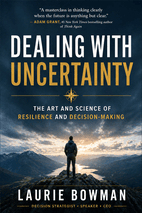
Dealing with Uncertainty by Laurie Bowman Book Cover

by Laurie Bowman

Laurie Bowman's Dealing with Uncertainty provides a practical framework for managing uncertainty through structured analysis and psychological awareness, blending neuroscience, behavioural economics, and mindfulness techniques for professionals facing high-stakes decisions and individuals navigating career or personal stress.

On Insta.page you also get an Apply This Book tool that lets you combine insights from up to 3 books to solve your specific situation.

Chapter mindmaps

Free preview: chapters 1–4 are fully interactive. Click any node to expand or collapse. Subscribe to unlock the rest.

Chapter 1: Chapter 1: Understanding the Nature of Uncertainty

Key concepts: Chapter 1: Understanding the Nature of Uncertainty

1. Chapter 1: Understanding the Nature of Uncertainty

The Gabba Fiasco: Uncertainty Ignored

  • Cost ballooned from $1B to over $3B
  • No comprehensive risk assessment was conducted
  • Leaders assumed stable costs and support
  • Project collapsed, wasting $6.4M in planning

Psychology of Uncertainty: Why We Freeze

  • Amygdala hijacks rational thought under ambiguity
  • Intolerance of uncertainty affects millions
  • Stress quiets the prefrontal cortex
  • Reframing question restores logical thinking

Cognitive Biases Distorting Risk Perception

  • Confirmation bias favors existing beliefs
  • Optimism bias sets unrealistic timelines
  • Availability heuristic skews probability judgment
  • Use scenario planning and decision journals

Neuroscience and Practical Tools

  • Box Breathing restores prefrontal cortex control
  • Placebo effect shows belief rewires the brain
  • Learned optimism is a strategic tool
  • Simple nudges shift organizational culture

Cultural Navigation of Uncertainty

  • Different societies have varying uncertainty tolerances
  • Chennai intersection example shows cultural navigation
  • Trust is the invisible architecture of resilience
  • Trust earned on Queensland rail project with owners

Building Grit and Learning from Failure

  • Grit is built through structured habits
  • Failure becomes fuel, not a dead-end
  • Steve Jobs and author's raw exit examples
  • 50-year-old body transformation during COVID

Values-Based Resilience as Foundation

  • Anchor decisions in core principles
  • Paul Polman's Unilever leadership example
  • Uncertainty becomes navigable and energizing
  • Befriend uncertainty rather than conquer it

Chapter 2: Chapter 2: Decision-Making Frameworks: An Introduction

Key concepts: Chapter 2: Decision-Making Frameworks: An Introduction

2. Chapter 2: Decision-Making Frameworks: An Introduction

Why Structured Decision-Making Matters

  • Frameworks strip away emotional bias from decisions
  • They bridge urgent action and long-range planning
  • Risk-based mindset prevents poor decisions under pressure
  • Aligns choices with core values and strategic intent

Decision Trees: Visualizing Options

  • Break complex choices into manageable branches
  • Weigh probabilities and expected values clearly
  • Example: flexible hospital capacity yields $27.5M expected value
  • Used in finance, healthcare, and engineering

Cost-Benefit Analysis (CBA)

  • Compares total costs with tangible and intangible benefits
  • Integrates ESG factors for values-based decisions
  • Personal example: weighted scoring for job offers
  • Incomplete CBA can lead to fatal failures like dam rupture

Data, AI, and Bias Reduction

  • Monte Carlo simulations and regression sharpen forecasts
  • AI flags unrealistic timelines with quality data
  • Must pair AI with human judgment to counter bias
  • Tools only as good as the data they are trained on

Scenario Planning and Updating Beliefs

  • Prepares for multiple futures, not just one bet
  • Openness determines success beyond technical tools
  • Start with prior beliefs, update with new evidence
  • Humility and willingness to change are learned skills

Intuition and the PDCA Cycle

  • Intuition reliable only in stable, fast-feedback environments
  • Pair gut feelings with structured PDCA cycle
  • More/Less/Better/Different tool sharpens focus
  • Embedding frameworks shifts from intuition to risk-informed governance

Ethics, Sustainability, and Values

  • Unilever boosted profit and trust via supply-chain redesign
  • Volkswagen scandal cost billions from ignoring ethics
  • BlackRock proves climate risk is financial risk
  • Every decision reflects what you truly value

Chapter 3: Chapter 3: When Finance Becomes the Risk: Rethinking Resilience Beyond Cost-Cutting

Key concepts: Chapter 3: When Finance Becomes the Risk: Rethinking Resilience Beyond Cost-Cutting

3. Chapter 3: When Finance Becomes the Risk: Rethinking Resilience Beyond Cost-Cutting

Redefining Financial Resilience

  • Risk is a human force, not just a spreadsheet number
  • Resilience requires investment in safety and relationships
  • Short-sighted decisions driven by pride or pressure cause catastrophe
  • Humility and connection are as vital as calculations

Dreamworld Tragedy: Cost-Cutting Kills

  • Four deaths from prioritizing profit over safety
  • Weak administrative controls failed; strong controls needed investment
  • Hidden prior incidents revealed systemic neglect
  • Safety demands leadership commitment to robust controls

Qantas Outsourcing: Stakeholder Risk

  • Unlawful outsourcing caused operational chaos and reputational loss
  • Ignoring frontline staff insights backfires
  • Short-term savings ignored long-term service quality
  • Ethical risk culture requires hearing those closest to failure

Strategic Misrepresentation in Projects

  • Costs underestimated, benefits overstated in 9 of 10 megaprojects
  • Overconfidence and pressure drive flawed decisions
  • Transparency and contingency planning are essential

Personal Crisis: Pride and Recovery

  • Author lost home and assets despite being a cost engineer
  • High risk appetite and overcommitment led to ruin
  • Pride prevented asking for help; opening up was turning point
  • Resilience depends on humility and support networks

Three Hard-Won Truths for Entrepreneurs

  • Know your worth: charge fairly and use clear contracts
  • Balance passion with pragmatism: secure your foundation first
  • Build a support network: hiding struggles deepens them

Practical Strategies for Financial Resilience

  • Proactive risk management: buffers, contingencies, risk registers
  • Stakeholder engagement to catch blind spots early
  • Ethical planning aligns profit with safety and values
  • Small consistent steps compound into lasting strength

Chapter 4: Chapter 4: Mindfulness and Stress Management Techniques

Key concepts: Chapter 4: Mindfulness and Stress Management Techniques

4. Chapter 4: Mindfulness and Stress Management Techniques

Mindfulness and Breathing Techniques

  • MBSR reshapes brain regions for focus and self-regulation
  • Box breathing activates parasympathetic nervous system for calm
  • Alternate nostril breathing from yoga for instant calm
  • Micro-meditations during commute create anchor points of clarity

Emotional Agility and Self-Compassion

  • Pause, accept emotions, and respond thoughtfully not reactively
  • Self-compassion builds resilience through kindness to self
  • Shift from 'What's wrong with me?' to 'What can I learn?'
  • Morning journaling transforms self-blame into self-inquiry

Mindful Journaling and Gratitude

  • Untangle thoughts and spot recurring patterns through journaling
  • Voice transcription apps make journaling accessible
  • Gratitude engages brain's reward system and strengthens relationships
  • Prompts about gratitude and emotions train mind toward presence

Stillness Practices and Nature Connection

  • Dadirri deep listening from Aboriginal practice for quiet attunement
  • Shinrin-yoku forest bathing reduces stress hormones
  • Stillness opens heart to what is already present
  • Nature connection deepens calm and reduces stress

Daily Rituals for Long-Term Calm

  • Morning meditation and movement ground the day
  • Evening wind-downs with journaling or tea create predictability
  • Protecting sleep is essential for nervous system regulation
  • Small intentional practices build foundation for steady optimism

Continue exploring Dealing with Uncertainty