Dealing with Uncertainty Key Takeaways
by Laurie Bowman
As an Amazon Associate, we earn from qualifying purchases.
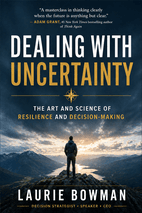
5 Main Takeaways from Dealing with Uncertainty
Structured frameworks cut through uncertainty and bias.
Decision trees, cost-benefit analysis, and scenario planning break complex choices into manageable parts, reducing emotional bias. Pair data-driven tools with human oversight to avoid blind spots, and update your beliefs as new evidence emerges.
Daily mindfulness rituals build calm and clarity.
Breathing techniques, journaling, and gratitude practices lower stress and sharpen focus. Anchoring your day with morning and evening rituals—like stillness practices or forest bathing—creates a foundation for long-term emotional resilience.
Career moves succeed when you frame organizational value.
Strategic negotiation isn't about personal demands—it's about showing how your skills solve company problems. Transferable skills let you pivot without starting over, and small daily shifts (like device-free time) realign work with what matters.
Emotional intelligence is a practical tool for trust.
Proactive empathy—reading unspoken cues and addressing concerns before they escalate—unlocks collaboration and high performance. Self-awareness and self-regulation, paired with social awareness, create psychological safety in teams.
Adaptability and lifelong learning future-proof your career.
Embrace change with a growth mindset and curiosity, leveraging digital tools and Agile methods. Future-proof by continuously learning, using data to challenge assumptions, and always pairing analytics with human values.
Executive Analysis
These five takeaways form a cohesive system for navigating uncertainty: analytical frameworks (takeaway 1) provide structure for decisions, while mindfulness (2) and emotional intelligence (4) regulate the inner chaos that uncertainty triggers. Career and adaptability insights (3 and 5) extend these principles into professional growth and change management. Together, the book argues that dealing with uncertainty requires both outer tools (scenarios, data, negotiation tactics) and inner skills (self-awareness, empathy, resilience)—neither alone is sufficient.
This book matters because it bridges business strategy, psychology, and self-help in a practical, non-academic way. Instead of abstract theory, Bowman offers actionable rituals, frameworks, and empathy exercises that readers can apply immediately to reduce anxiety, make better career moves, and lead with confidence. It stands out in the crowded uncertainty genre by integrating hard skills (decision trees) with soft skills (mindfulness) under a single, coherent thesis: mastery of uncertainty is a learnable, multi-dimensional capability.
Chapter-by-Chapter Key Takeaways
Decision-Making Frameworks: An Introduction (Chapter 2)
Structured frameworks like decision trees and cost-benefit analysis help you break down complex choices and reduce emotional bias.
Data and AI tools improve forecasts but need human oversight to avoid bias.
Scenario planning prepares you for multiple futures, not just one.
Updating your beliefs with new evidence leads to better decisions.
Intuition works best in stable environments with fast feedback.
Ethics and sustainability must be part of every decision framework.
Try this: Apply a decision tree or scenario plan to your next major choice, then review it with a colleague to catch emotional bias.
Mindfulness and Stress Management Techniques (Chapter 4)
Adopt mindfulness and breathing techniques to regulate stress and enhance mental and emotional clarity.
Use journaling, meditation, and gratitude practices for emotional balance and self-awareness.
Cultivate self-compassion through loving-kindness meditation and reflective writing to build resilience.
Incorporate stillness practices like Dadirri and forest bathing to deepen connection and calm.
Build daily rituals—morning and evening—that anchor your day, prioritize sleep, and create a foundation for long-term calm.
Try this: Start each morning with a two-minute breathing exercise and end the day with a short gratitude journal entry to anchor your calm.
Thinking About a Career Move? Here’s How to Make It Work (Chapter 5)
Strategic negotiation means framing proposals around organizational value, not personal demands.
Career pivots build on transferable skills—you don’t have to start from scratch.
Work-life balance is an ongoing practice of conscious design, not a fixed destination.
Small shifts—like reframing your commute or setting device-free time—can have outsized impact.
You have more agency than you realize: every choice is a chance to align your life with what matters most.
Try this: Before asking for a raise or pivot, write a one-page memo that links your skills to a specific organizational problem and proposed solution.
Cultivating Emotional Intelligence (Chapter 6)
Proactive empathy means reading unspoken cues and addressing concerns before they escalate.
Silence, hesitation, and body language often carry more information than words.
Emotional intelligence divides into personal competence (self-awareness, self-regulation) and relational competence (social awareness, relationship management).
Daily emotional journaling and reflective questioning build self-awareness and stress management.
Psychological safety emerges when leaders model vulnerability and create structures that reward honesty over defensiveness.
Empathy is a practical skill that unlocks collaboration, trust, and high performance.
Try this: In your next team meeting, intentionally pause after someone speaks to notice body language and ask a clarifying question about unspoken concerns.
Next chapter: “Adapting to Change and Building Future-Ready Skills” is locked
Keep learning from Dealing with Uncertainty — and unlock all 700+ book summaries with audio, mindmaps and AI Q&A.
$0.00 due today · 7 days free, then $89.99/year ($7.49/mo) · Cancel anytime before day 7
plus sales tax where applicable