As an Amazon Associate, we earn from qualifying purchases.
What is the book The Wealthy Consultant about?
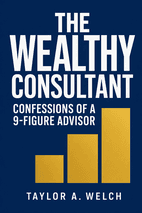
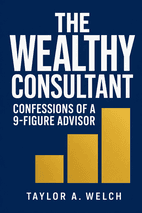
Taylor A. Welch's The Wealthy Consultant argues that experts selling their own time build fragile businesses, offering fifteen interconnected models for scaling income through product diversification, acquisition channels, demonstration, and monetization systems. Written for consultants, coaches, and service providers stuck as their own bottleneck who want predictable, protected growth.
Feature
Insta.Page
Blinkist
Shortform
Summary Depth
Full Chapter-by-Chapter
15-min overview
Section-by-section guides
Audio Narration
✓
✓
✓
Full access to all 800+ summaries
✓
✓
✓
Visual Mindmaps
✓
✕
✕
AI Q&A
✓
✕
✕
Missing a book? Request it, usually live within 48h
✓
✕
✕
Quizzes
✓
✕
✕
PDF Downloads
✓
✕
✓
Send to Kindle
✓
✓
✓
Price
$89.99/yr
$146/yr (PRO)
$199/yr
*Competitor data last verified July 2026.
1 Page Summary
Taylor A. Welch's The Wealthy Consultant: Confessions of a 9-Figure Advisor argues that independent experts — consultants, coaches, and trainers who sell intangible results like lessons, wisdom, and experience — typically sustain their income by selling more of their own time, leaving the business fragile and the owner trapped in a cycle of exhaustion and recovery. The book's central thesis is that scale is not the same as growth: drawing on a comparison to shifts in scientific thinking and the image of a car leaving the normal flow of traffic, Welch defines scale as rebalancing a business's size against its total addressable market while respecting a risk threshold he calls "market cap," beyond which growth compromises safety and yields diminishing returns. Scaling, in his framing, means growing impact and income together without sacrificing certainty, and it requires a business built on people, systems, and intellectual property rather than on the founder's constant push.
The author's approach is distinctive in organizing growth into a set of interconnected models rather than motivational advice. He presents diversification as the antidote to fragility: the three primary deliverables in training and consulting are information, customization, and proximity; acquisition rests on attention, demonstration, and monetization across four channels (paid media, organic media, partnerships, and outbound); and resilience comes from four monetization models — products, services, programs, and partnerships — each with different price ranges and fulfillment demands. Welch also addresses the human bottleneck, arguing that a great team leverages the owner's expertise, removes them as the bottleneck, and multiplies their efforts, and he connects free work to paid conversion through "demonstration," which turns cold markets warm by giving strangers enough proof to accept the risk of buying. The book culminates in the Codex, a single model combining its contents — one of fifteen models for building consulting and training companies — which he says can also make a business sellable without depending on its founder.
The intended audience is the consultant, coach, or expert who is good at the work but stuck selling their own time and attention, along with service providers who want predictable, protected growth. Readers will gain frameworks for deciding when expansion becomes exposure, for building product and revenue diversity that survives a single point of failure, for scaling acquisition and fulfillment without breaking the client experience, and for judging which advice to trust — Welch warns against experts who sell programs built on work their founders never did, contrasting information as mere data with wisdom as the ability to choose well and gain more while risking less. Throughout, he frames success at The Wealthy Consultant as turning expertise into income judged by the value delivered rather than the money made.
1. How We Got Here
Overview
Many independent experts keep money coming in by selling more of their own time and attention. But the business stays fragile, and the pressure never lets up. The real problem: how do you grow without constantly pushing everything yourself?
This is for the consultant, coach or expert who is good at the work and sells something you can't see: a result, a lesson, an experience, a piece of wisdom. That kind of work carries more force than a car or a house because it moves human knowledge forward. The goal is a business that works predictably and safely, with the details handled. A recurring shortage of time is usually a shortage of focus, so the aim is fast results without giving up certainty. Scale your impact and your income together.
Linear Thinking and the Sisyphus Trap
Much of business still follows an old-school view of science: one cause produces one effect, in a straight line. Newton's principles, then Planck's quantum theory, then Bohr's work on the atom show how accepted rules can be overturned when a field changes. Online business is going through a similar shift, and staying at its front edge should pay off. Many owners are exhausted because they still think in that straight line. They push a boulder uphill only to watch it roll back, over and over, with no end in sight.
The alternative is controlled, organized, measured growth rather than scale at all costs. Shortcuts are fine when they preserve certainty, not when they replace a system. Stress is treated as a habit to release. Entrepreneurs often feel nervous, anxious, afraid, vulnerable. The goal is to feel steady and sure, with a clear plan and real excitement for the work.
Millions went into inventing and testing new methods. That risk was judged smaller than blindly following the old ones. Other resources cover mental stamina, but the focus here is the models for a healthy, defensible business.
The Hamster Wheel
A client roster in the multiple thousands taught a repeated pattern: people find one thing that works, go all in, and ignore everything else. The first real scale came in 2018, when favorable markets met a system years in the making. It worked until it did not. There was no recurring revenue, profit depended on beating the previous month, old clients left, and new clients had to cover fixed costs. Scaling a hamster wheel is possible, but it is short-term and costly later.
The fix is to abandon a side-gig mentality and build a real business. Real businesses are worth something on their own. A client roster that depends entirely on its owner cannot be sold, and the more essential the owner is, the lower the business's value. Involvement is fine, especially early; the problem is depending on one source. Most experts carry that problem throughout their business. The recipes in this book are meant to smooth out the ups and downs, though previous problems may fade gradually rather than disappear at once.
Key Takeaways
Build the result, lesson or wisdom you sell into a real business that's worth something on its own, not a practice that depends on you; the more every client and decision runs through you, the lower the ceiling on both scale and sale price.
Treat chronic time shortage as a focus problem and redesign your week around clear priorities, so faster output comes from certainty rather than longer hours.
Assume the rules of online business can be overturned, and choose deliberate, measured expansion over growth for its own sake; keep shortcuts only when they protect certainty rather than replace your system.
Drop the pattern of finding one tactic that works and neglecting everything else, because a strong month built on that pattern only sets up the next fixed-cost squeeze.
Release stress as a habit and run the business from steadiness and deliberate enthusiasm rather than nervous reactivity.
Key concepts: 1. How We Got Here
How We Got Here
The Expert's Fragile Business
Experts sell invisible results, lessons, or wisdom, not physical products.
Business stays fragile when it depends on selling more of your own time.
Goal: predictable, safe business with details handled, scaling impact and income together.
Linear Thinking and the Sisyphus Trap
Old-school linear cause-and-effect thinking leads to exhausting effort.
Like Sisyphus, owners push a boulder uphill only to watch it roll back.
Online business is shifting; staying at the front edge should pay off.
The Hamster Wheel of Scaling
Finding one tactic and going all in creates short-term scale but long-term fragility.
No recurring revenue, profit depends on beating last month, old clients leave.
Scaling a hamster wheel is possible but costly later; abandon side-gig mentality.
Building a Sellable Business
Real businesses are worth something on their own; owner-dependent practices are not.
The more essential the owner, the lower the business's value and ceiling.
Recipes smooth ups and downs, though previous problems may fade gradually.
Focus, Certainty, and Steady Growth
Chronic time shortage is a focus problem; redesign your week around clear priorities.
Choose deliberate, measured expansion over growth at all costs.
Release stress as a habit; run from steadiness and deliberate enthusiasm.
💡 Try clicking the AI chat button to ask questions about this book!
2. Three Keys to Scaling a Business
Overview
Growth is usually mistaken for scale, and the push for more can outrun the safety and trust a business needs to keep its promises. The hard part is finding the threshold before expansion turns into exposure.
Scale is not simply more growth. It is a rebalancing of the size of a business against its total addressable market, a break from homeostasis that pushes market share upward against resistance and pressure. The image is a car leaving the normal flow of traffic: speed rises, and danger rises with it. Bad scale begins when growth blows past the natural market cap of the business without proper protection. Market cap here is not a public company’s valuation; it is the risk threshold beyond which growth compromises the safety of the business and yields diminishing returns. That threshold moves. Staffing up, fixing systems, or improving infrastructure can push it higher and make scale less dangerous, but crossing it again turns risk back up.
A business consists of people, systems, and intellectual property, with finances and accounts living inside those systems. Valuation simplifies into three parts:
Cash or assets
Current cash flows
Future cash flows
Future cash flows are discounted because they have not happened yet. The private equity question is what someone will pay now for the likelihood of later cash flows. Those later flows depend on supply and demand, customer acquisition, retention, brand and reputation, receivables, team and people, and other variables. The ability to acquire customers is not enough by itself. What raises a multiple is the number of ways a business can acquire customers. Buyers want certainty, and ten routes to growth are more certain than one. Anyone can hack the volume game by acquiring customers and then refunding them, but the debits and credits cancel on the profit and loss statement. Unhealthy scale is growth that violates the certainty of the business’s future.
Reputation and Goodwill
Good scale protects reputation as the business grows. Growth becomes a multiplier: the larger the business gets, the more respected and trusted it becomes. Many businesses invert this and harvest all their market goodwill to hit an arbitrary number today. Every market holds latent goodwill. People have seen the content or heard the ads and podcasts but have not yet bought. That unconverted trust is a moat against competitors. Charlie Munger talks often about business moats, and for training and consulting companies one of the best moats is the audience that has subscribed, listened, and implemented advice without yet paying. Those people become more bought-in as they listen. Sacrificing future reputation to convert them faster is robbing tomorrow to feed today.
Three Kinds of Leverage
Growth should come through multiplication rather than addition. Leverage lets a business grow without the usual trade-offs, so yield outpaces inputs. The three main forms are:
Financial leverage: getting something you did not pay for, such as business credit, lines of credit, or mortgages.
Operational leverage: getting something you did not work for.
Brand leverage: gaining access to people you had no previous way to reach, because reputation precedes you.
Attention and Attention Retention
Attention is the ability to get the eyes and ears of a group without working linearly for them. It is expensive and becoming more expensive. Some of the brightest minds today describe oil as the old guard’s currency and attention as the new guard’s currency. Command enough attention, perhaps the eyes and ears of 100 million people, and it can be parlayed into whatever business you want to scale. Attention is the leverage of media.
Getting attention happens through advertising or content: books, videos, podcasts, webinars, emails, billboards, or paying for someone else’s audience. The long-tail route is publishing good content and letting people find it organically. Expertise from one industry can be plugged into another. One client came from interior design, had consulted on some of the largest spaces in the world, and helped secure a Charleston venue because she had built it. She then brought that expertise to small businesses and built a branding agency, with branding covering design, scope, and market perception, or positioning. She began by publishing free content slowly. Advertising can speed that up, but it is not always necessary, and social media algorithms are tuned to surface what people are looking for even before they know they want it.
Keeping attention is harder and more important. If attention is paid for and then wasted, it will not be given again. If it is well rewarded, value can be exchanged for trust. Good attention cannot be hacked or tricked. You must be worthy of keeping it.
Repeat Customers and Pricing
A $10,000 attention spend that produces 70 buyers carries a cost per acquisition of $142. If the product is good enough that those buyers return, the acquisition cost of the second purchase is zero. Better products and services produce more repeat customers. Large organizations that scale through infrastructure, new products, and partnerships have often lowered acquisition costs, then reinvested the extra profit into more moats. Competitors cannot afford to match them. Network effects, where an offering becomes more valuable as the network grows, are a form of leverage when software or a community is attached, though they are not usually a major lever in consulting or training.
Pricing is the third lever, and it is more than a number. It is a model. Brad, a client in the financial space, had a business that kept starting over every month. About six months after he joined, over dinner in London, he said his business was collecting 100 percent of fixed expenses at the beginning of each month. The fix was internal infrastructure, not simply more clients. A companion resource details the revolving-price model. When perfected, upfront and recurring payment lets a business invest in growth without risking its cash accounts. Pricing must match the long-term goal and the cash conversion cycle. In 2018 a bank asked for an aging report when I requested a line of credit. We collected everything upfront and had no receivables, so the bank saw no future cash flow and no line of credit followed. That taught the value of recurring revenue.
Holly had two offers: time-intensive work for clients and expert advice for small businesses and software companies with their own teams. Both were presented at once but segmented by revenue level, so each tier of client fit one side. It reduced personal pressure and avoided cannibalizing one business for another. Tesla sells multiple cars at different prices that do relatively the same thing, with differences in manufacturing, features, and feel. The common failures are mispricing, either undercharging for lifelong expertise or overcharging beyond what the market can bear, and failing to use price to segment the market. Get attention, retention, and pricing right, and attention becomes cheap, churn falls, cash flow improves, and the business can afford to scale.
Key Takeaways
Treat every growth push as a trade against a moving risk ceiling: raise that ceiling with people, systems, and infrastructure before adding volume, so size does not start subtracting from the business.
Build several independent routes to customers instead of one efficient funnel, because a business that can buy demand many ways is worth more than one that can only buy volume.
Protect unspent goodwill as an asset: convert latent audiences slowly enough that growing reach compounds trust rather than spending tomorrow's reputation for today's revenue.
Use financial, operational, and brand leverage to multiply output rather than add hours, and spend paid attention only on offers good enough to earn a second look.
Design pricing as a system tied to your long-term goal and cash conversion cycle, segmenting offers by customer revenue level so upfront and recurring cash fund growth while repeat revenue carries no new acquisition cost.
Key concepts: 2. Three Keys to Scaling a Business
Three Keys to Scaling a Business
Scale vs. Growth
Growth is often mistaken for scale; more can outrun safety and trust.
Scale rebalances business size against total addressable market.
Bad scale blows past market cap without protection, causing diminishing returns.
Market cap is a moving risk threshold; staffing and systems can raise it.
Valuation and Future Cash Flows
Valuation simplifies into cash/assets, current cash flows, and future cash flows.
Future cash flows are discounted due to uncertainty.
Buyers pay now for likelihood of later cash flows.
Multiple routes to customer acquisition raise certainty and multiples.
Reputation and Goodwill
Good scale protects reputation; growth becomes a multiplier of trust.
Latent goodwill is unconverted trust and a moat against competitors.
Sacrificing future reputation to convert faster robs tomorrow for today.
Audience that has listened but not yet paid is a powerful moat.
Three Kinds of Leverage
Growth should come through multiplication, not addition.
Financial leverage: getting something you did not pay for.
Operational leverage: getting something you did not work for.
Brand leverage: reaching people because reputation precedes you.
Attention and Retention
Attention is the new currency; it is expensive and getting more so.
Get attention via advertising or content; long-tail content builds organically.
Keeping attention is harder and more important than getting it.
Good attention cannot be hacked; you must be worthy of keeping it.
Repeat Customers and Pricing
Repeat customers lower acquisition cost; second purchase cost is zero.
Better products and services produce more repeat customers.
Large organizations reinvest profits into moats competitors cannot match.
Network effects are leverage when software or community is attached.
Pricing as a Strategic System
Align pricing with long-term goals and cash conversion cycle.
Use upfront and recurring payments to fund growth without cash risk.
Segment offers by customer revenue level to avoid cannibalization.
Avoid mispricing: undercharging expertise or overcharging the market.
3. How To Scale With Product
Overview
A business built on one product can grow for a while and then stall against competitors with more ways to serve the market. The harder question is how to add paid offerings without weakening the goodwill that brought people in. Where does free work end and a buying relationship begin?
Simon Sinek's distinction frames the problem: finite-minded players make products they believe they can sell, while infinite-minded players make products people actually want to buy. The practical result is diversification. A business with a single offer is most exposed to competition. Every total addressable market contains a vertical, a collection of buyers in a similar industry, and scaling eventually means serving customers at different stages of the industry's product suite. That is how a single-offer business becomes a durable one.
Deliverables and Monetization
Products are deliverables; monetization is the payment collected. A purchase exchanges money for a deliverable, a receivable for something the buyer receives. In training and consulting, the three primary deliverables are:
Information
Customization
Proximity
Information is the foundation. It is cheap because it can be produced affordably, delivered to many people, and is not customized to one buyer; it transfers facts, data, and perspectives. If information becomes too expensive, it stops transferring. The broader task is to democratize it and lower the cost of acquiring skills while ensuring it is actually used.
Paid Information and Trust
Free information earns goodwill and respect, while expensive information earns commitment. People do not want everything free; they value what they pay for. Many save or download material without consuming or implementing it, so charging something completes the conversion cycle. Successful people have paid to be present, whether in money or sweat equity. There is also a psychological reason to sell paid products: buying builds a habit of buying. A good purchase makes the next purchase easier because the buyer trusts the process, not merely the brand's generosity.
The mechanical case is Jessica, an Australian recruiting consultant. Her marketing was strong, but revenues declined because earning trust had become harder. She moved from a webinar-first approach to a paid product at the front of her ecosystem. In three days, she spent $900 and made $2,757 in sales. Her buyers began developing trust through buying, and she got paid before taking them on as clients.
Liquidation and Price
Liquidation is converting an advertising investment into cash. Products can liquidate above 100% on day one: spend $1,000 and collect at least $1,000 immediately, before hands-on work begins. Not every product does this; iteration and outside perspective are often required.
At the information level, products on one training platform usually run from $10 to $100, including books, courses, and newsletters. Customization comes next. At the information level, people learn how the world works; at the customization level, they learn how their world should look for the outcome they want. Price rises with specificity, not volume. Buyers pay more for less material when it is more relevant, and they are effectively spending money to save time.
Proximity
The sequence can be stated as three requests:
Teach me something.
Teach me something specific.
Teach me something specific, then watch me or help me do it.
Proximity is the third level: access to the person or group. Masterminds create this. Thomas Edison and Henry Ford gathering smart people is the model, and some buyers pay multiple six figures yearly for access because one good idea can be worth millions. A room of good ideas can be worth far more.
Key Takeaways
Build more than one offer before competition forces it, and map each offer to an industry segment and buying stage so the business can grow without depending on a single product.
Put a paid information product at the start of your offer ladder rather than giving everything away; payment turns casual attention into commitment and makes the next purchase feel familiar.
Design at least one low-cost offer to recover its advertising spend immediately, so acquisition funds itself before you spend delivery time.
Increase price by increasing relevance, moving buyers from general information to customized guidance and then to direct access; specificity, not volume, is what buyers pay for.
Sell proximity last and at the highest price, because access to an experienced room can pay for itself when a single usable idea changes the buyer's outcome.
Key concepts: 3. How To Scale With Product
How To Scale With Product
Diversification for Durability
Single-product businesses stall against competitors with more offers.
Infinite-minded players make products people want to buy.
Map offers to industry verticals and buying stages.
Scaling means serving customers across the product suite.
Deliverables and Monetization
Products are deliverables; monetization is payment collected.
Three primary deliverables: information, customization, proximity.
Information is cheap to produce and transfer facts and perspectives.
Democratize information to lower skill acquisition costs.
Paid Information Builds Trust
Free information earns goodwill; paid information earns commitment.
Charging completes the conversion cycle and builds buying habits.
Buyers trust the process, making future purchases easier.
Jessica's paid front-end product built trust and revenue.
Liquidation and Pricing Strategy
Liquidation converts ad spend into immediate cash.
Products can liquidate above 100% on day one.
Information products typically range from $10 to $100.
Price rises with specificity, not volume.
Proximity as the Highest Offer
Proximity provides access to person or group.
Masterminds exemplify high-value proximity.
Buyers pay six figures for access to experienced rooms.
One good idea can pay for itself many times over.
4. Eight Figure Teams
Overview
Growth stalls not at the edge of demand but at the edge of one person's capacity. The work that built the business becomes the work that blocks it, and adding people raises a harder question than scheduling: how much of the thinking can be handed over without losing control. That question remains open.
Burnout and the Team Multiplier
Scaling alone turns growth into a repeating cycle: a good run, exhaustion, recovery, another run, deeper burnout. One client described the endpoint plainly: he could no longer see a path to his goals. That is what burnout does, disconnecting you from the way through until you stop caring about email, management, or the business itself. A great team does three things:
Leverages your expertise
Removes you as the bottleneck
Multiplies your efforts
The problem is not time but what you do with it. Drop tasks you do not enjoy and replace them with work you are uniquely capable of. Dan Martell's Buy Back Your Time covers time allocation, but the harder issue is people management, and a lack of time usually traces back to a team or personnel problem.
Two Kinds of Outsourcing
There are two levels to learn:
Outsourcing labor: hiring hands, an assistant or 1099 contractor to schedule meetings and push buttons. It helps but will not scale.
Outsourcing decisions: duplicating your brain, with people who can take on strategic responsibility, create partnerships, and make company-wide calls without you.
Time is not the most valuable asset; energy or bandwidth is. Tim Cook, Elon Musk, and the President of the United States all rely on this principle because no president can make every decision personally. Cabinet members, advisers, and staff absorb decisions so the work keeps moving.
Four Responsibilities
Every leader must do four things:
Hire
Train
Equip
Trust
Hiring is a skill learned by hiring. Geoff Smart's Who offers topgrading. Training builds competency; equipping gives autonomy and decision authority. A trained person can still be micromanaged into uselessness. Trust is tested by mistakes. Across almost 700 hires in ten years, one sales manager was hired for the right reasons and then fired over a decision the owner disagreed with. The error was denying him the chance to learn from it. The IBM CEO story makes the point: an executive lost millions and offered to resign; the CEO refused, saying the money was an investment and the lesson should prevent a repeat.
Three Levels of Replacement
There are three levels at which to replace yourself:
First, replace what you are not good at and do not enjoy.
Second, replace what you are good at but do not enjoy, because someone who loves that work will improve it.
Third, replace what you are good at and enjoy but are not irreplaceable at.
Only two or three activities are yours alone, and the bulk of your time belongs there. The limiting belief is that money must come from grinding; the work you are best at often does not feel laborious. When you put others in their zone of genius, they do it better and faster, and everyone is happier.
Culture rests on three questions, and a leader has to get all three right:
What we believe
Why we believe it
How strongly we believe it
Even with the correct T1, T2, and T3 in place, it remains the leader's job to ensure people hold the right beliefs for the right reasons. Compensation, meetings, and planning are the levers that reinforce those beliefs. The stronger the beliefs, the more enthusiastic people become, assuming they fit the organizational mission.
A Self-Cleaning Culture
A healthy culture removes people who do not stand for what the organization believes. The goal is a self-cleaning system: self-regulating, self-propelling, and capable of healing itself. The body offers the analogy. A viral infection or other foreign element is isolated, pushed out, or rejected. A common trap is imagining that good culture is always welcoming, happy, and friendly. A great culture is abrasive to the wrong fit. It does not accept everyone, and it does not bend standards for people who are not hell-bent on the collective mission. It reflects nature: the fittest survive, and those who are not fit cannot stay. The best players are rewarded; the weak ones are punished.
That severity makes scale possible. The business no longer requires constant top-down management or accountability, because accountability becomes bottom-up, running from the front lines to the top. Culture does work that supervision would otherwise have to do. A free team-management resource is promoted at the close.
Key Takeaways
Read your calendar as a hiring signal: a week that leaves no room for your best work points to a decision no one else is permitted to make, not to a shortage of hours.
Outsource judgment before you outsource tasks. Hands buy you time; people authorized to make company-wide calls buy you a business that grows without your involvement.
Hire, train, equip, then hand over real authority. Someone who has been taught the job but never trusted with it remains a cost rather than a replacement, and the only way to test that trust is to let a mistake happen and keep the person.
Sort your work in three tiers: what you are poor at, what you are good at but dislike, and what you are good at and enjoy but could be done by someone else. Keep clearing tiers until only the two or three activities that genuinely require you are left.
Settle what your organization believes, why it believes it, and how firmly, then let the group hold its own standards. Accountability that runs from the front lines upward replaces supervision, but only if the culture is willing to push out people who do not share the beliefs.
Key concepts: 4. Eight Figure Teams
Eight Figure Teams
The Bottleneck of One
Growth stalls at the edge of one person's capacity.
Scaling alone creates a cycle of burnout and recovery.
A great team leverages expertise, removes bottlenecks, multiplies efforts.
Focus on work you are uniquely capable of, not just time management.
Outsource Decisions, Not Just Tasks
Outsourcing labor (hiring hands) helps but does not scale.
Outsourcing decisions duplicates your brain for strategic responsibility.
Energy and bandwidth are more valuable than time.
Leaders like Tim Cook and Elon Musk rely on decision outsourcing.
Four Responsibilities of Leadership
Hire: learn by hiring, use topgrading (Who by Geoff Smart).
Train: build competency in your team.
Equip: give autonomy and decision authority.
Trust: test by allowing mistakes and learning from them.
Three Levels of Replacement
Replace what you are not good at and do not enjoy.
Replace what you are good at but do not enjoy.
Replace what you are good at and enjoy but are not irreplaceable at.
Keep only two or three activities that truly require you.
Self-Cleaning Culture
Culture rests on what we believe, why, and how strongly.
Healthy culture removes those who do not share beliefs.
I don't have reliable information about an author named Taylor A. Welch, so I can't write a factual biography without risking fabrication. If you can share details such as their notable works, area of expertise, or background, I'd be glad to help craft a concise 2-3 sentence biography.
Frequently Asked Questions about The Wealthy Consultant
What is The Wealthy Consultant about?
It's a practical guide for consultants, coaches, and independent experts who sell something invisible — a result, a lesson, or a piece of wisdom — and want to grow without constantly pushing everything themselves. The chapters walk through the mechanics of scaling: adding product diversity instead of relying on one offer, building a team that removes the founder as the bottleneck, acquiring attention across multiple channels, using demonstration to convert cold buyers, and designing monetization models that survive a single point of failure. It also tackles fulfillment at volume, the tension between growth and sellability, and how to turn expertise into income that's judged by the value delivered rather than the money collected. Everything ties together into a single framework called the Codex, designed to help a business adapt and become sellable without depending on its founder.
Who is the author of The Wealthy Consultant?
Taylor A. Welch writes for consultants, coaches, and experts who want to turn their knowledge into a predictable, scalable business rather than a cycle of selling more of their own time. His work draws on experience building and advising consulting and training companies, and he challenges the common assumption that these businesses can't carry real enterprise value. He also emphasizes ongoing education through podcasts, weekly YouTube content, and a healthy skepticism toward so-called growth experts who have never done the work themselves.
Is The Wealthy Consultant worth reading?
It's worth reading because it replaces guesswork with tested frameworks — the book explicitly argues that strength and resilience come from models rather than emotional decisions in hard moments. Rather than generic advice to raise prices or chase more attention, it gives concrete structures for diversifying revenue, scaling fulfillment without breaking the client experience, and building a team that multiplies your efforts. Readers who want a business that runs predictably, safely, and can eventually be sold without them will find a clear path here.
What are the key lessons from The Wealthy Consultant?
First, scale is not the same as growth: it's a rebalancing of the business against its market cap, the risk threshold beyond which expansion creates exposure and diminishing returns. Second, resilience comes from diversification — a single offer or single acquisition channel makes a business fragile, while a mix of products, services, programs, and partnerships protects revenue from one point of failure. Third, growth stalls at the edge of one person's capacity, so a great team must leverage your expertise, remove you as the bottleneck, and multiply your efforts. Finally, the sources of advice you trust matter as much as what you learn: information is just data, and wisdom is the ability to choose well and gain more while risking less.
📚 Explore Our Book Summary Library
Discover more insightful book summaries from our collection