Freyja Quotes
by Margrét Ann Thors
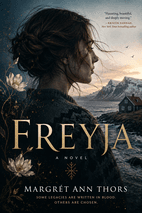
This collection pulls together some of the most memorable lines from Freyja, a novel that moves between sharp observation and raw emotion. You will find quiet narration, tense dialogue, and the kind of inner monologue that feels honest enough to make you pause. Some lines are tender, some are dark, and many capture the complicated love between parents and children.
What makes this book so quotable is its willingness to sit with discomfort. The narrator does not tidy her feelings into neat lessons. She lets anger, hope, guilt, and longing share the same page. The writing is plain but precise, so a single sentence can hold a whole life. These are lines you underline, reread, and want to pass along.
Top Quotes from Freyja
“But there she was: crouched by the door, tongue out in determination, looping her laces into bunny ears. Still learning to tie her shoes. Still here.”
Unnur glances at her daughter after finding an unsettling unaddressed envelope in the mailbox.
This line catches a mother's relief and anchors the chapter's unease in a tender, ordinary moment.
“I tried not to tally how long it had been since Lilja had seen her parents in the same room. We had promised that our family would be different, but old patterns die hard. We'd both been left as children, and so in due time we left each other.”
— Unnur
Unnur remembers the end of her relationship with Noi as his visit approaches.
It distills inherited trauma into a devastating cycle: two abandoned children who ended up abandoning each other.
“If our lives are stories, mine was missing the first hundred pages.”
— Unnur
After Viktor hits her for talking back, Unnur reflects on the loss of her mother and her own missing history.
It crystallizes a child's feeling of broken origin, making loss feel as concrete as a book with missing pages.
“I had not abandoned my hope. At airports, in long grocery lines, behind moss-green hills, in early morning mist, in dreams: Always, I looked for her.”
— Unna
Unna reflects on having left Iceland but still searching for Freyja in everyday life.
The rhythm and imagery make her lingering hope feel both beautiful and heartbreaking.
“Not all people are like starfish, ripping off limbs and growing them back. Some people give parts of themselves away and those parts do not regenerate.”
— Unnur
Unnur watches Noi return with a new girlfriend and daughter, and reflects on how she has not moved on the way he has.
The starfish metaphor makes emotional damage feel permanent and physical, capturing the haunting asymmetry of one-sided grief.
“All the clichés about parenting are true: The days are eternal and the years disappear between blinks.”
— Unnur
At the dinner table, Unnur watches Lilja and Freyja and remembers Lilja as a tiny baby.
It distills the bittersweet paradox of parenthood into a line most parents will instantly recognize.
“I don't go to school anymore because some older girls said they were going to splash toilet-bowl cleaner on my face. And that can make your face bubble like a volcano.”
— Freyja
Freyja explains to the narrator why she stopped going to school.
The childish, concrete image of a face bubbling like a volcano makes the cruelty against Freyja visceral and heartbreaking.
Themes Behind the Quotes
One major theme is the effort to protect a child while carrying a hidden past. The narrator wants to keep her daughter safe and stable, but her own history keeps pressing in. She lives with the tension between starting over and being haunted by what came before. This makes the book feel both urgent and intimate.
Another theme is the way people we love can vanish from our lives without ever disappearing from our minds. The quotes show a persistent hope, a habit of looking for someone in ordinary places. Alongside that hope is grief, guilt, and the slow realization that some losses do not grow back. The novel also explores how silence and secrets pass through families, and how claiming your own story may be the hardest form of care.
Quotes by Chapter
1. Reykjavík, 2018
“I hated meetings with Lilja’s teacher. I hated that I hated them. I hated that I wanted to look forward to them, and I hated that in another life, I probably would have.”
— Unnur
Unnur heads into a parent-teacher conference that she dreads.
The escalating admissions of self-hatred make everyday social anxiety feel visceral and painfully honest.
“Lie low, keep Lilja safe. Keep my past bound and gagged in a basement, accessible only by trapdoor, key lost even to me.”
— Unnur
While bracing for Lilja's father's return, Unnur longs for an unremarkable life.
The image of a past locked away in a basement is both menacing and heartbreaking, hinting at the cost of keeping secrets.
2. Dark Valley, 1990
“Rewriting a life takes no time at all. A blink, a breath, and then the world is nothing like it was before.”
— Unnur
Sandra asks how long Unnur will be staying, and Viktor dismisses the question as Unnur senses her life changing.
It captures the sudden, irreversible way abandonment rewrites a childhood in an instant.
“I barreled through bullying the way I barreled through wind, snow, and sleet: head down, chest pitched forward, forearm shielding my eyes, telling myself over and over that soon I would arrive at a better place—safe and dry.”
— Unnur
Unnur describes how she survives being bullied at school by pushing forward toward a safer future.
The resilience metaphor is vivid and universal, showing how a child endures pain by imagining somewhere better.
“There, on the other side of the pane, ghost-white, head backlit by faint sunlight, the sky setting her apart and anointing her to a world other than ours, was a girl.”
— Unnur
After the jeep disappears into the fog, Unnur looks up and sees a girl watching her from a window.
The haunting, almost sacred image turns abandonment into a doorway, ending the chapter with mystery.
3. Dark Valley, 1990
“You start telling people you saw something, in one of these boarded-up buildings of all places ... and before you know it, the wind’s blowing rumors along the whole blasted coastline. ‘Ghost in the Dark Valley! Another hex on the hills,’ I can hear it now. We've had enough of that to last us the next century, thank you very much.”
— Binni
Binni warns Unnur not to tell anyone she saw something in an abandoned building.
It exposes the town's haunted folklore and Binni's own frayed nerves in a darkly humorous, unforgettable rant.
“I was accustomed to horizon in all directions, 360 degrees of possibility. Now I felt infinitesimal and claustrophobic, imprisoned by the mountains, trapped in the grave of this valley.”
Unnur contrasts the open landscape she came from with the closed-in Dark Valley.
The stark shift from freedom to entrapment makes her displacement and vulnerability visceral.
“Her ice-colored eyes, her thumbprint of a nose, the frost of her white lashes—she looked like a girl from one of Sandra's stories, a girl made of snow and nature and mist.”
Unnur gets her first clear look at Freyja, the pale girl in Elias's kitchen.
The imagery marks Freyja as ethereal and magical, setting her apart from the harsh valley around them.
“I had an urge to bolt to the beach for some air. At a sprint, I could have been there in two minutes tops. So far, this was my only solace.”
During the truck ride through the valley, Unnur feels trapped and looks toward the beach as an escape.
It captures her desperation and the fragile hope she clings to after being left with strangers.
4. Reykjavík, 2018
“The more I spoke, the more they reacted to what I said. The more they reacted, the more I panicked. The more I panicked, the deeper I sank into the void of my memory.”
— Unna
During the investigation into Freyja's disappearance, Unna is repeatedly questioned as a child.
It captures the vicious cycle of trauma and interrogation, showing how pressure can erase memory rather than recover it.
“Volcanic rage inside me, too big for my body. Shattered ceramic. Tears. Threats. Screams.”
— Unna
Unna recalls the only part of the night Freyja disappeared that she is certain of.
The clipped fragments mirror a mind that can only remember flashes of a traumatic night.
“Freyja was alive. Freyja had somehow known these photos were being taken. Freyja had chosen now, right now, to reemerge and send me a message.”
— Unna
Alone with the strange Polaroids, Unna lets herself entertain the impossible idea that Freyja is alive.
The repetition of Freyja's name and the escalating certainty make this the chapter's emotional turning point.
5. Reykjavík, 2018
“Therein had always lain the draw of this job: certainty, physicality. Nothing abstract. None of the evil half-human spirits or vengeful gods I'd had nightmares about as a child. Flour, water, sugar, yeast.”
The narrator is back at work at the bakery, trying to ground herself in routine after receiving the envelope and believing Freyja is alive.
It contrasts the comforting physical world of baking with the supernatural dread of the past, showing how desperately the narrator wants stability.
“But what rose within me was not so much panic as fury. Fury that someone had taken it upon themselves to tell Freyja’s story. Fury that I had been blindsided by the book. Fury that Freyja wasn’t here to see it.”
The narrator sees the novel about the Freyja Case and feels invaded.
The repetition of "Fury" drives home a wounded, protective outrage over a friend's story being exploited.
“Could Freyja be the anonymous author? Perhaps she had finally written the truth about what happened that night and disguised it as fiction. Maybe she had waited until she was ready to tell the story, or until I was ready to hear it.”
The narrator connects the novel to the mystery envelope and begins to speculate about Freyja's intentions.
It captures the agonizing blend of hope, fear, and curiosity as the narrator reopens a closed chapter.
“Magic, I thought—a reflex, a figment of Freyja flowing through me. In this moment, my daughter could have been Freyja's double, her elfin feet barely touching the ground.”
Watching Lilja cross the street, the narrator sees her lifted by the wind and thinks of Freyja.
This line shows how deeply Freyja still permeates the narrator's perception of everyday moments, especially through her daughter.
6. Reykjavík, 2018
“I felt thrust into a moment of reckoning: Who did I want to be? The bigger person, right? The better version of myself. The gracious first wife.”
— Unnur
Unnur catches her reflection in Léa's sunglasses and silently chooses how to behave toward the woman with her ex-husband.
It lays bare the exhausting split between self-respect and social performance in an impossible situation.
“I smelled scalding chocolate, carried in fragile hands. Heard screams, threats. Broken glass. Blistering rage.”
— Unnur
Unnur sees a familiar burn scar on Léa's wrist and is flooded by a memory of violence and scalding chocolate.
The fragmented, staccato rhythm mimics the involuntary rush of a traumatic flashback, making it feel viscerally real.
7. Dark Valley, 1990
“One night, before I fell asleep in the attic that was now my bedroom, Freyja tugged on my shirt and whispered, “You found me.” As though I had been looking. As though she had been waiting.”
The narrator remembers Freyja’s whispered words one night before they fall asleep.
It captures the fairy-tale intimacy of their friendship and the eerie sense that Freyja had been waiting for the narrator all along.
“But still, even there on the highest hill, haloed in the soft light of friendship, the wind ripped through my skin. Had I listened more carefully, I might have heard whispers of what was to come. I might have known to warn her.”
The narrator looks down from the high hill with Freyja at the valley below.
This turns a happy memory into a premonition, adding an elegiac and haunting undertone to the friendship.
“The horse made sure not to show the girl its hooves, which were pointed backward. Not knowing any better, and desperate to see her mother, the girl hopped on the horse, thinking a good spirit had come to save her.”
— Freyja
Freyja tells the narrator the legend of the nykur, a water horse that lured a girl to her death.
The myth is both beautiful and sinister, and it casts the valley’s healing waters as dangerous and enchanted.
8. Dark Valley, 1991
“The secret to Freyja's disappearance is hidden, I think, between two horses.”
— Unnur
The narrator opens the chapter by hinting that the key to Freyja's disappearance is connected to two horses.
It immediately establishes the central mystery and makes the reader lean in.
“Sometimes I looked at its gimpy leg, shorter than the rest, and wished for it to sprain or snap. Sometimes I looked at that horse and wished upon it much worse.”
— Unnur
Unnur, jealous of Freyja's new horse, lets her darker thoughts take over while Freyja is off riding.
The raw, specific jealousy is unsettling and shows the narrator's lonely, more dangerous side.