Freyja Themes
by Margrét Ann Thors
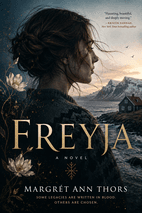
Underneath its plot, Freyja wrestles with how the past refuses to stay buried. Memory is partial, full of blackouts and misremembering, yet it is also the only path to truth. Secrets surface through letters, photographs, and unexpected visitors. Folklore and skepticism compete to explain trauma, while guilt over a dead sibling loops across generations. Maternal fear drives choices that protect and consume.
On this page, each major theme is paired with concrete moments from the book: unreliable recollection, maternal love, buried secrets, folklore and skepticism, grief and revenge, identity doubling. Then we break down the recurring symbols: the sea as a repository of the dead, the tackle box as a container of identity, photographs that expose hidden truths, and the watchful raven.
Major Themes in Freyja
Memory and unreliable recollection
The novel repeatedly shows that memory is partial, distorted, and easily lost, yet also the only path to the truth. Characters black out, misremember their own photos, and rely on written records that fail them, while returning to physical places triggers what was suppressed.
- Unnur recalls that the night of Freyja's disappearance was 'erased from my mind, as though excised with a scalpel.'
- Lilja has to remind Unnur that she took the photo at Kaffi Vest, exposing a memory gap.
- Unnur blacks out during police questioning and cannot remember the lost minute.
- Reading her old letter to Elias, Unnur reflects that 'time had warped yet another memory.'
Maternal love and protective fear
Maternal love is depicted as fierce, self-sacrificing, and all-consuming. Unnur's choices are driven by the need to keep Lilja safe from past secrets and present threats, and the narrative treats losing Lilja as equivalent to losing life itself.
- Unnur thins peanut butter so Lilja will not choke and prays for an unremarkable life.
- Unnur thinks, 'To lose Lilja, to lose half her remaining childhood or more, would be to lose my life.'
- Unnur says, 'When you're a mother, you have two hearts,' because whatever hurts the child hurts the mother twice.
- Carrying Lilja through the water, Unnur keeps going because 'I was Mamma, and that would have to be enough.'
Secrets, exposure, and the returning past
The novel shows that buried truths do not stay buried: they resurface through letters, newspaper articles, photographs, and unexpected visitors. Secrecy is treated as more damaging than the truth, and exposure often arrives exactly when the protagonist believes she is safe.
- The unstamped note reading 'Hee, Unna. Remember me?' drags the past back into Unnur's life.
- Unnur's old name and connection to Freyja are exposed through the Seltjarnarnes Sewing Club website.
- Elias tells Unnur, 'Secrets hurt more than the truth. Even if the truth hurts.'
- Léa impersonates Unnur, plants Freyja's GPS watch, and manipulates evidence to frame her.
Folklore, belief, and skepticism
Icelandic folklore runs through the novel as both a source of wonder and a way of interpreting trauma. The narrative pits old beliefs in huldufólk, nykur, and curses against scientific skepticism, and the characters' fates hinge on which worldview they trust.
- Freyja tells Unnur the story of the nykur, a water horse that drowns a girl.
- Binni warns Unnur about the cursed water that knows the sound of children's voices.
- Léa believes her daughter was swapped by the huldufólk and is a changeling.
- Even though Unnur once told herself Science was her only god, she finally asks for help from Freyja, Ran, the huldufólk, and the Norse gods.
Loss, guilt, and revenge
Grief over a dead sibling sets a cycle of blame and retaliation in motion that repeats across generations. The story explicitly connects two missing Freyjas and two red cars, and shows how revenge only multiplies loss.
- After the severed horse head, Freyja says, 'This is a curse. Because of me.'
- Unnur sees the echo: 'Red car, Freyja missing. Another red car, another Freyja missing. This was not right. Or rather, this was too right.'
- Léa's grief over her brother Tommi drives her to push Freyja into the water and later to target Unnur.
- The text observes that 'revenge had only begotten more loss.'
Identity and doubling
The novel questions the stability of identity through names, mirroring, impersonation, and shared histories. Unnur and Freyja played at being each other, Léa passes herself off as Unnur, and multiple characters share the name Freyja, suggesting the self can be duplicated, stolen, or mistaken.
- As children, Unnur and Freyja used to pretend to be each other.
- Elias identifies the woman in Unnur's photograph as 'Unnur,' while Unnur silently repeats 'That's Léa.'
- The newspaper article about 'FREYJURNAR OKKAR' links the 1991 disappearance of Freyja Eliasdottir to the current disappearance of Léa's daughter.
- Unnur asks, 'What if I came here, except I wasn't really me?'
Symbols and Motifs
Water / the sea
Water is a repository of the dead, memory, and unresolved grief, while also being a hostile, animate force tied to folklore and danger. The sea holds the ashes of mothers, the body of a sister, and the imagined presence of the nykur.
- Elias scattered Stella's ashes in the ocean, and Freyja sometimes talked to the water where they were spread.
- Freyja falls backward into the sea and disappears, and Unnur cannot find her in the frigid water.
- In the cave, Unnur glimpses what she believes is a nykur with a shimmering white tail and backward-facing hooves.
- At the end, Unnur imagines Freyja bobbing in the waves and reflects, 'We're all made of water.'
The tackle box
The tackle box is a physical container of Unnur's childhood memories, identity, and keepsakes. Its theft, recovery, and recirculation track the struggle over who controls her past and how it can be used against her.
- Unnur realizes her old tackle box is missing from the attic after someone impersonated her and visited Elias.
- She breaks into Léa's house and retrieves the tackle box from the office.
- The tackle box disappears from her car seat while she is at the hospital with Lilja.
- Matthias tells Unnur the stolen tackle box was found and is now with Pétur.
Photographs and Polaroids
Photographs are evidence of hidden truths, surveillance, and the unreliability of memory. They can expose what the naked eye misses, but they also document moments that characters have forgotten or never knew were captured.
- The Polaroids of twelve-year-old Unnur and Freyja were taken from an elevated or distant angle, and Unnur has no memory of them being taken.
- Lilja identifies a photo as one Unnur took at Kaffi Vest, revealing Unnur's memory gap.
- Unna photographs Tommi every day to track his health, and her funeral photo shows Freyja as translucent.
- In Léa's office, Unnur finds surveillance photos of herself and Lilja, including one at her bathroom window.
The raven
The raven is an omen of death and a watchful, uncanny presence. It also connects to memory and thought through Odin's ravens, reinforcing the novel's concern with losing memory and being observed.
- Unnur reflects on Odinn's ravens Thought and Memory while driving to the Dark Valley.
- A raven beats its beak against the window while Unnur lies sick with fever, before Bjartur is killed.
- After leaving Ndi's apartment, Unnur sees a raven perched on her car with 'black eyes unblinking. Watching.'