The Book of Elon Quotes
by Eric Jorgenson
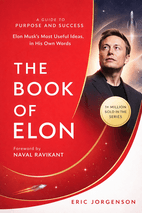
The Book of Elon gathers moments of raw insight from one of the most ambitious builders of our time. You will find lines about physics, failure, and the sheer will to make the impossible happen. Some are blunt and confrontational. Others are oddly poetic. All of them come from someone who has lived through the trenches of engineering and entrepreneurship.
What makes this book endlessly quotable is that Musk speaks from experience, not theory. His words carry the weight of real rockets, real factories, and real near bankruptcies. They stick because they are true under pressure. You can pull out a line and it lands instantly, whether you are building a company or just trying to get through a tough week.
Top Quotes from The Book of Elon
“Everything in this book is taken out of context.”
The author explaining the nature of the compilation.
A candid admission that challenges the reader's trust, making the book self‑aware and prompting critical engagement with the material.
“Don't make the thing to make the money, make the money so that you can make the thing.”
Naval Ravikant advising on the proper relationship between purpose and profit.
It encapsulates a core entrepreneurial mindset shift—prioritizing mission over money—and resonates with those who seek meaning in their work.
“You and I may be ants, but we are building an intergalactic cathedral.”
Eric shares the spiritual satisfaction he gained from working on the book.
The striking contrast between smallness and grandeur ignites a sense of humble ambition, reminding readers that even tiny efforts contribute to something vast.
“Nobody ever changed the world on forty hours a week.”
Elon Musk explains the extreme work ethic required for world-changing innovation.
It challenges conventional work-life balance norms and inspires those who aim to make a massive impact to commit fully.
“If you have beliefs that are incompatible with a rocket getting to orbit, the rocket will not get to orbit. Physics is a harsh judge.”
Elon Musk on the unforgiving nature of physics in rocketry.
It underscores the importance of aligning beliefs with reality, especially when failure is catastrophic, and reminds us that nature cannot be fooled.
“Impossible is a strong word. It’s just a strong word. I approach things from a physics standpoint, and the word impossible is more or less banned in physics.”
Elon Musk on challenging the concept of impossibility.
It inspires readers to reject self-imposed limits and adopt a physics-based mindset that seeks possibilities within physical constraints.
“Starting a company is like eating glass and staring into the abyss.”
Musk quotes his friend Bill Lee about the reality of entrepreneurship.
It is a brutally honest and memorable description of the constant stress and unpleasant work involved in startups.
Themes Behind the Quotes
A central theme is the relentless application of first principles thinking. Musk strips problems down to their fundamental physics and builds up from there, ignoring conventions. This leads to rejecting the word impossible because physics does not accept excuses. Another theme is the value of direct, brutal experience over theory. The only teacher that truly works is making mistakes and learning from them, often through extreme effort and long hours.
Purpose must drive profit, not the other way around. Money is a tool to build something useful. Leading by example is crucial. A leader who bleeds alongside the team earns respect. Finally, there is a strong urgency. The world does not wait, and the only way to protect an idea is to innovate fast. These themes form a philosophy of building the future through determination and logical rigor.
Quotes by Chapter
Notes on This Book
“All brilliance in this book is Elon’s; any mistakes are mine.”
The author's note taking responsibility and attributing credit.
This line is a humble and honest disclaimer, acknowledging the source while owning any errors, which resonates with readers for its integrity.
“As ideas passed through time, space, and medium, phrasing may have shifted in flight.”
The author describing the process of editing and recontextualization.
This poetic metaphor captures the fluidity of language and meaning, reminding readers that interpretations can drift across contexts.
“Please verify phrasing with a primary source before citing Elon from this book.”
A direct instruction to the reader about using the book as a reference.
Encourages critical thinking and truth‑seeking, a rare and responsible caveat that adds credibility to the work.
Foreword
“The only reliable teacher is bitter experience.”
Naval Ravikant in the foreword, reflecting on the founder's journey and the limitations of mentors and books.
This line distills a universal truth about learning through failure, making it a stark reminder for entrepreneurs that real wisdom comes from hardship.
“Hard work is common, intelligence uncommon, courage rare—and Elon combusts all three.”
Naval Ravikant describing Elon Musk's unique combination of traits.
It powerfully contrasts common virtues with rare ones, elevating Musk as a singular figure who embodies all, inspiring readers to value courage above mere effort or smarts.
“When one man shows what's possible, a million arise, not as followers, but as missionaries in their own right.”
Naval Ravikant explaining the ripple effect of visionary achievement.
This quote reframes influence as empowerment rather than imitation, encouraging readers to become independent creators inspired by example.
Eric’s Welcome to This Book
“Elon Musk has done the entrepreneurial equivalent of running a two- minute mile. Twice. At the same time.”
Eric describes Elon's simultaneous achievements with SpaceX and Tesla.
This vivid metaphor makes a complex, unprecedented feat instantly understandable and memorable, inspiring readers to aim for the seemingly impossible.
“After seeing what Elon and his teams have accomplished, we stand taller, and the universe seems smaller.”
Eric reflects on the emotional and philosophical impact of Elon's work.
It captures the shift in perspective that great achievements create, filling readers with hope and a sense of expanded possibility.
“He models our moral duty to grab the impossible and drag it into the possible through massive effort, ingenuity, and force of will.”
Eric explains the lesson he takes from Elon's example.
This turns admiration into a call to action, framing progress as an ethical obligation that anyone can embrace.
Living a Purposeful Life
“The measure of success in my life is: “How many useful things can I get done?””
Elon Musk defines his personal metric for success.
It reframes success away from wealth or fame toward tangible usefulness, offering a clear, actionable philosophy for anyone seeking purpose.
“I have a lot of respect for someone who puts in an honest day's work to do useful things.”
Elon Musk expresses admiration for everyday contributors.
This line validates the dignity of ordinary labor and counters the obsession with flashy achievements, making it deeply relatable.
“Look fear straight in the eye and it will disappear.”
Elon Musk advises on confronting fear directly.
The simple, almost aphoristic phrasing provides a powerful mental tool for overcoming anxiety, resonating with anyone facing daunting challenges.
Think like a Physicist
“The mental tools of physics are powerful. They tell us to assume we're wrong and that our goal is to be less wrong. Aspire to be less wrong.”
Elon Musk advocating for intellectual humility and continuous improvement.
This is a concise call to embrace fallibility and the scientific method in daily life, encouraging growth through iterative correction.
“It is important to view knowledge as a semantic tree. Make sure you understand the fundamental principles (the trunk and big branches) before you get into the leaves (the details), then there is something for them to hang on to.”
Elon Musk on effective learning and knowledge structure.
This metaphor provides a powerful framework for learning, emphasizing that deep understanding of fundamentals makes details easier to grasp and retain.
What It Takes
“My goals were to engineer products by having a feel for the physics and to never work for a boss with a business degree.”
Elon Musk explains his dual education in physics and business.
It captures his desire for technical independence and his anti-establishment engineer ethos.
“If I fall asleep in the middle of the factory floor at four in the morning and wake up four hours later, they see that. They are like, “If the CEO is willing to take that level of pain, I can do it too.””
Musk describes sleeping on the factory floor to inspire his team.
It vividly illustrates his hands-on leadership and willingness to endure hardship alongside his workers.
“Nobody bleeds for the prince in the palace.”
Musk argues that leaders must be on the front lines rather than in ivory towers.
This pithy metaphor powerfully conveys the necessity of shared sacrifice and visible commitment.
Building Exceptional Teams
“Physics does not care about hurt feelings. It cares about whether you got the rocket right.”
Elon Musk in the section 'FEEDBACK OVER FEELINGS' discussing his approach to criticism.
This line cuts through emotional noise and underscores the importance of objective reality, making it a memorable mantra for high-stakes engineering.
“Only exceptional performance constitutes a passing grade.”
From the 'CREATE A CULTURE OF BUILDERS' section, describing Tesla's demanding standards.
It encapsulates Musk's zero-compromise philosophy on performance, inspiring readers to aim far beyond mediocrity.
“If you can’t tell me the four ways you fucked something up before you got it right, you weren't the one doing the real work.”
Elon Musk to a discouraged engineer, emphasizing learning through failure.
Its raw honesty and directness make failure a badge of genuine effort, encouraging bold experimentation.
“THE BEST PART IS NO PART. THE BEST PROCESS IS NO PROCESS.”
Elon Musk explains his core philosophy for eliminating unnecessary complexity in manufacturing.
This pithy mantra challenges conventional engineering thinking and emphasizes elimination over addition, inspiring a minimalist approach to design.
Maniacal Urgency
“It is not rude to leave; it is rude to make someone stay and waste their time.”
From the section 'DON’T WASTE TIME,' Elon Musk advises on meeting etiquette.
This flips conventional politeness on its head, empowering individuals to prioritize productivity over social obligation. It resonates because it gives permission to leave unproductive meetings without guilt.
“The real way you actually achieve intellectual property (IP) protection is by innovating fast.”
In the section 'SPEED IS BOTH OFFENSE AND DEFENSE,' Musk argues for innovation speed over legal barriers.
This encapsulates Musk's belief that relentless innovation is a stronger competitive moat than patents or copyrights. It challenges traditional business wisdom and inspires a focus on rapid progress.