As an Amazon Associate, we earn from qualifying purchases.
⚠️ READER ADVISORY: This is a deep-dive summary designed for those who want the full story. Contains spoilers.
What is the book Storytelling for Business about?
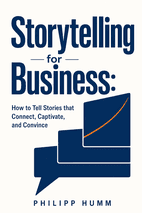
Philipp Humm's Storytelling for Business follows Humm as he commits to becoming a storytelling coach, only to have his grandfather ask what a story actually is—sparking a humbling apprenticeship through failed pitches, coaching sessions, and skeptical buyers. A practical craft memoir for professionals who want to tell better stories at work.
Feature
Insta.Page
Blinkist
Shortform
Storytelling for Business
✓
✕
✕
Summary Depth
Full Chapter-by-Chapter
15-min overview
Section-by-section guides
Audio Narration
✓
✓
✓
Full access to all 700+ summaries
✓
✓
✓
Visual Mindmaps
✓
✕
✕
AI Q&A
✓
✕
✕
Missing a book? Request it, usually live within 48h
✓
✕
✕
Quizzes
✓
✕
✕
PDF Downloads
✓
✕
✓
Send to Kindle
✓
✓
✓
Price
$89.99/yr
$146/yr (PRO)
$199/yr
*Competitor data last verified July 2026.
1 Page Summary
Philipp Humm has just staked his future on a bold public declaration: he is going to become a storytelling coach. But when he sits down for coffee with his grandparents to share the news, the moment he hoped would confirm his new path instead exposes a hole in it. Opa wants to know what a storytelling coach actually does—and, more pointedly, what a story is. Philipp recites the dictionary definition and watches it fail to land, leaving his grandfather no clearer and himself quietly shaken. The gap between the words he knows and the understanding he needs becomes the engine of everything that follows, as Philipp chases proof that he can truly master the craft he has promised to teach.
That chase is anything but smooth. A pitch built on an elaborate, carefully crafted story backfires with a buyer, and his sister's blunt diagnosis—too long, too dramatic—costs him his confidence in big-stage structures. A masterclass speaker hooks him with a small, embarrassing coffee stain and sends him back to the recording again and again, hunting for the hidden mechanics behind the effect. A survey of 127 professionals surfaces a surprising roadblock: most people don't lack faith in storytelling—they simply don't know what stories they could share at work. In coaching sessions and workshops, Philipp confronts the same recurring pattern, storytellers who abandon their natural charisma the moment a story begins, and he faces his own inner critic when a senior sales professional interrupts a virtual workshop to declare the method won't work in Germany.
The book traces an earnest, often humbling apprenticeship in which every confident assumption gets tested—by skeptical grandparents, unimpressed buyers, and one very direct sales guy—and replaced with something sturdier. Humm moves between personal narrative, real coaching case studies, and hands-on frameworks, always circling the question Opa first posed. Readers who enjoy practical craft books with a memoir's pulse, who like their advice delivered through failure and recovery rather than bullet points, and who have ever wanted to explain their work to family and found the words insufficient will recognize the stakes here and want to follow Philipp through to the answer he is still reaching for.
1 What Is Storytelling?
Philipp decides to become a storytelling coach after taking a course in the Netherlands, wanting a fresh career rather than a continuation of what he has been doing. To make the commitment real, he announces it publicly on LinkedIn, deliberately closing the door behind him so he cannot quietly back out if doubt sets in.
Coffee with Opa and Oma
Philipp sits down with his grandparents over coffee to share the news, wanting their approval. He tells them he is becoming a storytelling coach. The reaction he hopes for does not come. His grandfather, Opa, is confused, and the confusion is not hostile, just genuine. Opa wants to understand what his grandson has actually decided to do with his life.
Opa asks what a storytelling coach is. Philipp answers confidently, but the answer does not land. Opa is not satisfied, and the conversation does not move forward. Then Opa asks the question that matters: what is a story? Philipp is caught off guard. He wants to sound competent, so he recites the dictionary definition. The moment the words leave his mouth, he knows he has failed. Opa stares at him, still confused, wanting clarity that never arrives. Philipp leaves knowing he cannot explain his own profession, and the gap between the confident LinkedIn announcement and the reality of his knowledge is now painfully visible.
Rethinking the Definition
Philipp resolves to fix this. He wants to rethink and simplify storytelling until he can explain it to anyone, including his grandfather. He strips the idea down and redefines a good story as a moment when a person faces a challenge that changes how they think, feel, or act. Wanting to make the definition usable rather than abstract, he breaks it into four parts: moment, person, challenge, and change. This becomes the framework he will teach.
To test it, Philipp presents the story of Steve Jobs calling Bill Hewlett at age twelve, wanting a concrete example that illustrates all four elements. In the story, young Steve Jobs calls Bill Hewlett to ask for spare frequency counter parts, wanting to build a device. Hewlett laughs at the audacity of the request but gives him the parts. Jobs then accepts a summer assembly-line job at Hewlett-Packard, wanting to be near the work, and takes away the lesson to just ask. The example carries the framework: a moment, a person, a challenge, and a change.
The Evidence
Philipp then turns to research to justify why storytelling matters. Gordon Bower and Michael Clark test 48 students on memorizing word lists, wanting to know which method works best. The story group recalls 93 percent of the words, while another group recalls only 13 percent. The gap is enormous.
Paul Zak shows volunteers videos, one about a father and his dying son and another about a zoo visit, wanting to measure storytelling's effects on the brain. Oxytocin rises only in the group that watches the conflict story, not the zoo footage.
Rob Walker and Josh Glenn buy 100 thrift-store objects for $129 and add invented stories to them before selling them on eBay, wanting to test whether story adds value. The items sell for $3,613.
The Pivot to Practice
Philipp concludes that stories make messages memorable, build trust, and raise perceived value. With the case made, he pivots from why to how, turning to the craft of building stories. He assigns readers to list three work challenges and pick one, wanting them to arrive prepared, and sets up the next chapter's story-building exercise.
💡 Try clicking the AI chat button to ask questions about this book!
2 Structure Stories
Philipp has a buyer coming, and he wants to impress him. So he spends a full day crafting a story for the pitch, time he could have spent on the actual work. He delivers the story to the buyer, wanting to close the sale, and the buyer politely dismisses him. The sale does not happen.
The Call That Reframes Everything
Philipp wants to understand why the story failed, so he calls his sister for advice. He starts telling her the story, and she interrupts him, wanting to diagnose the problem. She tells him it is too long and too dramatic. The story he built to win the buyer was the thing that lost him. Philipp realizes his story was too big and irrelevant, and the failure costs him his confidence in big-stage structures. What he believed was a strength, the elaborate crafted narrative, turns out to be the obstacle.
Rebuilding from the Ground Up
Philipp decides to rebuild his approach. He wants a simple structure, so he studies and tests storytelling frameworks. Out of that work he creates the four-step CART structure, wanting a reliable tool for concise professional stories. He explains the Context step, wanting listeners to grasp who, when, where, and what quickly. Context is the foundation, the orientation that lets an audience follow what comes next. But Philipp warns against too much context, wanting storytellers to move fast to the adversity. Too much setup and the listener drifts away before the story has begun.
The Adversity Step
Philipp introduces the Adversity step, wanting storytellers to show struggle and risk instead of only successes. This is the heart of the structure, the place where something is at stake and the outcome is not guaranteed. To show how it works, Philipp shares his workshop example, wanting to show how he faced a room of disengaged VPs. He sets the scene: a room of executives who are not with him, silent and unmoved. Philipp pivots in the story, wanting to turn the room around, and uses absurd images to spark laughter. The absurdity is the move, the deliberate break from the expected that gives the audience permission to react.
The Room Turns
The VP laughs and participates, changing the room from silent to roaring with laughter. The shift is total, from disengagement to full participation, and it happens inside the story itself. A VP tells Philipp the workshop was the most fun and useful he had attended, validating the resolution. The struggle in the Adversity step pays off, and the resolution lands because the audience felt the risk along the way.
The Takeaway and the CAT Variant
Philipp draws the Takeaway, wanting listeners to learn that humor can create connection. The lesson is the point the story exists to deliver, the reason it is told at all. Then Philipp introduces the CAT variant, wanting a simpler option when there is no resolution or only a quick lesson. CAT is the shorter form, the version for moments when a full arc is not available or not needed, and it gives storytellers a way to stay concise even when the story is small.
3 Enhance Stories
The narrator signs up for a free masterclass, hoping to become a better storyteller. He has told stories for years, but he feels the gap between what he wants to convey and what listeners actually experience. The risk of a wasted hour seems small against the possibility of finding a real method, so he commits and shows up ready to take notes.
The masterclass speaker opens by recounting spilling coffee on his shirt. He does not announce a technique or promise a formula; he simply tells the small, embarrassing moment in a way that makes it feel present. The narrator is immediately hooked, and the risk of wasted time gives way to genuine curiosity about how the effect was achieved.
He re-watches the recording, studying every pause, tone, and detail. He is not content to enjoy the story; he wants to reverse-engineer it. He notices how the speaker lingers in certain places, how his voice shifts, how specific details carry the weight of the moment. Watching it again shows him things a single viewing had hidden.
He begins to see patterns. He likens the discovery to unlocking a secret recipe: the same ingredients keep appearing, arranged in a way that produces a powerful effect. The masterclass was not a performance to admire from a distance but a demonstration of a repeatable craft, and the narrator starts to name the components he keeps noticing.
He shares Eric Edmeades' war-movie analogy. The helicopter view is the wide, strategic perspective, the summary of events from above. The trenches are where the action is immediate, sensory, and personal. Great stories, the narrator argues, do not stay in the helicopter; they drop into the trenches and let the listener experience the moment from the ground.
He challenges readers to recall a standout moment from their own work life. He asks them to locate it: where were they? What were they doing? What were they thinking? What were they feeling? What were they hearing? The questions are designed to pull the memory out of summary and back into the senses, showing that everyone already carries powerful moments inside them.
He warns against over-describing. The temptation is to paint every detail of a room, but the narrator shows that simple placement is enough to form pictures in listeners' minds. A few words of setting give the audience somewhere to stand, and their own imagination fills in the rest. Too much description buries the story; the right amount of location anchors it.
He shows how stating "I am" or "I was" plus an action gives the story momentum. It puts the teller inside the moment and sets something in motion. Instead of describing a situation from outside, the storyteller becomes a person doing something, and the listener follows.
He demonstrates that raw, messy inner monologue makes stories relatable and engaging. Clean, polished thoughts sound like a report; the unedited voice inside a person's head sounds like a human being. Sharing the messy interior is what lets an audience recognize themselves in the story.
He shows that demonstrating emotion through actions and expressions beats naming it. Saying "I was nervous" is a label; showing what nervousness made a person do is a scene. The narrator argues for the physical and visible over the abstract, because the audience feels what it can see.
He shows that concise, catchy quotes bring momentum and a real-time feel. Dialogue pulls the listener into the moment as it happens, and short lines land harder than long speeches. The narrator treats dialogue as a tool for pace and presence, not for completeness.
He sets a rule for keeping stories truthful: the core elements must be real, with only minor tweaks allowed. A storyteller can adjust small details, but the heart of the story has to be true.
He advises zooming into the trenches during adversity and resolution. Those are the points where the audience most needs to feel the ground under their feet. The wide view can carry the setup, but when the stakes rise and the outcome hangs in the balance, the story must go close.
He models the technique by analyzing Bob Iger's story of Steve Jobs revealing his cancer before the Pixar announcement. Iger is preparing to announce the acquisition of Pixar, and Jobs calls him with news that changes the frame of the decision: he has cancer. Iger wants to decide whether to proceed with the acquisition, and the moment is charged with uncertainty. Jobs offers him an out, giving him room to walk away. Iger chooses to go through with the deal. The narrator uses the story to show how these techniques operate in a real, high-stakes account: the location of the conversation, the actions, the thoughts, the emotion demonstrated rather than named, and the dialogue that carries the weight of the choice.
He closes with a challenge to enhance your own stories using one or two of these techniques. The masterclass that began with spilled coffee ends with an invitation: take a story you already tell, drop into the trenches, and make the listener feel the moment.
4 Find Stories
The narrator wants to understand what actually holds professionals back from telling stories at work, so he goes straight to the source. He surveys his LinkedIn network and newsletter subscribers, asking what keeps them from bringing storytelling into their jobs. The responses come back clear: 127 people say they want to tell more stories but name their biggest roadblock, and the single largest group, 37 percent, lands on the same confession. They don't know what stories they could share at work. It isn't reluctance or disbelief in storytelling's power. It's a blank where the material should be. That gap becomes the problem the narrator sets out to solve, and he distills the experience of thousands of professionals into a simple framework: the 4 C's of Business Storytelling.
Four Stories, Four Rooms
Sophia Meyer wants to break the ice with a coworker, and she reaches for a story from her own life rather than small talk about the weather. She tells a story about a pottery class, something personal and specific enough to open a real conversation, and then she turns it outward, inviting the coworker to share a hobby in return. The story does the work of making space for the other person to answer in kind.
Philipp Humm wants to build rapport with a customer, so he tells a story about returning from India. The story is his own, but the move is deliberate: he follows it by asking the customer when they last returned from a trip. The question hands the conversation over, turning his travel story into an invitation for the customer to tell theirs.
Samantha Lee wants to open a team meeting on process improvement, and she needs the team to feel why planning matters before they discuss how to do it better. She tells a story about a wobbly bookshelf, a concrete image of what happens when planning gets skipped, and the cost of that shortcut becomes the frame for the whole meeting.
Raymond Hernandez wants to kick off a customer-satisfaction presentation, so he tells a story about ordering a pizza. The story exposes rigid policies, the kind that frustrate customers for no good reason, and it sets the stakes for the presentation before anyone opens a slide.
Eric's To-Do List
Eric Mann is a new analyst who wants to be productive, and he measures himself the way new analysts often do: by the list. He obsesses over his to-do list and clears eighteen of twenty items. The number feels like proof of a good day.
Then his manager asks for a project update, and Eric discovers the two unchecked items were the ones that actually mattered. The eighteen completed tasks were noise; the two he skipped were the substance. The realization lands hard, and Eric stays until 2 a.m. fixing his mistake, the hours of cleanup paid for out of his own night. Out of that night comes a decision: each morning he will ask what three things will move the needle, and he challenges his coworker to do the same. The list stops being a scoreboard and becomes a filter.
Mark Hunter's Fee
Mark Hunter wants to defend his fees against a CEO who is demanding a discount. He refuses to lower them, and the refusal puts the deal itself at risk. The tension sits in the room: hold the price and possibly lose the client, or cave and set a precedent he doesn't want.
Then the CEO reveals the rest of the story. He tested Mark's competitor first, and the competitor caved immediately. That instant surrender is exactly what told the CEO what he needed to know. Mark's refusal to fold is the reason the CEO decides Mark's firm is the one he wants, and the deal closes that same day. The discount demand was never really about the discount.
Kate Fisher's Rating Labels
Kate Fisher wants to change the performance appraisal system, and she makes her case with a story about James. James spent a brutal day defending rating labels, and Kate recounts it to show the pain of the five-category system, the hours burned arguing over what a label means instead of talking about the work itself. The story makes the cost visible: real people, real exhaustion, all of it spent on categories rather than growth.
Out of that comes Kate's decision. She will propose a two-category system, one that keeps reviews focused on growth instead of on defending where someone lands on a five-part scale.
Soojin Kim's Customer
Soojin Kim wants to shift the company toward customer-focused content, and she builds her argument around a customer named Jen. Jen's complaint is specific: the brochures list features without answering her real questions. The company is talking about itself while the customer is trying to solve a problem, and the gap between those two things is the whole problem.
Soojin decides to propose an AI-powered recommendation engine, one that delivers tailored solutions to customers like Jen, content that answers the question the customer actually has rather than reciting what the product does. The story of one frustrated customer becomes the lever for changing how the company talks to all of them.
You've reached the end of the free chapters
Next chapter: “5 Tell Stories” is locked
Keep reading Storytelling for Business — and unlock all 700+ book summaries with audio, mindmaps and AI Q&A.
$0.00 due today · 7 days free, then $89.99/year ($7.49/mo) · Cancel anytime before day 7
Philipp Humm is a distinguished author and thought leader whose works explore the intersection of modern leadership and personal transformation. His insightful books, including the acclaimed "The 8 Metaphors of Leadership," provide a unique framework for navigating the complexities of the contemporary professional world. Drawing from his extensive experience in international business, Humm delivers powerful narratives that resonate with aspiring and established leaders alike. His publications are celebrated for their practical wisdom and innovative perspectives, establishing him as a vital voice in the genre. Philipp Humm's influential books are available for purchase on Amazon, where they continue to inspire a global readership.
Frequently Asked Questions about Storytelling for Business
What is Storytelling for Business about?
It follows a coach who sets out to master business storytelling after a career change, only to discover how hard it is to explain what a story actually is when his own grandfather asks him straight over coffee. Early missteps, including an overcrafted pitch that loses a buyer, push him to build simple, repeatable frameworks instead of elaborate performances. Along the way he works with professionals who freeze up or slip into 'performer mode' when it is time to tell a story, and the stakes are practical: winning trust, holding a room, and sounding like yourself while doing it.
Who is the author of Storytelling for Business?
Philipp Humm writes as both narrator and guide, drawing on his own transition into storytelling coaching after a course in the Netherlands and a public commitment he made on LinkedIn. He developed the CART structure and the 4 C's of Business Storytelling, testing his methods with clients, workshop audiences, and a survey of 127 professionals. His approach is built from hands-on coaching experience rather than abstract theory.
Is Storytelling for Business worth reading?
It is a genuinely practical book, offering frameworks like CART and the 4 C's that you can apply to a pitch, a meeting, or a difficult conversation right away. The lessons arrive through real scenarios, such as a lost sale, a recording that reveals an unnatural delivery, and a heckled workshop, which makes the advice stick far better than a list of rules. It is especially useful if your roadblock is not believing in storytelling but simply not knowing which stories you have to tell.
What are the main themes in Storytelling for Business?
The book champions simple structures over elaborate, dramatic narratives, showing how an overbuilt story can cost you the very sale you crafted it for. It explores the gap between how storytellers think they sound and how they actually come across, urging people to drop performer mode and stay themselves. Another thread is that stories are abundant rather than scarce, and that the real skill lies in noticing and collecting them from ordinary life and work. Confidence, inner critics, and the value of learning through real audience reactions run throughout as well.
📚 Explore Our Book Summary Library
Discover more insightful book summaries from our collection