Storytelling for Business Book Club Questions
by Philipp Humm
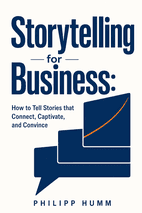
These questions assume everyone has finished the book and contain spoilers, including the ending.
This book gives a book club plenty to argue about because it mixes personal stories, business examples, and practical experiments rather than offering one tidy formula. Readers can compare what feels convincing, what feels too polished, and where their own work stories fit.
Use the questions as conversation starters, not a test. Pick a few that match your group's interests, give people a minute to jot notes, then discuss in pairs or as a whole. The numbered groups below move from story basics to examples to practice, but you can jump around.
What Makes a Story Work
- 1.When Opa asks Philipp what a story is and Philipp recites a dictionary definition, how does that failed explanation push Philipp toward his simpler definition of a good story as a person facing a challenge that changes how they think, feel, or act?
- 2.Philipp's sister interrupts his story and says his stories are too long and dramatic, telling him 'This isn't a TED Talk. It's a casual conversation.' Did you agree with her critique, and how does it lead to the CART and CAT structures?
- 3.After Philipp spends a day crafting a story for a buyer, the buyer gives a polite smile and says 'Ah, well... thanks for sharing. We'll be in touch.' What does this failure reveal about professional storytelling, and how do CART and CAT respond to it?
Examples, Adversity, and Real Moments
- 4.Philipp uses Steve Jobs calling Bill Hewlett at age twelve as an example of moment, person, challenge, and change. Does that story effectively illustrate his definition of storytelling, or does another example from the book work better for you?
- 5.In Sarah Willingham's story, a lawyer assumes she is there to get coffee, and she makes him coffee before watching him realize his assumption. How does this story demonstrate CART, especially the idea that adversity is the step you cannot skip, and what does it suggest about turning a weakness into a superpower?
- 6.When Bob Iger walks with Steve Jobs before the Pixar acquisition announcement and Jobs reveals his cancer has returned, Iger decides not to back out and promises not to tell anyone. Did you agree with Iger's choice as presented in Philipp's example, and how do Iger's internal thought 'This can't be good' and Jobs's exact dialogue make the scene feel immediate?
Evidence and Practical Techniques
- 7.Which piece of evidence in Chapter 1 is most persuasive to you: Gordon Bower and Michael Clark's 1969 experiment where the story group recalled 93 percent versus 13 percent, Dr. Paul Zak's 2004 oxytocin study comparing the cancer-conflict video with the zoo video, or Rob Walker and Josh Glenn's 2009 experiment selling $129 of thrift-store objects for $3,613 after adding stories?
- 8.Philipp's survey receives 127 responses, and 37 percent say they do not know what stories they could share at work. How well do the four C's—Connection, Capturing, Coaching, and Convincing—address that roadblock, and which example, such as Sophia Meyer's pottery story, Samantha Lee's wobbly bookshelf, Raymond Hernandez's anchovy pizza, Eric Mann's to-do list, Mark Hunter's fee negotiation, Kate Fisher and James's performance reviews, or Soojin Kim and Jen's focus group, is most useful to you?
- 9.After watching David J.P. Phillips's TEDx Talk, Philipp distills 20 techniques, recruits 1,050 professionals via Prolific to rate story versions, and then finds in a second experiment that videos cramming many techniques scored lower than videos using just two or three. Does this 'less is more' finding change how you think about storytelling advice, and which advanced technique, such as anticipation, surprise, or restraint, seems most useful?
- 10.In the Nordstrom example, Craig Trounce accepts a man's tires, calls a local tire company to estimate their value, and gives the man a refund even though Nordstrom did not sell tires. How does this story illustrate surprise and pattern-breaking, and is it an effective business story?
Authenticity and Confidence
- 11.Marcela tells Philipp that a story she tried in a call 'sucked,' and when they watch the recording Philipp sees her switch from natural energy into a polished 'performer mode.' Why did her story fail despite being well crafted, and what does Philipp's advice to internalize rather than memorize suggest about authenticity versus performance?
- 12.During Philipp's virtual workshop for sales professionals at a German medical equipment manufacturer, a senior sales guy interrupts him saying the technique might work in the US but not in Germany, and Philipp's confidence is shattered. How convincing is the later Ultraspeaking insight from Tristan de Montebello and Michael Gendler that true confidence is trusting your ability to handle whatever arises, and did you agree with how Philipp responded to the interruption?
- 13.Philipp performs his first stand-up routine in front of 180 strangers in November 2021 after presenting a confidence progression from solo improv to sharing stories with friends, colleagues, teams, small audiences, and big stages. Why is this a turning point for him, and how does it connect to his improv games such as staying in character, zooming into one moment, and saying yes?
Building a Story Practice and Lasting Impact
- 14.When Jakob Manthei describes a five-day public speaking training in Estonia where the trainer answered every question with a story, Philipp realizes that the best storytellers are not the ones with a few shiny stories but the ones with the most stories. Do you agree with that conclusion, and how do the Life Map, Homework for Life, and Story Bank strategies make an abundance of stories practical?
- 15.At the Amsterdam food market, Daan reintroduces himself as a past workshop participant and tells Philipp he still remembers and has shared Philipp's avocado-and-nephew story three years later. How does this ending reframe the techniques and experiments in the book, and which story from the book has stayed with you most?