⚠️ READER ADVISORY: This is a deep-dive summary designed for those who want the full story. Contains spoilers.
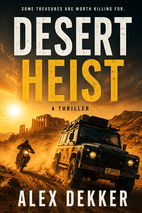
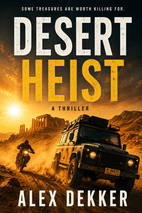
What is the book Desert Heist about?
Alex Dekker's Desert Heist follows Nate Wilde, a haunted ex-Special Forces soldier turned Harvard historian, who assembles his former brothers-in-arms to hunt a legendary treasure tied to a lost desert city—while pursued by a ruthless Russian operative. A high-stakes blend of military action and archaeological mystery for adventure lovers.
Feature
Insta.Page
Blinkist
Shortform
Desert Heist
✓
✕
✕
Summary Depth
Full Chapter-by-Chapter
15-min overview
Section-by-section guides
Audio Narration
✓
✓
✓
Visual Mindmaps
✓
✕
✕
AI Q&A
✓
✕
✕
Quizzes
✓
✕
✕
PDF Downloads
✓
✕
✓
Price
$89.99/yr
$146/yr (PRO)
$199/yr
*Competitor data last verified July 2026.
1 Page Summary
In 1932, British explorer Harry St. John Philby searches the Empty Quarter of Saudi Arabia for the legendary lost city of Ubar, a mythic metropolis of golden palaces on the ancient frankincense trade routes. His quest is marked by dwindling supplies, vanishing guides, and the personal sting of being beaten to a historic crossing by a rival. Decades later, in Boston, Nate Wilde—a former Special Forces soldier haunted by a devastating deployment in Yemen that cost him most of his team—is trying to build a quiet new life as a history doctoral candidate at Harvard. But his past refuses to stay buried, and through a series of events that begin with an uncharacteristic bar encounter and a favor for a retired navy captain, Nate is drawn into a dangerous new mission that will force him to reconcile with the ghosts of his military career.
Nate's investigation leads him to London, where he pores over Philby's archived expedition notes, and then to Kentucky, where he must confront Tim McBride, the former teammate who still resents Nate's abrupt departure from the army. Nate is assembling an unlikely team of old brothers-in-arms—including the wheelchair-bound but brilliant Bobby Long, the MMA-gym-owning Shane Price, and the steady British veteran Wally—to pursue a lead that points to the very same desert region where Philby searched. Their objective is tied to Ana, a fierce and intelligent woman whose father vanished in Yemen while hunting for a legendary treasure connected to the ancient city of Ubar. With her at the center of the mission, the group travels from Cairo to the coast of Yemen, burdened by military-grade gear, personal demons, and the knowledge that they are operating with no flags, no backup, and no official protection.
As they push deeper into the desert, the team is pursued by Novikov, a ruthless former Russian operative with his own heavily armed squad and a personal score to settle. The expedition uncovers ancient aqueducts, forgotten burial chambers, and a buried palace filled with the preserved bodies of a royal court—and unimaginable wealth sealed behind bronze doors. Yet every discovery is shadowed by the knowledge that there may be no way out, and that their enemies are closing in from every direction. Desert Heist is a high-stakes adventure thriller that blends military precision, historical mystery, and archaeological wonder, perfect for readers who love breathless action, found-family camaraderie among hardened veterans, and treasure hunts that feel both ancient and lethally modern.
Part 1 - Chapters 1 to 3
Part 1 - Chapters 1 to 3
Harry St. John Philby pulls his keffiyeh up against a gust of wind, though it hardly matters. His beard is caked with sand, his hair crusted with salt and dust from weeks under the desert sun. Perched atop a dune in the Empty Quarter of Saudi Arabia in 1932, he gazes out over a vast blue landscape. As a former British officer, a convert to Islam, and an Arabist, Philby loves this land. At the moment, however, the land does not love him back.
He walks down toward camp, a ring of camels surrounding small tents. A month ago he set out with thirty-two camels and fifteen Arab tribesmen to find the lost city of Ubar. He now has less than half those numbers; many guides turned back. He originally sought to be the first explorer to cross the Rub' al Khali, but his friend Bertram Thomas undertook the journey instead the year prior. It is a crushing blow. Philby recalls an Arab poet's words about a friend who stole glory.
Years earlier, a Bedouin guide told him the story of Ubar, a city on the frankincense trade routes with golden palaces. Its people became wicked through greed, and Allah buried the city beneath the sands. Philby has been obsessed with locating Ubar ever since. Being the first to cross the Empty Quarter was stolen from him, but the lost city remains within reach. He has spent most of his adult life in the Middle East, serving as advisor to King Ibn Saud. These are accomplishments most men would call a legacy, but Philby wants more.
Today those ambitions look foolish. The expedition arrived four days ago and found not a fabled city but remnants of ancient volcanic eruptions. Philby has occupied himself by charting the craters. The locals point at black glass crater walls and speak of castles and buried riches. Philby knows better. There is no lost city here.
Years ago, the guide told him the city's location was marked by a lump of iron as big as a camel's hump. Days of searching turned up nothing but iron deposits smaller than his fist. The Bedouins pick up small black pellets, believing them to be pearls. Philby explains these are glass created by volcanic heat. The men do not understand. One guide answers with conviction: "No. This is the city of Ubar." Philby feels the bitter sting of defeat.
Matters grow worse. They are low on food, water is scarce, and the camels have gone ten days without watering. Philby sends one guide to search for a well closer to camp. Sitting down, he prays to Allah for guidance. Then he opens his notebook and improves his sketches of the craters. He will be damned if his charting is less than accurate. He studies the pattern of the craters but cannot judge if it is strange. He is forced to accept the expedition has been a failure.
But he is not a man who accepts failure easily. More regions remain to explore. He intends to chart the border between the Kingdom of Hejaz and Nejd and the Yemeni Frontier. Perhaps he will find evidence of Ubar along the way. Yet he senses the lost city is not here. If it exists, it must be farther south. He closes his notebook and eats a date. He feels he has solved the mystery of the Wabar area. It was a volcano, nothing more.
A shout comes from the north. Philby turns to see the guide Jahman approaching with another tribesman. Jahman leads the way with a large grin, tossing one of the black pieces of glass into the air. Philby asks if he has had success. Jahman steps aside with a flourish, presenting the man accompanying him. Philby's eyes widen in bewilderment. "I don't understand," he stammers. "How is such a thing possible?"
Al Ghaydah, Yemen
Al Ghaydah is a decidedly nondescript city, yet there is a mystical beauty about it. It sits on the southeastern coast of Yemen near the Omani border. The population is among the poorest in the world. The Arabian Sea provides a stunning backdrop, yet Al Qaeda terrorists hide among the people, using the lawlessness of war-torn Yemen as a safe haven.
Sergeant First Class Nathan Wilde leans against a Hesco barrier, stroking his beard and staring east as the sun reflects off the Gulf of Aden. His mind wanders to the ancient history of this land. But that is not why he is here. As the Special Forces Intelligence Sergeant on an Operational Detachment Alpha, he serves with the 5th Special Forces Group. A war rages in Yemen. The Iranian-backed Houthis ousted the Sunni government in 2014. Wilde's team works alongside the Saudi military to train and advise Yemeni forces against Al Qaeda in the Arabian Peninsula. A contingent of the British SAS joined them several months earlier.
It has been five long months. The deployment has not been a total loss: Wilde has made friends among the Saudi officers and deepened his Arabic proficiency.
Footsteps approach. Timothy McBride, the senior weapons sergeant, walks up. He is Wilde's workout partner and best friend. They went through Special Forces training together and have deployed together half a dozen times. McBride asks if Wilde is ready to work out. Wilde is not yet; he needs to speak to Captain Ahmed about the attackers killed last night. A group of Yemeni forces were attacked on the highway but managed to kill all the attackers. Wilde wants to know what they took off the bodies.
McBride jokingly accuses him of quitting because it is leg day. Wilde laughs and heads toward the joint operations center. He finds the work rewarding; he enjoys solving mysteries. The drawback: when the rest of the team enjoys downtime, Wilde is usually stuck analyzing data.
He enters the JOC, a large tent with laptops, whiteboards, and maps. Captain Deforest, his team leader, is speaking with the interpreter. Wilde has seen team leaders come and go, but Deforest is the exception—older, smarter, and levelheaded.
Wilde spots Captain Ahmed Malik with other Saudi officers. Over the months, the two have grown close. Both intellectuals, they share satisfaction in long conversations about history and politics. Wilde greets his friend in Arabic. Once alone, Wilde asks about the attack. Ahmed explains the attackers appeared to be Al Qaeda. The locals killed three terrorists, and the team suffered no injuries.
A British accent cuts through. It is Sergeant Benjamin Walton of the SAS, called Wally. The tall medic's presence explains the clean outcome—the British were involved. Wally jokes about keeping colonials safe, trying to bait Wilde into a debate about the American Revolution. Wilde refuses.
From under a table, Shane Price, the senior engineer sergeant, unfolds his large frame. He is a former UFC fighter. Wally raises his hands in mock surrender. Ahmed watches the exchange and remarks, "You guys are crazy." The room erupts in laughter.
John Kendall, the team sergeant, walks in. He runs the day-to-day operations. He asks Price if the monthly inventory is finished. Price promises it will be done by tomorrow.
Ahmed turns his attention back to Wilde. "So, we noticed something interesting from the satellite photos of the attack." Ahmed waves him over to a laptop and flips through satellite stills. Dark impressions run away from the road. "These are routes the terrorists use to transit the desert."
Wilde's interest sharpens. He thinks of T.E. Lawrence using guerrilla tactics in World War I. Wilde asks where the trails lead. Ahmed switches to a map of Yemen rendered in colors. Wilde recognizes it as LIDAR imagery. He takes control and scrolls along the routes. The trails run southwest toward Sana'a and northeast toward Oman, with intersecting trails breaking north into Saudi Arabia. "What are these trails?" "Darab al jamel," Ahmed tells him. Camel trails. Ancient, thousands of years old.
Wilde's mind races. If the terrorists move along these trails, the team could track movements and locate camps. He calls Deforest over. Deforest stares at the images. "This is great information," he says. He promises to include it in the daily report and request surveillance drones. First, Wilde must outline the trails and type up the intelligence. So much for the gym.
Wilde keeps studying. The trails run deep into Saudi Arabia. Near the northern border lies the Rub' al Khali, the Empty Quarter. The main trail continues north until it curves west and meets several fainter trails. Wilde calls Ahmed back over. "Could this be a camp?" "No, my friend," Ahmed says. "Ubar." Wilde searches his memory. "You mean the lost city of Ubar? Iram of the Pillars?" Ahmed confirms. "What makes you say that?" "Everyone knows. This is where the lost city is." "Well, has anyone seen it?" "No, my friend. It is lost to the sands."
Wilde says he believes Ubar was found in Oman years ago. Ahmed shakes his head. What they found was a trading post. One route cut through the Rub' al Khali, and at its center stood Ubar. Ahmed is certain. His tribe is from this region. His ancestors have told tales of this place for generations. It is written in the Qur'an.
Ahmed can tell Wilde is not convinced. He hurries out of the tent. Wilde leans back. The lost city of Ubar is a famous tale. Wilde has been working toward a master
💡 Try clicking the AI chat button to ask questions about this book!
Part 2 - Chapters 4 to 9
Part 2 - Chapters 4 to 9
Nate Wilde jolts awake in his Boston apartment, heart racing and soaked in sweat. Yemen has not crossed his mind in a long time, but the memories surface now: the mortar barrage, the shrapnel wounds, the AK rounds that hit his thigh and shoulder. He and Tim survived that night, and the attack collapsed. But the cost was staggering. Bobby Long lost his right leg below the knee and his left hand. Shane Price suffered a concussion and traumatic brain injury. The rest of the team died.
In the years since, the survivors scatter. Long joins a DHS program training wounded veterans in computer forensics. Shane leaves the military and opens an MMA gym in Florida. Wally leaves the British army and works for a London insurance firm. Tim takes Nate's departure from the army personally, and the two barely speak. For Nate, Yemen was the end. He had watched too many friends die, and the job no longer brought fulfillment.
Six months after the deployment, Nate leaves the army after eight years in Special Forces. He falls back on his passion for history. His father, a Stanford professor, had always wanted him to be an academic. Nate earned his undergraduate degree in archaeology from Boston University but enlisted after September 11. After Yemen, the team room felt full of ghosts, and he could not stay. He applies to PhD programs, gets accepted at Harvard, and moves to Boston.
Now, years later, Nate has thrown himself into Near Eastern archaeology. Today he has to pitch his dissertation proposal to an examining committee, and the legend of the lost city of Ubar has consumed him since that night in the JOC when Ahmed, a Saudi officer, first shared his tribe's story. Nate believes there may be truth to it. He has studied every expedition and corresponded with Ahmed over the years, but he cannot access unpublished notes at Cambridge or Oxford. His biggest problem is evidence. The military satellite images that first drew his attention were classified, and his clearance has expired. Ahmed's ancient coin is not something Nate can ask for, and the photograph of it will have to suffice. He also knows he will have to contend with the site of Shisr in Oman, discovered in 1992. Many believe it is Ubar, but Nate does not. It was an important watering hole, but it could not have provided a rest stop in the heart of the Empty Quarter.
He runs along the Charles River as the sun rises, rehearsing his presentation, pushing away thoughts of Yemen. Back at his apartment, he examines himself in the mirror. He is nearing his mid-thirties, still fit, but his age shows in his eyes and his scars. He avoids sharing his experiences because he does not want people's pity. He dresses carefully in a blue Joseph Abboud suit and puts on his Omega Seamaster watch, a gift to himself after graduating from the Combat Diver Qualification Course. He has briefed generals and congressmen before, and his routine has always been the same: rehearse, anticipate questions, succeed.
At Harvard, Nate presents his proposal and then waits for the committee's response. His major professor, Keith Rogers, has been supportive, but the other two seem less enthused, and the head of the department, Dr. Roberta Martinez, sits on the committee. Dr. Martinez seems genuinely intrigued, but Dr. Bradley scoffs at the circumstantial nature of his evidence. Nate argues that the Shisr discovery and the prospect of another city deeper in the Rub' al Khali are not mutually exclusive. He glances at Rogers, hoping for support, but Rogers remains silent.
The questions grow sharper. Martinez presses him: what does he bring that is new? Nate's answer is twofold. As a former Special Forces intelligence sergeant, he had deeper situational awareness on the ground than analysts miles away, and the same applies here. The additional pieces come from his interaction with a Saudi military officer—the coin is real, the ancient camel trails detected by LIDAR are real—but Bradley dismisses this as thirdhand evidence. Nate struggles to contain his anger. Martinez points out that Saudi Arabia is not easy to get permits for archaeological expeditions. Nate claims he has connections in the region and that it's being worked as we speak. It is a half-truth—he has reached out to Ahmed multiple times, but Ahmed has been avoiding the question. The panel dismisses them to deliberate.
In Manama, Bahrain, Youssef Metry clicks away at his keyboard, filled with satisfaction. His big project is finally about to be realized. As a program manager for the United Nations Environment Programme, he oversees projects in twelve Middle Eastern countries. A native of Cairo, he is a Coptic Christian, and he genuinely loves his work. He knows the oil won't last, and the region is rapidly running out of fresh water, particularly Saudi Arabia.
Months ago, Metry coordinated with a German man named Gilbert Richter from the UN Convention to Combat Desertification. Richter connected him with a colleague at Western Michigan University, and Metry secured a grant for remote sensing of the Rub' al Khali using ground-penetrating radar. The results showed considerable evidence of underwater springs and rivers. Metry hoped to lead a survey, which would raise his stock within the UN and earn gratitude from the Saudi government. But then the funding fell through. Devastated but unwilling to give up, he was exploring alternatives when a solution fell into his lap: a wealthy donor approached the UN, an idealist interested in preserving indigenous peoples of the Arabian Peninsula, who felt exploring new water sources was the best way to do that.
Metry looks at his Seiko watch, a gift from his daughter, and panics—he has twenty minutes to meet the donor at the Four Seasons. He hurries out, hails a cab, and offers extra money for speed. He makes it with two minutes to spare and knocks. The man who opened the door is about average height but appears very broad, with a shaved head and fair, slightly red complexion. He is impeccably dressed, smiling, but his ice-blue eyes appear cold and judging. He speaks with a slightly accented voice that sounds Eastern European. Metry assumes the man must be an assistant—he can't imagine a rich and powerful man opening his own door. The man extends an open hand toward the entertainment area. Metry turns and begins walking, now certain the man is a servant. He is wrong. As soon as his gaze leaves the man, he feels a great force strike the back of his head, and everything goes black.
In Boston, Nate covers his face to protect himself from gloved fists raining down on him. The dissertation proposal went badly. The panel found his ideas intriguing but not enough evidence to warrant fieldwork, and approval for Saudi Arabia was doubtful given the war in Yemen spilling over the border. They told him to find a new proposal and return in a few weeks. Needing to blow off steam, he headed to the mixed martial arts gym he attends several times a week.
But instead of clearing his mind, he is distracted by the crushing rejection of years of independent research. He considers doubling down and doing it anyway, high risk but high reward—if he can prove his theory, the anthropology department has no choice but to accept it. It is this mental wrestling that distracts him from grappling, and his opponent gets the better of him. His opponent pulls Nate's head down and smashes his own head into Nate's face. Nate sees stars, blood trickles from his nostrils. He sees red. Once free, he starts raining hate down on the man's face.
Nate is pissed. Pissed about the cheap shot. Pissed that years of effort were scoffed at. Pissed that a decade in service left him with nothing but sleepless nights and broken relationships. He fails to react when one of his punches catches the man on the chin, instantly rendering him unconscious. He brings several more fists down before strong arms yank him off. It's Brock, the gym owner. "Hey, chill out, man! What the fuck has gotten into you?" The red begins to fade. Nate looks at the man on the mat, blood pouring from his nose, coming to. He feels guilty. The second his opponent went unconscious, Nate became a victimizer. He has never lost control like that before. Brock tells him first offense means a one-week ban from the gym. Nate walks into the locker room, grabs his bag, and doesn't bother showering or changing.
In Manama, Bahrain, Aleksandr Novikov looks down at the wilted form of Youssef Metry. Metry lies helpless on the floor, not yet dead. Novikov pulls on gloves, steps over the twitching man, and retrieves a large canvas bag from the closet. Inside is a roll of thick contractor's plastic wrap. He unrolls a section, wipes down the tire iron he used to subdue his victim, and drops it onto the sheet. He drags Metry onto the makeshift tarp. Novikov picks up the tire iron and smacks him in the temple for good measure. Satisfied, he places the cross section of the bar against the victim's windpipe and presses down with all his might. There is a feeble struggle before the windpipe is completely crushed. He holds it for approximately three minutes, then checks for a pulse to confirm death.
The easy part is over. Novikov dons a full painter's suit and begins systematically breaking every major joint in the body. Then he works on the larger bones. It takes nearly thirty minutes to remove the arms, legs, and head, and twenty more to chop the torso into a
Part 3 - Chapters 10 to 15
Part 3 - Chapters 10 to 15
The ride out to Nashua does much to improve Nate's mood. The wind and the roar of his Harley Davidson Fat Bob ease something inside him. The bike takes him back to a different life: he bought it after a deployment to Afghanistan, talked into it by his team sergeant, John Kendall, who is gone now. Nate pushes that memory away along with everything that went wrong the day before.
What happened the night before keeps nagging at him. At the bar he and Paige hit it off, and back at his place they talked. Paige showed genuine curiosity about his past, but Nate deflected her questions using a technique he learned in the Special Forces. He likes Paige, genuinely. But when he woke up this morning, she was gone. Nate has never been abandoned after a one-night stand before, and he's surprised by how much it bothers him.
He arrives unannounced at Frank and Janet MacKenzie's property. Frank is a tenured Harvard physics professor, a retired navy captain and former fighter pilot. He sponsored the veterans' event where Nate met Brian. Frank recognized in Nate a determined man and a fellow veteran, but also someone who had lost something. Their bond grew into something like mentorship. Janet's cooking and their long evening conversations gave Nate a sense of family he lacks.
Over breakfast, Nate tells them about the train wreck of his thesis proposal. He also tells them about Paige. Janet tells him he shouldn't let a nice girl get away. Frank turns the conversation to the dissertation and asks what Nate plans to do. Nate admits he doesn't know. Frank asks if Nate has ever failed at anything long-term. Nate slowly shakes his head. Frank lists what Nate has already accomplished: the Special Forces, Dive School, earning a master's. So what makes him think he'll fail now?
Janet chimes in that Nate has clearly already made up his mind. Frank adds that his professors are already part of the system; they can't take chances the way he can. This might be his last chance to take a risk before he gets pulled in too.
Frank and Janet are right. Nate realizes he can't let Ubar go. If he walks away now, he'll never forgive himself. He tells them he has some travel arrangements to make.
Over the North Atlantic
Night has fallen outside the small window. Sleep stays elusive, but excitement keeps Nate awake. After the morning with Frank and Janet, he rode back to Boston and used the time to think things through. Dr. Martinez was right: there are pieces of the puzzle missing. Nate had assumed he could piece it all together on the ground with modern techniques, but that line of thinking made him overlook obvious avenues of additional information.
He decides to email Ahmed, the Saudi officer, and ask for imagery of the ancient camel trails. And he decides to pursue the work of the explorers who searched for Ubar before him.
Bertram Thomas caught his attention first. On a late-1930 expedition across the Empty Quarter, Thomas came within miles of the Wabar craters. He became the first European to cross the Arabian Desert. Thomas first became intrigued by Ubar when a local guide pointed to ancient tracks and said the road led to Ubar, a once great and wealthy city. Thomas followed those tracks. Thomas even wrote to T. E. Lawrence to lay out plans for an expedition, and Lawrence devised a strategy to use airships to observe the area from above. Lawrence's death ended the expedition, but the logic stuck in Nate's mind. Some things are hard to see from the ground and from space, but from several hundred feet? No one had tried that technique.
Then there is St. John Philby. In 1932, Philby launched an expedition to search for Ubar, and instead discovered the Wabar craters. He originally thought the site was a volcano. When he brought iron chunks back for analysis, the truth emerged: the craters were caused by a meteorite impact. This matters to Nate because the stories of Ubar describe the city being swallowed by the sands, and a meteorite impact could certainly reshape the terrain. The Wabar craters sit at Al Hadidah, a location historically associated with Ubar. But the date of the impact is highly disputed.
Nate suspects the explorers left more behind than what they published. Thomas's original notes are held at the University of Cambridge. St. John Philby's private collection sits at St Antony's College, Oxford, while his notes on the Rub' al Khali are kept at the Royal Geographical Society in London. Nate arranges to view the material as a doctoral student at Harvard. He hasn't told his dissertation advisor anything. The next time Nate sees his professor, he plans to have definitive evidence that cannot be ignored.
He books a British Airways flight from Logan International Airport to Heathrow.
The plane touches down at 7:50 a.m. Nate passes through passport control, collects his luggage, and rents a Volkswagen Golf. Driving on the left side of the road takes a moment to come back to him. His appointment isn't until noon. This isn't his first trip to England: he came as a child with his father on academic outings, and later attended courses run by British special operations personnel. He hopes this visit proves as worthwhile as the others.
Copenhagen, Denmark
The rain beats steadily against the window as Anastasia Metry stares down into the gray inner courtyard. This was supposed to be a good week. Her office just wrapped up a huge project in Germany.
Anastasia has worked at the European Environment Agency in Copenhagen for the past three years, her dream job. She earned her geology degree at Cairo University, then pursued graduate studies in geology with a focus on hydrology. Her big break came when a coastal reinforcement contract in Denmark caught the eye of the EEA. She relocated to Copenhagen and became a project lead within two years.
A daughter's resolve
Anastasia's mother had been a geologist, and although she died before Anastasia went to college, she remained her daughter's inspiration. Her father, Youssef, worked in environmental science in Bahrain for the United Nations. Anastasia contributed to her education by working odd jobs until a fellow student suggested she enter a beauty pageant for the cash prize. She won, and soon pageants became her way to pay rent. Her dark Arab features made her stand out in Northern Europe, and it brought her endless attention from men. It has grown tiresome over the years, and she is focused solely on her work.
Her father is the reason she is worried tonight. They usually talk a few times a week, but she has not heard from him in several days. She tries both numbers again without success. She opens her email and finds a message her father sent several days ago: a detailed hydrological remote sensing report of the Arabian Desert, with no explanation.
Calling the United Nations Environment Programme office in Bahrain, she reaches a man with a French accent who identifies himself as Pierre Dufort. He tells her that Youssef Metry has not reported to work for several days. The police were called that morning. He promises to contact her the moment there is more information.
After hanging up, she takes several minutes to compose herself. She cannot sit still while her father is missing. She opens the Emirates airline website, buys a ticket to Bahrain, and prepares to leave that evening.
A letter in the archive
In Cambridge, England, Nate enjoys a crisp morning. He has breakfast at the Cambridge Chop House, then walks through the beautiful, quaint town. His destination is the Museum of Archaeology and Anthropology. A pretty young redhead with a Welsh accent greets him. She is Marie Wharton, a teaching assistant in the anthropology department. She has pulled the Bertram Thomas archive for him and moved it to a private room.
Nate works for nearly five hours. The wealth of material in the boxes is staggering. Bertram Thomas wrote Arabia Felix in 1932 about his journey across the Rub' al Khali, and Nate now realizes how much Thomas left out of the book. Nate is halfway through the eighth box and has found nothing that helps him find Ubar. Thomas's raw notes show that his guides believed absolutely in the Atlantis of the Sands.
Then a page catches Nate's eye. It is a letter addressed to T. E. S.—Thomas Edward Shaw, the name T. E. Lawrence legally adopted. It appears to be an unsent letter. Thomas describes a remarkable encounter with a Bedouin tribe during his travels. The Arabs had pottery shards that looked ancient, plus rings and necklaces of gold inlaid with precious gemstones. They refused to trade or let Thomas touch the items. When he asked where they acquired them, they said the treasures came from the ancient lost city of Iram. Trinkets occasionally surface in buckets when water is drawn from a well, or lie exposed in the sand after the wind shifts. They never dig for them, because the area is protected by Djinn. Thomas speculates that if the lost city truly lies underground, the treasures may have traveled underground or been tossed by the sands over a thousand years. The Bedouins describe a well several days due west where items often wash up in buckets, but he cannot verify the story.
Nate stares at the letter without seeing it. This is what he has been looking for: a firsthand account from Bertram Thomas about witnessing the treasures of Ubar. The Bedouins specifically named Iram as the source. It supports Nate's theory, explains why Lawrence wanted to search for the city, and bridges the gap to the oral histories of Ahmed's tribe. Thomas had recorded his bearings and estimated distances. It
Part 4 - Chapters 16 to 20
Part 4 - Chapters 16 to 20
Nate wakes with a throbbing headache in Wally's London flat, unsure if it's from the beer or the punch he took the night before. He drinks water, takes two Tylenol, and heads out for a run around Hyde Park. The crisp air clears his mind, and running past fountains and statues, he feels the familiar comfort of London. On his loop south along Broad Walk, he spots his destination across the street: the old brick walls of the Royal Geographical Society. Satisfied, he turns back. Wally brews him tea, and after a shower and a change into the same suit from the previous day, Nate arrives at the Society several minutes early.
Inside, a staffer leads him to a large room lined with bookshelves, where five boxes of notes await. These are the institution's records from St. John Philby, similar to Bertram Thomas's writings. Nate digs in immediately. Though he could spend months combing through such material, he has only hours, so he speed-reads, scanning for keywords and dates. The first box contains records of Philby's monthlong expedition to the Wabar craters. Nate reads of Philby's disgust for the Arab tribesmen who turned away at the first sign of hardship, and his high regard for two guides who stayed: Ali Jahman and Salim Ibn Suwailim. Nate feels compassion for the old explorer whose journal pages describe his despair at finding only the Wabar craters, which Philby mistook for a volcano. He sounds defeated, having lost faith in the legendary lost city. Nate knows the missing "camel's hump," a piece of iron Philby never found, would be discovered in 1966 and now sits in a museum in Riyadh. That fact brought no comfort to Philby, but it helps Nate build a case for the city. The expedition conditions were grueling; by the time they reached the site, water was long gone, the camels were failing, and morale was low.
Then something catches his eye. A crude sketch, so unrefined compared to Philby's other detailed drawings that it could be a child's work. Lines indicate some terrain feature, perhaps a stream or wadi system, and several circular shapes depict the Wabar craters. The lines run to the southwest of the craters, far from the marked base camp, and along one line a tiny box is drawn with no annotation. Judging by the distance, the box must sit between fifteen and twenty miles from the craters. Nate has never read of the expedition pushing that far out. He turns the page over and finds a hand-scrawled note. It describes how Philby, certain the area held no more secrets, sent Jahman to locate a reliable water source near the Wabar volcano. Jahman returned with more than expected: a tribesman had fallen into a well nearly ten fathoms deep, into running water with a current so strong the poor fellow was nearly swept away. Philby was led to the site, nearly twenty miles west of camp, and verified the find himself. There was indeed a strong river underneath the sands, cold as ice, likely ancient in nature. The entry records coordinates and then simply ends, with no follow-up notes anywhere in the pages that follow.
Nate reads the journal page several more times as the magnitude settles in. Philby discovered water near Wabar. Not just any water, an ancient underground river. And Nate has the coordinates. He tamps down his excitement. Unlike the Bertram Thomas letter, there is no corroborating story here, just Philby's word. But it makes perfect sense. The kingdom's underground water sources are widespread enough that the Saudi government taps into them for agriculture farther north; satellite images show circular green fields throughout the desert. Nate has never seen or heard of serious water sources this far south in the Empty Quarter, but a city like Ubar would need a robust freshwater source, and the geography of the country was vastly different thousands of years ago. "This is the key," he mumbles. The camel trails told part of the story. The Bedouin treasure location from Bertram Thomas was another. But the water source discovered by Philby is possibly the biggest piece yet. The final piece, how it all relates to the Wabar impacts, will only be solved on the ground. Or rather, in the air. For now, Nate needs to find out who charts these underground waterways, get in touch with them, and lay hands on the data. He recalls a line from The Empty Quarter: Philby bequeathed the task to his successors, younger men and women who might not be deterred by his barren search. The old explorer, from beyond the grave, is encouraging future generations to succeed where he failed. Nate intends to do just that.
"So it all comes down to water, then?" Wally asks, confused.
"More or less," Nate answers, distracted.
They sit at a table by the window in Tattersalls Tavern, a pub close to the park. Nate's Microsoft Surface is open; he plots the location of Philby's well, nineteen miles northwest of the Wabar craters, and marks the new routes from both expeditions. He adds the location where Thomas encountered the Bedouins with their treasures. None of it provides much context yet, but he knows the information will become relevant when he has better data on the subterranean water tables. For the last two hours he has researched organizations studying Saudi Arabia's water crisis, a looming disaster: groundwater makes up ninety-eight percent of the country's naturally occurring fresh water and is running out, while Saudi consumption doubles the world average. He compiles a spreadsheet of nonprofits, universities, and United Nations entities, then sends out emails describing himself only as a doctoral student from Harvard conducting research in London. He deliberately hides any mention of Ubar, fearing that "harder sciences" personnel would refuse cooperation. What he needs are hydrological tables charted for the Rub' al Khali, specifically underground water sources, not dry surface streambeds. He tweaks each email for its audience and blasts them out, deciding to remain in London in a holding pattern. He wants to stay agile; if someone on this side of the Atlantic responds, he doesn't want to cross the ocean again. His bank account couldn't handle it.
"So are you going to eat that, then?" Wally asks, pointing at Nate's steak and ale pie.
"All yours," Nate says, having barely touched the food while drinking a few beers.
"Nah, mate, you gotta eat. Keep your strength up." Wally pushes the plate toward him and slowly closes the laptop. Nate stares at the top of his computer, then looks around the pub as it begins to fill. He glances down at the meal and realizes he is, in fact, hungry. He breaks the crust; steam rises and he sees his food has stayed warm.
Wally asks for the plan. Nate explains that they wait to see who responds. Someone must have a thorough geographic survey of underground waterways in Saudi Arabia. Wally is surprised it isn't on the internet; Nate explains that what exists is low grade, dated, or unverified. He needs a real map at high scale, something like 1:500,000 or better, to overlay with the detailed points from Philby and Thomas. The Rub' al Khali spans over two hundred and fifty thousand square miles of practically nothing; the smallest mistake could have massive consequences. He compares it to minutes of angle in shooting: a tiny error in aim is amplified downrange, and the same principle applies here. If they're off by even a mile because of poor data, they'll miss the mark entirely. Wally, who went to sniper school and knows the term well, concedes the point but notes that Nate keeps saying the word "we." Nate flushes, embarrassed, and apologizes for implying anything. Grinning, Wally says, "So now I'm not invited, then?" It takes Nate a fried-brain moment to realize his friend is messing with him. Wally has no case right now, nothing but time, and he wants to stick around and help. "We're mates, Nate," he says, sincere for once. It's been years since he got pissed and had a good rumble with someone he trusts watching his back. Nate raises his beer. "I would be honored to have your help, Sergeant Walton." They clink glasses. "God save the King." "God save the King."
They need to find a correlation between the underground water sources and St. John Philby's well. Wally corrects his pronunciation: it's "Sin-juhn" Philby, a name he learned from a Rupert he served with. Nate is genuinely fascinated he never knew that. When Wally pushes him to check for responses, Nate opens the laptop and logs back into email. Two automated replies, and one that catches his eye: a man from the Secretariat of the United Nations Convention to Combat Desertification, the UNCCD. He has been working on the Saudi water crisis. The UNCCD commissioned a study charting freshwater sources in the country, including the Empty Quarter, which he received earlier this month and forwarded to the UN Environment Programme in Bahrain. He has a copy. He can't release the study itself, because it supports a UN expedition to chart new wells, but he will allow them to come and take a look. Nate slams his fist on the table. Wally asks if that's good enough, given they don't get a copy. Nate nods: one thing at a time. With discreet photos and detailed notes, he
You've reached the end of the free chapters
Next chapter: “Part 5 - Chapters 21 to 26” is locked
Keep reading Desert Heist — and unlock all 600+ book summaries with audio, mindmaps and AI Q&A.
$0.00 due today · 7 days free, then $89.99/year ($7.49/mo) · Cancel anytime before day 7
Alex Dekker is a speculative fiction author and aerospace engineer known for blending hard science with philosophical depth. Their notable works include the Nebula-nominated novel *The Orrery Clause* and the short story collection *Echoes in the Lagrange Point*. Drawing on a decade of work in satellite propulsion, Dekker’s narratives frequently explore the ethical boundaries of human enhancement and deep-space colonization.
Frequently Asked Questions about Desert Heist
What is Desert Heist about?
The novel follows Nate Wilde, a former Green Beret turned Harvard doctoral student, who assembles a team of old military comrades and a determined woman named Ana to find her missing father and the legendary lost city of Ubar in the Arabian desert. Their quest, triggered by archaeological clues and family history, leads them deep into hostile territory where they must outrun a ruthless ex-Spetsnaz operative known as Novikov. The stakes include not only a priceless ancient treasure but their very survival.
Who is the author of Desert Heist?
The author of this novel is Alex Dekker. While the provided chapter summaries do not offer biographical details about Dekker, the story's gritty military action, detailed archaeological mystery, and desert settings showcase a writer comfortable combining thrills with historical intrigue.
Is Desert Heist worth reading?
This is a gripping adventure that pairs a former Special Forces operator with a tight-knit crew of veterans on a high-stakes desert expedition. The blend of ancient-history mystery, modern combat skill, and personal redemption makes for a fast, tense read. Fans of action thrillers who enjoy layered characters and real stakes will find it genuinely rewarding.
What are the main themes in Desert Heist?
Central themes include brotherhood and the lingering bonds of military service, as Nate and his former teammates must trust one another after years of distance. The story also examines trauma, survivor's guilt, and the search for purpose after leaving the battlefield. The lost city of Ubar serves as a symbol of obsession—drawing characters into danger while testing their loyalty, morality, and endurance in the desert.
📚 Explore Our Book Summary Library
Discover more insightful book summaries from our collection