Desert Heist Quotes
by Alex Dekker
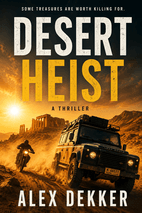
If you are browsing Desert Heist quotes, you probably already know that Alex Dekker's novel is equal parts action and brooding character work. These lines mix sharp dialogue, narrative observation, and raw inner monologue. They show mercenaries, academics, and wanderers at moments of tension, regret, and dry self-awareness.
The novel earns quotable status because it rarely overstates. The dialogue sounds like people who have been through something. The narration has a bite. And the inner thoughts feel real, not staged. Read together, these quotes capture a world of hard choices, old friendships, and buried secrets without spoiling how it all lands.
Top Quotes from Desert Heist
“Most stories were rooted in truth, no matter how outlandish they might initially sound.”
Nate is running and mentally rehearsing the legend of the lost city of Ubar.
It captures the intellectual faith at the heart of his research, and the novel’s old-fashioned romance of discovery.
“You have the luxury of taking chances. Your professors don't. They're part of the system already. And this might be your last chance to take a risk before you get pulled in too.”
— Frank
Frank explains to Nate why his background makes him well suited to pursue an unconventional dissertation on Ubar.
It distills the novel’s theme of outsider courage versus academic conformity. The line challenges Nate, and the reader, to take a real risk before it becomes too late.
“The truth was that he would have done it for free. He wasn't a psychopath, he simply enjoyed the work. He liked having an objective and completing it to the best of his ability.”
Novikov reflects on his transition from Russian state service to private mercenary work.
It makes Novikov chilling less through violence than through his calm professionalism and self-aware amorality.
“This man was not only academically bright, he was downright lethal.”
Novikov reads the military file on Nathan Wilde after their fight.
It crisply captures the double identity at the heart of Nate’s character and raises the stakes.
“The majority of useful information in the world wasn’t classified, but rather out in the open for anyone to find.”
Nate looks for Richter’s home address using open-source intelligence.
It is a sharp reminder that important secrets often hide in plain sight.
“You're damned right it was a bad time for all of us! But some of us stayed and stuck it out. We didn’t run off to some fancy fucking Ivy League school to live in a fantasy world.”
— Tim
Tim answers Nate after Nate says he did not know what else to do but leave.
It is Tim's wounded definition of loyalty, and it makes personal betrayal inseparable from loss.
“Men have been killing each other for thousands of years. Only those sick in the head enjoy it or feel nothing at all. The rest of us simply find ways to deal with it. So, we wrap it up in bonding, camaraderie, shows of bravado. It's nothing new.”
— Tim
Tim explains to Ana why Nate and the other men behaved the way they did after the pirate attack.
It offers an honest, unsentimental view of how soldiers process violence. The final line turns the moment into an ancient human pattern rather than cold-bloodedness.
Themes Behind the Quotes
One theme is the weight of the past, whether from combat or a trail of unexplored mysteries. Many characters carry old losses, absent friends, and decisions they cannot undo. Their loyalty to each other is real, but it is often tangled with guilt and a feeling of being out of place in ordinary life. The job, the mission, or the search becomes a way to keep moving, even when it stops providing meaning.
Another theme is the cost of playing it safe. Quotes in this collection push against comfortable academic or institutional choices, suggesting that real answers often sit in plain sight and require some nerve to chase. At the same time, the novel does not romanticize violence. It presents danger, and the people drawn to it, with honesty. Bravado is a coping mechanism. Bonds made in hard places matter, but they leave marks.
Quotes by Chapter
Part 1 - Chapters 1 to 3
“He recalled the words of an unknown Arab poet: 'Twas I that learn’d him in the archer’s art; At me, his hand grown strong, he launched his dart.”
Philby broods over his friend Bertram Thomas having made the first crossing of the Empty Quarter before him.
The old verse gives an aching voice to a betrayal that Philby cannot say aloud. It also deepens the historical and literary texture of the story.
“In the recesses of his mind, he still held out hope, straining to envisage how the area could contain a city. He willed it to be so but alas, it did not appear to him.”
Philby sketches the Wabar craters after realizing they are volcanic, not the ruins of Ubar.
It captures the painful collision of desire and evidence. The prose makes Philby’s fading obsession feel honest and melancholy.
“He was not a man to accept failure easily, and he was not about to begin now.”
Philby accepts that the crater area is not the lost city, but decides to keep exploring.
It tells us exactly what kind of man Philby is, placing stubbornness next to disappointment. That resolve becomes the emotional engine of the chapter.
“While this had in fact given Wilde plenty of opportunity to travel to exotic and historic locations such as Iraq, Afghanistan, and Syria, it did not provide many occasions to satisfy his scientific curiosity.”
Wilde, a Special Forces soldier, reflects on a decade of deployments in historic conflict zones.
It captures the irony of seeing the world’s great places only through war. The line gives Wilde a thoughtful, almost wistful dimension.
Part 2 - Chapters 4 to 9
“The former Green Beret had watched too many of his friends die over the years, and the job no longer held the same sense of fulfillment for him. Instead, it only created holes in his life and brought a feeling of emptiness.”
Nate remembers why he walked away from the Army after the Yemen attack.
It sums up the moral cost of war without glamor, showing that what finally drove him out was grief and emptiness.
“The team room was filled with ghosts, and even though new team members arrived to replace the fallen, it wasn’t the same.”
Nate considers returning to his Special Forces team after so many of its men were killed.
The ghost metaphor makes the loss permanent and tactile, and explains why replacements could not heal the team.
“They were hard set. They had seen a lot.”
Nate looks into his own eyes in the mirror before dressing for his dissertation defense.
The clipped, understated sentences convey the whole weight of his combat history without a single complaint.
Part 3 - Chapters 10 to 15
“If he walked away now, he'd never forgive himself. He didn’t want to get sucked into the academic world only to never question anything outside of mainstream ideology ever again. For a moment he had forgotten who he was and what he stood for. It wouldn't happen again.”
After Frank and Janet convince Nate not to abandon his dissertation, he reaches a quiet turning point.
This captures Nate’s renewed sense of identity and purpose. It makes the decision feel personal and irreversible, not just academic.
“I think I have some travel arrangements to make.”
— Nate
After Janet and Frank push him to keep pursuing both his research and the possibility of love, Nate announces his next move.
The understatement carries real weight—he has chosen action over doubt. It closes the scene with quiet determination and forward momentum.
“A man with an obsession such as Ubar would not simply let it go. Nate should know.”
Nate reflects on explorer Bertram Thomas’s search for Ubar while studying earlier expeditions.
It links Nate to the historical obsessives who came before him. The dry aside reveals his self-awareness while confirming he shares the same unstoppable drive.
Part 4 - Chapters 16 to 20
“I could now honourably bequeath the task to my successors—to younger men or women who may not be deterred by my barren search for the fabled ruins from embarking upon similar enterprises in the great sand of Arabia.”
— St. John Philby
Nate remembers this line from Philby's The Empty Quarter while reviewing the explorer's records.
It turns Nate's research into an inherited quest and honors the failure that made the next discovery possible.
“Alas, when I thought for certain that the area held no further secrets, Jahman returned to me with both a gift and a puzzle.”
— St. John Philby
Nate reads this note written on the back of a crude sketch Philby made near Wabar.
The explorer's voice is suddenly full of wonder, and the phrase 'a gift and a puzzle' makes the old clue feel alive.
“We're mates, Nate. And honestly, I've been having a good time. It’s been a few years since I got pissed and had a good rumble like last night. It's not the same without someone you trust watching your back.”
— Wally
Wally offers to stay in London and help Nate after teasing him about saying 'we'.
The joking falls away and reveals that trust and friendship are at the core of their partnership.
Part 5 - Chapters 21 to 26
“A cold chill ran up his spine, and it wasn't the cool night air. This was the first time he had felt personally hunted outside of a war zone.”
Nate realizes the attack on him and Richter's murder are connected.
It draws a line between the war zone and civilian life, making the threat feel both intimate and new.
“There was no more room for coincidence. Metry was tied to Richter, who was tied to himself. One was missing, one was dead, and one had been assaulted. Something bigger was going on, and Nate got the distinct feeling that he was wrapped up in a larger plot, the magnitude of which he could not yet grasp.”
Nate reacts after learning that the man he telephoned has also disappeared.
The parallel losses make the danger feel inescapable, and the final sentence captures the chill of realizing one is a small piece in a much larger plot.
Part 6 - Chapters 27 to 33
“He could have bullshitted him and told him he missed him and that he wanted to make amends, but Tim would have seen right through that. It's not that it wasn't true. Nate had missed his friend terribly. It was just that they didn’t talk, and at some point it became too late to start again.”
Nate stands with Tim at the shooting range and thinks about their long silence.
It captures how true affection can be buried by pride and time, making silence feel irreversible.
“I’m sorry, Tim. Is that what you want to hear? I'm sorry I left. It was a bad time for all of us. I didn't know what else to do, so I left.”
— Nate
After Tim says he wants nothing from Nate, Nate offers a raw apology.
The stripped-down apology shows how insufficient words are against years of unspoken grief.
“A lot of good men died over there. Men whose memory you just left behind in the dust.”
— Tim
Still at the firing range, Tim rebuffs Nate and speaks of the fallen.
This accusation lands with brutal finality, making Nate's adventure feel like an abandonment of memory.
Part 7 - Chapters 34 to 39
“It seemed wildly out of place with the rest of the gear being carted around, but then again, so was Ana.”
Ana’s roller bag sits among the group’s military-grade expedition equipment.
It turns an observation about luggage into a wry summary of Ana’s unusual role in the mission.
“Ana might actually be safer with them in a war zone than she would be on this ship.”
Nate weighs whether he can honestly reassure Ana after she asks if he will leave her on the ship.
This dark internal calculation highlights the moral danger of the crew and raises the stakes.
“Besides, I think I’d rather see you with us in Yemen than left alone on this rig.”
— Nate
Ana asks Nate how she can trust him not to abandon her aboard the ship.
The line reassures Ana while quietly confirming that the ship is no safer than their destination.
“A cataclysmic event such as that happening in close proximity is a pretty big coincidence. It certainly would account for the city’s disappearance.”
— Nate
Nate theorizes that the meteorite craters might explain how the legendary city of Ubar vanished.
It ties scientific evidence to ancient myth, making the search feel both credible and exciting.
Part 8 - Chapters 40 to 47
“We can stay on the ship and get off in Dubai, no questions asked. If we choose to go in now, it's just us. No flags on our shoulders, no government protection. We get into trouble, the cavalry isn’t coming. I need to do this. But anyone who wants out... now’s the time. No hard feelings.”
— Nate
Nate gives the assembled team one last chance to stay aboard the cargo vessel before they launch the infiltration.
It lays out how isolated and unprotected the mission is, with no rescue or official support. The line about the cavalry not coming is a sharp reminder of the stakes.