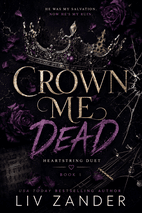
⚠️ READER ADVISORY: This is a deep-dive summary designed for those who want the full story. Contains spoilers.
What is the book Crown Me Yours about?
Liv Zander's Crown Me Yours follows Elara, a queen bound by a cursed crown, as she marries Vale, the god of Death, to save her dying brother—only to discover the prophecy demands she genuinely love the one being who has avoided feeling for centuries. A dark gothic romance for fans of morally complex gods and fierce heroines.
Feature
Insta.Page
Blinkist
Shortform
Crown Me Yours
✓
✕
✕
Summary Depth
Full Chapter-by-Chapter
15-min overview
Section-by-section guides
Audio Narration
✓
✓
✓
Visual Mindmaps
✓
✕
✕
AI Q&A
✓
✕
✕
Quizzes
✓
✕
✕
PDF Downloads
✓
✕
✓
Price
$89.99/yr
$146/yr (PRO)
$199/yr
*Competitor data last verified July 2026.
1 Page Summary
Bound by a crown fused to her skull and a brother dying from a curse she cannot break, Elara has buried one king and must now save another—her only hope resting on a wish bound to Death himself. Her reluctant husband is Vale, the god of endings, who wears a devastating mortal face and carries an ancient heart held together by a single thread. As pestilence sweeps the lowlands and her brother's life wanes, Elara must untangle a prophecy that demands something far more impossible than a blade: love, grown and nurtured, aimed at the one being who has avoided it for centuries. But the curse is not what either of them believes, and every step toward breaking it pulls them closer to a truth that could shatter them both.
Vale has spent eons avoiding the full agony of feeling—yet Elara, stubborn and unflinching, refuses to recoil from the bone beneath his skin or the vulnerability he hides from moonlight. She wants to love him, not through trickery but through genuine tenderness, while he struggles against a heart that is mysteriously healing, terrifyingly whole, and utterly bound to hers. Their marriage is a battlefield of wit and yearning, played out against funerals, frozen graveyards, and the desperate weight of a dying brother, until the moment their masks drop and the real connection begins—consequences be damned. But Vale's greatest fear is not the curse breaking; it is the possibility of what their union might create, and the prices both life and death will demand.
This second installment in The Heartstring Duet weaves gothic romance with raw, visceral emotion, delivering a story that is as much about the terror of opening a guarded heart as it is about defying fate itself. Fans of dark fantasy romance who crave morally complex gods, fierce heroines, and love that dares to reshape the boundaries of life and death will be captivated by its shadowed atmosphere and unflinching intimacy. The stakes are eternal, the passion is consuming, and the truth at the heart of the prophecy will leave readers breathless for the resolution.
Chapter 1
The afternoon sun hangs bloody over the palace graveyard as Elara and her mother set about the grim work of burying a king. They lift Kael’s body from a plain plank bier onto lowering straps, the rigor of death making his limbs stubborn, his weight awkward for a man who seemed hollowed out by years of carrying a curse. Elara’s mother, hands trembling, reaches for dried marigolds and packs them around the shrouded head and neck, hiding the slash across his throat that Elara herself carved. A mercy for the observers. A lie for herself. If she covers the wound with flowers, maybe it isn't murder.
A handful of people watch from a distance: two priests, courtiers, a palace guard. Miss Hampshire, the housekeeper, stands apart, her gaze fixed on the crown fused to Elara’s skull, a band of gold that bites into bone as if it belongs there now. Elara’s brother Daron lies in the west wing, too consumed by the rot to attend, his breath rattling in his throat.
One priest objects loudly to a woman, and a gravedigger at that, performing royal rites. Elara answers flatly, unmoved: the dead don’t care whose hands lower them, only that they land soft. The priest bristles, calling it a disgrace, warning that the people will be outraged by a common gravedigger wearing the crown. It is Miss Hampshire who cuts him off, reminding him of the stench of the streets, of children eating mud and mothers eating their stillbirths. The common folk won’t care if she digs graves, she declares; they will only care that a new ruler might end the rot. The priest retreats, defeated by a housekeeper with missing fingers and a queen with dirt under her nails.
Together, Elara and her mother lower Kael into the earth. The straps hiss, the body thuds home, and the familiar ritual steadies Elara’s nerves. Death is simple: you stop breathing, you get heavy, you go down. The graveyard sits beneath the looming palace walls, and beyond them the city smolders under a haze of decay. Hunger doesn’t stop because a king dies, and rot doesn’t pause to see who wears the crown.
A single tear tracks down Elara’s cheek as she whispers an apology she cannot voice aloud. Her mother can offer only a pat on the back and the reminder that there is a brother to look after. Elara watches her mother walk away, catching the dark veins on her neck, the first telltale sign of rot, and wonders how many days remain before it surfaces elsewhere.
Miss Hampshire steps up beside Elara as the first dirt hits the shroud. She tells Elara that Kael was a good man. Elara cannot say whether that is true. She knew so little of him, except that he was cruel, stubborn, half-mad with hope, and kept his secrets sealed tight as coffins. And yet his hands had trembled when he touched her face. The contradiction pulls at her. She wants to spit on his grave and claw it back open at the same time.
She presses Miss Hampshire for answers. Did Kael leave instructions? A message? Miss Hampshire says he came to her that morning possessed, wild-eyed, terrified, and hopeful, telling her to prepare the rite. He called Elara their best hope to break the curse, but he kept his counsel close. As for the messenger Elara asks about, the woman’s mouth works soundlessly, and her silence lands in Elara’s gut like a stone. Kael crowned her with no knowledge of what she is supposed to do, and if she cannot figure it out, the curse will keep devouring the realm. Daron will be its supper.
Miss Hampshire curtsies, a stiff, desperate gesture of order in a crumbling world, and walks away. Elara remains by the grave until her legs ache, until the sunset bleeds red and fades to twilight, until the air turns cold with the smell of damp earth and the promise of winter. Here, among the silent dead, is where she belongs. Not on a throne. She whispers Kael’s final cryptic words to the grave: “It’s about ending it at the source. What the fuck did you mean?”
A wind rises, rustling dead leaves and swirling mist around her ankles, carrying the scent of carnations. Her spine stiffens. Memory floods back: moonlight, bone, black pits where eyes should be, a ribcage holding a rumbling moan in place of a heart. It is the smell of the entity that calls itself inevitable, the one that vanished in a whirl of shadows and rage when she crowned herself dead in the throne room yesterday.
A voice, smooth as oil and cold as the grave, speaks from behind her. “You have a nasty habit of fighting me like I am not inevitable.”
💡 Try clicking the AI chat button to ask questions about this book!
Chapter 2
Twilight gathers in the graveyard. Elara stands at the fresh, dark mound of King Kael's grave, the hem of her funeral cloth dragging in stiffening grass. She lets the wind bite her cheeks and the scent of turned earth fill her one last time, grounding herself against the cloying smell of mourning flowers. When she finally turns, Vale is already there, leaning against a gnarled tree trunk, arms crossed over midnight-blue velvet. Not Death's true face, but a devastating mask of a man: arrogant, immaculately groomed, unbearable.
She mocks the costume. He answers that he prefers a form that does not send mortals screaming into madness. She reminds him she has already seen beneath the silk and felt what is down there. The memory of bone and ivory, a hunger that once thrust into her with agonizing pleasure, creeps up her thighs, and she buries it in the place where she keeps her screams.
She demands his true form, done with masks and puppets. He cuts back with the memory of her terror: the screaming, the fleeing, the cowering, the hiding under a table. The shame heats her collar, but she steps into his space anyway and asks to speak to the thing that cursed her, not the pretty puppet that seduced her.
His answer is silk turning to steel. He reminds her who came to whom. She pressed her gravedigger's hands against his chest and practically begged to be ruined. When she insists she came for instruction, he calls it a history she is rewriting because she is frightened of the ink. His voice drops to her ear. He remembers her pulse hammering against his mouth, the way she unraveled, the sounds she made when she came on his cock. She whispers "stop," but it is a plea, not a command. A thumb finds the frantic beat at the hollow of her throat. He calls her little queen and tells her she stands in the center of his domain, among worms and decay, looking perfectly, terrifyingly at home.
Then her eyes catch the mound of dirt behind his shoulder, and the spell dies. She grabs his wrist with the force of a woman who hauls dead weight and tears his hand away. She came to Vale, she hisses, not to Death, because she was starving for anything that was not death. He must not mistake her desperation for desire. She names him a lying, scheming monster.
Death, Fooled
The temperature plummets. Frost blooms over the grass with a sound like breaking glass. Whatever civility he had left straightens into a thin, terrible line. He calls her the biggest liar of them all, and then the real accusation tears out of him: she and Kael. He seizes her by the scalp and the chin, forcing her to hear it. Was it planned while he dealt with a foolish farm girl? Did Kael whisper promises about her brother's life if she spread her legs for Death? He shouts about the curtain, a stroke of theatrical genius that must have been Kael's suggestion. He thought he had left as she demanded that night, and she ran straight to Kael. He has been left the fool once more.
And Elara understands. The old law surfaces in her memory: when a mortal fools Death, Death must grant a wish. To Vale, everything since the greenhouse has looked rehearsed, Kael crowning her, the knife in her hand, the timing of the cut. It never happened. But she is not foolish enough to confess that. If Death's humiliation buys her a wish, she will take it.
She lets a gravedigger's calm settle over her face and says, "Took you long enough."
He freezes. His grip falls away. He searches her face for the lie and finds only resolve. The admission he makes sounds almost human: being made a fool is a particular humiliation for a being whose own laws will not let that foolishness pass unpaid. He asks what she demands.
Her answer is instant. Lift the curse. Destroy the crown. Take his damn heartstring back.
Denied.
The crown exists because of a wish made by a forgotten king, bound by laws mortals cannot fathom. No wish can contradict a prior binding. The hope inside her shrivels to ash. He watches her struggle, amused, and wonders aloud whether Kael was so busy scheming that he forgot to tell her what to ask next. She cannot let him see how close that cuts. Kael left her nothing.
She tries for her family's health. She thinks of Daron's failing lungs, of Mother, who arrived at the palace with dark veins and rot spreading under her skin. Vale almost pities her. A wish for the whole family contradicts what the crown demands, but he offers a concession: choose Daron or Mother, and he will restore that one, but only once. She sees the trap immediately. A single healing is a bandage on an eternal wound. The sickness would return, and the crown would still have its fangs in her bloodline.
He starts counting at her ear. Five, four, three. The pressure is meant to break her, but it sharpens her instead. There is nothing she can safely ask for, and no one left to guide her. Her gaze drags to the fresh mound of earth. Kael knew something about this curse. If she had five minutes with him, she could wring the truth out of his throat.
She looks up and asks if Vale can bring him back.
Bring Him Back
The smirk slides off his face. He repeats her words slowly, disbelieving. Why would she want Kael breathing again? She refuses to give him a reason, and that refusal turns the graveyard arctic. Frost entombs the grass. His hands snap up and bracket her face, pressing with the weight and finality of a coffin lid. He calls her pathetic. She stands before Death with a wish that could topple fate, and she asks for the return of him. His thumbs dig into her jaw. Was Kael her lover? Did she let him touch her after she denied Vale? Is that why she wept over his grave? He roars it into her face, the words vibrating through the soles of her feet: do you love him? She stands before a god and pines for the rotting flesh of a man.
Fear rattles her lungs, but through it she reads him. This is not the reaction of a god who has been fooled. It is the jealousy of a lover scorned. She tells herself it cannot be love; he has no heart to give. Whatever this is, it is arrogance, ownership, possessiveness. She refuses to be bullied by his wounded pride. Lifting her chin inside his grip, she asks again: can he bring Kael back, or not?
The grip breaks. He turns away sharply, as if the sight of her face has become unbearable. He rakes a hand through his curls, smooths his cuffs, stares at nothing beyond the headstones. When his voice comes, it is hollow.
No. Kael has been cold for hours. He has been dead too long.
Too long, Elara thinks. Not impossible. Her heart lurches, and she steps toward him, asking if that means he truly can bring someone back. He gives no answer. When he turns around, his face is a mask of ancient, impenetrable ice, and he orders her to choose her wish now.
She stays silent. Every wish that comes to her, health, wealth, power, feels like a mistake. Her stillness unmans him; he shifts, paces, boots crunching over frozen grass. She watches, and then understands. Not pacing. Dodging. The clouds above are shredding to rags, and silver beams are beginning to pierce the canopy. He refused to show her his true form, but the rising moon is stripping that choice away from him. She simply waits.
He snaps that he fails to see the complexity. He lifts a finger to punctuate the threat, promising to rip the words from her. The wind tears the last cloud from the moon, and a beam of silver light catches his outstretched hand. The illusion evaporates in an instant. Elegant tapered fingers dissolve into sinew and bone.
Vale stares at the skeletal claw protruding from his velvet cuff. He jerks it back, clutching it against his chest as if burned. "Next time, little queen." Shadows curl around his boots, rising through his form until he is nothing but dark ink against the night, and then he is gone.
Elara stands alone in the freezing dark, beside the fresh grave, with frost on the grass and a wish she has not yet spent.
Chapter 3
Elara sits at the edge of her brother Daron’s bed, pressing a damp cloth to his forehead while he struggles for every breath. His lungs rattle with each inhale, wet and shallow, and his ribs show beneath the blanket like a cage fighting to hold in life. She murmurs that he only needs to hang on a while longer, but she does not know how long. Every step she takes toward breaking the curse seems to cost him more days, more strength. The crown on her head hums faintly and bites into her scalp, a constant tether to a mess she cannot solve. Her mind runs through impossible combinations: crown Daron, hand him the knife, and let him cut her throat over the gold? He is too weak. Crown her rotting mother and wish Daron healthy? The sickness could return, and Mother would be left to rot. And none of it matches whatever Kael wanted.
Daron forces his eyes open and rasps that something itches behind his ear, but when he tries to lift his hand, the wrist trembles, the tendons strain, and the hand falls back to the mattress. Elara moves his damp hair aside, touches the angry purple skin with the cloth, and the skin slides off, a layer of wet gray flesh sloughing away to reveal raw, weeping meat beneath. The rot is no longer just in his lungs. It is eating its way out of him. She swallows the bile, tells him it is only dry skin, and hurries out to fetch salve from the infirmary.
The hallway is silent. Before she can reach the infirmary, a hand clamps over her mouth and an arm like steel hooks around her waist, dragging her into an alcove of tapestry and shadow. She thrashes, kicks, claws at leather, until a rough voice hisses in her ear to be quiet, or Kael died for nothing. The man hauls her through a narrow door and down a spiraling stone staircase into darkness that smells of rust and damp earth.
Death’s Confidant
In a forgotten cellar, he lights a torch, and Elara recognizes him: the messenger who entered Kael’s room that day. He calls himself Corvin Hale, and says he is Kael’s only confidant, a man complicit in undoing the curse whom Death would torture for information if his identity were known. He pulls her through the dark at a frantic pace, past wine racks and rusted prison cells, refusing to stop. Stillness, he tells her, is like a bell that Death cannot unhear. It is the nature of the grave to be still.
As they walk, Corvin explains. Elara is the first queen to wear this crown longer than a few seconds, because the original curse was altered. Priests scrubbed the language, changing heir to son, ruler to king, bride to consort, sealing the curse so it would travel through men and men alone. Kael found the proof, along with evidence that the bloodline was already impure. He had spent a year tracking down a distant cousin, the farm girl, hoping to crown her and begin unmaking the curse. But by the time Corvin returned with supplies, the house was ice. She was gone. She is irrelevant now, Corvin says. Destroying the crown is a task for a queen. For Elara.
He asks if it is true that Death took her as his lover, as Kael’s note claimed. Elara confirms it, her neck burning with shame, and Corvin stops, stunned. In a thousand years of lore, Death is solitary, rarely touching the living unless it is time to reap them. But before he can say much more, the air shifts. Cold slides under Elara’s skirts. A fine white crust crawls outward over the damp stone wall. The torch flame bends away, as if a mouth has just exhaled in the dark. And then she smells carnations. Death is near. They have stopped too long.
The Rite
Corvin pushes her up a narrow, spiraling stairwell into Queen Maeryn’s greenhouse, a glass chamber full of yellow-speckled leaves and blackened stems struggling to survive. There, in the damp warmth, he delivers the plan. The crown is a magical binding that demands a debt. If the curse is fed the blood of the creditor, the loop closes and the curse shatters. If Death has a body, he has blood. If that blood touches the crown while the rite binds Elara to him, then she must wed him, bed him, crown him, and slit his throat, bleeding him over the gold. Making Death her consort is their only hope.
Elara laughs, sharp and hysterical, staggering back against a potting bench. The absurdity of it makes the world tilt. Corvin insists Kael was certain, that he spent years unrolling scrolls to unravel the roots of the curse. And then he tells her what leverage she has: Death desires her. Use it. But when Elara protests that Death was furious at her coronation, that he hates her, Corvin corrects her. His hate is not her greatest hurdle. Hers is. You have to love him, Corvin says. Elara calls it impossible, but Corvin is already squeezing through a hidden door in the ivy, wishing her luck and vanishing into the wall.
She stands alone among the dying plants, watching the ivy tremble. Water drips. A thorn clings to her skirts. She looks down at her hands, calloused from shovel handles and grave dirt, and works through the sequence backward. Slitting Vale’s throat would be a pleasure. Putting the crown on his head is no great cost. Bedding him, she has done once, twice, kind of, and can do again. But how does one convince Death to become her husband? Her lips twist into a smile. Not convince. Demand.
Chapter 4
Fog lies over the lower graveyard in a thick, wet blanket, beading on Elara's lashes and smudging the world into silhouettes: crooked stones, stunted yews, a slanted fence. Near the servants' grounds, two men dig a fresh grave for a kitchen maid who fell down a stair and snapped her neck. Elara sits in the frost-damp grass, the queen in the dirty dress, watching the spades turn the earth. She has come here at the hour between worlds, when dawn leaves enough gray light for Death to hide his bones, and she waits for Vale with a desperate stillness, debating whether lying with him in the tower already counts. She cannot risk a technicality. If her wish depends on wedding him and bedding him, she needs to make sure the deed is real.
So she lowers herself into the open grave. The walls of clay rise above her, leaving only a rectangle of gray sky, and she lies down with her hands crossed over her chest, forcing her breath into something dead-shallow. Nothing comes at first. Then slow, deliberate footsteps crunch on gravel. Dirt rains down from the edge, and a shadow blots out the sky.
Vale leans over the lip of the grave, black velvet coat absorbing the mist, his expression one of supreme, unimpressed boredom. He tells her she looks theatrical, that things which cannot be killed have no business lying in graves. When she says she was waiting for him, he remarks that he preferred the way she rolled her hips against him. Then he jumps down beside her, crushing himself against her in the narrow space, his scent of carnations and ice replacing the smell of the loam. He lies down next to her, mirroring her pose, and tells her to make her wish. He has places to be.
Elara tries to bargain instead. She offers a deal: show me your true form, and I will make my wish. The request strips the arrogance from his face and freezes him cold. He dismisses the demand, reminding her that her wish is a transaction, not a parlor trick for his amusement. She claims she only wants to know who she is dealing with, and he answers simply: she is dealing with the end of all things. Yet he does not leave. He remains pressed against her, and she notices the strangeness of it all, that a creature so tied to cold radiates a feverish heat against her skin.
A quieter moment settles between them. Elara asks why people cannot see him, why her mother and Daron looked right through him at the Gutter Lane house, while the kitchen girl could. Vale explains that he is a concept. Most minds refuse to perceive him. She saw him only because he chose to let her see Vale, and once that curtain lifts, it cannot be lowered. She remembers the carriage driver who never saw him, the way Miss Hampshire scolded her for talking to herself, and she begins to understand the strangeness of being the only one who knows he is real.
But patience is not his virtue. He turns on his side, telling her to stop wasting his morning and ask what she is clearly prepared to ask. So she asks about the farm girl, Kael's distant relation whose death was reported. Did he kill her? The question ignites another muscle in his jaw. He swears he cannot take a life like that, not by poison, not by pushing old men down stairs. He is not the plague, not the blade, not the hand that shoves a child into a river. He only collects the soul. Elara presses the point, sarcastically calling him innocent given the curse he cast over the death of a ferryman. He counters that innocence and guilt are mortal inventions. He does not decide how much sand sits in a mortal's hourglass, though he might tap it. He can nudge. Stretch a fraying thread or pull it taut, if it was going to snap anyway. The library scribe was already close to his end. It took minimal effort to make an adjustment.
All the while, Elara's fingers work on him: brushing dirt from his collar, tracing the sharp line of his jaw, finding no stubble, only polished stone. He swallows beneath her touch, his breathing quickening, and he lets it happen. Then he murmurs something that stops her cold. The farm girl will remain a farm girl, he says, and Elara will remain queen in her stead. The words land too neatly to be casual. Vale knows exactly what Kael intended in the throne room. He knows the plan, and he knows what she is doing in the dead girl's place.
She should stop. She knows it. But she keeps touching, combing her fingers through his damp curls, tracing his lips. He calls her out with a mocking smile, asking if she is trying to distract him from her wish. She answers with a seductive question of her own, and something breaks in him. He seizes her wrists and pins them into the dirt on either side of her head, his weight crushing her, his desire unmistakable. He spits accusations at her, that she thinks she can seduce him into bleeding over her crown, that he will not give her the reaction she seeks. She bucks her hips against him, taunting him with the very evidence of his lie. He growls that it is a biological imperative, a flaw of the human form, that even if he fucked her right there it would only be an itch scratched. She lifts her chin and dares him. Scratch the itch.
He kisses her like a collision, teeth and tongue and ancient hunger. She kisses back with equal desperation, arching into him. For a second, doubt creeps into her chest. What if Kael was wrong? What if the fairytale logic he scribbled down is nothing but the hope of a desperate man? But the ferocity of Vale's anger tells her the opposite. Why else would he fight so hard? Why else would the god of endings tremble at the thought of being bound to her? No. This is the way. This has to be the way.
She frees her hands and shoves her skirts up, reaching between them, fumbling with his trousers. She begs him to put it inside her, to fuck her, to come inside. He grinds against her in that desperate rhythm, and she thinks she has him. But at the last moment, he pulls back, spilling himself hot and wet over her stomach and clothes, never entering her. He shudders, rests his forehead on her shoulder, and then laughs, a dark, dry sound of triumph. He adjusts his clothing and rises, leaving her exposed, sticky, and burning with fury. She shoves her skirts down and screams at him. He merely straightens his coat and tells her she gave him permission to scratch an itch, so he scratched it. He turns to climb out of the grave.
"My wish!" she shouts, desperate rage in her voice. "Is for you to marry me!"
Vale freezes. His boot slides off the clay wall. Slowly, painfully, he turns around. Every trace of mockery is gone, replaced by a stillness so profound the air itself seems to vanish. She scrambles to her feet, ignoring the mess clinging to her body, and repeats the demand. He will become her husband.
The temperature plummets. Frost blooms across the roots embedded in the grave walls. His face twists, lips pulling back from his teeth, and the god emerges through the man: a jagged line of darkness splits his cheek and a skeletal jaw gleams beneath. The green rots from his eye, dissolving into a hollow socket. He flickers between man and Death, his voice a roar that sends dirt raining from the walls. He will not bind himself to a mortal. He is eternal. He will not play house with a fleeting spark of life that will burn out in a blink. But Elara shouts back with a wild, desperate hope, because his fury is too defensive. If the marriage meant nothing, he would laugh and let her age and die while he watched, bored. The fact that he rages means it matters. It threatens him.
She presses her advantage with cold logic. The wish does not interfere with another wish. It does not break the wording of the curse. Death keeps his word. He flinches, his supernatural rage crashing against the immovable wall of his own rules. His features stitch themselves back into handsome flesh, and a cruel smile slices across his face. He leans in, his lips brushing her ear, his voice cold as the grave itself. Fine. He grants her wish. He will marry her. He will play her husband for twenty or thirty miserable years, watch her wrinkle, watch her beauty rot. And when the last grain of sand falls, he will take her soul and drag it down to the deepest, darkest pit.
Elara stands in the grave, damp and trembling, her wish granted at last. The cost of winning stares back at her in the satisfied malice of Death's agreement. But the bargain is struck, and the game is only beginning.
You've reached the end of the free chapters
Next chapter: “Chapter 5” is locked
Keep reading Crown Me Yours — and unlock all 700+ book summaries with audio, mindmaps and AI Q&A.
$0.00 due today · 7 days free, then $89.99/year ($7.49/mo) · Cancel anytime before day 7
Liv Zander is a dark romance author specializing in high-heat, morally gray characters and gothic themes, best known for her *Feathers So Vicious* and *Kingdom of Lies* series. Her writing background includes self-publishing deeply emotional and plot-twist-driven stories that explore obsession, power dynamics, and redemption. She is celebrated for crafting immersive worlds that challenge conventional romance tropes with intense, often violent passion.
Frequently Asked Questions about Crown Me Yours
What is Crown Me Yours about?
Elara, a queen whose skull bears a cursed crown fused to her flesh, must find a way to break the dark magic devouring her brother while confronting the god of Death, who appears in the devastating human form of Vale. Desperate to save her family, she plans to wed and bed him, then cut his throat to end the curse—but the ritual is far more complicated than she expects. As animosity gives way to intimacy, a buried prophecy reveals that love, not a blade, may be the only force strong enough to break what binds them.
Who is the author of Crown Me Yours?
The novel is written by Liv Zander. She crafts a moody, atmospheric fantasy world filled with royal burial rites, restless spirits, and a brooding immortal who quietly longs for connection beneath his terrifying power.
Is Crown Me Yours worth reading?
It is absolutely worth reading for fans of dark, emotional romance with high fantastical stakes. The tension between Elara and Vale is raw and magnetic, slowly building from hostile bargains to vulnerable tenderness. With a prophecy that keeps redefining the rules, the story keeps you guessing while pulling at your heart.
What are the main themes in Crown Me Yours?
Central themes include love as a potential cure for ancient curses, and what it truly costs to bind your life to an immortal being. The book also explores mortality, aging, and the quiet pain of loving someone who may outlive you. Sacrifice, choice, and the resonance of family across generations run throughout, with Death’s own shattered heart healing as he rediscovers what it means to feel.
📚 Explore Our Book Summary Library
Discover more insightful book summaries from our collection