Crown Me Yours Quotes
by Liv Zander
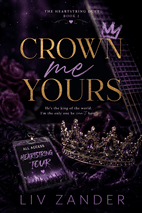
Open Crown Me Yours and you will find a voice that refuses to look away. The lines gathered here come from sharp dialogue, close narration, and raw inner monologue, all tangled in a world where rot creeps through kingdoms and gods walk in human shapes. What makes the book so quotable is the way it mixes brutal honesty with aching vulnerability. Characters say awful things and mean them, then undercut themselves with longing they cannot hide.
These are lines you underline, then reread. They feel like secrets traded in the dark: confessions about duty, fear, love, and the impossible choices pressed on a woman who wants more than survival. Expect wit that stings, grief that speaks in images, and chemistry that burns through every scene.
Top Quotes from Crown Me Yours
“The dead don’t care which hands lower them, so long as they land soft. And nobody drops them softer than a gravedigger. All that shoveling numbs the arms. No choice for us but to handle the body with care.”
— Elara
A priest objects that a king’s burial rites should not fall to Elara, a new queen who is also a gravedigger.
Elara answers with the plain authority of her old trade, making competence and care matter more than rank or ceremony.
“Do not rewrite history because you're frightened of the ink, little queen. I remember the way your pulse hammered against my mouth. I remember the way you unraveled.”
— Vale
Vale argues with Elara over why she originally came to him.
His intimate, accusatory memory cuts through her defenses and makes their past visceral.
“You stand before a god, and you pine for the rotting flesh of a man?”
— Vale
Vale rages after Elara asks him to resurrect Kael.
The line lays bare his wounded pride and the possessive jealousy beneath the godly mask.
“Wed him. Bed him. Slit his throat and break the curse.”
— Vale
Vale waits for his bride at the forced wedding and mentally echoes the curse-breaking plan Elara hopes to carry out.
A brutal, rhythmic line that turns a wedding into a death sentence and sets the story's tension in one breath.
“To love is to open your heart to the blade of grief, offering it a bloody sheath to land in before it cracks under the agony of loss. Love is madness. But it is a madness that cannot befall me.”
— Vale
During the marriage vows, Vale watches the mosaic kings and queens and thinks about what love costs.
It frames love as self-inflicted injury rather than joy, exactly why Vale believes he is safe from it—until Elara proves otherwise.
“You've got it backward, big sister. Grief is just love hiding in a mourning dress, piling up inside you because the person you want to give it to isn't there to take it.”
— Daron
Daron tells Elara this after she says she hates that grief is all she has left of their father.
The metaphor reframes grief as love with nowhere to go, making loss both tender and aching.
“Maybe I'm not supposed to seduce Vale... but Death.”
— Elara
Elara wonders whether her true goal is not to seduce Vale but Death himself.
The line sharply reframes her plan and makes the supernatural stakes feel suddenly personal.
Themes Behind the Quotes
The collection circles around death in all its forms: the quiet of the grave, the smell of rot, the strange mercy of an ending. But death here is not simply horror. It is also a presence, a challenge, and sometimes a comfort. The characters live with decay around them, inside them, and still reach for desire, hope, and meaning. This tension gives the book its ache.
Alongside that runs a deep meditation on love and grief. Love appears as an open wound, a risk only fools take, and a hunger that promises better than it should. Grief is what remains when affection has nowhere to land. The novel also questions power, duty, and self sacrifice. A woman pushed toward a crown must decide what she is willing to become, and whether salvation can exist without loss.
Quotes by Chapter
Chapter 1
“The realm has been rotting for years. Children eat mud; mothers eat their stillbirths.”
— Miss Hampshire
Miss Hampshire rebukes the priest when he complains that Elara’s low birth defiles the monarchy.
A brutal dose of the kingdom’s desperate reality, it makes the court’s outrage feel frivolous while people starve.
“Death is simple. You stop breathing. You get heavy. You go down. There is a comfort in the finality of it.”
— Elara
Elara steadies herself by lowering the king’s body into the grave.
The narration turns mortality into a physical, practical fact and finds a bleak comfort in its closure.
Chapter 2
“I prefer a form that doesn’t send mortals screaming into madness. It simplifies... conversation.”
— Vale
Elara mocks the handsome velvet-clad form he wears in the graveyard.
The line distills his terrifying nature into a cool, darkly humorous explanation.
“Don’t mistake my desperation for desire, you lying, scheming monster.”
— Elara
Elara answers Vale’s insistence that she seduced him when she came to him.
It turns her shame into defiance and rejects his rewriting of her surrender.
Chapter 3
“I sit on the edge of his bed and pretend the damp cloth I press to his forehead is making a difference. We both know it's not.”
Elara tends to her dying brother Daron, wiping his forehead although she knows the gesture is useless.
The quiet admission of futile care captures both love and helplessness in the face of terminal illness.
“The idea is so hungry it almost tastes like hope.”
Elara weighs the desperate plan to place the crown on Daron and let him kill her to end the curse.
It makes an unthinkable sacrifice feel like a seductive, visceral temptation rather than a clean choice.
“The rot isn’t just in his lungs anymore; it's eating its way out of him.”
Elara sees the skin behind Daron's ear slough away, revealing the curse is consuming his body from within.
The image grounds magical illness in bodily horror and makes the race to save him visceral and urgent.
“It's the nature of the grave to be still. His senses are more likely to drift to us if we linger.”
— Corvin
Corvin urges Elara to keep moving through the dark cellar while they try to hide from Death.
It transforms stillness into a haunting danger and gives the escape a mythic, unnerving logic.
Chapter 4
“I am a concept, Elara. Even in this form, most minds refuse to perceive me.”
— Vale
In the grave, Elara asks why most people looked right through him but the kitchen girl saw him.
It is a chilling, precise definition of Death’s place in the mortal world—and of Elara’s isolated ability to see him.
“I am not a plague. I am not a blade. I am not the hand that pushes a child into a river.”
— Vale
Elara asks whether he killed the farm girl, and Vale denies being a direct killer.
It cleanly separates Death from ordinary murder, but the unnerving examples remind readers of his cold intimacy with every ending.
“You think you can beckon me into your bed and make me vulnerable enough to bleed over that crown? Little queen, I won't give you the reaction you seek.”
— Vale
Vale pins Elara down in the grave and warns her that he sees through her seduction.
It exposes the central game of the chapter—her plan versus his control—while keeping the tension crackling.
“I am eternal! I will not play house with a fleeting spark of life that will burn out before I even blink!”
— Vale
When Elara tells Vale her wish is to marry him, he loses his composure and roars this refusal.
The clash of eternal and human scales makes his fury feel godlike and raises the danger of trapping him in marriage.
Chapter 5
“But if you're going to be her husband... be kind.”
— Mother
Elara's mother steps closer to Vale before the ceremony and asks this of him.
A plain human plea inside a dark fantasy wedding, reminding Death that Elara is someone's daughter and deserving of mercy.
“I ought to sneer. The fact that I can't seems far more damning than any vow I'm about to speak.”
— Vale
Elara enters the chapel in her wedding clothes, and Vale tries and fails to summon his usual contempt.
It shows Elara has already undone him before the ceremony; his own reaction is the real vow he is trapped by.
Chapter 6
“I know how to stretch a sack of flour. Know how to lime a grave. But I have no fucking clue how to stop a damn flood.”
— Elara
Elara panics internally when the minister asks her what to do about a catastrophic flood.
It captures Elara's blunt, self-aware voice and the painful gap between her past skills and impossible royal duties.
“The dead care less about the rites than the living care about keeping rot away. Do it. Now.”
— Elara
When the minister hesitates over burial rites, Elara orders the flood-corpses dumped into an abandoned salt mine.
The ruthless, practical line proves Elara can make hard decisions that prioritize the living over ceremony.
“Wed him. Bed him. Crown him dead and slit his throat. How can something that sounds so neat be so impossible to achieve?”
— Elara
Elara stares out the window after the flood crisis and mentally recites the brutal terms of the curse she has to break.
The clipped rhythm makes the impossible task feel dreadfully simple, capturing her frustration and determination in one breath.
“Even if I break this curse and stop the rot, I'll still be stuck being queen.”
— Elara
Exhausted after hearing about floods and crowds at the gates, Elara confesses her frustration to Miss Hampshire.
This dark realization lands with bitter humor—winning the fight does not mean escaping the trap of duty.
Chapter 7
“If there's one thing I've learned about Vale, it is that where he offers no resistance, there’s no value. But where he fights? There's the path.”
— Elara
After Vale refuses to take their intimate encounter further, Elara realizes that his resistance has shown her where the true obstacle lies.
It transforms frustration into strategy: what Vale fights hardest to protect is exactly what she needs to uncover. The aphoristic bite makes the realization feel earned.
“You've merely shackled yourself to a corpse that even the ground refuses to swallow.”
— Vale
Pinning Elara against the wall, Vale tries to disabuse her of believing their marriage is a victory.
The grotesque self-image cuts to the core of his curse and his self-loathing. It is the most poetic proof yet that he sees himself as unworthy of love.
“You should be running away, Elara. Why aren’t you running?”
— Vale
Vale says this while he is unnerved that Elara's body responds to his violence instead of shrinking from it.
His control cracks as he asks the question he is afraid to answer. It reveals that his cruelty is partly a test, and her lack of fear unsettles him more than defiance could.
“I've watched neighbors spit teeth onto the floorboards after a husband's chaotic rage, only to crawl back to them before the blood even dries. I've seen them cling to the legs of the men who broke them, confessing love.”
— Elara
Countering Vale's warning about unruly wives, Elara describes the abused women she has seen return to their husbands.
It refuses to pretend that endurance equals love, grounding the romance in a brutal, unsentimental reality. The ugly, visceral details make Vale's version of 'not true love' disturbingly relevant.
Chapter 8
“I remember the smell of his coat: pipe tobacco and wet felt. I fell asleep up there, high above everyone else. I felt... invincible. Like nothing in the world could touch me as long as I was held by him.”
— Daron
Daron recalls being carried on their father’s shoulders at the harvest fair.
It turns a childhood memory into a visceral image of safety, and makes the loss of that protection devastating.