Crown Me Yours Themes
by Liv Zander
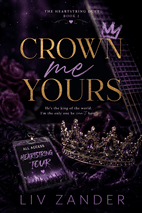
Beneath the fantasy plot, the novel wrestles with a hard truth: to love is to accept loss. Vale, being eternal, knows every attachment ends in goodbye. So he resists love. Elara keeps mending his heart, and each repaired string makes him more vulnerable. Is love worth the grief?
Here you will find each major theme with concrete moments from the book: love and grief bound together, death both lover and ending, healing as a dangerous gamble, vows and bargains that trap, and mortality as the source of meaning. Plus recurring symbols: heartstrings, the crown, rot, and moonlight that strips away masks.
Major Themes in Crown Me Yours
Grief is the price of love
The book argues that love and grief are inseparable: to love is to accept that loss will come. Vale resists love precisely because he cannot bear eternal grief, while Elara insists that refusing that pain means merely existing instead of living.
- Daron tells Elara, 'Grief is just love hiding in a mourning dress, piling up inside you because the person you want to give it to isn't there to take it.'
- Elara tells Vale in the grave, 'You can't have love without embracing grief. Pain is the price we pay for participating in life.'
- After Elara dies, her soul presses against Death's heartstrings one last time and the three mended strings hold instead of breaking.
Love and Death are intertwined
Elara's lover and husband is literally Death, and the story eroticizes and domesticates him rather than treating him only as an end. Over the course of the book the dreaded god becomes a father, a weeping husband, and even a witness at births.
- After lovemaking in the stable, Vale murmurs 'Death is a lover.'
- At the birth of his daughter, Death whispers, 'I didn't take a soul. I helped create one.'
- At Maren's wedding, Death sits in a chapel pew bouncing a toddler and cries as his daughter walks down the aisle.
Healing is dangerous but necessary
Love acts as literal repair of Death's destroyed heart, but every mended heartstring makes him vulnerable to loss. The curse is only broken when Elara accepts sacrifice and lets Death feel everything, even pain.
- Death sees one healed heartstring in a mirror and deliberately slices it open with his fingerbone so he will not fall in love.
- At the graveyard, Elara sees a second heartstring beginning to mend, and later in the stable she touches two healed strings and says, 'Your heart is healing.'
- Elara crowns Vale and lets him cut her throat; as she dies she sees his three heartstrings mend, then chooses to return to life when she hears him sobbing.
Binding rules, vows, and bargains
The plot is driven by inescapable magical contracts: the curse, the wish owed to a mortal who fools Death, and the marriage vow. Characters repeatedly try loopholes, but the binding holds until the proper ritual is fulfilled.
- Vale explains that Elara cannot wish away the crown because it would contradict an older binding wish.
- Elara uses her wish to make Death marry her because it does not break the wording of his own rules, trapping him.
- Corvin tells Elara that the crown is a magical binding demanding that a debt be paid.
- At the wedding, the ceremonial cord tightens and the binding clenches when the vows are spoken.
Mortality makes life precious
Because Vale is eternal, every mortal attachment feels like an inevitable goodbye, but Elara teaches him that finite time is exactly what gives love meaning. The ending embraces aging, descendants, and grief as evidence of a life truly lived.
- Vale says he is eternal and will outlive Elara and their descendants, so loving her means endless grief.
- Elara tells Vale that dying for someone is easy, but living for someone means waking up every morning even when it hurts.
- At Maren's wedding, Vale traces Elara's white hair and wrinkles as evidence of their twenty years together.
- Death looks at his newborn daughter's finite, blazing aura and feels gratitude for the brief, unrepeatable moment instead of grief.
Symbols and Motifs
Heartstrings
Death's literal capacity for love. His heart is destroyed and its strings are broken; each string that Elara mends represents his growing willingness to love despite the certainty of loss.
- In the woods, Elara reaches into Death's chest and finds his heart destroyed; he says one string tore and the third pulses in her crown.
- In Elara's chamber, Death sees one healed heartstring and cuts it open because 'having is the first step to losing.'
- After Elara's sacrificial death, all three strings mend; when she dies decades later, her soul presses against them and they hold.
The crown
The curse and unwanted sovereignty bound to Elara. It is fused to her skull, described as a magical debt, and can be passed or forced onto another head; giving it willingly is part of completing the ritual.
- King Kael shoves the crown onto Elara's head before dying, and it fuses to her skull.
- Corvin tells Elara that the crown is a magical binding demanding that a debt be paid.
- In desperation Elara rips the crown from her head and slams it onto Vale's head.
- Before the sacrifice, Elara removes her crown and places it on Vale's head, crowning him.
Rot
The physical manifestation of the curse spreading through the land and Elara's family. Its advance tracks the curse's power, and its retreat marks healing and renewal.
- Dark veins of rot appear on Mother's neck.
- When Elara touches Daron's skin behind his ear, it slides off to reveal raw rot.
- After the curse breaks, Mother's black veins vanish and crocuses bloom through the snow.
Moonlight
A force that exposes what Vale hides. Moonlight dissolves his handsome human masks, revealing his skeletal true form and forcing his hidden feelings and vulnerabilities into the open.
- Moonlight strips away Vale's mortal illusion and exposes a skeletal hand beneath the velvet.
- Elara opens a slit in the drapes so moonlight falls on Vale's hand, provoking his reaction.
- In the forest, Vale steps into the moonlight and transforms into his half-skeletal, ancient form of Death.