The Secret Garden Murders Themes
by J. R. Ellis
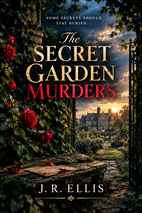
Underneath its plot, the novel is really wrestling with how secrecy lets people manage appearances. Bishop Hewick looks tranquil, but hidden blackmail, exploitation, and self-protection keep shaping what people say and do, and the walled garden turns privacy into a trap.
On this page you'll find theme analysis with concrete moments: Clarissa's blackmail operation, Austin ending his affair under police scrutiny, the locked garden with its bolted door and high walls, and Anne's dangerous delay in sharing what she knows. It also traces recurring symbols: the secret garden, keys and the hidden coal chute or cold-frame panel, Clarissa's telescope, notebooks, and coded ledger, plus the garden books that mirror the case.
Major Themes in The Secret Garden Murders
Secrecy and hidden lives
The novel repeatedly connects the walled "secret garden" to characters' concealed pasts and motives: Clarissa hides a blackmail operation, June hides a forged death certificate and bigamy, Paul hides his former work with Clarissa, Laura hides her affair, and Mark hides a conviction. The investigation advances by decoding and exposing these layers, so secrecy becomes both the killer's method and the community's condition.
- Clarissa's loft contains a telescope with a night setting and notebooks recording who walked, talked, or got into whose car.
- After speaking with police, June Kendal makes a low-voice phone call: "The police are here but don’t worry. I can handle it. She's dead. It’s all over."
- Paul Nelson admits after confrontation that he worked with Clarissa at Wilson and Charters and claims she framed him for embezzlement.
Appearance versus reality
Bishop Hewick and its gardens look tranquil and pretty, but the book contrasts that surface with murder, blackmail, and hidden corruption. Clarissa is publicly treated as a harmless elderly local but is posthumously exposed as a serial blackmailer, and the beautiful walled garden is also described as an ideal isolated killing place.
- At the hall, June Kendal, Paul Nelson and Lesley Stevenson describe Clarissa as a harmless elderly local; later Oldroyd reveals at a press conference that Clarissa Morden was a serial blackmailer.
- Oldroyd finds the walled garden beautiful and calm but notes it is also "an ideal place to kill someone: isolated and not easy to access."
- Alison and Margaret discuss how "darkness in human nature still lurks" beneath Bishop Hewick's pretty exterior, and Margaret says she was not entirely surprised by the murder.
Blackmail and exploitation
Blackmail drives the plot's motives and violence. Clarissa extracts money by targeting vulnerabilities, and after her death Anne and Margaret attempt to use similar leverage, showing exploitation spreading beyond one blackmailer. The murders of Clarissa and Anne arise directly from blackmail schemes.
- Clarissa Morden's coded notebook reveals blackmail victims including June Kendal over her marriage status, Mark Moorhouse over his concealed conviction, Laura Thornton over her affair, and Richard Cooke over his qualifications.
- Anne Lennon intends to take Clarissa's place as a blackmailer, approaches Laura for money to keep quiet, and is later overpowered, murdered, and dumped in the river by Laura and Richard.
- Margaret Summerfield confesses to blackmailing Richard Cooke and explains how she entered Clarissa Morden's house, found the coded notebook, removed the last page, and replaced it.
Reputation, status, and self-preservation
Characters conceal truths or act to protect public standing: Austin prioritizes his community position and ends his affair under police scrutiny, Laura lies to protect her relationship and job, and Watkins worries about Bishop Hewick's influential friends. Reputation often competes with honesty, safety, and the needs of the investigation.
- A woman in the pub accuses Austin of putting his standing in the community first and walks out; Austin smiles and relaxes, thinking the outcome could not have been better for him.
- At school, Laura lies that she did not know Clarissa Morden well and had never heard of Anne Lennon.
- Watkins calls Walker complaining that Bishop Hewick's friends are good people and asking whether the police are going carefully and not treading on toes.
Locked-room puzzle and concealment
The locked walled garden becomes an "impossible crime" that structures the investigation: the door is bolted from the inside, the walls are high, CCTV shows no escape, and no obvious mechanism is found. The solution reveals concealed architecture, making the puzzle about hidden access rather than supernatural impossibility.
- Richard Cooke and Jenny Brown tell Oldroyd that the walled garden door was locked and bolted from the inside with a key in the lock; they gain entry by pushing the key out and sawing the bolt.
- The garden walls are over four metres high and smooth, CCTV shows no one climbing out, and the search finds no ladder marks or footholds.
- Andy descends the coal chute and finds blood and hair, and Oldroyd opens a removable cold-frame panel revealing the secret exit into the garden.
Withheld information and amateur sleuthing
The book shows the danger of keeping knowledge from the police and treating murder as a private puzzle. Anne claims to know the killer but delays going to the police and then attempts blackmail, leading to her murder; colleagues and police later emphasize that she should have come forward.
- Anne Lennon claims she knows who murdered Clarissa Morden but refuses to reveal more until she can prove it and says she will go to the police when she is right.
- Bill Hughes privately warns Anne not to be goaded by Nathan and to be careful about withholding information or putting herself in danger.
- Anne hides in a Harrogate alley, watches a target leave a restaurant and drive off, and later is found bound and hooded in the River Ure after attempting to blackmail the killers.
Symbols and Motifs
The walled "secret garden"
A beautiful enclosed space that promises privacy and shelter but becomes a trap and an image of hidden violence. Its name literalizes the concealed lives and secrets that the investigation exposes.
- Clarissa locks herself inside the walled garden for a private meeting and is strangled there.
- The narrator calls it "a secret garden where a secret and also deadly thing had happened."
- After the murder, the enclosing walls that normally create a "cosy womb-like feeling" become "a place not of life, but death."
Locked door, keys, and the hidden coal chute/cold-frame panel
Concealment and secret access: the official lock and missing key make the crime seem impossible, while the hidden coal chute and removable panel show how secrets can bypass ordinary barriers.
- One of three walled-garden keys is missing from the gardeners' shed.
- The walled garden door is locked and bolted from the inside with the key in the lock.
- Oldroyd and Andy move a cupboard to reveal a low door and coal chute, and later open a removable cold-frame panel that serves as the secret exit.
Telescope, notebooks, and the coded ledger
Surveillance and blackmail as invasive hidden knowledge. Clarissa watches and records villagers' movements, turning private lives into payment records that must be decoded to expose the truth.
- Clarissa's loft contains a telescope with a night setting and notebooks recording who walked, talked, or got into whose car.
- Andy finds a hidden coded ledger of blackmail payments behind a panel in a concealed desk drawer.
- Sharon Warner cracks the three-stage shift code in Clarissa Morden's notebook, revealing names of blackmail victims.
The Secret Garden and The Walled Kitchen Garden books
Texts about hidden gardens and garden architecture mirror the case and provide the clue to concealed access. They connect the literary idea of a secret garden to the practical solution of the walled garden's hidden mechanism.
- Andy and Steph discuss The Secret Garden, and Steph suggests the garden in the book was hidden behind ivy and brambles, giving Andy a vague, unpinned thought about the case.
- Beatrice Simpson lends Deborah The Walled Kitchen Garden for Oldroyd.
- Oldroyd reads the borrowed book, shouts with realization, and later explains the underground fireplace and hot wall that help him understand the hidden coal chute and cold-frame panel.