The Secret Garden Murders Quotes
by J. R. Ellis
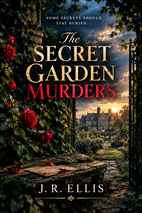
This page gathers lines from The Secret Garden Murders for readers who like a cozy mystery with a darker edge. You will find narration that sets the garden’s mood, dialogue between police and villagers, and inner thoughts that show how suspicion works on people.
What makes the novel quotable is the way ordinary garden calm keeps brushing against murder, secrets, and small-town judgment. The lines are short, sharp, and easy to remember, whether they are creepy, dryly funny, or quietly revealing about human nature.
Top Quotes from The Secret Garden Murders
“A particularly heavy cloud suddenly obscured the sun, plunging the garden into relative darkness, and a chill came into the air. Even the birdsong stopped for a few moments.”
Immediately after the murder, the garden itself seems to respond to the violence.
The sudden darkness and silence create a haunting pause that makes the killing feel cosmic, not merely human.
“The birds were singing in the trees as if the horror in the garden had not happened. The enclosing walls normally engendered a cosy womb-like feeling, but today it was a place not of life, but death.”
The gardeners and hall staff enter the walled garden and discover Clarissa's body.
It captures the chilling indifference of the natural world and turns the garden's sheltering walls into a prison of death.
“It was beautiful and calm, but in many ways it was also an ideal place to kill someone: isolated and not easy to access.”
Oldroyd takes in the walled garden while waiting for the pathologist to finish examining the body.
The line turns the garden’s beauty into something sinister, making the setting itself feel complicit in the murder.
“She was like Agatha Christie's Miss Marple in reverse: instead of being a quiet but powerful force for good, she used her apparent harmlessness to put people off their guard and leave a trail of nastiness.”
— Oldroyd
Oldroyd reflects on the dead woman's deceptive use of apparent harmlessness after seeing Sharon's decoded names.
It sharpens the chapter’s central inversion of the cozy village mystery. The simile makes the killer memorable by turning a familiar figure of benevolent detection into a source of hidden malice.
“He waded out a little to investigate and received a shock when he saw two human hands tied together just beneath the surface of the water.”
A man fishing investigates what looks like a bundle of clothes and discovers bound hands in a reed bed.
The understated sentence turns a quiet morning into a murder scene with one concrete, horrifying image. The bound hands instantly signal cruelty and concealment.
“What a devious and nasty person she was - utterly ruthless, self-centred and psychopathically lacking in empathy. It's a classic, isn’t it? The sweet but deadly old lady in the village.”
— Oldroyd
After Paul Nelson leaves the interview, Oldroyd reflects on Clarissa Morden’s character.
It captures Oldroyd’s damning summary of the victim and the novel’s deceptively cozy yet lethal small-village tone.
“It makes murder seem much closer, not something distant in dangerous urban areas. The murderer could be anyone.”
— Lesley
Lesley objects to Paul’s idea that the murder could draw visitors to Bishop Hewick Hall.
It articulates the intimate dread a murder brings to a quiet community, making the threat feel uncontainable.
Themes Behind the Quotes
The novel keeps returning to the contrast between beautiful, orderly gardens and the violence hidden inside them. A peaceful place can feel safe, but isolation also makes it dangerous, and the quotes show how quickly calm can turn eerie. Small communities intensify this tension because everyone watches everyone else, and reputations can be just as misleading as locked doors.
Another major theme is the gap between appearance and reality. Sweetness can disguise cruelty, politeness can cover resentment, and ordinary people can become suspects. The lines also explore gossip, fear, and moral judgment, asking how well anyone really knows a neighbour. Murder stops feeling distant and becomes something that could sit close to home, which gives the mystery its unsettling pull.
Quotes by Chapter
Prologue
“She sat looking at some espalier pear trees which were about to burst into blossom and didn't notice the figure wearing a hood and gloves coming up slowly behind her before it was too late.”
Clarissa sits alone in the walled garden, unaware of the hooded figure approaching behind her.
The tranquil image sharpens the sudden threat, making the murder feel both inevitable and intimately close.
“They neatly adjusted her clothing, as if to leave the body in a decorous state, so as not to further disturb the peace of the garden.”
The killer checks Clarissa is dead and then stages her body on the bench.
The careful adjustment of her clothing is deeply unsettling, showing a murderer who treats violence with eerie propriety.
One
“I suspect she was sitting here totally unaware of what was about to happen when someone slipped the rope around her neck.”
— Groves
Groves gives Oldroyd his initial findings from examining the victim in the walled garden.
The clinical delivery makes the victim’s last moments especially chilling and vivid.
“Sir, these two are Richard Cooke and Jenny Brown, the gardeners. They're saying that when they arrived, the door into the garden was locked and bolted . . . from the inside.”
— Hardiman
Hardiman brings the gardeners’ account of the locked garden door to Oldroyd.
It plants a striking locked-room mystery at the heart of the case and deepens the sense that something impossible has happened.
“The police are here but don’t worry. I can handle it. She's dead. It’s all over.”
— June
After leaving Oldroyd, June makes a hushed phone call from a quiet corner of the entrance hall.
The secretive call is instantly suspicious, suggesting she knows more about Clarissa’s death than she has admitted.
Two
“Yes, and that's why it became known as the secret garden; people knew it was there, but no one went inside any more. I think the door was locked and the key lost.”
— June Kendal
June explains the walled garden's history to Oldroyd and Andy during the investigation.
It gives the title its eerie force, turning a neglected garden into a locked, half-forgotten place.
“She was indeed, thought Oldroyd. But not for the reasons one might usually expect.”
— Oldroyd
After June says Clarissa Morden was well known in the village, Oldroyd silently qualifies that reputation.
The line hints that the victim’s public standing hides a more complicated and possibly darker truth.
“The latest bee in his bonnet is “business efficiency”, as he calls it; as if we were a bloody business in the first place.”
— Walker
Walker rants to Oldroyd about the chief constable’s latest management initiative.
It captures Walker’s blunt, sardonic voice and the friction between real police work and bureaucratic jargon.
“I don't know whether you're serious about knowing something about that murder or not, but you want to be careful. Not just because the police won't like it, but if you do know something you could be putting yourself in danger.”
— Bill Hughes
Bill warns Anne after Nathan teases her about her private murder theory in the workshop.
It shifts the office banter into genuine menace and flags the risk of Anne’s amateur investigating.
Three
“They want to show off their garden but are frightened that people won't think theirs is the best. At the same time they feel obliged to take part, or people might talk and wonder why they haven't opened their garden when other people have.”
— Deborah
Deborah and Beatrice discuss why villagers are anxious about opening their gardens for the event.
It exposes the competitive social pressure lurking beneath a charitable community event. The line captures how pride and fear of judgment can make generosity feel compulsory.
“I haven't said anything, but it sort of makes me feel uneasy. I mean, it's spooky how someone could, like, materialise and then disappear again.”
— Jenny
Jenny tells Richard she feels uneasy about how the killer could materialise and disappear from the locked kitchen garden.
It gives voice to the uncanny fear at the heart of the locked-garden mystery. The casual phrasing makes the eerie impossibility feel immediate and human.
“I discovered a little verse at the back of the book: “I will pour I When me and you I Take tea”. It doesn't mean anything — the significance is in the rhymes: “pour”, “four”; “you”, “two”; “tea”, “three”.”
— Sharon
Sharon explains to Oldroyd how a verse in Clarissa Morden's notebook revealed the shift code.
It is a satisfying breakthrough moment that turns a cryptic rhyme into a key. The line rewards attention to language and makes Sharon's quiet persistence feel triumphant.
Four
“The fish impaled on the sharp beak was quickly swallowed and the heron settled down again to wait for more prey to appear.”
A heron hunts by the River Ure on the misty morning before a body is found.
The calm, precise image of natural predation mirrors the violence about to surface in the human world. It makes the river feel both peaceful and ominous.
“Blackmail is all about psychology, Andy: assessing people and deciding who is most likely to pay up and why, and if they might react in a dangerous way to being blackmailed.”
— Oldroyd
Oldroyd explains to Andy why Clarissa Morden might have targeted Laura Thornton instead of Austin Lewis.
It distills the case into a study of vulnerability and risk rather than simple greed. It also foreshadows how misjudging a victim can turn blackmail deadly.
“She must have been right; she really was on to something. Why didn’t she come to us? If she had, she could have saved her own life as well as helping us solve Clarissa’s murder.”
— Oldroyd
After hearing that Anne Lennon claimed to know the killer, Oldroyd reflects on how close she came to helping the police.
It captures the frustration and guilt of an investigation that might have been prevented by one phone call. The line makes Anne's death feel both tragic and avoidable.
Six
“I'm sure you wouldn't expect me to lament her passing, Chief Inspector. It's obvious that she had many other victims in addition to me. I didn't harm her, but the world is clearly better off now that she's not here.”
— Paul Nelson
Oldroyd asks Paul Nelson how he feels now that Clarissa Morden is dead.
Paul’s calm refusal to mourn makes his grudge feel chillingly credible and morally complicated.
“It's an interesting discovery, but it actually leaves us worse off. It means the killer could be someone whose name is not in the book. We could have wasted all this time decoding and following up the names she recorded, but the crucial one could have been removed.”
— Oldroyd
Oldroyd realizes that a page may have been removed from Clarissa Morden’s notebook.
The line turns a discovery into a setback, deepening the mystery and raising the stakes.