The Housewife Quotes
by Natalie Barelli
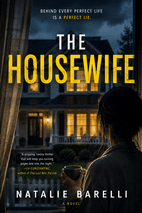
This page collects some of the sharpest lines from Natalie Barelli's The Housewife. You'll find a mix of narration, dialogue, and inner monologue, often all tangled together in the same scene. The voice is frank, uneasy, and darkly funny, which is part of what makes the book so easy to sink into.
These quotes work because they sound like someone thinking out loud, not like a writer trying to craft a perfect line. The narrator watches herself, judges other people, and lets her anger slip through in unexpected ways. That mix of everyday domestic detail and chillier undertones is what makes the story stick with you.
Top Quotes from The Housewife
“I’m not in handcuffs, but you get the sense there could be a “yet” after that statement.”
— Jodie
She reflects on the interview-room atmosphere while waiting to be questioned.
It is a wry, unsettling line that shows Jodie's composure and her fascination with hidden threats.
“If she was so beautiful and talented and the life of the party and she had this amazing life and a million adoring friends and you two were so in love, why did she shoot herself in the face?”
— Jodie
At Roy's birthday party, after the guests have spent the evening praising and mourning Deborah, Jodie finally confronts Roy.
It is a devastating, precise strike against the room's sanctimony, and it reveals the anger beneath her perfect-hostess facade.
“I've never understood why some people insist on calling a spade a spade when they've never held one in their lives and wouldn't know the difference between a spade, a shovel, and a pitchfork without reading the labels at Home Depot.”
— Jodie
During the party, after Roy says 'let's call a spade a spade,' Jodie has an inward reaction to the cliché.
It showcases Jodie's sharply observant, sarcastic inner voice and her impatience with thoughtless clichés.
“I told him later that was the night I fell in love with him, and I'll always remember his face in the candlelight, the way his eyes twinkled, the way I had the urge to stab them out with my fork so badly I had to sit on my hands. I didn’t tell him that part.”
— Jodie
Jodie remembers her first date with Roy while pretending to be in love with him.
The dark humor and the contrast between candlelight romance and violent hatred make this moment unforgettable.
“I am making a statement, and the statement is: Love Is All You Need.”
— Jodie
Jodie prepares an elaborate romantic dinner for Roy after canceling his appointment with a divorce lawyer.
The banner of love becomes an ominous weapon, exposing the gap between her domestic fantasy and her real intentions.
“And anyway, revenge is like honey: it doesn't matter how long you leave it, it never goes bad.”
— Jodie
Jodie resists sabotaging Meredith's luncheon and tells herself she can afford to wait.
This dark, aphoristic line crystallizes Jodie's cold patience and her chilling conviction that the people who wronged her will eventually get what they deserve.
“I am on my best behavior. I am loving, dutiful, and deferential. I am the perfect housewife.”
— Jodie
Jodie deliberately plays the adoring wife to distract Roy while he opens his safe.
The ritual repetition underscores the performance required for survival in an abusive marriage, making the ideal of the 'perfect housewife' sinister.
Themes Behind the Quotes
One central theme is the gap between appearance and reality. The narrator is busy performing the role of a devoted wife while hiding a storm of resentment, suspicion, and grief. Domestic life becomes a stage, and the most ordinary moments are loaded with menace. This tension drives much of the book and gives the quotes their uneasy edge.
Another thread is revenge and obsession. The narrator is consumed by a deep sense of loss and blame, and that obsession bleeds into every thought. At the same time, there is a dark humor running through her rage, a wry awareness of how absurd and dangerous her own mind can be. Together these themes create a voice that feels both unreliable and completely compelling.
Quotes by Chapter
Prologue and Chapters 1-3
“And I don’t think you should talk about other women’s babies like that. Even if they were never real.”
— Jodie
In the kitchen, just after hiding a shard of glass in the cake slice meant for Meredith, Jodie thinks about Meredith's cruel comment about her supposed miscarriage.
It turns the reader's sympathy on its head: her revenge is monstrous, yet her reasoning is disturbingly understandable.
Chapters 4-8
“I thought we would be happy together, just the two of us. I never thought beyond that.”
— Jo
Jo reacts to Deb's news that she is marrying Roy.
It captures the shock of being replaced and reveals how much Jo had tied her future to her sister.
“He did it. Dr. Roy Davies had killed my sister. I knew it in every fiber of my being. And the thought that he was living his life, that he'd gotten away with it, filled me with a rage so pure, I felt like I was possessed.”
— Jo
After reading about Deb's death, Jo becomes convinced Roy murdered her.
This line crystallizes Jo's certainty and all-consuming rage, driving the rest of the story.
“She was so lovely and kind, Mrs. Deborah, never putting on airs, never looking down on anyone. Everybody loved her and especially Dr. Davies. I know you don't want to hear this, Mrs. Davies, but he really did. You could see it in his face whenever she walked into the room.”
— Marie
Marie tells Jodie about Deborah's kindness and Roy's devotion to her.
Marie's loyalty to Deborah is a quiet threat, and her words sharpen Jodie's isolation in the house.
Chapters 9-13
“Kill him, of course, they'll reply in unison. And I'll laugh. You girls are being silly, I'll say. It’s way too soon.”
— Jodie
Jodie imagines her invented friends Amy, Nora, and Abigail responding to her question about what to do with Roy.
The deadpan chorus of 'kill him' and her teasing dismissal is blackly comic, revealing how casually she can entertain murder.
“He adores me. He told me so last night. And again, this morning, he said he can’t live without me. So I don’t know where you got the idea that I won't be here long, but you can banish that thought right out of your head because I’m not going anywhere.”
— Jodie
Jodie tells Marie she is wrong to doubt her place in Roy's life after Marie objects to her using Deborah's Steuben glassware.
Her sweetly delivered defiance is possessive and steely, asserting permanence while the reader senses a darker need to secure it.
“I remember reading somewhere that people who say they slept like a baby obviously never had one.”
— Jodie
Roy says he slept like a baby, and Jodie privately reflects on the saying.
It is a sharp, caustic one-liner that punctures Roy's pleasantry and hints at her suppressed resentment.
Chapters 14-17
“Neither do I. But nobody does. Not even God.”
— Mother
Jodie flashes back to her mother leaning close and asking why nobody likes her.
The casual cruelty lands like a slap, revealing the wound that shaped Jodie's need for control and her distrust of love.
“I can picture him in the electric chair, moments before his executioner flicks the switch. Do you have any last words, Dr. Davies?”
— Jodie
Roy hums cheerfully at breakfast while Jodie watches him stir his coffee.
It turns a cozy domestic moment into a cold revenge fantasy, showing how perfectly Jodie hides her hatred.
“I am on a quest to prove my husband killed my sister. Also, I hate him so much, some days all I want is to stab him in the throat.”
— Jodie
Erin asks Jodie what she does, and Jodie privately answers instead of telling her polite lie.
This is the bluntest statement of the novel's engine: Jodie's grief, certainty, and barely restrained violence.
“If I hear one more peep out of you, as God is my witness, I'm leaving you in there all night.”
— Mother
Jodie tells Erin about the time her mother locked her in the cellar as a six-year-old.
The threat is terrifying and matter-of-fact, a glimpse of the childhood that made Jodie so ruthless and self-protective.
Chapters 18-20
“I've never had a friend before— other than my sister—and I'd always assumed I would never have one, despite Deb's protestations.”
— Jodie
After meeting Erin for coffee, Jodie reflects on her sister Deb's old assurances that she would one day have friends.
It is a raw admission of lifelong isolation, made more painful by the fact that she is only now beginning to believe it might change.
“It’s going to be amazing, Debs. If only you were here to see it.”
— Jodie
Jodie is daydreaming about the social life she pictures for herself with Meredith, Barb, and Eileen.
The enthusiastic promise turns into a quiet lament in the second sentence, showing that Deb's absence hangs over even Jodie's happiest fantasies.
“Oddly, I feel a flutter in my chest. I try to recognize the feeling, and it takes me a while. I settle on pleasure.”
— Jodie
After Dolores gives Jodie a small homemade cupcake and thanks her for being kind, Jodie realizes what she is feeling.
It is a tender portrait of emotional numbness, and the small joy of being treated with warmth feels like a rare, fragile treasure.
Chapters 21-25
“You're all the same. Every one of you. Whores.”
— Roy
After Roy witnesses Phillip McIntosh assaulting Jodie, he turns on her in the corridor instead of helping.
The blunt, venomous misogyny exposes the controlling cruelty beneath Roy's polished surface, and the repetition hammers home how little he values his wife.
“And it's funny, because it occurs to me that I have seen that expression before, that jealous, disbelieving rage.”
— Jodie
As Roy hisses his accusations, Jodie suddenly recognizes his expression from her sister's violent stalker.
It is a chilling moment of insight, linking past trauma to her present danger and showing how abuse repeats itself.
“What is happening to me? It's not a seam on the pillowcase, and it's not a bite or wrinkle. He's doing it to me. I'm really scared, Jo. He scares me.”
— Jodie
Jodie examines the marks on her face and realizes her husband is harming her.
It is raw, frightened recognition of danger, and the direct appeal to 'Jo' makes the isolation of her terror palpable.
Chapters 26-29
“Even my rib cage feels too small for this grief, and no matter how hard I try, I can’t take a breath. I feel like I'm drowning.”
— Jodie
Jodie sobs into her pillow, trying not to wake Roy.
It renders grief as physical suffocation, making the reader feel her helplessness.
“Then I think of all the ways I could kill him, and I keep hitting the same roadblocks: He will be dead, but revered. He will be remembered as a tragic figure, a kind man who devoted his life to fixing other people, only to marry one depressed woman followed by her psycho sister.”
— Jodie
Jodie lies in bed imagining killing Roy, then realizes he would be mourned as a martyr.
It captures the unbearable irony that an abuser will be mourned while his victim is erased.
“All that to say, it's me they'll arrest. Not Roy. No. Somebody else has to do it. And I know just the person.”
— Jodie
Jodie realizes the police would believe Roy, not her, so she decides someone else must expose him.
It is the story's pivot: Jodie chooses action and an accomplice instead of silence.
“So, he locked her up, convinced her she was crazy, made her ugly, then hired a hit man and made it look like suicide. Convoluted, certainly, but cheaper than a divorce lawyer. It happens all the time.”
— Jodie
Jodie explains to Erin how Roy murdered his first wife.
It is a cold, concise indictment of how marriage can be weaponized and abuse disguised.
Chapters 30-33
“I feel like I've been punched in the solar plexus.”
— Jodie
Jodie is listening at Roy's office door and hears him speaking affectionately to Veronica on the phone.
The shock of betrayal lands as a sudden physical blow, making the reader feel it in the body.
“So that's where he kept her, locked up, alone. And that's why he gave Marie a week's leave.”
— Jodie
Jodie opens the locked attic room and realizes Roy imprisoned Deborah there.
The quiet, factual tone makes the horror of the discovery even more chilling.