The Head Collector Themes
by Mark Griffin
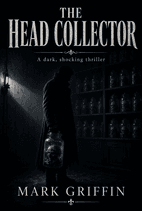
The Head Collector is really wrestling with what orderly surfaces hide: violence, control, grief, and the performances people use to seem normal. Under the case, it keeps asking how restraint, surveillance, suicide, mental illness, and vulnerability shape intimacy and memory.
On this page you'll find theme analysis with concrete moments like Mary Jane's neat living room above a bloodstain, her basement restraint, her diaries, and Oswald's hair ties, profiling, and the attic cameras. It also traces the recurring symbols: the hidden angel or St Dymphna, the guillotine, Oswald's hair ties, and Anderson's carved roses.
Major Themes in The Head Collector
Staged Appearance and Hidden Violence
The novel repeatedly contrasts orderly surfaces and official conclusions with concealed brutality: Mary Jane's neat living room sits above a bloodstained homemade guillotine, and her death is first read as suicide. Oswald's suspicion grows from staging details, and later killers stage confessions, grief, and even their own bodies to misdirect investigators.
- Oswald notices the basement candle still has two inches left and suggests someone blew it out, undermining the suicide scene.
- Mary Jane's living room is neat with family photos and porcelain knick-knacks while the basement contains a bloodstained homemade guillotine.
- Martin stages Laura's death as suicide/OD and later describes faking a frantic 911 call.
- Karl's apparent suicide note and confession, found with an origami angel and photos of Mary Jane and Jason, is called too convenient by Oswald.
- Martin removes a fat suit made of sixty pounds of sand, revealing his physical disguise.
Imprisonment, Restraint, and Dominance
Restraint recurs as both literal captivity and psychological control, from Mary Jane strapped to the basement floor to Oswald's parents held in separate prison wings and Oswald handcuffed in the church basement. The notes explicitly interpret unnecessary straps as dominance, and Martin articulates total control over Oswald's life.
- Mary Jane wakes restrained on a basement floor, unable to move or speak clearly.
- Oswald visits his mother Nora in A-Wing and his father Anthony in B-Wing.
- Oswald says the leather straps were unnecessary because chloroform would have immobilized Mary Jane, so they show the killer wanted more dominance.
- Martin tells Oswald, 'Your life is in my hands. I decide.'
- Oswald wakes handcuffed to a plastic chair in the Hope Gateway Church basement.
Grief, Memory, and Loss
Grief is carried through objects, rituals, and returns to the dead: Mary Jane's diaries record the loss of Ben, Oswald wears hair ties for three dead friends and remembers a lost baby, and Anderson marks her wedding anniversary with her husband's carved roses. The investigation repeatedly forces characters to sit with private loss even amid public violence.
- Mary Jane's diary records 'We lost Ben today.'
- Oswald touches the faded hair ties on his wrist, worn for three deceased friends, Leo, Robert, and Hannah.
- Anderson lays out the carved roses her husband gave her year by year and kisses his photo on their anniversary.
- Oswald reads Mary Jane's diaries and reflects on his own wife's lost baby after IVF.
Psychopathy, Empathy, and Performance
The book studies psychopathy as an ability to perform normal feeling while lacking empathy, and it tests that idea through Oswald's profiling, Martin's confession, and side figures who manipulate others. Martin's failure to catch Oswald's yawn becomes a concrete test of empathy, while his account of faked grief and power makes performance central.
- Oswald tests Martin by yawning; Martin does not catch the yawn, which Oswald links to a lack of empathy.
- Martin describes the 'gorgeous feeling of power' over mourners at Laura's funeral and says making people think he is good is the 'gold standard of psychopathy.'
- Oswald's lecture on Marina Abramovic's Rhythm 0 describes audience members who harmed her and others who removed the gun, arguing that moral compass is shown by action.
- Mr Clark manipulates Maxwell Allen with claims about Liz and his uncle's Chicago gallery to get a painting.
- Jeff and Amanda ask Oswald to review interview tapes for narcissistic or psychopathic red flags.
Suicide, Mental Illness, and Vulnerability
Suicide and mental illness run through the case as both lived history and killer symbolism: Mary Jane's past suicidal planning and recovery meetings, St Dymphna as patron of mental illness and suicides, and the killer's preference for vulnerable victims. The notes also connect this to Oswald's own suicidal history and to a meeting speaker's image of depression as a mask.
- Mary Jane's diaries reveal she planned suicide with sleeping pills, got a DUI, and recovered through therapy and Hope Gateway Church meetings.
- Oswald attends Hope Gateway and shares his history of divorce, an unborn child, and a misfired suicide attempt, urging 'Kill the pattern, not the person.'
- Oswald says the killer seeks victims with mental problems, social anxiety, and depression and lures them with ploys appealing to sympathy.
- Maisie cries and asks whether it will all be okay after a speaker describes depression as a mask and a skintight suit.
Surveillance, Observation, and Hiding in Plain Sight
Watching is both investigative method and predatory practice: the killer camps in the attic and threads endoscopic cameras over Mary Jane's bed, while police reconstruct movement through doorbell and Amtrak footage. The novel repeatedly shows violence depending on blind spots, disguises, and the assumption that a familiar figure belongs.
- Endoscopic cameras are threaded through drilled holes to watch Mary Jane's bedroom, the landing, and Clementine's room.
- Oswald sees a CSI carrying an unlogged can opener out of the house and argues the killer walked out disguised as a CSI.
- Amtrak footage shows a lone figure repeatedly walking to the tracks until finding a CCTV blind spot on February 25th.
- A crowd gathers with cell phones filming and a news van reports from outside Mary Jane's house.
- Oswald and Anderson lie on the basement floor with the light off and only then see the blue phosphorescent angel on the ceiling.
Symbols and Motifs
The Angel / St Dymphna
The hidden angel represents the link between mental illness, suicide, and the killer's ritual symbolism. It is visible only in darkness, tying revelation to a deliberate change of perspective.
- A blue phosphorescent angel is painted on Mary Jane's basement ceiling and becomes visible only when Oswald and Anderson lie down and turn off the light.
- Harper identifies the basement angel as St Dymphna, the patron saint of mental illness and suicides.
- The train-track victim's eyelids are cut with a dark red oval and the letters St D, identified as St Dymphna's initials and a halo.
The Guillotine
The guillotine symbolizes theatrical, mechanical violence and the killer's attempt to create distance from the act while staging it as suicide. It also shows control and spectacle rather than a simple, intimate killing.
- Mary Jane is decapitated in her basement by an elaborate guillotine, apparently self-inflicted.
- Oswald describes the guillotine as 'brutally effective, but also darkly theatrical' and says the killer likes to put on a show.
- Oswald argues the killer created distance through the machine, chloroform, and lavender candle.
- Headless mannequins and a guillotine are found during the raid at Martin's Tammy Lane address.
Oswald's Hair Ties
The faded hair ties represent private grief and the silence of pain. Oswald wears them for dead friends, and they recur when he is alone with memory rather than professional performance.
- Oswald wears faded hair ties for three deceased friends, Leo, Robert, and Hannah.
- After looking at an old photo of his father, Oswald plays choral music and gently touches the faded hair ties on his wrist.
- Oswald says his three friends 'never reached out' and that 'pain doesn't always speak. Sometimes it just sits in silence.'
Anderson's Carved Roses
The handmade carved roses represent enduring love and grief kept physically close. They mark Anderson's ongoing attachment to her dead husband and her private ritual of remembrance.
- Anderson treasures the handmade roses her late husband gave her and lays them out year by year on what would have been their nineteenth wedding anniversary.
- She looks at her late husband's photo, says 'Hello, beautiful,' and later kisses his photo before leaving for a body on a train track.
- Anderson carries a photo of her husband, Barry, when she later comes to Oswald for a counseling session.