The Head Collector Ending Explained
by Mark Griffin
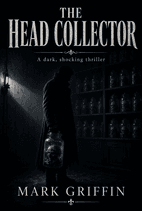
If you just finished Mark Griffin's The Head Collector, you probably have a few questions about that ending. This page walks through what literally happens, why the story ends that way, and where each character lands. It is here to help you make sense of the final pages without guessing.
The Ending, Explained
ListenWhat Happens at the End of The Head Collector
After hearing what he believes is genuine pain in Oswald's voice, Martin Brown turns his car away from Harper and back toward Hope Gateway Church, because he needs to verify that Oswald has obeyed him. Oswald is on the basement floor, badly injured: one bullet has severed the chair from his handcuff, his left foot is destroyed, his left hand and wrist are mangled or broken, and he has covered himself in blood to make the fake suicide convincing. He has also shot out the ceiling camera and used the metal table to create loud bangs; he passes out holding St Dymphna's necklace. Martin enters cautiously with a blue-handled filleting knife, finds Anne Boleyn's head, and confronts Oswald. Martin claims he heard all six shots and checked the breech, so the Glock must be empty; he describes his plan to kill Harper and move on to new identities and further kills in Syracuse, Philadelphia, and California. Oswald says it is not empty, explains that the table made the bangs, calls Martin a psychopath and a fucking idiot, says 'Thank you for sharing, Martin,' and shoots him.
Oswald drags himself upstairs into a church meeting, apologizes, and collapses. He wakes in Northern Light Mercy Hospital, where Harper kisses and hugs him and says Anderson told her he saved her life. His left hand is in plaster, his left leg is bandaged and elevated, and his left toe is gone. Anderson gives him a black beanie with WANKER crocheted on the back. Anderson later reports that Martin survived eight hours of surgery, that the bullet damaged his intestines, right lung, and spine, and that he is in an induced coma with a thirty per cent chance. Police evidence includes faecal DNA, maps and floorplans of Mary Jane's property, a soldering kit, two guillotine sizes, mannequins, ropes, sandbags, and disguises; Martin used the name Ian Brady at a marketing company and Douglas Daniel Clark for Syracuse realtor enquiries and a Hertz rental. He had already leased a Syracuse apartment and had files on five potential victims there. Karl's note was his own original 2016 suicide note, to which Martin added the two names and hearts. The power cut was roadworks. Anderson reveals her first name is Maisie, and Oswald deduces that the photo in her office is Barry, her late husband, and offers to talk.
Oswald recovers on crutches, appears in newspapers and on local television, receives a standing ovation from students, and sees his course numbers double. Harper cares for him closely. Anderson comes for a private counseling session; Harper microwaves a blanket for her, and Oswald explains the stages of grief to Maisie, ending with the idea that it will never be okay because it is not supposed to be, and that 'Life is everything in between.' The next day Harper drives Oswald to Cumberland County Jail. B-Wing is on lockdown, so he cannot visit his father, but he sees his mother and tells her he caught a narcissistic psychopath. She says she is proud but warns him not to put them all in the same category and asks whether she will always be his most fascinating; he says no, but she will always be his first. That evening Harper asks why he has shared his suicide attempt with other people but not with her. He retrieves an old envelope from his top drawer, where the Glock is back with St Dymphna's gold necklace wrapped around the barrel, and gives her his handwritten note to Mum and Dad. Harper reads it, apologizes, asks to be his second opinion, and makes him promise to reach out. He agrees. The next morning he stares into the bathroom mirror, says 'Good morning, Oswald Bennet. It's good to see you...', breaks down crying, and then says, 'One day at a time.'
The Ending, Explained
The ending is built as a payoff of Martin's psychology and Oswald's method. Martin returns to the church not because he needs to but because his ego and need for domination require him to witness Oswald's suffering and obedience for himself. Oswald has counted on that. His fake suicide is a performance built from real injury, blood, the destroyed camera, and the loud bangs made by the metal table; it exploits Martin's certainty and contempt. Martin's confession and his plans for Syracuse, Philadelphia, and California reveal him as a serial predator with multiple identities, and his defeat prevents further victims. The final investigation also resolves earlier mysteries: Karl's note was genuine but augmented, the power cut was a coincidence, the fat suit explains how Martin evaded CCTV, and St Dymphna ties the angel and necklace to mental illness and suicide.
The emotional resolution is deliberately not a cure. Oswald's own suicide note and history are brought into the open, and Harper becomes his 'second opinion,' a practical suicide-prevention promise rather than a romantic conclusion. His mother remains imprisoned, manipulative, and proud; Oswald refuses to make her his most fascinating psychopath but admits she is his first. The mirror scene and 'one day at a time' show that Oswald is still grieving and still struggling, even after solving the case and saving Harper. The closing also gives Maisie Anderson a grief-counseling session, tying her widowhood to Oswald's expertise and to the book's recurring concern with loss, depression, and support. The ending means that survival is not the same as being fixed; the book closes on ongoing recovery, human connection, and the idea that life is what happens between the pain and the better days.
The ending hits harder if you see how you got there.
The ending of The Head Collector makes more sense with the full plot.
Read the full plot, chapter by chapterWhere Every Character Ends Up
Questions the Book Leaves Open
- Whether Martin Brown survives his induced coma and thirty per cent survival chance; the book leaves him alive but critical.
- Exactly how Martin transported Jason Warden to the train tracks; Anderson says police still do not know and only suspect a boat was used.
- Why Karl Lobanov kept his 2016 suicide note; Oswald suggests it was to remind himself how far he had come, but this is not confirmed.
- Whether Oswald and Harper become romantic; their bond deepens and she becomes his second opinion, but no romantic label is stated.
- What happens with Anthony Bennet's health and Oswald's blocked B-Wing visit; the final chapter leaves the father unvisited because of the lockdown.
- Whether the DA's proposed awards ceremony takes place; it is mentioned but not shown.
These are answered in the chapter summary. See the full plot →