London Falling Themes
by Patrick Radden Keefe
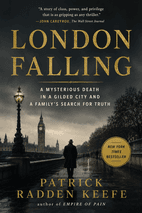
On the surface, London Falling is a brisk thriller about a young man's plunge into a violent underworld. But beneath the plot, the novel wrestles with something darker: the gap between the glittering city and the rot underneath. It asks how far people will go to chase wealth, belong, or bury the truth about themselves and each other. On this page, you will find each major theme grounded in concrete moments. Zac's fake identity at Mill Hill, his parents' desperate investigation, Verinder Sharma's casual torture, and the city's transformation into a playground for oligarchs. Recurring symbols include the Thames where bodies turn up, empty ghost mansions, the heated knife of debt collectors, and the riverwalk balcony where Zac's lies finally catch up to him.
Major Themes in London Falling
Deception and False Identity
The book explores how characters construct elaborate lies and false personas to gain acceptance, wealth, or survival. Zac pretends to be the son of a Russian oligarch and tells multiple contradictory stories, while his grandfather Hugo fabricates a Cambridge education and his early life details to reinvent himself after the Holocaust.
- Zac pretends to be Zac Ismailov, the son of a Russian oligarch, fooling Akbar and others (Chapter 4).
- Hugo Gryn lies about studying at Cambridge; after his death, his daughter discovers vocational school records instead (Chapter 12).
Money, Aspiration, and Ill-Gotten Wealth
Zac becomes obsessed with money at Mill Hill, surrounded by oligarchs’ children, and strives to emulate a flashy lifestyle. London itself is depicted as a haven for dirty money, with foreign-owned 'ghost mansions' and a financial sector built on laundered oligarch fortunes.
- Zac tells Dimitris 'I want to be bigger' and begins dealing cigarettes and reselling sneakers to make money (Chapter 2).
- London is described as a 'twenty-four-hour laundromat for dirty money' and its aesthetic a 'literal whitewash' concealing criminal wealth (Chapter 15).
Parental Grief and the Search for Truth
After Zac’s death, his parents Matthew and Rachelle are consumed by grief and frustration with the police investigation. They conduct their own inquiries, confront witnesses, and struggle to piece together the truth about their son’s secret life and final night.
- Rachelle describes uncovering Zac’s lies as 'piece together a jigsaw in the dark' after his death (Chapter 12).
- Matthew loses faith in the police after two years with no answers and begins meeting doormen and witnesses himself (Chapter 16).
Criminal Underworld and Violence
The book reveals a violent London underworld through Verinder Sharma, a debt collector and murderer who uses torture and intimidation. His past includes a knifepoint kidnapping, a machete attack, and a contract killing with an AK‑47, showing how easily violence coexists with legitimate business.
- Verinder and Andy Baker kidnap Graeme Hammond, press a knife into his throat, and force him to empty his bank account (Chapter 13).
- Roger Vincent and David Smith murder Dave 'Muscles' King with an AK‑47 outside a gym (Chapter 13).
Transformation of London and the Ambiguity of Death
London’s shift from an industrial port to a financial playground for the super‑rich creates a backdrop of hidden danger. Zac’s death remains ambiguous – the MI6 video shows him jumping alone, but evidence of threats and a broken jaw suggest possible foul play, leaving the family with an open verdict.
- The chapter describes the decline of London’s docks and factories and the rise of finance, with power stations turned into museums (Chapter 1).
- The coroner delivers an open verdict because of gaps in evidence; the police admit they cannot prove murder or suicide (Chapter 18, 19).
Symbols and Motifs
The Thames
It represents death, mystery, and the hidden currents of London’s underworld. The river is where bodies are dumped and where Zac’s body is found, and it constantly reminds the Brettlers of their loss.
- Every year about thirty bodies are retrieved from the Thames; the river has been a dumping ground for corpses for centuries (Chapter 6).
- Baxter Willis spots Zac’s body on the riverbank while walking across Vauxhall Bridge (Chapter 6).
Ghost Mansions
Luxury properties bought by foreign owners and left empty, they symbolize the hidden, sterile wealth flowing into London and the way criminal money is laundered through real estate.
- The Riverwalk complex is described as having dark windows at night, many apartments unoccupied (Chapter 1).
- London is called a 'twenty-four-hour laundromat for dirty money' and its aesthetic a 'literal whitewash' (Chapter 15).
The Heated Knife
A specific intimidation technique used by debt collectors – heating a knife blade to threaten victims – it symbolises the casual violence underpinning the criminal economy and the pressure placed on Zac.
- A longtime associate of Verinder describes how he would 'warm up the knife' to extract money (Chapter 22).
- Akbar’s text message about 'heating up knives and clearing up blood' takes on new meaning in this context (Chapter 14, 22).
The Riverwalk Balcony
The fifth‑floor balcony from which Zac jumps is the point where his false life collides with lethal reality. It represents both a trap – he felt he had no other way out – and an escape into the river’s ambiguity.
- Zac steps onto the balcony, peers over, pauses, and jumps (Chapter 1).
- Matthew and Rachelle later theorise that Zac jumped to 'survive' rather than die, desperate to escape Verinder (Chapter 16).
The London Falling summary covers these themes in the plot.