London Falling Quotes
by Patrick Radden Keefe
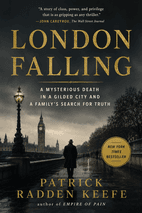
The quotes from London Falling run the gamut from sharp dialogue to vivid narration and quiet inner monologue. You will hear characters make cynical observations about wealth, parents express raw grief, and the city of London itself become a brooding presence. What makes this novel so quotable is the way Keefe distills whole worlds into a single line. A moment of ambition, a flicker of danger, or a sudden loss can snap into focus with eerie clarity. These lines stick because they feel both specific and universal, like fragments of a dark truth you almost already knew.
Top Quotes from London Falling
“If you misstepped on a slick cobble after a night out drinking, the black water could suck you under in an instant.”
Describing the dangers of the Victorian-era Thames waterfront.
The visceral immediacy of the image makes the river's menace tangible.
“The press gave a nickname to these vacant palaces: ghost mansions.”
Describing luxury properties owned by foreign investors that sit empty.
The phrase 'ghost mansions' is hauntingly evocative of urban emptiness.
“If you were young, savvy, and unscrupulous, it was an amazing time to be a capitalist.”
Describes the rapid privatization in Russia after the USSR's dissolution.
Succinctly captures the moral vacuum and opportunity of the era, setting the tone for the chapter's critique of wealth accumulation.
“The whole thrust of their sales pitch was that the true measure of success is when you are liberated once and for all from the indignity of owning conventional stuff.”
Describing the marketing philosophy of the Candy brothers, developers of One Hyde Park.
This line sharply critiques the empty pursuit of status through hyper-consumption, and it resonates as a poignant reflection on the values that drive Zac's new world.
“A whole life that was just an edifice of lies.”
Matthew realizes that his son Zac has constructed an elaborate deception.
This phrase crystallizes the chapter's central theme of deception and false identity.
“The river is haunted—it draws people in.”
The mother of a young man found dead in the Thames in 2003 describes the river's effect.
The line evokes a haunting, almost supernatural quality of the Thames, underscoring the chapter's theme of tragic riverine death.
“It was as though I'd walked into a hospital that was fully equipped but they'd forgotten to put the patients in it.”
Sinden describes the Mermaid's pristine but unused restaurant and kitchen facilities.
A vivid metaphor for the theater's wasted potential and the Shamjis' mismanagement, highlighting the absurdity of their operation.
Themes Behind the Quotes
A major theme is the illusion of success and the high cost of chasing it. Many quotes highlight how characters perform wealth and confidence, only to reveal the shaky foundations beneath. The city of London itself becomes a character, both glamorous and treacherous, drawing people in with promises of reinvention while hiding dangers beneath the surface. Another thread is family and loss, especially the raw ache of parents trying to understand a child's death. Guilt, secrets, and the haunting pull of the Thames recur, suggesting that the past never stays buried. Finally, there is a sense of moral ambiguity. Characters navigate a world where lies and ambition blur together, and the line between entrepreneur and con artist fades.
Quotes by Chapter
Prologue
“London had been a port city. Then, quite abruptly, it wasn’t.”
Summarizing the rapid decline of London's docks after the container revolution.
The stark simplicity of the sentence captures a profound historical shift.
“Returning to the center of the balcony, he jumped.”
The final moment of a young man observed by MI6 surveillance before his suicide.
The blunt, understated delivery creates a chilling and unforgettable ending to the prologue.
Chapter 1: The Big I Am
“AFTER ZAC BRETTLER DIED, his parents tried to decode the mystery of what had happened to him, endlessly revisiting specific moments from his short life.”
Opening of the chapter, introducing the parents' obsessive examination of their son's life after his death.
This line sets an immediate tone of loss and mystery, hooking the reader with the promise of a profound story.
“Who would have thought, in those dark days in a concentration camp, that he would live to the next day?”
Rachelle reflects on her father Hugo Gryn's survival of Auschwitz and the miracle of his later life and family.
The line powerfully contrasts unimaginable suffering with future hope, highlighting the resilience that shapes the family's identity.
“The zing of that first letter together with the click of the second consonant combined to encapsulate the force of his personality.”
Matthew explains why they changed their chosen name 'Louis' to 'Zachary' (Zac) after seeing the baby's distinct nature.
This poetic description of a name reveals how deeply parents perceive their child's essence and the symbolic weight they assign to it.
Chapter 2: A Fast Life
“How do you reject liberal parents?”
Rachelle wonders aloud about Zac's rebellious behavior and his admiration for wealthy thugs and autocrats.
It captures the ironic dilemma of a teenager trying to rebel against unusually permissive and progressive parents, a struggle many readers recognize.
“For new arrivals to London who had money and wanted class, a membership at Annabel’s offered a chance to buy in. For Londoners who had class but needed money, this presented an opportunity.”
The narrator describes the social dynamics of the exclusive nightclub Annabel's as it evolved to cater to wealthy foreigners.
This sharp observation encapsulates the transactional nature of status and class in modern London, exposing how privilege can be purchased and sold.
“Zac appeared to savor “the adrenaline of a fast life,” Joe thought.”
Joe observes his younger brother's transformation into a high-rolling wheeler-dealer.
The phrase "adrenaline of a fast life" encapsulates the reckless glamour that Zac chases, and the insight comes from the brother who feels left behind.
Chapter 3: An Edifice of Lies
“On a cheerful impulse, she stopped a passing stranger, handed over her phone, and posed against the wall, bundled in her puffy coat, the delicate wings branching out on either side of her. Rachelle did not know it in that moment, but it was the last time for a long time that she would feel happy.”
Rachelle takes a photo of herself with angel wing lights before returning home, unaware that her son Zac will soon disappear.
This passage foreshadows the emotional devastation to come, contrasting a moment of innocent joy with the prolonged sorrow that follows.
“Zac—I need to know you are alive. My motherly heart is aching, as is dad's.”
Rachelle writes an increasingly desperate email to her missing son.
This line reveals raw maternal anguish and the emotional core of the search.
Chapter 4: Missing Persons
“What I'm really scared of is that we are lifting up stones and there are going to be big snakes underneath.”
Rachelle tells the private investigator Clive Strong her fear about uncovering dangerous people who were duped by her son Zac.
This vivid metaphor for hidden dangers captures the suspense and moral ambiguity of the investigation, resonating with anyone who fears what lies beneath the surface.
“Everything about the guy seemed sinister.”
Strong reflects on his impression of Verinder Sharma after meeting him in the Riverwalk lobby.
This blunt, understated judgment immediately establishes an ominous tone and deepens the mystery surrounding Verinder.
“Akbar stood there, in the afternoon cold, and gazed down into the Thames.”
After learning there is no CCTV footage of Zac leaving the building, Strong sees Akbar alone by the river, staring into the water.
The stark, cinematic image lingers as a powerful symbol of loss and unanswered questions, closing the chapter on a haunting note.
Chapter 5: River of Death
“No one can prepare you to be told your son is dead.”
Rachelle reflects after being told that Zac's body has been found.
This line captures the raw, universal anguish of a parent confronting the unimaginable loss of a child.
“Like someone had whacked a massive dent into his face.”
Baxter Willis describes the severe injury visible on the body he spotted on the riverbank.
The vivid, violent imagery suggests foul play and leaves a lasting impression about the mystery surrounding Zac's death.
Chapter 6: The Night in Question
“All told, he said it nearly two hundred times.”
Verinder Sharma repeatedly answers 'No comment' during police interrogation.
This stark numerical detail underscores Verinder's absolute refusal to cooperate, creating a sense of obstruction and mystery.
“I would like it to be our family address. I'm working towards that.”
Akbar corrects that the Mount Street home belongs to his wife, not him, during police questioning about where he slept.
It exposes the fragility of Akbar's domestic life and his yearning for belonging, humanizing him while hinting at deeper instability.
“A camera captured Akbar approaching the concrete wall overlooking the river. He craned his body to lean over the wall, then peered into the water at precisely the spot where Zac had just plunged into it.”
CCTV footage reveals Akbar returning to the building and then going to the river's edge right after Zac jumped.
This chilling visual contradicts Akbar's earlier statements, creating dramatic irony and a powerful moment of suspense.
Chapter 7: A Family of Braves
“It was only when the wheels finally left the ground and they could feel the plane enveloped in the gentle embrace of the air that the fleeing Ugandans could exhale and erupt into cheers.”
Ugandan Asian families fleeing Amin's expulsion finally feel safe as their plane takes off from Entebbe.
The lyrical imagery of the plane's 'gentle embrace' contrasts with the terror of ethnic cleansing, making the relief palpable and deeply emotional.
“He came from “a family of braves,” he liked to say, and he was not inclined to let the ignorance or xenophobia of some people in his adopted country stand in the way of his ambitions.”
Describing Abdul's response to the racism he faced after the Ugandan expulsion.
The phrase 'a family of braves' encapsulates resilience and pride, turning victimhood into a narrative of defiance and aspiration.
“To be an entrepreneur is, on some level, to engage ina confidence game—to show people a business prospectus or an architectural model and persuade them that it is not just your idle fancy but a reality that you will soon birth into existence.”
The narrator reflects on Abdul Shamji's entrepreneurial methods and the role of perception in business.
This line distills the essence of entrepreneurial ambition into a universal truth about the power of conviction and illusion, resonating beyond the story.
“Like Harold Shand, Abdul had discovered that if you act like you are already a success, people tend to treat you like a success, which in turn can lead to real success.”
The narrator compares Abdul's self-presentation to the film character Harold Shand, noting the self-fulfilling nature of projecting success.
It offers a pithy, almost aphoristic insight into the psychology of status and the modern cult of image, making it memorable and widely applicable.
Chapter 8: Prodigal Son
“There were photographs everywhere of Akbar with Ali.”
Marc Sinden recalls how after the Ali premiere, Akbar placed pictures of himself with the champ all around the theater.
Illustrates Akbar's vanity and his attempt to borrow celebrity glamour, much like his father's own photo displays.
Read London Falling in context on the summary page.