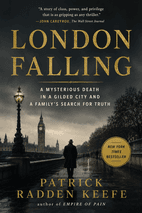
London Falling Book Club Questions
by Patrick Radden Keefe
These questions assume everyone has finished the book and contain spoilers, including the ending.
London Falling is a true crime story that raises unsettling questions about wealth, deception, and the lengths families go to protect their own. The case of Zac Brettler is full of twists, and the book's exploration of ambition and legacy will give your group plenty to debate.
These questions are meant to help you dig into the layers of the story. Pick the ones that spark the most interest. They cover characters, motives, police work, and the larger culture that enabled the tragedy. Let the conversation flow naturally. No need to answer every question. Just enjoy the discussion.
Family and Legacy
- 1.How did Zac's rejection from UCS and subsequent attendance at Mill Hill shape his identity and obsession with wealth, and did the family's emphasis on education as a status marker contribute to his path?
- 2.Rachelle and Matthew both had fathers who survived the Holocaust. How did that legacy influence their parenting styles and their eventual response to Zac's deceptions and death?
- 3.The Brettlers chose to 'choose life' after their loss, inspired by Hugo Gryn's story with two endings. How does the book balance the darkness of Zac's story with moments of resilience and family connection?
Deception and Appearances
- 4.Zac's persona as Zac Ismailov, son of a Russian oligarch, fooled Akbar Shamji and others. What does this say about London's culture of accepting ill-gotten wealth and the power of appearances?
- 5.Akbar Shamji lied repeatedly to police about his movements on the night Zac died. After reading about his family history and business dealings, did you see him as a predator, a pawn, or simply another confidence man?
- 6.Verinder Sharma's past includes kidnapping, extortion, and ordering a murder. Why do you think Zac became involved with him, and what did Verinder really want from Zac?
- 7.Akbar Shamji's text message about 'heating up knives and clearing up blood' is never fully explained. How did you interpret that message, and did it change your view of Akbar's role in Zac's death?
The Investigation and Unresolved Questions
- 8.The police investigation was criticized for missing interviews and losing evidence; the Brettlers felt abandoned. Did you agree with the coroner's open verdict, or do you believe Zac was murdered?
- 9.Rachelle says that after Zac's death she felt like she was 'piece together a jigsaw in the dark.' What do you think the Brettlers will never know about the night of November 29, 2019?
- 10.Dominique Sharma testified that the 2:26 a.m. call from her father was a pocket dial. Did you find that explanation credible, and what might she know that she hasn't shared?
- 11.After reading about Verinder's death and the police's 'sterile' handling of it, do you think Verinder was a police informant, or was that just a theory from Matthew's desperation?
Interpretations and Endings
- 12.The book draws a parallel between Zac's lies and Hugo Gryn's fabrications about his Cambridge education. How does the theme of self-invention connect these two generations?
- 13.The book ends with an epilogue showing Zac waving from the balcony on a happier summer day. Why do you think the author chose to end on that memory rather than with the inquest or the meeting with the Deans?
- 14.Matthew Brettler theorized that Zac jumped not to die but to survive, believing he could make it to the Thames. Do you agree with that interpretation, or do you think Zac intended to kill himself?
The London Falling summary is the best prep for discussion.