Zero to One Quotes
by Peter Thiel
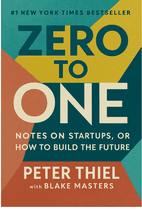
Welcome to the best quotes from Peter Thiel's Zero to One. This collection captures the book's sharpest insights on building startups, thinking differently, and escaping competition. You will find lines that challenge conventional wisdom, push for boldness over triviality, and remind you that creating something truly new matters more than copying what works. What makes this book so quotable is its unapologetic contrarianism. Thiel doesn't just offer advice; he reframes the way we see business, luck, and the future itself.
Top Quotes from Zero to One
“Doing what we already know how to do takes the world from 1 to n, adding more of something familiar. But every time we create something new, we go from 0 to 1.”
Introduces the central metaphor of the book's title.
This passage perfectly distills the difference between incremental progress and genuine innovation. It becomes a memorable mental model for entrepreneurs and anyone seeking to create lasting value.
“What important truth do very few W people agree with you on?”
The author poses this question when interviewing job candidates.
It forces unconventional thinking and challenges the reader to identify their own unique perspective, setting the tone for the book's contrarian approach.
“Brilliant thinking is rare, but courage is in even shorter supply than genius.”
The author reflects on the psychological difficulty of answering his contrarian question.
It succinctly captures the idea that having a smart idea is not enough—voicing it publicly requires rare bravery, making it a memorable call to action.
“The most contrarian thing of all is not to oppose the crowd but to think for yourself.”
The closing line of the chapter, summing up Thiel's philosophy.
It redefines contrarianism as independent thought rather than mere rebellion, offering a powerful and memorable call to intellectual autonomy.
“All happy companies are different: each one earns a monopoly by solving a unique problem. All failed companies are the same: they failed to escape competition.”
This is the chapter's concluding paragraph, directly echoing and inverting Tolstoy's famous opening to Anna Karenina.
It serves as the book's core thesis in a memorable, aphoristic form, reinforcing the central lesson that differentiation and monopoly are keys to success.
“More than anything else, competition is an ideology—the ideology—that pervades our society and distorts our thinking.”
Peter Thiel explains why people mistakenly believe competition is healthy.
This line reframes competition not as a neutral economic force but as a pervasive belief system that warps our judgment. It challenges the reader to question an assumption so deeply ingrained that we rarely examine it.
“We don’t live in anormal world; we live under a power law.”
The author concludes the introduction, stating the key insight for understanding venture capital and life.
It's a memorable, provocative summary that reframes how readers should think about success, risk, and decision-making.
Themes Behind the Quotes
A central theme is the difference between moving from zero to one versus from one to n. The first means building something new, the second just copying or scaling what already exists. The book argues that true progress comes from the former, and that startups should aim for monopoly, not competition. Another major idea is that most people are too focused on competing in crowded spaces when they should be looking for unique opportunities. Thiel also emphasizes that thinking independently is the most contrarian and valuable act, far more than simply opposing the crowd. Power laws dominate venture capital and life itself, meaning a few things matter far more than the rest. Finally, the book stresses that success is not random luck but the result of clear vision and deliberate action.
Quotes by Chapter
Preface: Zero to One
“E next Bill Gates will not build an operating system. The E next Larry Page or Sergey Brin won't make a search engine. And the next Mark Zuckerberg won't create a social network.”
Opening of the preface, challenging the notion of copying past successes.
This line immediately establishes the book's core thesis: the most valuable opportunities are unique, not imitative. It resonates because it forces readers to abandon the safety of copying and embrace the uncertainty of original creation.
“Today’s “best practices” lead to dead ends; the best paths are new and untried.”
A warning against conventional wisdom in business.
This sentence is a sharp, contrarian reminder that following established playbooks can be a trap. It inspires readers to question orthodoxy and seek uncharted territory.
“Humans don’t decide what to build by making choices from some cosmic catalog of options given in advance; instead, by creating new technologies, we rewrite the plan of the world.”
Explaining the unique human capacity for innovation.
This line elevates technology to a form of world-building, giving readers a sense of agency and responsibility. It is both poetic and empowering, framing innovation as an act of rewriting reality.
1. The Challenge of the Future
“Most people think the future of the world will be defined by globalization, but the truth is that technology matters more.”
The author provides his own answer to the contrarian question earlier in the chapter.
This is the core thesis of the book, reframing the debate about progress and emphasizing the primacy of innovation over mere replication.
“Positively defined, a startup is the largest group of people you can convince of a plan to build a different future.”
The author explains the role of startups in creating new technologies.
It redefines a startup not by size or funding but by its mission-driven ability to persuade others, inspiring entrepreneurs to think ambitiously.
2. Party Like It’s 1999
“The first step to thinking clearly is to question what we think we know about the past.”
The author reflects on how the dot-com bubble distorts current thinking.
It challenges readers to re-examine their assumptions and avoid being trapped by conventional wisdom, a core theme of the book.
“It is better to risk boldness than triviality.”
One of the four contrarian lessons Thiel presents after debunking the post-crash dogmas.
It encapsulates the book's advocacy for ambitious, transformative thinking over safe, incremental steps, inspiring entrepreneurs to aim high.
“The market high of March 2000 was obviously a peak of insanity; less obvious but more important, it was also a peak of clarity.”
Thiel argues that despite the bubble's madness, it reflected a rare moment of forward-looking vision.
This paradoxical insight re-frames a historical disaster as a moment of valuable perspective, urging readers to see beyond surface-level lessons.
3. All Happy Companies Are Different
“Creating value is not enough—you also need to capture some of the value you create.”
This line appears early in the chapter as the author explains why even big businesses can be bad businesses.
It distills a fundamental entrepreneurial insight into a single, memorable sentence, reminding readers that value creation alone doesn't guarantee success.
“Americans mythologize competition and credit it with saving us from socialist bread lines. Actually, capitalism and competition are opposites.”
The author challenges conventional wisdom about competition while discussing Google's monopoly and the nature of markets.
This provocative reversal forces readers to rethink a deeply ingrained belief, making it a powerful and thought-provoking statement.
“In business, money is either an important thing or it is everything.”
This line comes from the section contrasting monopolists and non-monopolists, explaining why only profitable companies can afford to plan for the future.
It captures a harsh but essential truth about the pressures of competitive markets, resonating with anyone who has faced the tension between survival and values.
4. The Ideology of Competition
“We preach competition, internalize its necessity, and enact its commandments; and as a result, we trap ourselves within it—even though the more we compete, the less we gain.”
Thiel describes how society enforces the ideology of competition.
This sentence captures the paradoxical, self-defeating cycle of competition with rhythmic clarity. It resonates because many readers have experienced the frustration of working harder yet feeling stuck.
“Elite students climb confidently until they reach a level of competition sufficiently intense to beat their dreams out of them.”
Thiel criticizes the educational system's relentless competitive structure.
This vivid metaphor exposes how competition crushes ambition at the very institutions that claim to nurture it. It strikes a chord with anyone who has seen bright peers—or themselves—lose sight of original goals under academic pressure.
“But really it's competition, not business, that is like war: allegedly necessary, supposedly valiant, but ultimately destructive.”
Thiel contrasts business metaphors with the reality of rivalry.
This line cuts through the romanticized language of business-as-war to reveal competition's true cost. It offers a compelling reframing that makes readers rethink the value of relentless rivalry.
5. Last Mover Advantage
“A great business is defined by its ability to generate cash flows in the future.”
This is stated while comparing the valuations of Twitter and the New York Times to explain why future cash flows matter more than current profits.
It encapsulates the core thesis of the chapter—that long-term monopoly potential, not short-term earnings, determines a company's true value.
“If you focus on near-term growth above all else, you miss the most important question you should be asking: will this business still be around a decade from now?”
This appears in the section critiquing measurement mania and short-term thinking among entrepreneurs.
It cuts through the obsession with vanity metrics and forces founders to confront the fundamental question of durability, which is easy to ignore.
“As a good rule of thumb, proprietary technology must be at least 10 times better than its closest substitute in some important dimension to lead to a real monopolistic advantage.”
This is part of the discussion on the first characteristic of monopoly: proprietary technology.
It provides a concrete, memorable benchmark for entrepreneurs to evaluate whether their technology truly offers a defensible edge, rather than a marginal improvement.
“It’s much better to be the last mover—that is, to make the last great development in a specific market and enjoy years or even decades of monopoly profits.”
This concludes the chapter, reframing the familiar concept of first-mover advantage.
The phrase 'last mover advantage' is a powerful, counterintuitive idea that sticks with readers and redefines success as enduring dominance rather than early entry.
6. You Are Not a Lottery Ticket
“Shallow men believe in luck, believe in circumstances.... Strong men believe in cause and effect.”
Ralph Waldo Emerson wrote this, quoted by the author to capture the ethos of mastering luck.
It powerfully contrasts two mindsets, urging readers to embrace cause and effect over chance. The aphoristic style makes it memorable.
“Victory awaits him who has everything in order—luck, people call it.”
Roald Amundsen said this after becoming the first explorer to reach the South Pole in 1912.
It redefines luck as the result of meticulous preparation, inspiring a proactive approach to success.
“If success were mostly a matter of luck, these kinds of serial entrepreneurs probably wouldn't exist.”
The author argues that the existence of serial entrepreneurs challenges the notion that success is mostly luck.
This concise logical statement undermines a common excuse for failure and supports the idea that success can be engineered.
“At no point does anyone in the chain know what to do with money in the real economy. But in an indefinite world, people actually prefer unlimited optionality; money is more valuable than anything you could possibly do with it.”
The author describes what happens when successful entrepreneurs sell their company and give the money to a bank.
It vividly illustrates the absurdity of indefinite thinking in finance, where money becomes an end in itself rather than a tool for creation. The line 'money is more valuable than anything you could possibly do with it' is particularly striking.
7. Follow the Money
“The biggest secret in venture capital is that the best investment in a successful fund equals or outperforms the entire rest of the fund combined.”
The author explains the power law distribution of venture returns based on Founders Fund experience.
This line is striking because it overturns conventional diversification wisdom, revealing a counterintuitive truth about extreme concentration of returns.