Zero to One Key Takeaways
by Peter Thiel
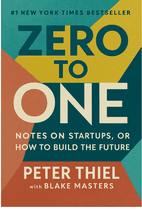
5 Main Takeaways from Zero to One
Seek Monopoly by Creating New Markets, Not Competing in Old Ones.
Competition erodes profits and forces ruthless behavior, so the goal is to build a unique business that dominates a small niche. For example, PayPal focused on eBay power sellers before expanding, illustrating how monopolies drive progress and capture value.
Progress Comes from Vertical Innovation, Not Horizontal Copying.
True value is created by going from 0 to 1—inventing something new like technology—rather than from 1 to n—copying existing ideas through globalization. This vertical innovation is essential for a sustainable future, as stagnation outside IT since the 1970s shows.
Build Your Company on a Secret or Unique Insight.
Great businesses are founded on important truths that few others agree with, such as Facebook's early focus on college networks. Discovering and leveraging these secrets creates defensible advantages and attracts conspirators to change the world.
Distribution is as Important as Product; Master One Channel.
Even the best product fails without effective sales, so design distribution as a fundamental part of your offering. Follow the power law by perfecting a single dominant channel, like complex sales or viral marketing, to avoid the distribution doldrums.
Founders Must Think Definitively and Plan Long-Term.
Reject indefinite optimism—the expectation of improvement without a plan—and instead adopt a definite optimistic mindset with a bold, multi-year vision. This allows for deliberate execution, as seen with Apple and Facebook, and rejects luck-based strategies.
Executive Analysis
These five takeaways form a cohesive argument: to build a transformative future, one must embrace vertical innovation (0 to 1) by creating monopolies based on secrets, supported by definitive planning and masterful distribution. Thiel posits that competition is for losers, and true progress comes from singular acts of creation that solve unique problems, not from iterating on existing ideas.
This book matters because it provides a contrarian framework for entrepreneurs and investors, challenging conventional wisdom about competition, growth, and innovation. It sits at the intersection of business strategy and philosophy, offering practical, actionable insights for startup success while advocating for a future built through technology and human agency.
Chapter-by-Chapter Key Takeaways
Title Page (Chapter 1)
The book positions itself as a practical guide, not an academic text, focused on the tangible process of creating new ventures.
The collaboration between Thiel and Masters implies the content is filtered through both established expertise and contemporary application.
The ultimate subject is framed as building the future itself, setting a ambitious and transformative tone for the entire work.
Try this: Approach entrepreneurship as a tangible process of building the future, not an academic exercise.
Copyright (Chapter 2)
Copyright protection formally establishes the book as Peter Thiel's intellectual property
The publication details reveal the ecosystem of professionals involved in book production
Legal cataloging information makes the work discoverable through library systems
The notice covers both print and digital editions, reflecting modern publishing practices
Try this: Formally protect your intellectual property and understand the publishing ecosystem to bring ideas to market.
Contents (Chapter 3)
The book is a structured argument, moving from critique to prescription.
Its core concern is the difference between horizontal (globalizing) and vertical (innovating) progress.
Success is framed as building a "monopoly" by solving a unique problem, not by competing in an existing market.
Practical advice on company culture, sales, and distribution is grounded in this larger philosophical framework.
The ultimate goal is not just business success, but driving humanity toward a transformative future.
Try this: Structure your business argument around creating a monopoly by solving a unique problem, not competing.
Zero to One (Preface)
The Path to the Future: Progress can be horizontal (1 to n) or vertical (0 to 1). Copying what already exists only creates more of the same; the real rewards and the only sustainable future lie in creating something new.
Embrace the Singular: Every great business is built on a secret or a unique insight about the world. Don't compete in established markets; create a new market where you can be the sole dominant player.
There is No Formula: Innovation cannot be prescribed. Success comes from thinking for yourself, reasoning from first principles, and being bold enough to believe you can create a miracle.
Technology is Hope: The ability to create new technology is humanity's defining trait. It is the tool that allows us to build a radically better future, and business is the vehicle for doing so.
Try this: Reject imitation and focus on creating something new through technology, believing in your ability to build a better future.
1. The Challenge of the Future (Chapter 4)
The best way to think about the future is to identify an important truth that very few people agree with you on.
Meaningful progress comes from vertical innovation (0 to 1 technology), not horizontal replication (1 to n globalization).
Globalization without new technology is an unsustainable path that will lead to resource depletion and environmental catastrophe.
Technological progress is not automatic; it requires deliberate effort and has been largely stagnant outside of IT since the 1970s.
Startups are the optimal structure for creating new technology because they are small enough to think freely but large enough to execute on a vision.
The fundamental task of a startup is to question established dogma and rethink possibilities from first principles.
Try this: Identify a contrarian truth about the world and use a startup structure to build new technology around it.
2. Party Like It’s 1999 (Chapter 5)
Bubbles often arise from rational responses to broader systemic failures
Contrarian truth requires questioning collective narratives, not just opposing them
Post-crash dogmas can become obstacles to innovation
Sustainable growth requires balancing bold vision with pragmatic execution
True contrarianism means thinking independently, not reflexively rejecting popular opinion
Try this: Question collective narratives after economic crashes and balance bold vision with pragmatic execution.
3. All Happy Companies Are Different (Chapter 6)
Creating value isn't enough—successful businesses must capture value
Monopoly is the condition of every truly successful business
Competition eliminates profits and forces ruthless behavior
Creative monopolies drive progress and innovation
Businesses should seek to dominate small markets rather than compete in large ones
All happy companies are different because they solve unique problems; all failed companies are alike because they couldn't escape competition
Try this: Focus on capturing value by dominating a small, specific market rather than competing in a large one.
4. The Ideology of Competition (Chapter 7)
Competition is often an ideological trap that leads to zero-sum outcomes and stifles innovation.
Educational systems reinforce competitive mindsets, steering people toward conventional paths and away from unique potential.
Business rivalries based on similarity (Shakespearean model) waste resources and create openings for disruptors.
Imitative competition focuses on trivial differences rather than creating real value.
Personal feuds and hallucinated opportunities divert attention from meaningful work.
De-escalation or merger can sometimes be more productive than all-out rivalry.
Only fight when necessary, and do so decisively—otherwise, avoid competition entirely.
Try this: Avoid competition whenever possible; if you must fight, do so decisively, but better to create a new market.
5. Last Mover Advantage (Chapter 8)
A business's true value is the sum of its future cash flows, not its current profits. Durability is everything.
Monopolies are built on a combination of proprietary technology, network effects, economies of scale, and branding—with substance always preceding style.
The path to a large, valuable monopoly is to first dominate a small, specific niche market. Always err on the side of starting too small.
After securing a monopoly in a niche, expand deliberately into adjacent markets.
Avoid framing your mission as "disruption." Instead of picking fights with incumbents, focus on creating something new and avoiding competition.
Try this: Start by dominating a small niche with proprietary technology, then expand deliberately to build a durable monopoly.
6. You Are Not a Lottery Ticket (Chapter 9)
The debate between luck and skill in success is unresolvable, but the existence of serial entrepreneurs suggests a significant role for design and execution.
Societies and individuals operate from one of four core attitudes toward the future: Definite Optimism (plan and build), Definite Pessimism (prepare for threats), Indefinite Optimism (expect improvement without a plan), and Indefinite Pessimism (expect decline without a plan).
Since the 1980s, Indefinite Optimism has become the dominant mindset in America, favoring financialization, process, and optionality over concrete planning and building.
This shift explains the stagnation in sectors like government and biotech, where indefinite processes have replaced definite, visionary goals, and contrasts with the rapid progress in software, which is characterized by a more definite, iterative approach.
Darwinian metaphors are poor models for building a business. Iteration without a bold plan leads only to incremental progress, not groundbreaking innovation (0 to 1).
Intelligent design beats evolution in the startup world. Success is a product of deliberate, multi-year planning, not random adaptation or simply listening to customers.
A definite plan is a key competitive advantage. It allows a company to execute a unique vision that outsiders cannot easily see or value, as demonstrated by Apple and Facebook.
The startup is the ultimate expression of personal agency. It is the largest domain where an individual can have definite mastery and actively reject the "unjust tyranny of Chance."
Try this: Adopt a definite optimistic mindset by creating a bold, multi-year plan for your startup, rejecting iterative, luck-based approaches.
7. Follow the Money (Chapter 10)
The world does not operate on a normal distribution of success; it is governed by a power law, where a small minority of entities account for the vast majority of results.
In venture capital, the best investment in a fund will outperform all other investments combined. This necessitates an extreme focus on finding and backing only those rare companies with billion-dollar potential.
Everyone is an investor—of their time and career. Therefore, the power law applies to you.
Reject conventional diversification wisdom for your life and career. You cannot diversify yourself. Instead, you must focus intensely on finding or creating the one thing that can become exceptionally valuable.
Success requires identifying and betting everything on the singular, non-obvious opportunities that lie on the far right of the power law curve.
Try this: Apply the power law to your career by focusing intensely on one venture with billion-dollar potential, not diversifying.
8. Secrets (Chapter 11)
The world remains full of secrets—important, unknown, but achievable truths—waiting to be discovered.
Disbelief in secrets stems from incrementalism, risk aversion, complacency, and the myth of a "flat" world.
Rejecting secrets leads to stagnation in justice, economics, and innovation, as seen in historical and corporate examples.
Secrets come in two forms: natural (physical world) and human (behavioral, hidden desires).
The best opportunities often lie in overlooked areas where conventional wisdom is flawed or incomplete.
Great companies are built around secrets, shared only with those who become "conspirators" in the mission to change the world.
Try this: Actively seek out and build a business around a secret—an important truth that few others see or believe.
9. Foundations (Chapter 12)
Thiel’s Law: A startup messed up at its foundation cannot be fixed. The initial conditions are paramount.
Founder Fit is Critical: Choosing a co-founder is as important as choosing a spouse; they should be someone you know and have worked with before.
Understand Ownership, Possession, and Control: Recognize these three distinct concepts and actively manage them to prevent misalignment.
Keep the Board Small: An ideal board has three members. Avoid large boards at all costs, as they are ineffective.
Everyone Must Be All-In: Only work with people who are fully committed and on the bus. Avoid part-timers and consultants.
Pay the CEO Less: Modest CEO compensation (≤$150k) aligns leadership with long-term value creation and sets the company culture.
Equity Over Cash: Use equity to incentivize and reward people for building the company's future value.
Secrecy in Equity Distribution: Since perfect fairness in allocating ownership is impossible, keep the specific details confidential.
Try this: Carefully choose co-founders and set up equity, board, and compensation structures to ensure alignment from the start.
10. The Mechanics of Mafia (Chapter 13)
Culture is Substance, Not Perks: A company's culture is its core identity and mission, not a set of superficial benefits. It is what you do, not what you decorate your office with.
Hire for Mission and Fit: Recruiting should focus on finding people who are passionate about your specific mission and who will enjoy working together long-term, not just those with the best résumés.
Define Roles to Eliminate Conflict: Clearly defining and assigning one primary responsibility to each employee reduces internal competition and friction, creating a more cohesive and peaceful team.
Embrace a "Cult-like" Cohesion: The most effective startup cultures are characterized by a shared, almost fanatical belief in the company's unique mission. This strong internal bond is a strength, not a weakness.
Try this: Build a strong, mission-driven culture by hiring people who believe in your secret and defining clear roles to reduce conflict.
11. If You Build It, Will They Come? (Chapter 14)
Distribution is not an afterthought; it is a fundamental part of the product. A great product without a way to sell it is a bad business.
Engineers systematically underestimate sales due to a cultural bias that values building over selling, failing to see the hidden difficulty in effective persuasion.
Distribution strategies exist on a spectrum, from high-touch Complex Sales to self-serve Viral Marketing, each with a specific price point and target customer.
The "Distribution Doldrums" is a dangerous zone for medium-priced products where neither advertising nor personal sales is economically viable.
Follow the power law: One distribution channel will dominate all others for your business. Success comes from perfecting that single channel, not from a diluted effort across many.
Everybody sells. You must sell your company to employees and investors with the same intention you sell your product to customers. PR and recruiting are simply other forms of essential distribution.
Try this: Design your distribution strategy as core to your product, and perfect one dominant channel to reach customers.
12. Man and Machine (Chapter 15)
Computers are complements, not substitutes. Their greatest value is in augmenting human capabilities, not replacing them.
The most valuable businesses will be built on symbiosis. Success comes from designing systems that leverage what humans and computers do best together.
Globalization and technology are fundamentally different. Globalization is about human competition (substitution), while technology is about partnership (complementarity).
Beware the substitution bias in tech. The academic focus on automating discrete tasks can blind us to the greater opportunities in human-computer collaboration.
"Strong AI" is a distant speculation. Current efforts should be focused on solving real-world problems through complementarity, not on fearing or yearning for a sci-fi future.
Try this: Build businesses that leverage human-computer complementarity, focusing on augmentation rather than replacement.
13. Seeing Green (Chapter 16)
Breakthroughs beat increments: Successful technology companies deliver order-of-magnitude improvements, not minor enhancements
Niche dominance precedes scale: Start with monopolizable submarkets rather than targeting trillion-dollar industries immediately
Timing requires precision: Market readiness involves specific technological and cultural conditions, not just general need
Distribution equals creation: Products must reach customers through clear, accessible pathways
Secrets drive advantage: Conventional opportunities attract competition; unique insights create durable businesses
Social need ≠ business opportunity: Solving important problems requires specific solutions, not generic participation in broad trends
Team composition matters: Technical ventures require technically competent leadership, not just fundraising ability
Try this: Aim for order-of-magnitude improvements in a monopolizable niche, led by a technically competent team, with precise timing.
14. The Founder’s Paradox (Chapter 17)
Founders Are Defined by Contradiction: The most successful founders are not just extreme; they simultaneously embody opposite traits (e.g., insider/outsider, poor/rich, villain/hero).
The Cycle of Myth-Making: Founder personas are amplified by a cycle where genuine extreme traits are strategically exaggerated by the individual and then further exaggerated by public perception and media.
Founders Are indispensable: Professional managers cannot reliably replicate the visionary innovation and long-term planning that a singular founder provides. Companies that create new value are more like monarchies than bureaucracies.
Greatness and Danger Are Two Sides of the Same Coin: The same prominence that allows a founder to succeed makes them a target for blame, attack, and eventual downfall. The founder's greatest danger is believing their own myth.
The Goal is to Enable Others: A founder's ultimate value is not in being a Randian "prime mover" but in their ability to bring out the best work from everyone else in the company. The wisdom lies in navigating the paradox without losing one's mind or mistaking disenchantment for wisdom.
Try this: Embrace the contradictions of being a founder but stay grounded; your role is to enable your team to do their best work.
Stagnation or Singularity? (Conclusion)
The conventional vision of a globalized, stable future is a dangerous myth that masks inherent competitive and resource pressures leading to conflict.
Humanity's realistic long-term options are not multiple, but a stark choice between stagnation (leading to collapse) and actively building toward a transformative breakthrough.
The future is not predetermined; it must be consciously created. Waiting for exponential trends to automatically deliver a better world is a fallacy.
The core responsibility for every individual and organization is to engage in singular acts of creation—to "go from 0 to 1" and build the new things that will define a better future.
The first and most crucial step in this process is to learn to think for oneself, to see the world with fresh eyes, and to challenge established conventions.
Try this: Take responsibility for creating the future by going from 0 to 1, starting with independent thinking and challenging conventions.
Acknowledgments (Chapter 18)
The book was a collaborative endeavor, born from academic collaboration and refined by professional publishing expertise.
Acknowledgment is given to individuals for specific intellectual, creative, and logistical contributions.
The supportive infrastructure of various affiliated organizations was crucial to the project's completion.
The closing sentiment of "Onward" reflects a continuous, forward-moving intellectual journey.
Try this: Recognize that building something great requires collaboration; acknowledge and leverage the support of others.
Illustration Credits (Chapter 19)
The book’s illustrations are original artistic interpretations by Matt Buck, not direct reprints of the source photographs.
A significant amount of research was undertaken to secure permissions and properly credit a vast array of image sources, from major photo archives to individual photographers and CC-licensed works.
The visual narrative is built upon the likenesses of prominent figures from technology, business, music, and history, grounding the book's concepts in recognizable real-world examples.
Try this: Use visual storytelling and thorough research to ground your ideas in recognizable examples, enhancing communication.
Index (Chapter 20)
Monopoly is the goal: Creating a unique, defensible business is preferable to entering a competitive market, as monopoly profits fund innovation.
Secrets are the fuel: Progress depends on discovering and building upon valuable secrets about the world that few others agree with or see.
Distribution is everything: Even the best product cannot sell itself; understanding sales, marketing, and the power law of distribution is paramount.
Learn from sector-specific failures: The cleantech bubble serves as a cautionary tale about the dangers of ignoring fundamental business questions in favor of a noble mission.
Founders matter: The origins, traits, and coordination of a company's founders are a critical determinant of its long-term trajectory and culture.
Try this: Continuously reference core principles—monopoly, secrets, distribution—and learn from sector-specific failures like cleantech.
About the Authors (Chapter 21)
Peter Thiel is a multi-faceted pioneer: a successful entrepreneur (PayPal), a visionary early-stage investor (Facebook, LinkedIn), and a builder of complex software companies (Palantir).
His career created the "PayPal Mafia," an influential network of entrepreneurs and investors who have collectively shaped the modern tech industry.
Through Founders Fund, he backs ambitious, future-defining companies like SpaceX and Airbnb.
His philosophy extends beyond business into challenging conventional pathways to success, most notably through the Thiel Fellowship which promotes innovation over traditional education.
Try this: Draw inspiration from Thiel's multifaceted career but forge your own path by challenging conventional wisdom and building networks.
Continue Exploring
- Read the full chapter-by-chapter summary →
- Best quotes from Zero to One → (coming soon)
- Explore more book summaries →