Too Sensitive Quotes
by Sasha Hamdani MD
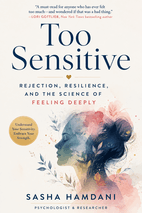
On this page you will find some of the most striking passages from Too Sensitive. These are lines you want to save, underline, or send to someone who finally gets it. They speak to the relief of naming something that has felt invisible for too long.
What makes the book so quotable is how personal and precise it feels. The author turns complicated brain science into everyday language about shame, self worth, and survival. She does not ask you to feel less. Instead she offers a way to understand your reactions and carry them with more grace. You will likely recognize yourself in these pages, and that recognition can be surprisingly healing.
Top Quotes from Too Sensitive
“If you have ever felt that your emotions were too much for others to handle or too fast and intense for you to control, I want to tell you this clearly: The problem is not you. There is a reason. It is real. It is valid. And with the help of Dr. Hamdani and this remarkable book, there is finally a path forward.”
Dodson speaks directly to readers who struggle with overwhelming emotions.
It replaces shame with validation and offers a concrete sense of hope, which is deeply comforting.
“In other words, your brain literally processes rejection like a wound. That's not an overreaction—it's evolution.”
This appears after the author cites fMRI studies showing social exclusion activates the same pain regions as physical injury.
It turns shame about sensitivity into an evolutionary explanation. The line is a powerful reframe.
“The point is, the same neurobiology that makes you feel rejection deeply is also what gives you empathy, creativity, and resilience.”
The author concludes her explanation of why heightened emotional sensitivity evolved in humans.
It reframes rejection sensitivity as a strength rather than a flaw. Readers can walk away feeling their painful trait has a meaningful upside.
“But perfectionism doesn't protect you; it paralyzes you.”
The book is discussing how perfectionism becomes a failed strategy to avoid rejection.
It captures the paradox of self-protection through flawlessness in one sharp, memorable line. Many people will recognize their own fear-driven overwork and procrastination in this warning.
“I think the question ‘Am I too much?’ is already stacked against you. It assumes there's a correct amount of emotion to feel. And honestly? There isn’t. Emotions aren't math. They don't follow rules of fairness or logic. They're signals about what is going on inside you.”
The narrator responds to a fellow resident who fears she is 'too much' after reading too much into a text.
It reframes emotional intensity as meaningful information rather than a flaw. This offers deep relief to anyone who has ever questioned whether they feel too much.
“It's not your job to feel less. You're allowed to have emotions. It's how you handle them that makes it bearable or not. Maybe we both need to shift from trying to shut down our emotions and instead focus on learning how to carry them.”
The narrator speaks to her exhausted resident friend in the doctors' lounge.
It offers a compassionate alternative to self-suppression and normalizes the struggle of carrying intense emotions. The line stays with readers as a gentle invitation to accept rather than erase their feelings.
“It means understanding that your overthinking, comparison spirals, self-criticism, and fear of judgment aren't personal flaws. They're symptoms of a nervous system that's trying (a little too hard) to protect you.”
From the chapter’s introduction to the idea of value through vulnerability.
This reframe turns shame into curiosity and self-compassion, making readers feel less broken. It also captures the chapter’s core message of finding worth through sensitivity.
Themes Behind the Quotes
One central theme is validation. Many of these passages remind readers that feeling everything intensely is not a defect or a choice. The language of neurobiology takes over, explaining how the brain registers perceived rejection as a physical threat. That shift matters: once you stop blaming your personality, you can see the reaction for what it is, a survival response that got too loud.
Another theme is the move from shame to skill. The quotes emphasize naming emotions, carrying them, and trusting yourself to handle difficult moments. They challenge the idea of toughing up or shutting down. Instead they point toward self compassion and practical awareness. Sensitivity is not something to fix or hide. It can become a source of insight, empathy, and strength, but only when you understand it and respond to it with patience.
Quotes by Chapter
Foreword by Dr. William Dodson
“I have waited my entire career for this book, one that finally brings Rejection Sensitive Dysphoria out of the shadows and into the light of clear language, grounded neuroscience, and genuine compassion.”
Dr. William Dodson opens the foreword.
It captures a long-awaited moment of recognition and hope for those affected by RSD.
“Being highly vulnerable to rejection, criticism, and the perception of failing or falling short creates even more rejection and criticism.”
Dodson describes the painful irony at the heart of RSD.
This line names the self-fulfilling loop that readers know all too well, making them feel seen and understood.
“You are meant to feel respected, unrushed, and unashamed for reading in the way that works best for you.”
Dodson explains the book's intentional design for emotionally sensitive and neurodivergent readers.
This line affirms that readers deserve care and flexibility, making the act of reading itself feel compassionate.
Introduction
“This book is for anyone who's ever been told they're overreacting, too emotional, or taking things “too personally,” when in reality, their nervous system was responding exactly as designed.”
The author introduces the book’s intended readers.
It turns a long history of being dismissed into a compassionate validation, making readers feel seen and accepted.
“But if you see yourself in these patterns, know this: Your experience has a name.”
The author reassures readers who recognize RSD patterns in themselves.
It gives language to an invisible struggle and offers hope that understanding is possible.
“But these reactions are not signs of weakness—they’re your nervous system working overtime to protect you.”
The author explains the true nature of intense emotional reactions.
It reframes sensitivity as a protective response rather than a flaw, which can be deeply validating.
“The real challenge lies not in feeling deeply but in living in a world that doesn't always know how to support that sensitivity.”
The author observes that the problem is often the environment, not the sensitive person.
It shifts the blame away from the individual and names a shared environmental failure.
1. What Is RSD?
“To me, all feedback was failure, and all failure was too painful to tolerate.”
The author describes the realization she had during a tense 2 a.m. call with her attending psychiatrist.
It names the core distortion behind rejection sensitivity in one devastating sentence. Readers who equate critique with personal failure will feel immediately seen.
“Here's the thing: You're not imagining it. This isn't a personality flaw, and it's not something you just need to “toughen up” about.”
The author addresses the reader directly after explaining how the brain reacts to rejection.
It offers validation to anyone who has been dismissed as oversensitive. The message that RSD is real and not a character defect is both relieving and empowering.
2. The Five Factors
“Putting words to a difficult “feeling” is a powerful act; when we name something, we can decouple it from the shame that has kept us fearful or quiet.”
The author opens the chapter by explaining why naming emotional experiences matters.
It captures how self-understanding can break the cycle of shame and give people permission to speak about their sensitivity.
“These aren't overreactions. They are physical manifestations of your nervous system being taken over in real time.”
The author describes common moments of rejection sensitivity, like a manager asking for feedback or a text message disappearing.
It validates intense emotional responses as neurological reality rather than personal weakness, which is deeply affirming for readers.
“Their lack of follow-through isn't laziness, and their emotional reactivity isn't overreaction—it's a brain-based struggle.”
The author explains how people with ADHD and emotional sensitivity are often misunderstood.
This line reframes blame as biology, helping readers replace self-judgment with self-awareness.
“Understanding that negative emotional reflexes are your brain's survival instinct (not a personal failing) allows you to work with your biology, rather than feeling like you're constantly fighting yourself.”
The author concludes the section on the amygdala and prefrontal cortex with a message about self-compassion.
It turns a source of shame into something to cooperate with, offering a path from self-criticism to agency.
3. The Hormonal Roller Coaster
“So if you've ever felt like your emotional responses fluctuate wildly depending on the day, your cycle, or even your stress level, you weren't imagining things.”
From the opening section, the author explains how hormones shape the intensity and unpredictability of rejection sensitive dysphoria.
It validates readers whose sensitivity has been dismissed as overreaction. It turns self-doubt into recognition that their experiences are real and biologically grounded.
“I don’t really do anything. It usually goes away when I start my period.”
Emma, the patient, answers the author’s question about how she gets out of her recurring emotional slump.
The simple admission exposes the hormonal cycle as the hidden engine of her distress. It resonates with anyone who has noticed a recurring pattern but never named it.
“It wasn’t that Emma was suddenly irrational or overly emotional. Her neurobiology was amplifying stress signals and muting the systems designed to regulate them.”
The author explains Emma’s experience after realizing her symptoms followed a hormonal rhythm.
This reframe removes blame and shame from overwhelming emotional states. It shows that intense feelings can be a biological amplification rather than a personal failure.
“Her normal ADHD coping mechanisms weren't failing. Her brain chemistry was cycling.”
The author describes Emma’s realization when she started tracking her cycle.
It captures the relief of understanding why usual coping strategies suddenly stop working. It is a powerful counter to self-blame for those with ADHD and sensitivity.
4. What It Feels Like
“Your brain identifies a threat, and your body follows suit, launching into a full stress response over something as simple as a look, a delay, or a tone of voice.”
The author describes the physical stress response triggered by perceived rejection.
It validates that these reactions are bodily and real, not imagined. It also names how small, everyday triggers can feel overwhelming to someone with RSD.
5. The CALM YOUR MIND Toolkit
“When you can trust yourself to handle even the most difficult moments, your sensitivity no longer feels like a liability. It becomes a strength.”
The author describes the goal of building emotional self-trust in the chapter introduction.
It reframes sensitivity as a strength rather than a flaw, offering hope to readers who feel controlled by rejection fears. It promises that self-regulation can lead to real confidence.
“Remember: You're not here to suppress your feelings. You're here to understand them, navigate them, and use them wisely.”
This appears near the end of the toolkit overview.
It gives readers permission to feel deeply while focusing on understanding rather than control. It turns emotional work into something empowering rather than shameful.
“When you name your emotions, you shift from feeling consumed to feeling capable.”
The author explains the power of affect labeling in the Label Your Emotions section.
This captures how simply naming an emotion creates distance from overwhelm. It offers a clear, hopeful shift in self-perception.
“Self-compassion won't erase the sting of rejection, but it will help you heal from it faster, with more self-respect and less self-blame.”
The author sums up the role of self-compassion after rejection.
It promises healing without invalidating pain. This resonates with readers who need permission to be kind to themselves.
6. Self-Worth: Value Through Vulnerability
“It's not because you're dramatic or self-absorbed—it's because your brain interprets perceived rejection as a threat to your emotional safety.”
From the chapter’s opening explanation of how rejection sensitive dysphoria affects self-worth.
It validates that the reaction is neurological, not a character flaw, and reframes shame as a protective response.