Too Sensitive Interactive Mindmaps for Too Sensitive (Free)

Too Sensitive — Interactive Mindmaps

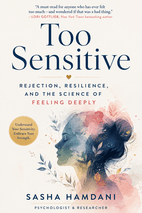
Too Sensitive by Sasha Hamdani MD Book Cover

by Sasha Hamdani MD

Sasha Hamdani MD's Too Sensitive provides a practical guide to Rejection Sensitive Dysphoria, explaining the neuroscience behind intense emotional reactions and offering the twelve-part CALM YOUR MIND toolkit. Written for anyone called "too sensitive," their loved ones, and clinicians seeking validation and concrete strategies for managing triggers and building emotional resilience.

On Insta.page you also get an Apply This Book tool that lets you combine insights from up to 3 books to solve your specific situation.

Chapter mindmaps

Free preview: chapters 1–4 are fully interactive. Click any node to expand or collapse. Subscribe to unlock the rest.

Chapter 1: Foreword by Dr. William Dodson

Key concepts: Foreword by Dr. William Dodson

Foreword by Dr. William Dodson

The Reality of Emotional Overwhelm

  • Overwhelming emotions invite criticism and distance, not comfort
  • Hiding true self becomes costly and unsustainable
  • Emotional intensity reflects importance, not personal flaw

Understanding Rejection Sensitive Dysphoria

  • Dodson waited decades for a book naming RSD
  • Vulnerability triggers more rejection, creating a painful loop
  • Masking becomes the only survivable strategy, a scar not choice

The Book's Design as Care

  • Clean fonts, short sections, and whitespace reduce overload
  • One idea per section respects a flooding brain
  • Reading out of order, pausing, and skipping are encouraged

Practical Tools Offered

  • Self-assessment helps describe struggles as a pattern
  • Plain-language neuroscience explains the condition
  • Strategies empower readers to work with their brain

A Message of No Fault

  • Dr. Hamdani's expertise backs the reader's experience
  • Nothing found will confirm a verdict against you
  • The book is written with compassion and validation

Chapter 2: Introduction

Key concepts: Introduction

Introduction

What RSD Is

  • Extreme emotional pain from perceived rejection or criticism
  • Dysphoria means 'difficult to bear' in Greek
  • Absent from DSM, leaving patients without validation
  • Reactions reflect a nervous system working as designed

Personal Stories

  • Panic attack after TED Talk on ADHD
  • Husband's sweaty reassurance confirmed her failure
  • Career rerouted from pediatrics to psychiatry
  • Chose psychiatry by asking which specialty allows crying

The CALM YOUR MIND Toolkit

  • Twelve emotional regulation strategies for sensitive people
  • Built from psychiatry, psychology, and neuroscience
  • Includes CBT, DBT, and somatic tracking
  • Also narrative exposure and mindfulness-based stress reduction

Sensitivity as Strength

  • Sensitivity means feeling deeply and perceiving subtle shifts
  • Emotional intelligence is the learned skill of deliberate response
  • Without boundaries, sensitivity feels like vulnerability
  • With tools, sensitivity becomes an asset

Key Takeaways

  • Panic on stage is RSD, not failure—needs self-validation
  • Treat painful 'no' as a directional signal, not verdict
  • Sensitivity plus emotional intelligence equals strength
  • Use toolkit strategies selectively based on trigger

Chapter 3: 1. What Is RSD?

Key concepts: 1. What Is RSD?

What Is RSD?

Defining RSD

  • Intense emotional pain from perceived rejection, criticism, or failure
  • Not a standalone DSM diagnosis, but widely accepted in psychiatry
  • Episodes are sudden, disproportionate, involving shame, rage, or physical pain
  • Linked to anxiety, depression, and suicidal ideation

Evolutionary and Neural Basis

  • Social exclusion activates brain regions for physical pain
  • Tribal belonging meant survival; rejection threatened life
  • Hyperreactivity was adaptive for ancestors, aiding bonding and danger detection
  • RSD is an adaptive response, not a character flaw

Related Conditions and Amplifiers

  • Also seen in highly sensitive people, trauma survivors, and social anxiety
  • Overactive amygdala and struggling prefrontal cortex turn rejection into threat
  • Perfectionism, emotion shaming, discrimination, and gender norms amplify RSD

Clinical History

  • Still (1900s) described ADHD as 'defect of moral control'
  • Wender (1960s) observed 'atypical depression' with rejection sensitivity
  • 1968 DSM removed emotional dysregulation, sidelining it for decades
  • Dodson coined 'rejection sensitive dysphoria' in the 1990s

Diagnostic Failures and ADHD Connection

  • Nearly 100% of ADHD cases have RSD, yet official criteria ignore emotion
  • DSM-5's narrow focus leads to misdiagnosis as anxiety or mood disorders
  • Treating symptoms without ADHD is like glasses for diabetes-caused vision loss
  • Europe recognized emotional dysregulation as core ADHD; US has not

Chapter 4: 2. The Five Factors

Key concepts: 2. The Five Factors

The Five Factors

The Five Factors

  • Naming RSD separates nervous-system reaction from character flaw
  • Five biological factors turn up emotional volume
  • Understanding factors turns spiraling into preparation

Dopamine Dysregulation

  • Dopamine is a motivator, not a reward chemical
  • Irregular regulation causes emotional whiplash
  • Lower baseline and overactive transporters drive validation-seeking

Norepinephrine and Overwhelm

  • Locus coeruleus triggers fight-flight-freeze response
  • Physical symptoms include racing heart and shallow breath
  • Vagus nerve restores calm via slow exhale or movement

Amygdala and Prefrontal Cortex

  • Amygdala treats rejection as danger
  • Prefrontal cortex engages too late to dampen response
  • Pausing, breathing, and labeling let logic catch up

Limbic System and Hormones

  • Limbic system encodes rejection with vividness of danger
  • Hormones act as master volume knob across brain and body
  • Hormonal influence is widespread and deserves dedicated focus
You've reached the end of the free mindmaps

Next chapter: “3. The Hormonal Roller Coaster” is locked

See every chapter of Too Sensitive as an interactive mindmap — and unlock all 500+ book summaries with audio and AI Q&A.

$0.00 due today · 7 days free, then $89.99/year ($7.49/mo) · Cancel anytime before day 7

Continue exploring Too Sensitive