Too Sensitive Key Takeaways
by Sasha Hamdani MD
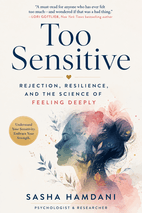
5 Main Takeaways from Too Sensitive
Rejection sensitivity is a wired alarm, not a character flaw.
RSD activates the same brain pain circuitry as physical injury because tribal survival depended on belonging. Treating the intensity as an overdriven alarm—not as evidence of being too sensitive—lets you label the pattern and begin regulating it.
Physiological pause before response prevents the alarm from hijacking.
Because the prefrontal cortex reacts late, a perceived rejection can crash into emotion before you can think. Delay your response, use four-two-six breathing, and move your body before deciding what the event means.
Your hormonal cycle sets the volume on rejection sensitivity.
Low-estrogen phases turn up the volume on the same trigger, making the crash a forecast rather than an ambush. Track your cycle for a few months and schedule rest, lighter commitments, and extra self-compassion for those days.
Match the right mental toolkit move to the emotional state.
Body-anchoring strategies work when emotions flood, while reframing, naming, and trigger-mapping help once shame takes over. Automatic negative thoughts should be treated as distortions to test with evidence, not as facts.
Boundaries and self-compassion turn sensitivity into a relationship asset.
Stating limits in plain, unapologetic words and using 'I' statements make relationships safer, while self-kindness builds resilience. The goal is not to become numb but to return to yourself with better tools.
Executive Analysis
These five takeaways form a single arc: rejection sensitivity is a physiological alarm system, not a character flaw. Because the brain treats rejection as physical pain and the prefrontal cortex lags behind the alarm, regulation has to start at the body level—pause, breathing, movement—before cognitive reframing is possible. Hormonal cycles set the alarm's volume, and the CALM YOUR MIND toolkit supplies targeted moves for each state. Once the pattern is named and regulated, boundaries and self-compassion turn sensitivity into empathy and social awareness.
The book matters because it fills a gap in ADHD and mental-health literature: RSD is intense, common, and often misread as anxiety or depression, leaving the underlying cause untreated. Hamdani writes with clinical authority and personal vulnerability, engineering the book itself for a flooded brain. It moves beyond symptom management into self-acceptance, arguing that sensitivity is an asset once tools, boundaries, and self-kindness are in place. In a field that pathologizes emotional intensity, Too Sensitive offers a validating, practical road map rather than another verdict.
Chapter-by-Chapter Key Takeaways
Foreword by Dr. William Dodson (Foreword)
For Dodson, rejection-sensitive dysphoria is an overdriven alarm: the intensity of the feeling registers how much the situation matters to you, not how flawed you are.
Each episode of rejection sensitivity invites fresh ostracism, and that loop eventually makes masking the only survivable strategy, so the smoothed-over version of yourself is a scar, not a choice.
The book's construction is part of the intervention: short sections, clean fonts, ample whitespace, and one idea per unit are all engineered for a brain that floods under too much input.
A linear cover-to-cover reading is optional; the sections invite entry at any point, permit pauses, and tolerate abandonment, because respecting the reader's available attention matters more than preserving sequence.
The book pairs a self-assessment with plain-language neuroscience so that your struggles become a describable pattern to work with, and it is written so that nothing you find will ever confirm a verdict against you.
Try this: Read the book however your attention allows—enter at any section, pause, skip ahead, or set it down—and take the self-assessment to name your pattern as something to work with, not as proof of a verdict against you.
Introduction (Introduction)
The author's own panic on stage is not proof of failure but the signature of RSD: a nervous system doing its job, left unnamed by the DSM and therefore in need of your own validation and tools.
Rejection can be repurposed as a compass: the refused recommendation for pediatric intensive care did not end a medical career, it rerouted it toward psychiatry, so treat a painful "no" as a directional signal rather than a verdict.
Sensitivity is only vulnerability when boundaries and coping tools are missing; add emotional intelligence, the learned art of deliberate response, and the same sensitivity becomes an asset.
The CALM YOUR MIND toolkit is a twelve-strategy arsenal, not a single remedy: draw on CBT, DBT, somatic tracking, narrative exposure, and mindfulness-based stress reduction selectively, depending on the trigger.
Try this: Reframe your next painful 'no' as directional data, ask what unmet need it points to, and choose one strategy from the CALM YOUR MIND toolkit rather than treating the rejection as a verdict on your worth.
1. What Is RSD? (Chapter 1)
Rejection hurts like physical injury because the brain's pain machinery evolved for tribal survival, so RSD's intensity is an inherited adaptation, not a character flaw.
The same threat response runs through highly sensitive individuals, survivors of trauma, and people with social anxiety, borderline personality disorder, or OCD, with perfectionism, emotion shaming, discrimination, and gender norms amplifying it.
Emotional dysregulation was central to ADHD's original clinical description a century ago, yet the 1968 DSM removed it; Europe has now restored it while the US classification still lags.
RSD collapses feedback and failure into one event, so neutral or constructive input can be experienced as rejection.
When RSD is misread as anxiety or depression rather than as part of ADHD, treatment misses the underlying cause and merely patches the symptoms.
Try this: Pause when neutral feedback stings and label it as your inherited alarm system confusing feedback with rejection, then look for support that treats RSD as part of ADHD rather than patching anxiety or depression alone.
2. The Five Factors (Chapter 2)
RSD is a label for a physiological alarm reaction, not a verdict on character, and adopting that label is itself the first act of regulation.
Dopamine governs motivation rather than pleasure, so erratic regulation explains why a perceived rejection triggers quick emotional swings, slow recovery, and a pull toward validation-seeking behavior.
Norepinephrine-driven overwhelm and a late-reacting prefrontal cortex make emotional crashes a timing problem as much as an intensity problem, which is why pausing and labeling the feeling can restore balance.
The limbic system stores rejection with the vividness of physical danger, while hormones act as a master volume control over the entire circuit, making hormonal mood shifts genuine, widespread, and impossible to reduce to a single brain chemical.
Try this: Use the label 'RSD' as your first regulation move, then name which part of the circuit is firing—dopamine drop, overwhelm spike, old limbic memory, or hormonal volume—and pause long enough for your prefrontal cortex to catch up before reacting.
3. The Hormonal Roller Coaster (Chapter 3)
Track your cycle for a few months and timestamp your harshest rejection moments; when they land in the same phase month after month, the crash becomes a forecast you can plan around, not an ambush.
On the days your tracking flags as low-estrogen, assume your tank is smaller: trim your commitments, defer tense conversations, rest, and reach for light movement, an activity you enjoy, or giving yourself credit to take the edge off.
Let the monthly rhythm set your schedule: reserve ambitious planning, social connection, and demanding work for the steadier mid-cycle stretch, and treat the low phase as a time for maintenance and recovery.
If self-care never seems to catch up, take the hormone pattern you have tracked to a provider and weigh medical options within a full-picture plan, rejecting fixes aimed at a single symptom in isolation.
Treat a low-estrogen day as a chemical event, not a verdict on your worth; name it as a bodily shift rather than a personal flaw, and the shame loses its grip.
Try this: Track your cycle and timestamp every rejection crash for a few months; when low-estrogen days appear, trim commitments, defer tense conversations, rest, and treat the low phase as a chemical event rather than a personal verdict.
4. What It Feels Like (Chapter 4)
Treat physical complaints like chest pain, headaches, or stomach trouble as part of the rejection response, not as signs you are fragile or imagining things.
When a reaction feels outsized, ask what the emotion is signaling about an old fear or unmet need, then focus on carrying it rather than suppressing it.
Take the 25-question self-assessment to see where you fall on the sensitivity spectrum, but treat the number as a snapshot to guide support and boundaries, not a permanent diagnosis.
If your score lands in the significant range, pair resilience strategies with treatment for any underlying anxiety, depression, or ADHD, and watch for hormonal shifts that lower your tolerance.
Practice recognizing rejection sensitivity as a repeating pattern you can reshape through knowledge, supportive relationships, and safe environments, so your goal is returning to yourself with better tools rather than becoming someone else.
Try this: Take the 25-question self-assessment to see where you fall on the sensitivity spectrum, treat physical symptoms and outsized reactions as signals to explore rather than fragility, and pair resilience strategies with treatment for any underlying anxiety, depression, or ADHD.
5. The CALM YOUR MIND Toolkit (Chapter 5)
Match the tool to the state you are in: anchor through the body when emotions flood, and reach for reframing, boundaries, or self-compassion when shame keeps circling afterwards.
Treat automatic negative thoughts as distortions to challenge with evidence or the friend test, never as accurate facts about what happened.
Label feelings with precise words, because naming shame, overwhelm, or loneliness does more to settle the emotion than calling it bad or upset.
Map your triggers so reactions stop catching you off guard: tracing an outsized response back to the older wounds feeding it lays new pathways that make the next spike less absorbing.
Aim to live with sensitivity rather than erase it, letting a pause before action train your tolerance for the emotional wave.
Try this: Match the tool to your state: anchor through your body when flooded, then use precise feeling-words and trigger mapping when shame keeps circling, and challenge every automatic negative thought with evidence rather than accepting it as fact.
6. Self-Worth: Value Through Vulnerability (Chapter 6)
When a past mistake keeps replaying, focus on stopping the loop rather than proving the thought wrong, and know that landing in the present moment works even if you never come to believe a kinder explanation.
Judge your failures against a realistic standard rather than an unattainable one, and treat another person's success as a different timeline rather than evidence of your own inadequacy.
Treat the urge to apologize as a sign that you are trying to feel safe, not as a reliable verdict that you are at fault, and when the apology would only calm your own anxiety, offer a truthful statement of the situation instead of a confession.
When self-punishment follows a strong emotional reaction, the target has shifted from the event to you; name the self-judgment as embarrassment or concern about what others think, and treat the original reaction as a sign of caring, not of losing control.
State your limits in plain, unapologetic words grounded in your own needs, and treat a relationship's ability to hear no as the test of whether it offers respect or merely access.
Try this: Interrupt the replay of past mistakes by grounding in the present, judge failures against realistic standards only, and when you want to apologize, ask whether it is safety-seeking rather than fault; then state your limit plainly and unapologetically.
7. Partner Relationships: Stability Through the Storm (Chapter 7)
When a delayed text or a shift in tone sends you into panic, treat it as a nervous system alarm about disconnection, then override it with movement, paced breathing, or a grounding exercise before you assign meaning to the silence.
In ambiguous or mixed-signal moments, make safety explicit by deciding what you need and asking for it, and treat the confusion itself as data instead of trying to decode every message.
Use “I” statements to voice feeling overlooked or silenced, say the feeling and the request in one sentence, and rehearse that sentence in low-stakes conversations until speaking up no longer feels like abandonment.
When comparison or jealousy flares, work backward from the feeling to the trigger, the old memory it touches, the story you tell, and the underlying need, and give yourself the same compassion you would give a friend on a different timeline.
Before any reaction to a breakup, ghosting, or the urge to leave first, hit a physiological pause with timed breaths and a delay of fifteen to twenty minutes, so the action you take comes from clarity rather than the pain spike.
Try this: Ground yourself at the first spike of panic over a delayed text or mixed signal, move, breathe, and ask for what you need in one 'I' statement, and if you want to leave first, delay any action for fifteen to twenty minutes until clarity returns.
8. Friendships: Connection Through the Chaos (Chapter 8)
When a vague reply or canceled plan stings, hold off on any response until you have named the feeling and asked whether the rejection is real or emotion-twisted.
Name the hurt without blame in an "I" statement, and let the discomfort of voicing it be a sign of courage rather than proof you said too much.
At the first stab of envy or FOMO, offer yourself the same compassion you would a friend, then test whether "I'm being replaced" is fact or an old wound before deciding anything.
Stop measuring your acceptability by your usefulness, practice stating what you need, and let friendships be defined by presence rather than performance.
Accept that friendships are self-selected and evolving, and carry the same boundary-setting into family, where the hardest emotional patterns began.
Try this: Pause before responding to a vague reply or canceled plan, name the feeling and test whether the rejection is real or emotion-twisted, then practice stating what you need and let presence, not performance, define your friendships.
9. Family: Strength Through the Strain (Chapter 9)
Step out of a triggering family room to move your body before you speak, so the freeze-and-tears response doesn't run the conversation.
When you feel unheard or criticized, use “I” statements and a three-breath pause to keep your prefrontal cortex online instead of letting the amygdala answer.
Name the precise emotion and the unmet need behind it, even if the apology never comes; that clarity is what takes the sting out.
Set nonnegotiables for what emotional safety requires at family gatherings, and voice them with love, because loyalty and self-care can coexist.
Observe the discomfort of breaking old patterns as protection, not danger, and treat your own need for support as legitimate so you don’t harden into hyperindependence.
Try this: Step out of a triggering family room and move your body before you speak, then name the precise emotion and unmet need in an 'I' statement, and set loving nonnegotiables for emotional safety even when the discomfort feels like danger.
10. Career and School: Purpose Through the Pressure (Chapter 10)
When a terse message or a stretch of silence feels like a verdict on your worth, delay the reply: put what you feel into words, breathe on the four-two-six rhythm, and write down three reasons unrelated to rejection before you respond.
Regulate before you respond, not after: find where the body is holding tension, then walk, stretch, shake, or dance it out so the reply comes from a cooled-down nervous system rather than from the alarm.
Perfectionism keeps you from starting because it demands flawless output in advance; counter it by saying what you are afraid of and taking one small imperfect action now, and when downtime reads as failure, acknowledge the guilt and ground yourself in what you can see and feel.
When achievement leaves reward feeling flat, test the "I got lucky" story against your preparation and the feedback you have received, then say plainly that the opportunity came from preparation and effort.
After a failure, narrate the scene from outside yourself, describing the emotions without trying to fix them; as the wave passes, the event separates from your sense of who you are.
Try this: Delay your reply when a terse message or silence feels like a verdict, regulate with four-two-six breathing and three non-rejection reasons, counter perfectionism with one small imperfect action, and after failure, narrate the scene from outside yourself without fixing the emotion.
What I Know Now (That I Deserved to Know Then) (Conclusion)
Treat self-kindness as the assignment, not the reward; the letter you write to yourself can stay unread and still do its work, because the writing itself changes how you meet your own mistakes.
See your social awareness, empathy, and deep processing as expressions of rejection sensitivity, and build resilience as an adaptable practice of self-compassion rather than a wall of numbness.
Bring in medication only to take the edge off, when coping tools fail or work, relationships, health, or shame demand it, and let it make your techniques viable instead of replacing them.
Treat hormonal shifts as a gain dial: normal fluctuations, not abnormal levels, can amplify the alarm, so plan extra self-compassion for the luteal phase, postpartum transitions, and other life-stage changes.
Remember that rejection is literal pain: Eisenberger and Kross found that social exclusion activates tissue devoted to physical sensation, which is why the countermoves are not optional; practice the twelve moves until each name-and-countermove pattern becomes reflexive.
Try this: Treat self-kindness as the daily assignment rather than the reward, use medication only to take the edge off, plan extra self-compassion around hormonal shifts, and rehearse the twelve name-and-countermove patterns until they become reflexive.