The Woman I've Become Book Club Questions
by Debra Webb
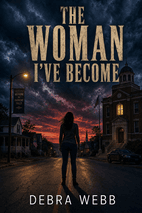
These questions assume everyone has finished the book and contain spoilers, including the ending.
This novel gives book clubs plenty to argue about because almost everyone is hiding something and the line between victim and manipulator keeps moving. The questions below are designed to get past plot recap and into motive, memory, and moral compromise, with enough ambiguity to keep the conversation lively.
Use them as a loose guide rather than a script. Pick a few that match your group's energy, let disagreements breathe, and don't worry about covering every question in one sitting. The best discussions often start where people disagree.
Sympathy, Objects, and Early Motives
- 1.Julia spends the opening chapters hiding her past from a viral article while telling herself no one will know her truth. How did the public accusations against her shape your sympathy for her, especially once later chapters reveal what she asked Casey to do to her parents?
- 2.The tarnished gold heart necklace appears first in Olivia’s bedside drawer and later connects to Wendy’s “Friends forever” gift. How effectively did this object work as a link between Julia’s present fear and the Wendy/Casey betrayal?
- 3.Julia suspects Acacia of planting the necklace and drugging her, yet Acacia later admits Phillip paid her to spy and to add Valium to Julia’s food. Did this confession make Acacia/Alicia more sympathetic, or did it confirm her role as an untrustworthy operator?
- 4.Wendy says she slept with Casey to protect Julia and then follows Casey to the Manhattan mansion where she is ordered to undress and dance. How did you weigh Wendy’s stated motive against the harm she causes later as the narrator who takes over Julia’s identity?
Family, Protection, and Suspicion
- 5.Julia’s decision to send Olivia away with Phillip and Catherine is described as painful but protective. Did you agree with Julia’s choice to keep Olivia near the family and away from the lake house, given what Julia suspected about Phillip and Acacia?
- 6.The private investigator Archer tells Julia that Eleanor’s autopsy ruled an accident but notes a spiral arm fracture and cheek bruise suggesting a struggle. How did this detail change your view of Eleanor’s death and of Acacia/Alicia’s involvement before the final confrontation?
- 7.Helen shoots Brian on the stairs and later drives Olivia to Catherine’s. Did Helen’s actions make her the most reliable adult in the house, or did the earlier mystery around her delivery and the gray SUV leave you suspicious of her?
Captivity, Manipulation, and Revenge
- 8.Wendy’s captivity chapters show her following her keeper’s weekly schedule, reading newspapers on a chain, and planning escape. How did these scenes affect your understanding of her later claim that what she did to the seven men was “justice” rather than murder?
- 9.Julia admits to Wendy that she lied to police about being kidnapped and apologizes for leaving Wendy with Casey. Did that apology feel genuine to you, or did Wendy’s private conclusion that Julia’s story is “lies” match your own reading?
- 10.Casey tells Julia that Wendy is “gone” and that he left her with a man, then later Casey threatens to expose how he killed Wendy and her parents. How did Casey’s manipulation of both women shape your view of him as the novel’s central villain?
Helpers, Villains, and Shifting Blame
- 11.Rick Howard presents himself as a helper, but Julia finds hidden photos in his basement showing the seven keeper death scenes with a circled figure she recognizes as herself. Did you see Rick as a protector, a cleanup man, or something in between by the end?
- 12.Alicia holds Julia at gunpoint and says Julia ordered Eleanor’s killing and ordered Brian to kill everyone including the child, then shoots Julia. Were you convinced by Alicia’s accusation, and how did it change your view of Julia’s claimed victimhood?
Endings and Moral Positions
- 13.The ending reveals that the official story about Casey Duval, Wendy Neely, Alicia Hopkins, and Brian Miller is almost entirely false, and Julia thinks, “May the best liar win.” Did that ending feel like justice, hollow survival, or a continuation of the same deception?
- 14.Wendy leaves Julia with the Monster and says she does not regret it, while Julia later reflects that she will “enjoy the life she has been given.” Which character’s final moral position did you find more defensible, and why?